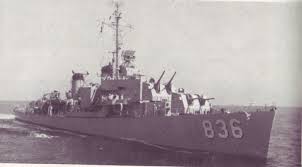
George K. Mackenzie WESTPAC 1971-1972
By: Captain James D. Barton (U.S Navy-ret.) Former Operations Officer USS George K. Mackenzie (DD-836)
The Western Pacific (WESTPAC) deployment of USS George K. Mackenzie (DD-836) began with the preparations typical of any other. After the shipyard availability in Long Beach ending August 3, 1971, we completed shakedown and began the grueling Refresher Training (REFTRA) cycle in San Diego. We honed our skills in gunnery and anti-submarine warfare, practiced our seamanship, operated in multi-ship formations, and fine-tuned our equipment under the adept leadership of Commander Curtis O. Anderson. All of this was in preparation for the deployment scheduled for November.
On November 11, 1971, refueled and our ammo magazines filled with ammunition for our 5-inch guns, we got underway from the Naval Station 32nd Street pier for what we thought would be a normal 5 ½ month deployment to WESTPAC. We passed Pt. Loma and the last sea buoy (1SD) and soon felt the swell of the ocean as we transitioned from the shallow water of San Diego Bay to the deep ocean canyons just offshore. It was a chilly day and partially cloudy. The weather was reasonable en route to Pearl Harbor and made the adjustment to “sea legs” a little easier for most crewmembers. Mackenzie was in company with USS John R. Craig (DD-885) and USS Chevalier (DD-805) for the trip west.
All three ships were Fleet Rehabilitation and Modernization (FRAM) I destroyers of the Gearing Class built at the end of World War II. They were an improvement upon the Allen M. Sumner Class with greater ASW capability, principally the Anti-Submarine Rocket (ASROC) launcher. Most importantly however, was that the Gearings at 390 feet in length were 14 feet longer than the Sumner Class. This meant we could operate for longer periods at sea because those 14 feet consisted of fuel tanks.
Our original transit plan west included a brief stop in Pearl Harbor for fuel and briefings after which we were scheduled to proceed directly to Guam. We arrived in Pearl Harbor on November 21st. After a brief 8 hour stop for fuel, and briefings at CINCPACFLT headquarters in Pearl Harbor where we picked up our WESTPAC publications, we were underway again around 6:30PM in our three ship task unit. Even though we did not need the fuel to make the transit to Guam, we were directed by CINCPACFLT to proceed to Midway Island to refuel; and then on to Guam. The reason for this was that the Fleet had changed its minimum on board fuel requirements to 50 per cent. Had we stayed with the original plan we would have been below the minimum by 10 per cent.
Our Task Unit arrived in Midway Island to refuel around 8AM November 23rd. The azure blue of the lagoon is almost indescribable. Those who did not have duty could go out and explore the island. After refueling and preparations to get underway, we left the pier headed to Guam just before 1700. The transit to Guam was smooth but long, nearly two weeks. We had a great Thanksgiving dinner underway on November 25th and we arrived in US Naval Station Agana, Guam on the morning of December 5th. Again we refueled, loaded stores and got underway around 1730 for the Subic Bay Naval Base, Republic of the Philippines. Our transit to Subic took us through the San Bernardino Straits, site of a famous naval battle in WWII.
We arrived in Subic Bay on the morning of December 9th and began six-day repair availability. This was standard for WESTPAC deployments. We also were required to re-qualify for naval gunfire support (NGFS) before proceeding to Vietnam waters. We did so at the naval gunfire range at Tabones. There we trained two teams which were called Blue and Gold. The plan for NGFS meant standing what was called port and starboard watches (one 4-hour watch section and one off on a 24-hour basis) each with one of our two gun mounts manned and ready for call for fire from spotters ashore. After refueling on December 15th we were headed to Military Region IV in the delta region of South Vietnam. This is a hot and steamy area and was a hotbed of activity for the Viet Cong guerillas. A series of firebases had been established in that area early in the war. In some places these fires bases were nothing more than a raised up area in the middle of rice paddies with howitzers encircling the main camp. By 1971 US troop presence had been reduced significantly and US personnel ashore were assigned primarily to advisor jobs to the Army of the Republic of Vietnam (ARVN) or the Navy (NVN).
We anchored off the southern Vietnamese coast On December 15th opposite the U Minh forest and settled in for the familiar role of NGFS. The U Minh forest appeared to be a dense forest from our position a mile or two from the coastline. In reality, it was a relatively thin line of trees behind which were arable fields and marsh areas interlaced with canals for local boats. Our targets at times were Viet Cong structures or trails. Our primary mission was harassing the enemy which was beginning to mass in certain areas and to interdict where we could. Much of this was done with the aid of spotting ashore. Other times we fired at pre-coordinated targets. This went on day and night and we got used to sleeping through the gunfire whenever and wherever we could. Our guns caused the ship to shake and shiver. Generally, apart from an occasional rain, the weather remained good. We would leave station only to refuel, rearm or shift firing positions. It was a one-way deal. We did not receive any enemy fire. Uniform regulations were relaxed so rather than buttoned-up uniforms we were often in tee shirts and shorts with no battle gear. It was typical of WESTPAC deployments, but it was long and tiring work on station for nearly a month. We were getting ready for a break. Finally, on January 12th we were joined by USS Chevalier and we proceeded to Subic Bay. We moored in Subic in a nest of Destroyers to the Alava Pier at about 10:30 on January 14th. We had been gone from Subic Bay exactly one month having expended numerous rounds of ammunition in MRIV.
On January 20th after an on load of ammunition at the Naval Magazine Subic Bay, we were underway in the late afternoon, not to return to Vietnam but for a scheduled port visit to Kaohsiung, Taiwan. We arrived outside the Kaohsiung Harbor early on the morning of January 22nd and anchored awaiting a harbor pilot. He showed up about 1½ hours later and helped guide us to our mooring buoys where we moored around 10 AM. It was a busy and bustling port. We remained in port until the morning of January 26th. It was a great port visit and provided the kind of rest we needed. Upon leaving Kaohsiung, we were ordered back to the NGFS Range at Tabones where we arrived the next day. This was a requirement after a specified period away from the gun line but we were also firing the new 5-inch gun Rocket Assisted Projectiles (RAP) we had recently on loaded. These projectiles boosted our maximum range another 4000 yards from our maximum gun range to 22000 yards. We spent time practicing at Tabones with conventional and RAP rounds.
We anchored in Subic Bay on the morning of January 29th. We shifted to a pier side berth later in the day and remained there until the morning of the 31st for more firing exercises at Tabones. Around 8PM we got underway for Vietnam but instead of going to an NGFS station we proceeded to Yankee Station in the Tonkin Gulf for escort duties with USS Coral Sea (CVA-43). These duties were steaming in formation, providing gunfire support if required for the carrier and plane guard duties astern in case a plane went down. Support for these operations was in the normal four section watch rotation. The seriousness of these operations was clear on the evening of February 4, 1972. One of the aircraft from the carrier crashed after taking off. Mackenzie proceeded to the scene, found wreckage in the water and lowered the motor whale boat to conduct the search. After an hour of searching, no sign of the pilot was found and we were ordered back to station astern of the carrier. On February 18th Coral Sea was relieved on station and we were assigned escort duties for a transit to Subic Bay. We arrived there and moored at the Rivera Pier on Friday, February 18th for a tender availability with Gompers and some work with the shipyard.
On the morning of February 28th, we got underway and after a morning testing and calibrating the sonar, we were en route to Hong Kong assigned duties as Station Ship Hong Kong (SOPA Admin) which meant we were to provide the communications and administrative duties for Commander Seventh Fleet. It also meant we had senior shore patrol responsibilities for the port. We arrived in Hong Kong Harbor and moored alongside USS Rowan (DD-782) around 1100 on March 1, 1972 for Station Ship turnover. A fascinating port but expensive for the average sailor, we remained in port for 15 days. While Hong Kong is a liberty port, since we were SOPA Admin, we maintained pretty much a normal work routine. However, a liberal liberty policy was in effect for those not assigned to the duty section. We remained in Hong Kong until March 16th exactly two months before our scheduled return date to San Diego. SOPA Admin duties were shifted to USS Westchester County (LST-1167). After getting ready for sea we got underway at 0800. The plan was for another stop in Subic Bay before returning to the gun line off the South Vietnamese coast. Almost immediately after clearing the reaches of Hong Kong a flash message arrived directing Mackenzie to proceed at high speed to Subic to undertake a highly classified mission in the days ahead. In the early afternoon we kicked it up to 25 knots for the transit. Other than the Captain, Executive Officer, Operations Officer and a couple of Radiomen, no one knew what was going on. We arrived in the approaches to Subic Bay in the early morning of March 17th and stationed the special sea and anchor detail. We moored by 0800 in a nest of destroyers. Rumors were flying all over the place. Liberty was not permitted. A fuel barge came alongside, completing the fuel transfer and we were underway about 2 ½ hours later for the special mission.
After securing the special sea and anchor about ½ hour later, Captain Anderson got on the 1MC Announcing System to explain events within the bounds of security to the crew. That operation, he said, involved the intercept and tracking of an Intelligence ship which was coming from the south and was now in the vicinity of the Philippines on a northwesterly course toward the South China Sea. On the world stage, on February 21, 1972 while we were in Hong Kong, President Nixon made his historic visit to China. While we aboard Mackenzie did not know it, during Nixon’s visit, one of the topics of discussion was disputed claims by the Chinese, the North Vietnamese, and The Philippines over islands in the South China Sea. One area in particular that was highly contested was the Paracel Island group.
The White House ordered CINCPACFLT to track suspicious Chinese movements at sea. Our assignment to intercept and track the Chinese intelligence ship was specifically ordered by the White House. Very few in the crew knew this ship was Chinese. We referred to it as North Vietnamese. The US intelligence community had reason to believe that the Chinese were beginning to build a presence in the Paracel and Spratley Islands. These islands and others, seized by the Chinese, are still being contested today. We followed the intelligence ship to Lincoln Island in the Paracels where we indeed saw activity ashore, including a large armed Chinese sailing junk offloading supplies. We turned over surveillance duties to U.S. Navy P-3 Orion aircraft on the early morning of March 24th. We proceeded to Yankee Station for duties with USS Coral Sea (CVA-43). We received word that Coral Sea was to head to Australia just prior to the WWII Coral Sea festival and that we would be one of her escorts. While we were operating on Yankee Station all of that changed.
On March 30, 1972, the Easter Offensive (Nguyen Hue) began. The offensive began at noon when an intense artillery barrage rained down on the northernmost ARVN outposts in Quang Tri Province. Two North Vietnamese divisions (the 304th and 308th – approximately 30,000 troops) supported by more than 100 tanks (in 2 Regiments) then rolled over the Demilitarized Zone to attack Military Region I, the five northernmost provinces of South Vietnam. This marked the first employment by the NVA of mechanized units on this scale. With reduced U.S. presence and widely distributed ARVN forces, North Vietnam believed they could deliver a knockout blow. The 7th Fleet aircraft and ships were called into action and US Navy carrier presence increased in the Gulf of Tonkin. Mackenzie’s job was to escort the carriers which were now launching strikes against the NVA around the DMZ. That soon changed to targets in the north. The few US Navy destroyers along the coast conducting NGFS were called to support the ARVN in Quang Tri. By April 2nd with the situation desperate, President Nixon authorized sea and air strikes north of the 18th parallel. Surface strikes had been suspended in 1968 and air strikes during the Paris Peace Accords. As the offensive continued, the White House launched a massive counter-offensive in support of the ARVN forces and their US advisors.
On April 7th, with us itching to get into the fight Mackenzie was directed to proceed from Yankee Station and rendezvous with other destroyer units to form Task Group 77.1 under command of Commander Destroyer Squadron 13 embarked in USS Buchanan (DDG-14). Other ships that made up Task Unit 77.1.0, the Surface Action Group as it was called besides Mackenzie and Buchanan, consisted of USS Strauss (DDG-16), USS Anderson (DD-786) and USS Larson (DD-830). This naval group was formed under the aegis of Operation Freedom Train, designed to perform hit and run strikes against targets in North Vietnam. In the late afternoon of April 7th, we made our first series of attacks as a surface action group against enemy positions north in the Dong Hoi Gulf in and around the coastal city of Vinh. Command infrastructure was terrible at sea with too many commodores and staffs who had little sense of the earlier Sea Dragon operations conducted for three years after the 1964 Maddox incident. The tactics employed by these staffs, ignoring lessons learned in the OPORDERS were going to get us killed. That came close to happening on April 8th. Once again we were formed into a column formation instead of a line abreast recommended by the OPORDER, this time our five ships were joined by three other ships, USS Gurke (DD-783), USS Hamner (DD-718) and USS Higbee (DD-806). In this “Freedom Train” of eight ships we were the caboose, last in the column. This was a daytime strike in light fog. We again executed a Corpen maneuver and we commenced firing about 1130. Almost immediately huge splashes were seen in the water in vicinity of Anderson and further up the column near the other ships ahead of us. The North Vietnamese were firing at the knuckle where each ship made its corpen maneuver and the rounds were landing close. We turned away from the shore with the other ships in what can only be characterized as mass confusion, executing independent weaves to evade the incoming rounds while increasing speed to 30 knots. While we as well as the other ships had some near misses, none of the ships were hit.
After this experience, Captain Anderson aided by his trusty Operations Officer, “suggested” to higher authority we might want to read the lessons learned so as to avoid the mistakes of the past. Most of the senior leadership got it. Others did not and were relieved of their duties. After refueling and rearming, a new commodore COMDESRON 33 (CDS-33) embarked in USS Strauss (DDG-16) and relieved as CTU 77.1.0. On the morning of April 9th, all of the ships less Buchanan conducted another raid at enemy positions ashore. Again it was a daytime strike in no fog; but this time we approached in a line abreast vice a column and at the designated point we turned simultaneously, the Sea Dragon tactic, for the firing run. The lead ship and the last (us) were assigned counter battery suppression duties while the other five ships were assigned point target responsibilities, another Sea Dragon tactic. Somebody was reading. We encountered no hostile fire and Mackenzie expended no ammunition. These tactics continued day and night over the next several days as we alternated between GQ to normal watch stations to the holding areas where we would rearm and refuel.
April 12th brought ominous news from South Vietnam. While the PAVN was meeting heavy resistance they were driving against the ARVN on two fronts. On the 12th the North Vietnamese launched a third phase of the Easter Offensive, striking from northern Cambodia into the Central Highlands and aiming for Kontum City. There was not much we could do about that but it signified a further intensity to the war; and that we would be heavily engaged with our missions to bring pressure to bear on North Vietnam. On April 13th we were ordered to DaNang. Although we had not received anything official, rumors abounded that we would be assigned NGFS duties and then proceed to Subic Bay for our scheduled return to San Diego arriving there maybe a week after originally scheduled.
That did not happen. Instead, we went to DaNang to refuel at anchor around 0800 on the 13th. We were underway around 1500. Sure enough, we were assigned NGFS duties around the DMZ. This was different than our earlier NGFS duties. There were targets everywhere, artillery, troops and tanks. You name it. We were in close and we could see with the naked eye the battle raging ashore. Throughout the morning of April 14th, at GQ employing directed fire from spotters ashore, we fired about 400 rounds of ammo into concentrations of what were described as troops and equipment. We learned later that we had hit and disrupted a major staging area of enemy troops getting set to attack the perimeter of DaNang’ s defenses. Mackenzie apparently destroyed a major supply depot troop staging area and we killed hundreds of the enemy. The attacking force, about which we had been briefed, had been so disrupted it never occurred. We detached in the afternoon, to rearm and refuel before returning to the area, again in directed fire to clean up the remnants from the first mission.
We then proceeded to join Task Unit 77.1.2 under command of COMDESRON 15 embarked in USS Benjamin Stoddert (DDG-22), and comprised of additional units Craig (now repaired from its near sinking earlier in the month after being hit by enemy fire from the DMZ) and Hamner. In the early morning hours of April 15th our Task Unit began strikes along the North Vietnamese coast. But on Sunday the 16th we were detached to rendezvous with USS Long Beach (CGN-9) for Positive Identification Radar Advisory Zone (PIRAZ) duties as Shotgun which meant that we provided protection to the cruiser while it sat and identified air contacts and shot at MIG aircraft. It was a successful mission. We detached late on the 16th for rendezvous with Buchanan and others located closer to the North Vietnamese coastline. After refueling on the 17th we joined the Task Unit (77.1.2) made up now of Buchanan, Stoddert, Hamner and us. We were conducting gunfire operations again near the city of Vinh about 175 miles north of the DMZ. Vinh was a priority target because of its airfield, fuel storage sites and military installations including a PT boat base in the harbor area. There were also three offshore islands, Hon Mat, Hon Nhieu (Ngu) and Hon Me, known to have coastal artillery. The southernmost of these islands was Hon Mat suspected to have long range artillery hidden in caves.
We began our run at Vinh on April 17th in a line abreast at GQ around noon. We did not know it but this would be an exciting day, more so than any before. Mackenzie was the northernmost of the Freedom Train ships. We made a circuitous route beginning to the north with an exit strategy planned offshore from Song Lam river mouth. Vinh sits a couple miles inland on the river. At 1255 we opened up on Hon Me Island about 5 miles on our starboard beam from which we had been receiving what we believed was heavy machine gun or 20mm fire. We ceased fire about 5 minutes later noting secondary explosions on the island. Having now turned to our firing course, our job was to protect the column to the north from counter battery fire which had begun from a position ashore. We engaged the counter battery while Buchanan and Stoddert continued their direct fire on the principal target, the PT boat base on the Song Lam, with their longer range 5”54 guns (approximately 6000 yards greater range than ours). Incoming hostile fire was noted all around our formation but all ships held steady with the mission. We noted secondary explosions in the vicinity of the target which we believed might have been coming from the oil storage area. Almost immediately we observed two incoming PT boats at a distance of 11000 yards, our maximum effective gun ranges. They were identified as Soviet-style North Vietnamese Project 183 (P-6) boats. The boats were equipped with two twin 25mm cannons forward and aft (range about one mile) and banks of torpedo tubes port and starboard. The latter was the biggest threat. The torpedoes were advertised as having a maximum range of about 3 miles (6000 yards). To be effective they had to be launched much closer.
This meant the boats would be under the arc of our radar controlled guns. Being the closest ship with the best angle, we shifted targets with our aft gun mount (Mt. 52) with its two barrels from the counter battery ashore to the incoming boats which were being tracked at a speed of 45 knots. We held our speed in the firing formation at 17 knots. Because of this the PT boats were closing fast. At the Captain’s directions, the OOD maneuvered Mackenzie slightly to starboard toward the coast in order to bring Mt. 51 to bear on the boats. Now we could fire at them with four 5 inch guns instead of two. Over the course of the next few minutes we poured considerable 5-inch ammunition down on the boats in a mix of variable time fuse ammo set to trigger off the mechanical time fused explosions from the high capacity ammo we were firing. We were creating a wall of steel designed to kill the personnel on board and/or sink the boats. The lead boat soon went up in an explosion and the second boat turned to shore. By this time, the primary firing mission had completed, the task group commander ordered a turn and we were racing from the coast at a speed of 34 knots, weaving furiously as we were taking considerable incoming fire from the installations ashore and from the offshore islands. We continued firing at the second boat as we turned away. But we could not confirm a kill because we shifted our attention and fire to the counter battery sites which were landing rounds all over the formation. We later received confirmation of the second PT boat kill. About 1 ½ hours into the operation on the way out of the area, Buchanan reported being hit by incoming. The shell penetrated the superstructure between the aft gun mount and missile launcher and exploded in the middle of the damage control party killing Seaman Leonard R. Davis and slightly wounding seven other personnel. Mackenzie had fired nearly 350 rounds of 5-inch ammunition during that short period.
On April 18th, Buchanan was detached to proceed to DaNang to tend to the transport of Seaman Davis’ remains and to get repairs done to the superstructure. Command of the task unit remained with the Commodore who shifted his flag to Stoddert. We were joined by Higbee as a replacement for Buchanan and our task unit proceeded to refuel and rearm. By this time Freedom Train Operations were being conducted by two SAG’s each under command of a Commodore (DESRON Commander). The numbers in the SAG’s varied from 3 to 6 ships and while often operating in close proximity to one another for mutual support, the SAG’s normally were separated by 50-70 miles. Other Destroyers were providing gunfire support, others missile duties and others still escort duties for the carriers. Very few if any ships at this time had the luxury of liberty port visits. Some would rotate to Subic Bay for repairs before heading back again.
After replenishment on the 18th, the Task Unit less Higbee proceeded back to the vicinity of Vinh. At one point it appeared we would go instead but we stayed with the northern Task Unit and Higbee joined the southern unit. As events would have it this would prove to be prophetic. Higbee joined with the 7th Fleet flagship, guided missile cruiser USS Oklahoma City (CLG-5), the guided missile frigate USS Sterett (DLG-31), and USS Lloyd Thomas (DD-764). Once back at the northern SAG, we set GQ again in the evening and proceeded to fire at targets in the vicinity of Vinh. After 45 minutes into the mission, we were once again under fire from counter battery as we left the coast. We noted splashes on our port and starboard quarters. For nearly four hours we fired at targets ashore and traded gunfire with North Vietnamese artillery sites. In all, we counted about 30 incoming rounds in the vicinity of Mackenzie and other splashes near the other ships in the SAG. After completion of the firing runs, we proceeded to replenishment for fuel and ammo. This was the long and tiring pattern of operations.
Early on the 19th, we proceeded out to sea for underway replenishment then worked our way back toward the holding area for evening strike operations. The southern shore area around Dong Hoi Gulf and that of Vinh were the two primary strike areas. First however, we moved to the southern sector while the southern unit refueled and rearmed in the late morning. When the southern SAG returned to the Dong Hoi sector we moved to the north. The SAG’s changed places in this way at times and rotated duties. Around noon on the 19th we had actually been at a location about 14 miles south of the Dong Hoi strike area but some 50 miles at sea. With the southern SAG’s return we slowly moved north to the Vinh holding area about 50 miles off the coast. By 1600, the two groups were separated by less than 50 miles. The atmospheric conditions were excellent because we could hear communications from the southern SAG as they conducted a firing run in the vicinity of Dong Hoi and were returning to the holding area. Oklahoma City was doing duty as a gun ship with its longer range 6 inch battery escorted by Higbee and Thomas. Normally, UHF communications are line of sight with ranges about 20-25 miles. Over the radio we heard lots of chatter from the southern SAG and we heard that they were under attack by MIG aircraft. We were riveted as the tense voice came from Higbee saying they had been hit by a bomb followed closely by the engagement by USS Sterrett with missiles against what turned out to be two attacking MIG-17 aircraft. Their apparent target must have been USS Oklahoma City with Commander 7th Fleet embarked. For some reason, the aircraft passed down the beam of Oklahoma City, dropped at least one bomb and it struck Higbee on the aft gun mount. No one was killed. Four sailors were injured. The ship had just evacuated the gun mount due to a misfire and no one was inside. Accounts of the engagement vary, North Vietnamese being different than American. Sterrett claimed one downed MIG and before it could get a second salvo against the other, the retreating aircraft was low over land and the fire control radar dropped its lock. North Vietnam claimed no losses. In the ensuing confusion Sterrett claimed it was being attacked by North Vietnamese patrol boats and took them under fire. This later proved to be not true. The North Vietnamese claimed also to have bombed Oklahoma City sustaining light damage but that has never been substantiated. As we listened to the voice reports of the battle, Oklahoma City did not report being hit. There was discussion via secure voice circuits about our SAG proceeding south to assist but that did not happen. We continued with our mission planning which included hitting the MIG airfield near Vinh that evening.
In the northern SAG we began our runs again at targets in the vicinity of Vinh from 1930-0100 on the 20th. Around noon we went in again for another strike for 1 ½ hours and once again from 1600-1730. One of these targets was Hon Me Island which Stoddert, Hamner and Mackenzie shelled repeatedly during the early morning hours of the 20th. Around noon we reattacked the area and shifted to a potential air threat which we engaged. We also fired upon and destroyed an enemy shore battery during counter battery fire. We then proceeded to the holding area to regroup for our evening operations. In the evening, having received intelligence that the North Vietnamese had positioned several PT boats at an anchorage near Cape Falaise, our SAG proceeded to the coast. Nearing the coast in the darkness we engaged and destroyed an approaching surface contact just before 2200. We shifted fire to the anchorage and support facility and noted secondary explosions as a result of gunfire from the three U.S. ships. The 21st, 22nd and 23rd were spent in the holding area off the coast resting as well as replenishing and rearming.
On April 24th, we had gotten the word that some carrier aircraft had severely damaged a coastal freighter and we were tasked to go finish the job and destroy the waterborne logistics craft which were offloading it. This was a job better left to aircraft we thought as we closed the coast without air cover in daylight. In a line abreast with Stoddert in the center and Hamner to its starboard side at 1000 yards and Mackenzie to port at the same distance, we approached the coast for the mission. It was a very clear morning. Stoddert commenced firing with its forward 5 inch gun in rapid fire at the surface contacts. Hamner and Mackenzie followed suit each firing from forward gun mounts as well. From the Bridge it was noted about four minutes into the mission what appeared to be dust in an area along a hillside just north of the target area. We soon determined that this was not dust at all but smoke from coastal artillery firing in the direction of the formation. Several splashes immediately landed in vicinity of Stoddert and then one incoming round penetrated Stoddert’s port bow obliterating the second painted “2”.
We were ordered to withdraw. Mackenzie was blocked from firing counter-battery by Stoddert. Hamner began its turn and commenced firing with its aft gun mount. We rolled in behind Stoddert as it turned away from the coast smoke billowing from the hole in the bow. As we passed behind Stoddert, drawing the enemy fire, we responded with our forward and aft gun mounts at the artillery ashore. The ship was then maneuvered away from the coast and commenced a weave at high speed. By this time, all of the incoming fire was being directed at Mackenzie. A number of hostile fishing/intelligence vessels lay ahead of us, so we steamed directly through them. In doing so, the artillery ceased fire long enough for us to adjust away from the coast at high speed. The three US Navy ships proceeded to the holding area and Stoddert began making repairs to its bow. The shell struck Stoddert forward in the windlass room. Although it was put out quickly, the resulting fire destroyed a medical storeroom and the degaussing cable. Later that night we refueled and rearmed.
Around noon the next day (25th of April), we were detached from the SAG to proceed independently to join USS Long Beach (CGN-9) for PIRAZ Shotgun duties again in the Tonkin Gulf well north of 19 degrees Latitude. Compared to what we were doing previously, this was boring duty but provided a rest even though we were in Condition III with one gun mount manned at all times. During this time Long Beach was credited with several MIG kills. On the evening of April 28th we were detached from PIRAZ duties and proceeded to rejoin TU 77.1.2 consisting now of Stoddert, Anderson and Mackenzie. By 2000 we were making a run at targets ashore and by 2240 we were engaged by enemy positions ashore as we fought a running gun battle with many splashes falling near the ship. In less than 20 minutes we had received over 100 rounds of incoming close aboard to the ship. At 0130 on the 30th, we re-engaged the targets ashore over the next 4 ½ hours but received no hostile fire. With so many days of combat, we were really getting tired from this continuous shifting between 3 section watches to GQ and back and in between refueling and rearming. Over the next day, operations continued until we were detached to proceed for Shotgun duties with USS Sterrett assigned to PIRAZ. On April 30th Sterrett‘s XO came aboard for briefings. The following evening May 1st, Captain Anderson and the Operations Officer were lifted aboard Sterrett‘s helicopter for meetings with the AAW team and CO of Sterrett. The broader construct of the operation was briefed; and how Sterrett was operating in a “Silent SAM” mode, targeting MIG’s with sensors from other ships and shooting missiles based on what was contained in the Naval Tactical Data System (NTDS). We also learned that the North Vietnamese had routed the ARVN forces and had captured the city of Quang Tri. We confirmed that the battle for Quang Tri began on March 30 with preparatory artillery barrages on the key areas of the province. PAVN infantry assaults supported by tanks overran ARVN outposts and firebases. The lightning speed of Communist attacks on those positions delivered a great shock to the soldiers of the ARVN, who were largely unprepared for the onslaught. The Navy’s job was to stem the tide and support South Vietnam.
On the early morning of May 2nd we detached from Sterrett and proceeded for refueling. Upon completion we were directed to head to Subic Bay. Perhaps, in spite of what we had been briefed, we hoped that this was going to become the overdue detachment to return to the U.S. We moored in Subic Bay at the Rivera piers on the morning of May 6th with Lloyd Thomas alongside. Since leaving Hong Kong on March 16th we had operated continuously at sea for 51 days, most of which was spent in intense combat operations. The ship needed a break. The crew needed a break and Subic provided that. On Monday May 15th, our availability was completed and we were underway a little after 0800. We had now been 6 months exactly on deployment and 10 days overdue from returning to San Diego. But we were headed to the northwest toward the Gulf of Tonkin unfortunately and not to the east and home. We had no idea when that would happen. There were simply not enough destroyers. We heard that help was on the way from the Atlantic Fleet but that would take time to arrive.
Instead of being ordered to North Vietnam for Freedom Train Operations, we were heading for Military Region I about 180 miles south of the DMZ to conduct NGFS for CTU 70.8.9, the Gun Line Commander. This didn’t seem to be as exciting to us as before. Again this was not going to be typical NGFS as we had known it before. This was the start of what was going to be the major counteroffensive operation. We arrived off the coast on the morning of May 17th and began our fire missions. We were very close to the coast, often within a mile or so to reaching targets farther inland. U.S. advisors were operating with the ARVN and South Vietnamese Marines. They were our spotters for indirect fire ashore. Missions were pretty much the same as when we had earlier been assigned NGFS except the numbers of rounds expended day and night were much greater. On the evening of May 18th, we moved off station to refuel and rearm. We returned, continuing to conduct these firing missions at a gunfire location called Point Heather until we were joined by USS Bausell (DD-845) which relieved us.
We then moved to a gunfire location called Point Angela. These stations were assigned to support ARVN forces ashore who were attempting to stop the PAVN advance south of the DMZ. Over the course of several days with Blue and Gold teams manned in four hour shifts, we hit targets ashore day and night. On one-night mission we received an urgent call from the U.S. Marine spotter ashore. After proper authentication, he declared an emergency for supporting his position ashore. In the black of night, he began calling in illumination rounds (projectiles with a parachute flare) from us so that he could better see his situation. His company-sized group was being attacked by at least a battalion-sized PAVN force in close proximity to the west of his location. After calling for fire and adjusting that fire forward of his position, he called for fire on to his own positions as he and his men sought whatever cover they could. His order to us after giving us the location of impact was “Keep firing until I tell you to stop”. We rained an enormous amount of 5-inch ammunition from both gun mounts (4 barrels) at a rate of fire of 15 rounds per minute into the coordinates he gave us. Our hope was that he and the South Vietnamese Marines he supported were going to survive. After 30 minutes of firing, he ordered Cease Fire, Target Destroyed”. Mackenzie’s guns had routed the attacking force; and we had not caused any casualties to friendly troops. We expended over 1500 rounds of ammunition. When the smoke and dust cleared and in the morning light over 250 North Vietnamese bodies lay on the battlefield.
Over the next few days, changes were in the air. We were joined by other units and Points Heather and Angela became a series of numerical station assignments as units provided NGFS and rotated off station to receive fuel and ammunition. In our NGFS group there were the familiar Pacific Fleet Cruisers and Destroyers, ships like Oklahoma City, Hull, Hamner, Thomas, Craig and others; and joined by others from the Atlantic Fleet, ships like Newport News, Cecil, Warrington and Mullinix (DD-944). On May 25th, we were on station with two other ships, Oklahoma City and Mullinix. Throughout the night we were firing at targets ashore in assigned sectors. This continued through the morning hours. In the afternoon we were firing at targets ashore when an engagement of opportunity presented itself to us. We spotted a column of PAVN tanks heading south near the beach. After securing permission, we engaged the targets at a distance of less than 3 miles and destroyed the column of tanks. That action filled us with a great degree of satisfaction as we could observe their smoking ruins. We had scored some nice results on this deployment. Our gunfire was accurate and most appreciated ashore. While we may have thought of ourselves as the “top gun” we never would have advertised it. Knowing it was enough.
USS John S. McCain (DDG-36) arrived on May 26th and COMDESRON 36 shifted his flag to it. In the late afternoon, USS John Paul Jones (DDG-32) arrived on station nearby and maneuvered to a position about 1000 yards from us. We lowered the motor whaleboat (MWB) and sent it to Jones to pick up a special passenger. At 1624 the MWB was alongside and the prospective Mackenzie commanding officer, then Lieutenant Commander Gordon M. Monteath reported aboard. Commander Monteath had come from Richard B. Anderson (DD-786) as Executive Officer and had operated with us. Over the next several days in between gunfire missions and underway replenishment we began the briefing and turnover process for the new CO. We also became the escort ship for USS Newport News (CA-148), a World War II era 8-inch gun turret Cruiser. Newport News had three 8”55 gun turrets each with three barrels and packing a range of nearly 16 miles; six 5” 38 twin barrel gun mounts (same armament as Mackenzie); and six twin 3”50 gun mounts. It was an awesome display of firepower. When we were stationed 2000 yards or less nearby, you could literally feel the shockwave from the 8-inch guns.
On May 31st we left NGFS station in company with Newport News and Stoddert, as Task Unit 77.1.1, for strikes against North Vietnam in our old stomping grounds in the southern SAG area. Our three ship unit conducted strikes during which time we encountered incoming hostile fire on several of the missions. We conducted a surveillance mission with Stoddert about 60 miles north of the DMZ during early morning darkness on Saturday June 3rd. The Change of Command Ceremony was scheduled for the DASH deck beginning at 0830. It was a sad time for Curt Anderson as photos from the ceremony show. He wore his sunglasses throughout because of the moisture in his eyes. At 0850 Monteath relieved Anderson as Commanding Officer. At 1215, a helicopter from USS Savannah (AOR-4) hovered over the fantail and lifted Commander Anderson aboard. A half hour later, Gordon Monteath, Commanding Officer, took the Conn for an approach alongside Savannah, while the former CO, Curt Anderson watched from Savannah’s starboard Bridge wing. It was perfectly executed. The long blue line of command was intact. In the evening it was business as before as we hit targets along the North Vietnam Coast about 115 miles north of the DMZ in company with Stoddert. The show must go on as they say. Operations in the north had changed somewhat since we had been last assigned there. On May 8th, President Nixon ordered the mining of North Vietnam’s ports and rivers in order to cut off the PAVN and North Vietnam’s supply lines. Nixon said that foreign ships in North Vietnamese ports would have three days to leave before the mines were activated; U.S. Navy ships would then search or seize ships, and Allied forces would bomb rail lines from China and take whatever other measures were necessary to stem the flow of material. Nixon warned that these actions would stop only when all U.S. prisoners of war were returned and an internationally supervised cease-fire was initiated. If these conditions were met, the United States would “stop all acts of force throughout Indochina and proceed with the complete withdrawal of all forces within four months.” The mining operations were not something new. During Rolling Thunder operations 1965 accompanied by Sea Dragon Operations, this same campaign had been carried out.
The Rules of Engagement (ROE) were changed to reflect all of this and while foreign ships delivering goods were viewed as enemies no hostile action could be taken unless first fired upon by them. We also had to be careful to plot the information as to where the mines had been placed. They were just as dangerous to us as they were to the enemy. Many foreign ships did not comply with the order to withdraw and remained in port to be bottled up and/or destroyed by air attack. These ships were not targeted necessarily but were alongside key target areas. Most of these mines were air-dropped by U.S. Navy attack aircraft in pre-calculated areas. On May 10th the U.S. Air Force and U.S. Navy carrier aircraft had already begun Operation Linebacker, the sustained bombing of North Vietnam’s military installations, storage facilities and transportation network. Freedom Train was over. Linebacker I took its place. The campaign was aimed to destroy the Communist ability to sustain its Easter Offensive by cutting off supply routes into North Vietnam and by stopping any PAVN reinforcements from entering South Vietnam. We continued the hit and run strikes with Stoddert, joined by Hull, until June 6th. On many more of our missions we were firing RAP to achieve longer ranges. On June 7th we formed as task unit, 77.1.2 with Newport News and Berkeley for strikes in the northern SAG area. On June 10th during a night engagement off Vinh we received considerable incoming hostile fire. It was a bit startling to many on the Bridge as some of the rounds were landing ahead of Mackenzie as we steered to avoid them with a weave. Splashes landed on the port and starboard sides ahead. We were beginning to believe that the North Vietnamese were using radar to guide their fire but on this occasion we had no confirmation that they were employing radar. On each occasion we returned fire in the direction of the incoming fire. This pattern was repeated on the following couple of nights. Normally the North Vietnamese gunners would wait until we were on our firing course before opening up on us. And when that happened our job was to return fire. On June 12th we rearmed and refueled and returned to the holding area for the next night’s activities.
Early in the morning of June 13th Newport News, Berkeley, Stoddert and Mackenzie formed for an attack in the Vinh target area. After completing a two-hour mission around 0230, we went to GQ again an hour later for another run in at the target area. On the first run we had received no hostile fire. Whether we had received intelligence information or whether they were simply changing things up is a mystery. We headed toward the target area at high speed at 0330. Mackenzie was assigned to the north closest to Hon Me Island. It was a clear night. Stars were out as was the moon and we could see the silhouette of the island and shore as we approached. Apart from some small arms fire from the island we encountered nothing of significance as we approached. Our job was counter battery. Newport News was the principal shooter. We finished the mission and were on our way out on a southeasterly course at 30 knots when it happened. At 0400 we saw gun flashes on the starboard beam from what we believed to be Hon Mat Island. All ships began receiving fire and we commenced our weave. Hon Mat was out of our gun range and even if it hadn’t been the target line was obstructed by Newport News to starboard. Electronic Warfare reported the detection of fire control radars to starboard. Almost immediately Mackenzie was bracketed port and starboard by intense incoming. Some of the rounds were impacting in the water with splashes above our radar mast. We knew the North Vietnamese gunners were using long range (15 mile) guns. We were feeling their effect as they were hitting around Mackenzie with deadly accuracy. All Bridge personnel except the helmsman and OOD hit the deck and took cover. The CO was in an exposed Bridge wing position under cover and ordering counter battery fire at Hon Me and Hon Nhieu Islands from which we were also receiving fire. The flashes, particularly from the air bursts were bright. Mackenzie kicked it up to 35 knots while weaving, actually overtaking Newport News. In the meantime, Newport News engaged the batteries on Hon Mat, cave guns we believed and reported several secondary explosions. Whether they destroyed the gun installations or whether they discouraged the North Vietnamese from shooting it was all over by 0446. Roughly 45 minutes of intense combat seemed like hours. We noted over 100 rounds of incoming in close proximity to the ship. There were many more around the formation. We did an assessment of damage and determined nothing significant. We had several areas of superstructure hit and innumerable amounts of shrapnel which hit the deck but no casualties and no significant hit. As we secured from GQ thoughts ran through the crew’s minds about all of this. We were tired yet seasoned combat veterans long overdue from going home, a crew who wanted very much for all of this to be over and to be home. But for now, we still had a job to do. After rearming the next day, we were back at it again before midnight and again taking counter battery fire once more. And so it goes.
On June 15th we thought the order to go home had finally arrived. But rather than that, we were needed south. So, we departed Linebacker and joined Task Unit 70.8.9 for NGFS operations around the DMZ. For the better part of a week we conducted the same NGFS support we had done during our previous times around the DMZ against targets ashore in support of the ARVN troops. Every afternoon near sunset artillery would fire a couple of rounds at us and every time we would follow procedure and turn away from the coast while firing at nothing we had seen. On the evening of the 17th and morning of the 18th things really picked up. We joined a huge line of Destroyers and Cruisers and all night long we bombarded the coastline around the DMZ at pre-assigned targets. We were between Newport News and its 8 inch guns and Oklahoma City with its 6 inch guns. We felt the shudder every time they fired in close proximity interspersed with our 5 inch guns. All of this was in preparation for a counteroffensive assault by ARVN and South Vietnamese Marine troops against the PAVN positions. Just after dawn June 16th, U.S. amphibious ships appeared a bit out to sea from our firing line and began discharging troops in boats. It was like what you see in the movie D-Day. As the boats began making their approach we continued firing, joined by a massive B-52 airstrike along the coast. The concussion from these 500 pound bombs was something else. As the boats hit the beach and discharged their troops an assault wave of hundreds of helicopters roared in for a vertical assault simultaneous with a column of ARVN troops from the south. Over the next several days we were engaged in support of those troops with call for fire and direct missions against targets of opportunity. During one engagement we were shot at by PAVN tanks. We responded and destroyed them. Their rounds dropped short. Ours did not. The battle went back and forth. We were close enough to see engagements between ARVN and PAVN from our location offshore. The better trained ARVN gained the upper hand and rolled back the North Vietnamese. The Easter Offensive was coming to a close. The North Vietnamese had failed at great cost of men and material. It wouldn’t be until September 16th when ARVN troops recaptured Quang Tri but for all intents and purposes, the support roles for the Navy from our positions along the coast were coming to a close as the fight moved inland. On the afternoon of June 21st Mackenzie was firing at targets ashore when we noted two incoming splashes on our starboard quarter. As we announced counter battery over the radio the other ships began their turn for the run out to sea which was standard operating procedure. The next set of events could have ended in catastrophe. Maybe the OOD, Mackenzie’s Operations Officer, was bored or maybe he was tired of running away from danger. But he delayed a bit to get a bead on the gunner ashore. Another flash was spotted ashore. It landed closer than the first. At that point Mackenzie began to move away while taking a bead on the gunner. The third round landed right where we had been a minute before. But we were firing away and we noted huge secondary explosions from the artillery position. We had scored a direct hit on it and its ammo dump. We put 82 rounds of ordinance on the target. While maybe not prudent, Mackenzie destroyed a major enemy position that day. The line of ships was never again bothered by counter-batteryfire. There was one less enemy gun to worry about. We continued the fire support for another week in the vicinity of the DMZ.
On the evening of June 28th after one final firing mission, Mackenzie was detached to proceed to Subic Bay. We were beginning to think that this might be the one we had been waiting for. At 1320 on June 29th Mackenzie moored alongside John R. Craig at the Rivera Piers soon to be joined by Lloyd Thomas. On July 2nd Lloyd Thomas, Craig and Mackenzie were underway for our return from deployment. It was finally going to be over and only the long transit home which seems to take forever awaited us. The firing missions were over. The grueling ordeal of no sleep and continuous combat was completed. Mackenzie had fired 16,549 5”38 round of ammo against the enemy. We had supported troops ashore and accounted for one PT boat and seven waterborne logistics craft sunk; we had confirmed kills on four tanks and five artillery pieces. We killed hundreds of the enemy. We did our job. Now it was our turn to go home. We followed the same route home we had taken in November 1971. We refueled in Guam on July 5th and again at Midway Island on the morning of July 10th. We were underway at 1900. On July 13th we moored in Pearl Harbor and refueled. We remained overnight getting underway for San Diego early on the 14th with John R. Craig. Lloyd Thomas was home being homeported in Pearl Harbor. The transit to San Diego was a smooth one. Early on the morning of July 20th we picked up the outline of Point Loma on radar. That is a sight everybody on watch is looking to see. In fact, many crewmembers not assigned watch were anxious about the return home. Days pass slowly as you are headed back in anticipation that the long deployment will finally be over. On the Bridge or in CIC, many guys, Engineers, Weapons Department, Operations Department personnel and guys from the Supply Department would be up and about hoping to catch some first glimpse of home. It is almost like a cruise ship with all the passengers standing about the decks hoping to see some wonder. We set the sea and anchor detail and entered San Diego Harbor behind John R. Craig which would be the first ship to moor. Their job was to get tied up quickly so that we could moor alongside. They did a fine job. At 0936 on the morning of July 20th we were greeted by a huge crowd of well-wishers on the 32nd Street Naval Station pier, mooring outboard to John R. Craig. Our eight months of excitement had come to an end. We were home. The sojourn was over.
The author is a retired career US Navy Surface Warfare Officer whose assignments at sea include duty in all Line Departments in the Destroyer and Auxiliary Forces up to and including command of a Frigate. Ashore he served in key national policy positions on the staff of the Chief of Naval Operations.



 Tales of an Asia Sailor