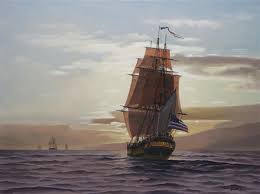
John Paul Jones and Whitehaven

John Paul Jones and Whitehaven

By:  Garland Davis

The perception by the public that the United States was losing the war in Viet Nam caused the politicians to end the war to the detriment of the country at a time when the Vietnamese communists were contemplating an action to sue for peace.

It is said that Walter Cronkite declared on the Six O’clock news, during the TET Offensive in 1968, that the U.S. was losing the war in Viet Nam and Lyndon Johnson believed him.  Vietnamese Commanding General Giap said that the American media functioned almost as another division in the field.

Something similar happened that caused the British public to believe that the Royal Navy was overwhelmed by the, almost non-existent Colonial Navy.  This perception by the public fanned by the press and rumor led to the loss of the Revolutionary War against the American Colonies.

After sunset on April 22, 1778, the USS Ranger, commanded by Captain John Paul jones, hove to about two miles off the unsuspecting town of Whitehaven. It was a clear and cold night. Two boats were dispatched, manned by about thirty sailors armed with pistols and cutlasses. Jones took command of one boat with his Swedish second in command, Lieutenant Meijer.  the other boat was commanded by Marine Lieutenant Wallingford and Midshipman Ben Hill.  The two boats rowed against the tide for three hours to reach the harbor.  Jones planned to destroy hundreds of ships by setting fire to them as they lay stranded by low tide.

The plan came unstuck because of delays by a near mutinous crew and poor winds.  They failed in their first attempt to land at a point where they could attack one of the two shore batteries protecting the port but the sea was too rough and the shore too rocky.  They then just rowed past the battery and into the harbor as first light was appearing over the hills behind Whitehaven on April 23, 1778.

The intention was for Wallingford’s men to burn the ships in the northern half of the harbor as Jones led a raid on the fort to spike the guns. This was vital to secure escape after their mission as the guns of the fort covered the harbor entrance and could have blasted the small boats as they made their retreat. John Paul Jones landed first, near the battlements. As it was a cold night, the guards had gone into the guardhouse at the back of the fort to keep warm. According to Jones, he himself led the surprise attack. By climbing on each other’s shoulders, they managed to silently scale the walls, enter the fort, burst into the guardhouse and secure the surprised guards without bloodshed.

He left Lieutenant Meijer guarding his boat, which was wise, as according to the Swede the rest had concocted a plan to take the boat and leave Jones behind had he not been successful. In fact, it was not until John Paul Jones himself stood on the battlements, gave his men reassurance and encouraged them to become heroes, that they plucked up courage to join his mission.

Having secured the fort Jones took Midshipman Joe Green to spike the guns at the Half-moon Battery which lay on the shore, 250m from the fort. This probably contained 32-pounders that could fire over a mile and it was thus vital to the escape that these were incapacitated. He sent the rest of his men to burn the shipping in the southern part of the harbor.

While Captain Jones was disabling the guns, Lt Wallingford, and his men landed at the Old Quay slip and headed straight to a pub and got drunk. [I’ll bet the new Marine recruits don’t hear this story of Marine daring and success in boot camp].  He later told Jones that they stopped at the pub to get a light for the incendiaries, but they did get drunk.

It was now full daylight.  Jones and his crew managed to fire two ships laden with coal.  On the largest ship they threw down a barrel of tar and as the fire took hold they made their retreat.  Among all the confusion, one of Jones men slipped away and warned the townspeople that fires had been started in the ships and could spread to the town.  There were many warehouses on the quay loaded with items like tobacco, rum, and sugar.

The town, aware of the dangers of fire was equipped with fire engines and were able to extinguish the flames before they reached the ship’s rigging which would have spread the fire throughout the ships moored there.

Thus ended the attack on Whitehaven of 1778.  Despite having the advantage of surprise and Jones’s inside knowledge of the port and town, the attack was a bungled failure. This seems to have been due largely to the American crew’s reluctance to “destroy poor people’s property” as Wallingford had put it. However, the shock waves, that it sent throughout the country were completely out of proportion with the mere few hundred pounds’ worth of damage actually caused and turned John Paul Jones into an infamous pirate to the English and a hero to Americans because of subsequent successes against the Royal navy.

The Parliament and Royal Navy were crucified in rumors and the press that sewed the seed of unpopularity of a war with colonies on the other side of the Atlantic, while their traditional enemy, the French, lay just across the English Channel.

The unpopularity of the war and the unrest caused by the belief that the Royal Navy was bested by the Colonial Navy was instrumental in the English succumbing after Cornwallis’ surrender.

Not unlike results during the war in Viet Nam, the attitude of the British populace likely played a strong part in the creation of the United States


To follow Tales of an Asia Sailor and get e-mail notifications of new posts, click on the three white lines in the red rectangle above, then click on the follow button.


A native of North Carolina, Garland Davis has lived in Hawaii since 1987. He always had a penchant for writing but did not seriously pursue it until recently. He is a graduate of Hawaii Pacific University, where he majored in Business Management. Garland is a thirty-year Navy retiree and service-connected Disabled Veteran.

Standard

Jake Goes to the Doctor

Jake Goes to the Doctor

By:  Garland Davis

I grew up in the hillbilly enclave of 1950’s Western North Carolina.  This is a fictional conversation but if the characters bring anyone to mind, there were and still are people like this.  It mirrors many such conversations that I heard.

There was a one-story country store located at the end of a dirt lane off an unlined two-lane blacktop road.  The store was a three room house that was converted into a one-room store.  A porch across the front ran the width of the building.  Sitting on a Coca Cola crate near the edge of the porch was a man.  He was wearing denim bib overalls, brogans and a fedora. He was whittling on a piece of two by four, chewing tobacco, and spitting into the dust near the edge of the porch.

A dusty pickup truck turned into the lane leaving a dust trail as it drove into the store yard and parked beside another equally dusty pickup already there.  A man wearing a dirty white painters cap and overalls climbed out of the pick up and walked to the end of the porch, stepped on a flat stone that had been placed there as a stoop, and then onto the porch.

“Hey Hank, how you doin’”, he said as he walked to the door. “I’ll be back, soon as Ah gits me a drank and a plug a ‘baccer.”

“Hey Jake. Ah’ll be raht here.  How ‘bout brang me that RC ya owes me.”Hank said as Jake entered the store.

A few minutes later Jake came back onto the porch carrying two RC Colas and handed Hank a bottle saying, “Ah already paid back that drank t’other day at Pete’s store, now ya owes me one.”

Hank eyes the plug of chewing tobacco and says, “How ‘bout cut me offen a piece a that plug. Ah lef’ mine in my other britches.”

Jake says in exasperation, “Dam’ an Ah ain’t even had a chainct to git it open up and ya already tryin’ ta bum my chewin’ ‘baccer.  An’ ya ain’t got but one pare a britches. Ah din’t take ya to raise.” He cut a chew off the plug and passed it over to Hank, who popped it into his mouth and took a pull on the cola.

Hank asked, “Ah din’t see ya ‘round yore ‘baccer fields and barn t’day.  What ya been doing’?”

“Ah went to tha doctor.  My Ole Woman been on me bout gittin’ a fiscal check up.  Ah done tole her that they ain’t nothing wrong wi me.  I got’s that plantar stuff on mah lef’ foot that makes mah heel hurt when Ah gits up in tha morning but after ‘while hit’s okay’.  Ah tell ya, when a woman gits her mind sot on somthin’ ain’t nothn’ fer it but ta do whats they want.” Jake replied.

“What’d tha doctor do? Did he take some a them x-ray pi’chers? Asked Hank.

“Yep, well he din’t do it.  Some other feller there took a whole bunch a them pic’hers. .  He took some a them pic’hers a mah foot too.“ Ah thank they was somthin’ wrong with that feller.  He kep’ lookin around and at me like I farted or sumpin’.

 But, ‘fore that, some gal asted me a whole bunch a fool questions.  She ast me when was tha last time Ah seen a doctor.  Ah told her that Ah seen Doctor Garret over to Walkertown Yistiddy.”  She wanted ta know why Ah seen him.  Ah told her Ah was drivin’ past his house an’ he was settin’ on tha porch, so I thowed up mah hand.  Must be sumpthin’ wrong with that girl, tha way she was shakin’ her head. Then she ast me when was the last time I was ‘zamined by a doctor.  Ah told her that a Army doctor down to Fort Bragg had poked me some when tha Army called me up fer Ko-ria.  She ast me what he said.  Ah tole her that he said a bunch a’ stuff, but I din’t unnerstand a bit of it ceptin mah feet was flat an he kep’ goin on ‘bout some pore feller’s high jeans an then he tole me tha Army din’t need me and let me come on back to Fa’syth County.  Then she ast me what doctor Ah goes ta see when I git sick.  Ah told her I goes to see Granny Ledbetter up in Yadkin County.  She makes the best potions an’ poultices an’ stuff.”

“She ast me iffen I had been to a doctor since tha Army doctor.  Ah told her Ah ain’t.  She tole me that Ko-ria was nine year ago.  Ah tole her I knowed that  I ain’t dum’.”

Ah tell ya Hank, Ah don’t know ‘bout that girl.  She told me to wait and was shakin’ her head and talkin’ to herself”. Jake told Hank.

Hank said, “That feller what was takin them x-ray pitches was prolly smellin’ yer ole stankin’ shoes an’ feet.”

“What ya talkin ‘bout.  Mah Ole Woman made me take a bath last night.  I tole her, Ah ain’t never heered of a body takin’ a bath on Winsdy night. Ah tells ya, Ah was smellin’ sweet as a flare.” Jake went on.

“What’d they do nex’?, asked Hank.

“Tha feller that took tha pic’hers took me in this little room and wrapped this thang like a inner tube ‘round mah arm and pumped it up.  Then he took this thang that had three thangs and put two a tha thangs in his ears and stuck tha other thang onto tha inside a my elbow and started to let tha air outten tha innertube whilst he was checkin’ tha time on this clock thang that was hooked to tha innertube.  After that, he made me git on a scale and wayed me like I was a hawg he was gonna sell.  Then he wrapped this rubber thang ‘round my arm and pulled it so tight, Ah thought it was gonna squeeze mah arm off.  He give me a ball in tha same hand that was bein’ squoze and tole me to squeeze tha ball.  Then dam’ if he din’t stick a needle inta mah arm and start dreenin’ mah  blood out inta a glass thang.  Then ta beat all Ah ever heered of, he give me a thang that looked like a dranking glass with a led an’ tole me to go in tha toilet and give him a specimen.  Ah tole him Ah don’t have no idĂ©e ‘bout this specimen thang.  Ya ain’t gonna b’lieve it, he tole me to piss in tha glass and put tha lid on it.  Ah din’t know how much he wanted, so Ah filled her all tha way ta tha top.  With all this stuff goin on, Ah haf ‘spected him ta want me to shit in sumpthin’.”

“After all that, tha feller took me into another room and tole me to take all mah cloths off but my underware.  Ah tole that feller that, women ware underware, Ah am a man Ah ware’s  draws, ‘ceptin’ it’s summertime and Ah don’t ware no draws in the summer ta keep cool.  Ah tole him Ah wares long handles in tha winter to hep keep warm.   Then he give me this white thang that looked sumpthin like my Ole Woman’s robe an’ tole me to take off my britches an shirt an ware it. Ah ast him iffen Ah ortta tak off mah shoes too.  He tole me to wait till he lef’ tha room.

Ya know Hank, that doctor got some strange people workin’ there.  People ain’t right walkin’ around talkin’ to their selfs is they?”

“Did ya ever git ta see tha docter,” Hank asked. “Mah Woman is been talking bout me goin’ ta git a check up too.”

“Ah tells ya, ya better find a differnt doctor.  Ya ain’t gonna believe what he done.  Ah took off my britches an shirt an shoes like that first feller said an put on that robe thang.  He give me one that was too little.  Iffen Ah din’t hold tha front uv it, anybody could see mah thang. 

Tha Doctor come in.  He told me ta set on a table.  He had one of them ear thangs too.  He stuck them two pieces in his ears and stuck tha other piece onto my back and tole me to breathe.  Ah tole him Ah usually did.  He moved that thang aroun’ four or five times.  Then he put it on my front and tole me not to breathe.  Din’t seem ta be able to make up his mind. After that he took a hammer and begun to hit my knees.  Not hard ‘nough ta hurt, but it made mah legs jump.  Now Hank, ya ain’t gonna b’lieve what he done next.  He said he wanted to check a prostertate or sompthin’g like that.  He tole me to turn around and bend over.  Ah done it.  An he stuck his fanger in mah butt.  Iffen Ah wadn’t so s’prised, Ah would a jumped all that way over that table. Ah ast him what fer he done that.  He said it was the way they checked the prostertate.  I ast him if hawgs had them proster thangs.  He said the boar ones do.  By George, tha nex’ time Ah kills hawgs, Ah’m gonna check tha butthole.  I wants ta see what them proster thangs looks like.”  Jake continued.

Hank, shaking his head, says, “Ya got me worried, Ah don’t want anybody sticken their fangers in mah butt.  Onliest thang that I know of in yore butt is turds. What happen’d nex’?”

Jake went on with his tale. “After that he tole me ta put mah clothes on and he would come back in a minute.  He must a farted, Ah din’t and Ah din’t smell anything.  He had that look on his face.  Ya, know tha face ya Ole Woman an dotters makes when ya looses a bean fart.”

“After Ah got my duds on, he comes back and tells me that he’s finished with mah check up.  He said he’s saprized but Ah ‘peered ta be in purty good health all thangs considered.  He tole me that I ortta stop chewin’ ‘baccer.  He said chawin’ and smokin’ and dippin’ snuff aint good fer a body.”

“I ast him if he had tha okay ta be a doctor in No’th Ca’lina.  He said he did. I asted him if they knowed he was talkin’ ‘gainst ‘baccer. Most everbody in No’th Ca’lina makes their livin’ from ‘baccer.  He laughed at me an’ said that some Surgery General feller , I guess he is prob’ly in tha Army iffen he’s a General, says that it is bad fer folks an don’t do it. I figger since Ah aint in tha Army, it’s okay.”

“I guess we’s lucky ‘cause we wear overalls stead a jeans and ain’t pore.  He went on like that Army doctor down to Fort Bragg talkin’ about some pore feller with high jeans.”

I heard conversations like this around country stores, gas stations, tobacco barns and pack houses during my formative years.  If you had a hard time reading that, I understand.


To follow Tales of an Asia Sailor and get e-mail notifications of new posts, click on the three white lines in the red rectangle above, then click on the follow button.


A native of North Carolina, Garland Davis has lived in Hawaii since 1987. He always had a penchant for writing but did not seriously pursue it until recently. He is a graduate of Hawaii Pacific University, where he majored in Business Management. Garland is a thirty-year Navy retiree and service-connected Disabled Veteran.


Standard

Beer and Decisions

Beer and Decisions

By:  Garland Davis

Most people use certain procedures and receive help from outside sources to make decisions, both large and small, that affect them and their lifestyle.  While growing up, the primary influence is from the parents, family members, teachers, and, as one moves into the teen years, their peers become the primary source motivating decisions.  No one wants to differ from the crowd and the great efforts a person makes to emulate others becomes a driving influence on most life decisions from the brand of soft drink, the style of undergarments one chooses, or the haircut you sport.

As you move into adulthood, experience, accumulated knowledge, societal morals, and other influences motivate decision making.  Once I entered the Navy, many of these decisions were already made for me.  All I had to do was conform to the regulations. Looking back on my late teens and advancing into my twenties and my early, and exciting years as a sailor in the Asia Fleet, I now realize that one of the biggest factors influencing my decision making was beer.

I grew up in the hillbilly enclave of Western North Carolina where, more often than not, moonshine was the drink of choice.  Actually, it was often the only thing available as most of the state was “dry.”  Moonshine did the trick, but when the county authorized its sale, I learned to love beer.

Arriving at NAS Lemoore, California is 1961, after boot camp, I learned the sophisticated sailor’s choice of libation was Olympia beer.  Not wanting to be different, I became a connoisseur of Oly.  It prompted and assisted me in making many decisions.  And they weren’t always good decisions.

Olympia’s influences were not always the best. For instance, Oly decided that I should enter the bull riding event in an amateur rodeo.  Being easy going I went along and signed.  I didn’t realize the stupidity of that decision until they pulled the gate and I ended up on my ass, with a broken arm.  By the way, I was still in the chute.  The bull left without me!

Another time, after imbibing a quantity of this sterling product of Tumwater, Washington, another fool and I decided to go from Fresno to Los Angeles.  We only had enough money for one-way bus tickets.  We thought we would hitch hike back.  We barely made it back to the base, hungover, sick, and sleepless, after hitchhiking and walking all night.  That was one of the longest, most miserable days I have ever spent working in a Navy galley.

A year later, finally in the fleet and in WestPac, I was introduced to the quality fermented beverages of Kirin, Sapporo, Asahi, and that real detriment to sound decision making, San Miguel Beer.  Not only did one make foolish decisions, the actions were often repeated.  For example, I was a pretty good poker player, and, more often than not, was a winner in the nickel and dime games played on the mess decks.  After a few beers, I decided that I was good enough to play in the higher stakes games played at CS1’s house on weekends.  Lost my ass a few times, always after the beer of the moment convinced me that playing in that game was a sound decision.

In Yokosuka, a bluejacket could check a case of American beer, or bottle of whiskey, into a Japanese bar for a fee.  The sailor was given a ticket and a number was marked off each time one of the beers was ordered.  The tickets were usually good for three days and then unless another fee was paid, the beer became the property of the bar.  It was common practice to check cases in three or four bars so one could bar-hop and have cheap beer available.  The night before the ship sailed became a marathon of trying to drink all the beer checked into the various bars.  Not always the best decision!

But all the decisions prompted by beer were not bad.  In 1964, I received orders to the Commissary Store, Yokohama, Japan.  The only thing I can say is that, in 1964, duty in Yokohama was akin to going to heaven.  The single enlisted men lived in an old Army BOQ.  We had private rooms and there was maid service available for a pittance.  The maids did laundry, shined shoes, made beds, and cleaned the rooms.  Most of the maids were older women who spoke little or no English.  When a sailor wanted to communicate with his maid, he would go to the Billet Office and have the young girl that worked there translate for him.

We were drinking beer and someone asked if I was bringing a date to the Navy Day Ball. That was when the beer kicked in.  I told them that I was going to ask the girl from the Billet Office.  They laughed and told me that she didn’t date sailors.  Many had tried and failed.  After a couple of more beers, I decided that now was a good a time as any to ask her.  So off to the Billet Office I went. To make a long story short, ten months later, she became my wife.  We have now been together for over fifty years.  If it wasn’t for the beer, I may have believed my shipmates and not have mustered the courage to ask her.

Another decision that began as a poor choice actually worked out well.  I was in China Town drinking with some shipmates. We decided to go to the club and walked out to find a taxi. I saw a puppy in the window of the pet store next door to the bar.  The puppy was cute, I was tanked up on beer and decided to buy him.  I carried the puppy home and gave him to my wife. In the taxi on the ride home, I was worried that she would be upset that, I had spent money on a dog.  That cute little puppy, Taro, grew up to be a beautiful Akita and became her companion through many deployments.  He was with us for fourteen years.

I was probably thirteen or fourteen when I drank my first beer.  That means beer has been assisting me with my decision making for the last fifty-six or fifty-seven years.   I have lived a good and eventful life.  I choose to believe beer contributed more positively than negatively to the decisions that led to the present.

I do know that it has been a helluva of a ride and without the beer, it would not have been as near as much fun.

If you attend the Asia Sailor reunion in Branson this year, look for me in the chair nearest the cooler!


To follow Tales of an Asia Sailor and get e-mail notifications of new posts, click on the three white lines in the red rectangle above, then click on the follow button.


A native of North Carolina, Garland Davis has lived in Hawaii since 1987. He always had a penchant for writing but did not seriously pursue it until recently. He is a graduate of Hawaii Pacific University, where he majored in Business Management. Garland is a thirty-year Navy retiree and service-connected Disabled Veteran.


Standard

The Dreaded Veteran’s Administration

The Dreaded Veteran’s Administration

By:  Garland Davis

The question arose during a conversation, this morning,  with a couple of shipmates on FaceBook about where one should go for advice when dealing with the Social Security Administration, Tricare, Tricare for Life, and the Veterans Administration.  This is my story of a four-year ordeal with the VA endeavoring to gain a presumption of exposure to Agent Orange as a cause for my Parkinson’s disease.

In 2008 and 2009, I was still running three to six miles per day. I began to notice some changes in my motion as I ran.  My right arm seemed to want to hang and not move naturally, my right leg seemed heavier and took more of an effort to move forward. I just figured these were caused by age and muscle weakness and increased the intensity of my workouts at the fitness center.  From time to time, I would notice a slight trembling in the fingers of my right hand.  I didn’t know why but it was easy to control.

One evening in 2010, I was drinking beer with my Bubblehead friend who lives a few houses from me. This was pretty much our normal Friday evening routine.  I pointed out the tremble in my fingers and said, “Look at this shit.”  He asked if I had ever been tested for Parkinson’s disease.  He had seen it before.  His father had suffered from PD.

At the time, all I knew of the disease was that Michael J Fox and Muhammad Ali had it and that Hitler had had it.  My wife was in Japan visiting her family and  I spent most of the next day on the computer researching Parkinson’s disease.  I learned that Dr. Parkinson had originally described the disease as a rare malady of the aged in 1814.  At the time, the life expectancy was about forty-two years.  The dramatic increase in the numbers of Parkinson’s patients since stems from elevated life expectancies.  Fox has a rarer Early Onset Parkinson’s and Ali’s affliction was caused my multiple head trauma.

The more I read of the condition and the symptoms, the more convinced I became that I had the disease. I made an appointment with my doctor.  He knows that if I think there is a problem, I will do the research before I come to him.  When I told him I thought I may have PD and the reasons why, he explained that there were no definitive tests for PD.  The procedure is to perform tests to rule out other causes of the symptoms.  He scheduled me for blood tests, x-rays, an MRI, and a CT scan.  He also told me that he would prescribe a medication and if the trembling stopped when I took it, there was a ninety percent surety that it was PD.  The medicine worked.  The tests ruled out stroke, brain tumor, or palsy.  It was official, I had Parkinson’s disease.

When I retired, I was never screened by the VA for any disabilities. I was in good health and didn’t want to be classified as “Disabled.” My friend asked if I had served in Viet Nam.  He told me that PD was on the list of afflictions attributed to Agent Orange.  I told him that I had never served in-country, but had served in an Ocean Going Tug that operated in and out of the ports of Vung Tau, Da Nang, and Cam Ranh Bay.  We had always anchored and never moored to a pier.  Mooring to a pier automatically qualifies as a presumption that one was exposed to the chemical. The difference a few hundred yards can make!

He asked if I ever went ashore.  I was ashore in Da Nang and Cam Ranh a number of times to arrange for stores. He urged me to apply to the VA for Agent Orange screening and Disability benefits.  I basically told him that none of the ships I served in were on the register of ships presumed to be exposed during the periods I was aboard.  I told him I would, but procrastinated for about six months.

I was at his house one evening, and he gave me the card of a gentleman involved with advocating VA claims.  The fellow was an officer with the local VFW.  I called and made an appointment to talk with him.  The different VA advocates were all officed in the VA wing of Tripler Army Medical Center.

The VA advocate explained the VA policy of determining exposure and brought out a myriad of forms which he helped me to complete over the next couple of hours.  He told me that I should order copies of ship’s logs, and get letters from as many previous shipmates as possible to support my claim.

The ship’s Commanding Officer, at the time I was in her, was retired and lived less than three miles from me.  I called him and explained my problem. It turned out that he had kept a personal log of the ships’ movements.  He provided me dates and times that the ship was in Vietnamese ports.  Using that information, I ordered copies of ship’s logs.  He also wrote a letter, which he sent directly to the VA, stating that he was the ship’s CO and could attest that CS1 Garland Davis had been ashore in Da Nang and Cam Ranh Bay on numerous occasions on ship’s business.

The gentleman at the VA told me that it would take a considerable amount of time for my claim to be processed and to give it time.  After waiting for over three months, I stopped by the VFW office to touch base.  The fellow didn’t recognize me and had no idea of who I was or the particulars of my claim.  From that minute on, I took complete control of my claim and no longer relied on any outside source to advocate for me.  Don’t depend on someone else to represent you, do it yourself.

In due time, I was scheduled for three different doctor’s appointments. In the meantime, I had received copies of the ship’s logs.  They were written in standard Navalese and were not helpful in proving my claim. None of them stated specifically that CS1 Garland Davis went ashore in any Vietnamese port.

After almost a year, I received the VA’s determination that I was not exposed to Agent Orange and awarded me a ten percent disability because of a gastric surgery I had while on active duty. They dismissed the CO’s letter and other letters as “Lay letters of no consequence.”

I had a period of time to appeal the decision and/or to submit additional evidence to bolster my claim.  I submitted all the log copies in line with the old adage, “If you can’t dazzle them with facts, baffle them with bullshit.” I also received and submitted letters from other shipmates. I did this to keep the claim alive.  As long as the claim can be kept active, the beginning date of any subsequent benefits is the date the original claim was submitted.

I had managed to keep my claim active for over three years when, in 2014, I learned that a Destroyer I had served in was added to the list of ships presumed to have been contaminated by Agent Orange.  I went to my records and pulled copies of orders and other documents to prove that I was serving in her during the period stated and submitted them to augment my claim.  Within a couple of weeks, I was scheduled for another round of doctor’s appointments.  About a month afterward, I received notification that I was rated at eighty percent disability effective in August 2011.

A retired Air Force Chief Master Sergeant acquaintance told me that since I was no longer capable of working, to file for Individual Un-employability which would automatically raise my disability to one hundred percent.  Anyone with a VA rating of over seventy percent is eligible to file for this category.

I was awarded an eighty percent rating from August 2011 and a hundred percent from August 2012 when I was no longer able to pass the PUC physical that caused the loss of my CDL(taxi).

When dealing with the VA, DO NOT GIVE UP!

Standard

Effin’ Nukes

Effin’ Nukes

By: Garland Davis

Remember the Science and Mathematics Geeks and Nerds from high school??  The Navy actively recruits these individuals.  They are the people who can learn, understand and operate the nuclear reactors and propulsion systems used in our Submarines and Aircraft Carriers.  They are subjected to boot camp and must get past the rigorous training there.  While there, they are tested extensively.  If selected for training  in the nuclear field, they must extend their enlistments by agreeing to serve for eight years.  In return, they are sent for up to six months training as Machinist’s Mates, Electronics Technicians, or Electrician’s Mates.   After completing this training, they are sent to Nuclear Power School for a period of two years.  They study advanced Mathematics, Physics, and Nuclear Physics.  They go to classes forty-five hours a week and are expected to study up to 25 hours a week outside the classroom.  They attend classes six days per week.  They are also required to perform military functions and duties.  It has been said that a newly graduated Nuclear School Alumnus has the equivalent scientific training of a PHD.

They are not, however,  taught Art, Economics, Literature, Poetry, Law, Ethics, Composition, English or any of the other liberal arts subjects considered the building blocks of an advanced education.  They come into the fleet lacking a complete and well-rounded education. They also lack the one element that always serves the seafaring man (and woman in our Politically Correct Navy) well.  COMMON SENSE!  They have a well-earned reputation for being devoid of that particular trait

They are known by their fellow sailors as “Nukes”, or to be more exact, “Fucking Nukes”.  The stories abound about them and the situations they can get themselves into.  I was teaching an on base, evening course in Personnel Management for one of the local universities.  I had a First Class ET Nuke in the class.  We were discussing human behavior in the workplace.  He could not understand that there were no ‘hard and fast’ rules that applied to humans in the same way in every situation and eventually dropped the course.  Nukes see the world as “black and white”.  There are no gray areas.  But then, that is as it should be, for they are tending the atom farm and science and physics do not recognize gray areas.

The other evening a group of us were sheltering from the rain in my neighbor’s garage (that’s where the cooler was located) when the conversation turned to the Submarine Base at Pearl Harbor.  Each of us had been stationed there at one time or another during the 80’s.  Diesel Dave was talking about a night shift with the Base Police Force.  He said that they observed two sailors crossing the street and every now and then, one of them would bend over and pat the street.  They went to see what was happening.  The sailors were herding a pair of Cane Toads across the street because they didn’t want them to get flattened by a car.

The four of us listening said, “Fuckin’ Nuke” simultaneously.


To follow Tales of an Asia Sailor and get e-mail notifications of new posts, click on the three white lines in the red rectangle above, then click on the follow button.


A native of North Carolina, Garland Davis has lived in Hawaii since 1987. He always had a penchant for writing but did not seriously pursue it until recently. He is a graduate of Hawaii Pacific University, where he majored in Business Management. Garland is a thirty-year Navy retiree and service-connected Disabled Veteran.

Standard

“The Lesser of Two Weevils”

“The Lesser of Two Weevils” or A Decision to Bake or Not

By: Garland Davis

Two weevils crept from the crumbs. “You see those weevils, Stephen?” said Jack solemnly.

“I do.”

“Which would you choose?”

“There is not a scrap of difference. Arcades ambo. They are the same species of curculio, and there is nothing to choose between them.”

“But suppose you had to choose?”

“Then I should choose the right-hand weevil; it has a perceptible advantage in both length and breadth.”

“There I have you,” cried Jack. “You are bit — you are completely dished. Don’t you know that in the Navy you must always choose the lesser of two weevils? Oh ha, ha, ha, ha!”

For those unfamiliar with “the Canon” as Patrick O’Brian fans are prone to call the Jack Aubrey novels, the above exchange comes from The Fortune of War.


What were these weevils, lesser or greater?

This is a story of more than two weevils.  I won’t name the ship or the year.  There may be someone out there reading this with whom I served.  They may be able to figure it out.  I am pretty sure the mess cooks spread the word.  It didn’t seem to lessen the demand for the items that I baked.

The ship was at sea and I was preparing to start the night’s work in the bake shop.  The Jack of the Dust had left my breakout in the shop.  I put the items away except the flour.  There was a flour bin built under the work counter.  I opened the bags of flour and emptied them into the bin when it was empty.  There was enough flour in the bin for the night’s products.  Then I would clean and refill the bin.  As I was moving the bags of flour I noticed something that looked like a worm on the bags.

I thought, “Oh no, weevils.” I grabbed a pan and opened the bag into it.  I closely inspected the flour and saw many of the worms.  The worms that we call weevils are actually the larval stage of the Flour Beetle.

The female beetle deposits eggs into food or into crevices in food packages. The larvae hatch and make their way into the product to eat. Many people find these larvae in the flour and call them “weevils.” Hence, the name “flour weevils.”

As larvae, all flour beetles are light brown, six-legged, wormlike creatures. Within as little time as one month, beetles are capable of developing into adults. The average life span is one year, although some specimens can survive for up to three years in warm, humid conditions.

I went to the First Class lounge and asked for the CS1 and told him about the problem.  He ran off to the CPO Mess to tell the Chief.  A few minutes later they came bursting into the Bake Shop to verify what I told them.  We ascertained that the flour in the bin wasn’t infested only the new breakout from the storeroom.  They sent me for the Jack of the Dust.

He came up from the movie and told them that today’s breakout was the first from the batch received from the last unrep.  He also said that was all the flour we had on board.  Off they went to the storeroom.  They came back looking depressed.  They were envisaging answering to the command and the crew why there would be no baked products for the next couple of weeks.

I told them that I knew a way to get rid of the weevil worms and beetles. I recommended that we move all the flour into the freezer.  The worms would all move to the center away from the cold and freeze.  The beetles would die.  Cut the bags open, throw away the ball of frozen worms.  Sift out the weevils and remaining worms. Use the flour.

The Chief said, “I’ve got to tell the Supply Officer.”  We ended up with the CS1, the Chief, the two Pork Chops, the XO, the CO and me all in the Bakeshop.  I again explained my solution to the problem.  I was asked how I knew this.  I told them that I had read it in a book during my vocational school studies in baking and bakery science.  I couldn’t name the book.

The Captain thought about it for a moment and then put me on the spot.  “Petty Officer Davis, if I approve your solution and you can sift out the weevils, would you be willing to eat bread baked from the flour.”  The only answer I could give was, “Yes Sir.” Although, the idea made me a little queasy. Just a little, after all, I once ate a cockroach on a dare.

I have since talked with other bakers who told me they just sifted the flour and used it without letting anyone know.  Evidently it happens more often than we realize.

When I was the Leading MS in Midway, we had an entire  storeroom infested.  We put six tons of flour over the side.


To follow Tales of an Asia Sailor and get e-mail notifications of new posts, click on the three white lines in the red rectangle above, then click on the follow button.


A native of North Carolina, Garland Davis has lived in Hawaii since 1987. He always had a penchant for writing but did not seriously pursue it until recently. He is a graduate of Hawaii Pacific University, where he majored in Business Management. Garland is a thirty-year Navy retiree and service-connected Disabled Veteran.

Standard

Big Orange

Big Orange

By: Garland Davis

I was killed in the Nam,

But, my name does not adorn that wall,

I have not yet died, I still live and,

Walk the streets among you,

I was not killed by the Viet Cong,

Nor by friendly fire,

There should be a wall with names of,

Those whose deaths attribute to the fucking agent,

Known among us as Orange.


To follow Tales of an Asia Sailor and get e-mail notifications of new posts, click on the three white lines in the red rectangle above, then click on the follow button.


A native of North Carolina, Garland Davis has lived in Hawaii since 1987. He always had a penchant for writing but did not seriously pursue it until recently. He is a graduate of Hawaii Pacific University, where he majored in Business Management. Garland is a thirty-year Navy retiree and service-connected Disabled Veteran.

Standard

Oatmeal

Oatmeal

By: Garland Davis

One of my earliest memories is breakfast and my mama bringing that dreaded bowl containing the blue-gray amorphous mass sprinkled with cinnamon and sugar.  It became one of the constant repetitious memories of my childhood.  I didn’t know the word during the early years, but it eventually came to be known as “that fuckin’ oatmeal that mama gives us for breakfast.”  Although, to be perfectly fair to her, she did from time to time give us thick lumpy flour gravy that one had to sop up with her hard tough biscuits.  On Sundays, we got bacon or ham and scrambled eggs with the biscuits and gravy.  I will admit that my mama was a great cook, except when it came to breakfast.  The bacon was either limp and undercooked or so crisp that you, more often than not, ended up with bacon chips it was so crumbly.

My brother decided that he could improve the quality of breakfast by just not eating it.  He forgot to take into account our daddy’s temper and the wide leather belt that held his holster.  Daddy told him that if he didn’t eat he would get an ass whippin’.  Being the oldest, I had already learned that it was not a good strategy to call daddy’s bluff.  My brother got the ass whippin’ and ate his oatmeal!

Looking back on those times, I now realize that oatmeal and flour gravy and biscuits were cheap.  Daddy was a chain gang guard for the county penal system (the state took over the county penal facilities in the early fifties) and didn’t make a lot of money.  His salary went to pay rent, keep one or another old car running, buy clothes for three growing boys.  Mama had four hens for eggs, which she saved up for Sunday breakfast.  Once there were five hens, but the Rising girl’s (I might tell a story or two about them someday) dog killed one.  My mama cleaned it for the dumpling pot.

I never minded the pinto beans and potatoes almost every day.  Loved corn bread when mama baked it. Hated when daddy would catch a catfish.  Always ended up with the choice of eat it or ass whippin’. Believe me, if you ever had one of my daddy’s ass whippin’s you would rather eat almost anything.  I loved the summers, there was always stuff from the garden to eat.  So, with more than one dish on the table, you could ignore one item without incurring daddy’s wrath.

That was pretty much the cuisine of my childhood.  The biggest treats I can recall are annual weenie roasts by a farmer who lived up the road and Spam sandwiches. Thought I couldn’t get enough Spam.  But then, I still hadn’t dined on the Navy’s version of the pink meat.

When I was fourteen daddy died.  By then a little sister had been added to the mix. With three boys in school and a baby at home and Social Security Survivors Benefits as the only income, my mama had a hard time making ends meet.  She did it by feeding us more fuckin’ oatmeal.  The threat of ass whippin’ was removed, then the choice became eat the oatmeal or go hungry.  The rest of the menu at home pretty much continued as before except happily, there was no more catfish.  Ass whippin’s and catfish are the only things I didn’t miss about my daddy not being there.

The summer after daddy died, I got a job at a company the catered pit-cooked barbecue and homemade ice cream to restaurants and diners.  My personal menu improved greatly.  I decided then that I would never eat fish, chicken or that fuckin’ oatmeal ever again.  I have extended and added to those three items over the years.  People call me finicky, why hell, some of my shipmates call me pussy because I won’t eat raw fish.  Calamari, for instance, I saw a movie where it took John Wayne and Ray Milland fifteen minutes to kill one of those mother fuckers.  I ain’t eating it!  Often times, my Japanese wife and I eat separate meals because of my food eccentricities.

I went into the Navy and became a baker and cook.  I am a hell of a baker and a competent cook.  I’ll cook it, but I don’t have to eat it.  After a few years of the Navy version, I added Spam to my list of avoided foods.  Another item added to the list of “Rather Starve Than Eat” is a Filipino delicacy known as “Balut”.  Many of my shipmates claim to like Balut.

I will admit to eating a cockroach once.  But there were extenuating circumstances.  A group of us were in the Barrio enjoying the local libation.  The girl had just brought a fresh round of San Miguel when a cockroach strolled onto the table.  I remember someone saying, “You ain’t got a hair on you ass if you don’t eat that mother fucker.”  My only excuse is you cannot let a challenge like that go unanswered.  I just beat the others to him.

I pretty much went through a thirty-year Navy Career and a productive twenty years of civilian endeavors without changing my eating habits.  While my wife is enjoying one of KFC’s Chicken Pot Pies, I can be quite happy with a peanut butter and banana sandwich washed down with a diet Dr. Pepper.  I sometimes watch the cooking shows on the Food Network.  I could do the things they do, but I am not really crazy about eating any of it.

I recently had my annual follow up appointment for my Parkinson’s disease.  No real change.  It is a progressive condition, but I am not progressing very rapidly.  Except for one thing.  Constipation is a complication of the disease.  Parkinson’s is a muscular disorder.  Peristalsis is a muscular movement of the digestive tract that moves food through the body.  This movement slows markedly in Parkinson’s patients.  The doctor prescribed some pills and recommended that I get more fiber in my diet.  He recommended eating fuckin’ oatmeal!

I bit the bullet. I bought a box of rolled oats yesterday and cooked some this morning.

You know the shit ain’t that bad!


To follow Tales of an Asia Sailor and get e-mail notifications of new posts, click on the three white lines in the red rectangle above, then click on the follow button.


A native of North Carolina, Garland Davis has lived in Hawaii since 1987. He always had a penchant for writing but did not seriously pursue it until recently. He is a graduate of Hawaii Pacific University, where he majored in Business Management. Garland is a thirty-year Navy retiree and service-connected Disabled Veteran.

Standard

“Special Liberty”

“Special Liberty”

By:  Garland Davis

He was a fireman, I’ll call him Shoetree.  He was sent to the Food Service Division to perform Mess Cooking (Crank) duties for three months.  Although a good worker, he was loquacious, let’s face it, the boy had enough mouth on him for two sets of teeth.

My office was just off the mess decks and I could hear Shoetree continually expounding on one subject or another.  There was no subject that he didn’t have an opinion about. He was always willing to share his opinion, ad nasuem.

Shoetree and another Crank were discussing special liberty.  The other fellow told him that when you are mess cooking, you can forget about special liberty.  At sea cranks work twelve to fourteen hours a day, seven days a week. In port, they get every other afternoon and every other weekend off.  He also told him that Chief Davis never approves special liberty for cranks.  He immediately answered that he bet he could convince me to give him special liberty.

It was his afternoon off.  After completing his work and being released by the Mess Deck MAA, he came to me and asked if he could have special liberty the next afternoon.  I told him that I had heard every reason possible for special liberty and his request was disapproved.  He told me that he bet he could come up with an excuse I had never heard.

I told him, “If you can give me an excuse I have never heard at twelve fifty-five tomorrow, I will give you special liberty, commencing at thirteen hundred. You only have one chance.  I am not going to listen to but one excuse. So you better make it a good one.”

He says, “All you have to do is say that you have already heard it and deny me special liberty.”

I promised that I would be honest and if he came up with an original excuse, I would grant the liberty.  I also told him that I didn’t want to overhear him trying out stories the next morning.

The next morning he was quieter than most days. He conducted a number of semi-whispered conversations with the other mess cooks, testing possible excuses, I presume.

Finally, the appointed time arrived.  FN Shoetree knocks on the bulkhead by my door.

“Yes”, from me.

“Chief can I have special liberty this afternoon?”

“Fireman Shoetree, you know our agreement.  If I have heard your reason before, no special liberty.”

He took a deep breath and said. “Yeah Chief.  Well here goes.  My brother is arriving at Honolulu Airport at three o’clock and I need to meet him.”

“I’ve heard it before no liberty”

“Wait a minute Chief, there’s more. You see, my brother is an amputee. He only has one arm.  He has two suitcases and needs my help to carry one.”

Through my laughter, I told Shoetree to get the fuck off the ship.

Never underestimate the ingenuity of the North American Blue Jacket when it comes to “Special Liberty.”


To follow Tales of an Asia Sailor and get e-mail notifications of new posts, click on the three white lines in the red rectangle above, then click on the follow button.


A native of North Carolina, Garland Davis has lived in Hawaii since 1987. He always had a penchant for writing but did not seriously pursue it until recently. He is a graduate of Hawaii Pacific University, where he majored in Business Management. Garland is a thirty-year Navy retiree and service-connected Disabled Veteran.


Standard