Musings of an Old Sailor

Musings of an Old Sailor

By:  Garland Davis

Reading an article about the USS Zumwalt DD-1000 with their rail-guns and lasers, I have been thinking about the impersonal nature of Naval engagements in this modern technological age.

Two hundred and forty-one years ago, when our Navy was founded, engagements between ships took place at “rock throwing range.”  Men shoved powder and iron balls into the muzzles of heavy cannon, heaved on lines to drag the heavy bastards into position, jammed a burning slow match into the touch hole, and sent a salvo across a small expanse of ocean into the foe.  Then immediately did it again, while the enemy sailors were doing the same.  Masts fell, tackle and sails crashed to the deck, chunks of gunwales were thrown everywhere, and the toll in blood and bone was horrendous.

Throughout the ensuing years and wars, the range of the guns increased to the visible horizon.  Instead of an iron ball, the rounds were explosive and created much more devastation.  The battles were still ship to ship and man to man.  Then came the aircraft carrier and its ability to carry the battle beyond the visual limit of the horizon.  Now photo reconnaissance became necessary to determine the outcome of actions.  Once combat extended beyond the horizon, beyond the visual confirmation of effect, naval warfare lost something.

Now destroyers carry surface to air missile capability, surface to surface missile capability, surface to sub-surface rockets, and, oh yeah, they still have a gun.  Once submarines made high-speed transits by diesel-electric on the surface and submerged to stalk its target using battery power.  Once in position, they would fire a four torpedo spread and then enjoy several hours of depth charge evasion.  Today’s submarines are comparable to FedEx or UPS, designed to deliver packages of devastation to multiple destinations.

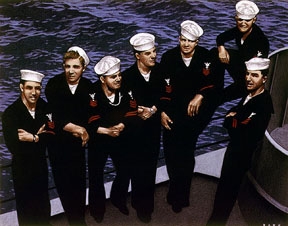
Sailors of our generation grew up on the farms of the countryside or the streets of the cities.  We played baseball and football in the fields and pastures or the streets and parks.  Our first jobs were on the farms or in the stores and bodegas.  The biggest technical innovations of our childhood were the advent of broadcast television and the transistor radio, a radio that one could almost fit in one’s pocket.

Today’s generation of sailors cut their teeth on computers and video games.

Us old half-baked coots are barely limping along on the periphery of this technology, understanding it less and less the more we become involved with it. We grew up in a world of highly personalized adventures where the good guys won.  We knew it because we saw it on Victory at Sea and the Silent Service and the News Reels at the Saturday movie.  I realize now that this was “chum” to draw us to the Navy recruiters.

There was no G.I. Bill nor free college education either and no we will “kiss your ass” and treat you with kid gloves.

No, in the sixties, they gave you forty some bucks every couple of weeks, they fed you and clothed you, gave you a free airplane ride to San Diego or Great Lakes, and opened up a world of adventure and unique wonders.

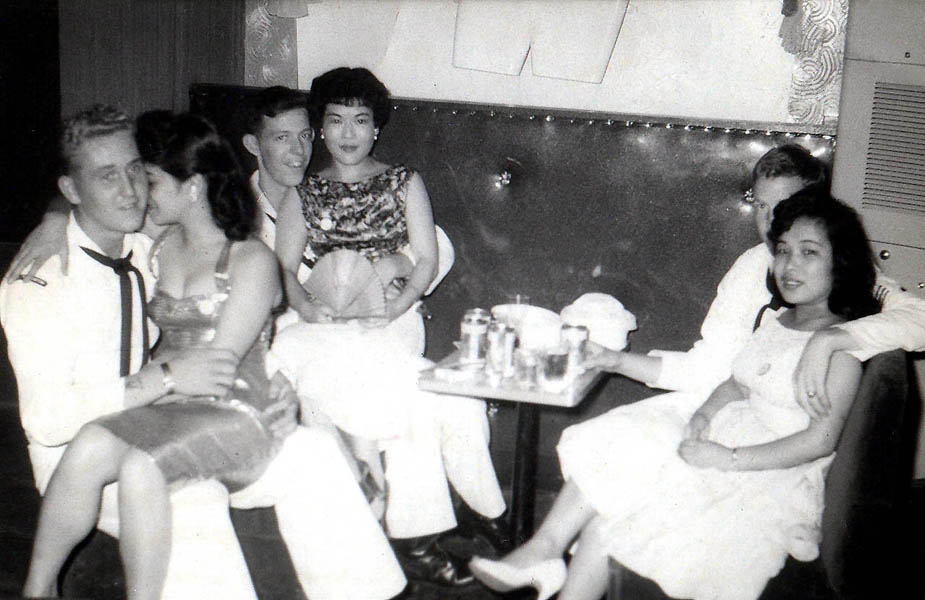
My view of combat sailors stems from the gun line and the Vietnam war.  General quarters and shooting all night and refueling and rearming the next day.  Sweating and laboring through the days and nights broken by brief visits to one of the fleshpots of Asia.

I feel fortunate that it was that way during my Navy time.  I was old fashioned. I grew up on tales of John Paul Jones, Horatio Hornblower, Richard Bolitho, and Jack Aubrey, fighting, boarding and winning by pistol and cutlass. Victory at Sea and Silent Service was akin to flypaper that sucked in a hillbilly daydreamer from Western North Carolina.

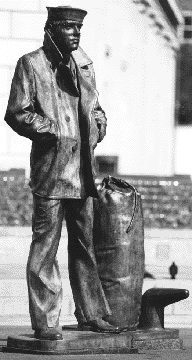
I wonder, do high school girls dream of sweating as the first loader on a three-inch gun.  Do they ever write, “Manning a five-inch thirty-eight-gun turret in the blank that reads “Occupational Preference?  Did they ever roam the highways searching for enough empty soda bottles to buy a movie ticket?  “Operation Pacific” is showing!  Do they linger at the beauty parlor to hear some old gal tell about rough days in the service?  Do they tell sea stories that can be categorized as “no shitters”?  Now they are on all the ships and will soon invade the last bastion of the male sailor, the Fast Attack Submarine.  And I wonder if they really understand the “Call of the Bluejacket.”

I do know that women in Repair II It will make pissing down the forward bilge sounding tube during General Quarters an interesting event.


Standard

The Wheels and the Wheel Book

The Wheels and the Wheel Book

By: David “Mac” McAllister

I’m probably dating myself here, but when I entered the Navy, I never spoke to a Chief Petty Officer unless I was in the shits. Rarely did I speak to a First Class and thought that a Second Class had the authority of God. My LPO was a Third Class, and he took care of all my needs good or bad. I didn’t go on liberty with him and I damn sure didn’t call him Bill, Frank, Joe or whatever his first name was for two reasons, 1. It just wasn’t done and 2. To this day I don’t know it.

When I made Third Class, I was introduced to the proper use of the Wheel Book. It was a small green memorandum book issued by the supply system. Every petty officer had one. I was taught to create sections in the Wheel Book. One section was devoted to the men that worked for me. This is where I kept track, on a daily basis, of their performance (good and bad), job assignments and watch qualifications. Another section was for maintenance and cleanliness of my assigned spaces. I kept track of what work needed to be done as preventive as well as corrective maintenance, work that was assigned by my seniors, a record of work completed or deferred, and work that required outside assistance. The third section was devoted to supplies. What supplies were required to be on hand, what needed to be ordered, what was ordered, status and funding info.

As you progressed to higher pay grades, the Wheel book progressed as well in complexity and scope. An informal document at best, the only one that needed to make sense of it was the keeper. The Wheel Book was as much a part of the Petty Officer’s life aboard ship as his pecker was on liberty. The Wheels of the ship ran it from the pages of their Wheel books.

Then along came programs such as PMS, PQS, SFWL and POAM to name a few. These were designed to allow the junior officer to get a handle on the workings of his division and make accurate reports to a higher authority on what he thought he knew. However, the Wheel Book was still the underground nerve system and heartbeat that the petty officer ran things with and the dipshit Division Officer was often left, by his own doing, with the short end of the stick. Therefore, in an effort to meld the JO’s programs and the Petty Officers Wheel Books into a seamless system, the labor intensive programs were delegated to the Petty Officers. As usual, the shortcomings of the JO’s fell on the shoulders of the Wheels. Consequently, the added, unnecessary and unwanted administrative burden of these programs robbed and taxed the Petty Officers time preventing him from doing his main job – hands on supervision. Petty Officers, over time, morphed into being administrative leaders weakening their main roles of being working leaders and supervisors. Of course, this gave the JO’s more tea and crumpet time to compare lineal numbers, decide who gets to sit where at the wardroom table and other such promotionally important matters.

Often we wonder how did the Navy get to the point it is today. How did we become so focused on social and political correctness? Why has military decorum ebbed? Why is the Navy so top heavy while being asset short? Could the root of the evil forces at work today be traced back to the demise of the Wheel Book and the consequential neutering of the Wheels?

Standard

U.S. Navy IV

October 13, 2016, marks the Two Hundred Forty-First birthday of the United States Navy.  I have compiled a history of the Navy from its inception through the present.  The entire document comprises over eleven thousand words and twenty pages.  This installment is the final of four culminating in the final posting today, the anniversary of the founding of the United States Navy.

 U.S. Navy IV

 Compiled and Authored by Garland Davis


World War II (1941–1945

Command structure

After the disaster at Pearl Harbor, Roosevelt turned to the most aggressive sailor available, Admiral Ernest J. King (1878-1956). Experienced in big guns, aviation and submarines, King had a broad knowledge and a total dedication to victory. He was perhaps the most dominating admiral in American naval history; he was hated but obeyed, for he made all the decisions from his command post in the Washington, and avoided telling anyone. The civilian Secretary of the Navy was a cipher whom King kept in the dark; that only changed when the Secretary died in 1944 and Roosevelt brought in his tough-minded aide James Forrestal Despite the decision of the Joint Chiefs of Staff under Admiral William D. Leahy to concentrate first against Germany, King made the defeat of Japan his highest priority. For example, King insisted on fighting for Guadalcanal despite strong Army objections. His main strike force was built around carriers based at Pearl Harbor under the command of Chester Nimitz Nimitz had one main battle fleet, with the same ships and sailors but two command systems that rotated every few months between Admiral “Bull” Halsey and Admiral Raymond A. Spruance The Navy had a major advantage: it had broken the Japanese code. It deduced that Hawaii was the target in June 1942 and that Yamamoto’s fleet would strike at Midway Island. King only had four carriers in operation; he sent them all to Midway wherein a miraculous few minutes they sank the Japanese carriers. This gave the Americans the advantage in firepower that grew rapidly as new American warships came on line much faster than Japan could build them. King paid special attention to submarine use against the overextended Japanese logistics system. They were built for long-range missions in tropical waters and set out to sink the freighters, troop transports and oil tankers that held the Japanese domains together. The Southwest Pacific theater, based in Australia, was under the control of Army General Douglas MacArthur; King assigned him a fleet of his own without any big carriers.


Carrier warfare

On 7 December 1941, Japan’s carriers launched the Attack on Pearl Harbor, sinking or disabling the entire battleship fleet. The stupendous defeat forced Admiral King to develop a new strategy based on carriers. Although the sunken battleships were raised, and many new ones were built, battleships played a secondary role in the war, limited chiefly to the bombardment of islands scheduled for amphibious landings. The “Big Gun” club that had dominated the Navy since the Civil War lost its clout.

The U.S. was helpless in the next six months as the Japanese swept through the Western Pacific and into the Indian Ocean, rolling up the Philippines as well as the main British base at Singapore. After reeling from these defeats, the Navy stabilized its lines in summer 1942.

At the start of the war, the United States and Japan were well matched in aircraft carriers, in terms of numbers and quality. Both sides had nine, but the Mitsubishi A6M Zero carrier fighter plane was superior in terms of range and maneuverability to its American counterpart, the F4F Wildcat. By reverse engineering a captured Zero, the American engineers identified its weaknesses, such as inadequate protection for the pilot and the fuel tanks, and built the Hellcat as a superior weapon system. In late 1943 the Grumman F6F Hellcats entered combat. Powered by the same 2000 horsepower Pratt and Whitney 18 cylinder radial engine as used by the F4U Corsair already in service with the Marine Corps and the UK’s allied Fleet Air Arm, the F6Fs were faster (at 400 mph) than the Zeros, quicker to climb (at 3,000 feet per minute), more nimble at high altitudes, better at diving, had more armor, more firepower (6 machine guns fired 120 bullets per second) than the Zero’s two machine guns and pair of 20 mm autocannon, carried more ammunition, and used a gunsight designed for deflection shooting at an angle. Although the Hellcat was heavier and had a shorter range than the Zero, on the whole, it proved a far superior weapon.[134] Japan’s carrier and pilot losses at Midway crippled its offensive capability, but America’s overwhelming offensive capability came from shipyards that increasingly out produced Japan’s, from the refineries that produced high-octane gasoline, and from the training fields that produced better-trained pilots. In 1942 Japan commissioned 6 new carriers but lost 6; in 1943 it commissioned 3 and lost 1. The turning point came in 1944 when it added 8 and lost 13. At war’s end, Japan had 5 carriers tied up in port; all had been damaged, all lacked fuel and all lacked warplanes. Meanwhile, the US launched 13 small carriers in 1942 and one large one; and in 1943 added 15 large and 50 escort carriers, and more came in 1944 and 1945. The new American carriers were much better designed, with far more antiaircraft guns, and powerful radar.

Both sides were overextended in the exhaustive sea, air and land battles for Guadalcanal. The Japanese were better at night combat (because they American destroyers had only trained for attacks on battleships). However, the Japanese could not feed its soldiers so the Americans eventually won because of superior logistics. The Navy built up its forces in 1942-43 and developed a strategy of “, that is to skip over most of the heavily defended Japanese islands and instead go further on and select islands to seize for forward air bases.

In the Atlantic, the Allies waged a long battle with German submarines which was termed the Battle of the Atlantic. Navy aircraft flew from bases in Greenland and Iceland to hunt submarines, and hundreds of escort carriers and destroyer escorts were built which were specifically designed to protect merchant convoys. In the Pacific, in an ironic twist, the U.S. submarines fought against Japanese shipping in a mirror image of the Atlantic, with U.S. submarines hunting Japanese merchant ships. At the end of the war, the U.S. had 260 submarines in commission. It had lost 52 submarines during the war, 36 in actions in the Pacific. Submarines effectively destroyed the Japanese merchant fleet by January 1945 and choked off Japan’s oil supply.

In the summer of 1943, the U.S. began the Gilbert and Marshall Islands campaign to retake the Gilbert and the Marshall Islands. After this success, the Americans went on to the Mariana and Palau Islands in summer 1944. Following their defeat at the Battle of Saipan, the Imperial Japanese navy’s Combined Fleet, with 5 aircraft carriers, sortied to attack the Navy’s Fifth Fleet during the Battle of the Philippine Sea, which became the largest aircraft carrier battle in history. The battle was so one-sided that it became known as the “Marianas turkey shoot”; the U.S. lost 130 aircraft and no ships while the Japanese lost 411 planes and 3 carriers. Following victory in the Marianas, the U.S. began the re-conquest of the Philippines at Leyte in October 1944. The Japanese fleet sortied to attack the invasion fleet, resulting in the four-day Battle of Leyte Gulf, one of the largest naval battles in history. The first kamikaze missions were flown during the battle, sinking USS St Lo. and damaging several other U.S. ships; these attacks were the most effective anti-ship weapon of the war.

The Battle of Okinawa became the last major battle between U.S. and Japanese ground units. Okinawa was to become a staging area for the eventual invasion of Japan since it was just 350 miles (560 km) south of the Japanese main islands. Marines and soldiers landed unopposed on 1 April 1945, to begin an 82-day campaign which became the largest land-sea-air battle in history and was noted for the ferocity of the fighting and the high civilian casualties with over 150,000 Okinawans losing their lives. Japanese kamikaze pilots inflicted the largest loss of ships in U.S. naval history with the sinking of 36 and the damaging of another 243. Total U.S. casualties were over 12,500 dead and 38,000 wounded, while the Japanese lost over 110,000 men, making Okinawa one of the bloodiest battles in history.

The fierce fighting on Okinawa is said to have played a part in President Truman’s decision to use the atomic bomb and to forsake an invasion of Japan. When the Japanese surrendered, a flotilla of 374 ships entered Tokyo Bay to witness the ceremony conducted on the battleship USS Missouri. By the end of the war, the US Navy had over 1200 warships.


Cold War (1945–1991)

The immediate postwar fate of the Navy was the scrapping and mothballing of ships on a large scale; by 1948 only 267 ships were active in the Navy.

Another important postwar development for the Navy was that in 1948 the gave women permanent status in the Regular and Reserve forces of the Navy.

The Navy gradually developed a reputation for having the most highly developed technology of all the U.S. services. The 1950s saw the development of nuclear power for ships, under the leadership of Admiral Hyman G. Rickover. The USS Enterprise was the world’s first nuclear-powered aircraft carrier and was followed by the Nimitz-class supercarriers. Ballistic missile submarines grew ever more deadly and quiet, culminating in the Ohio-class submarines.

Tension with the Soviet Union came to a head in the Korean War, and it became clear that the peacetime Navy would have to be much larger than ever imagined. Fleets were assigned to geographic areas around the world, and ships were sent to hot spots as a standard part of the response to the periodic crises. However, because the North Korean navy was not large, the Korean War featured few naval battles; the combatant navies served mostly as naval artillery for their in-country armies. A large amphibious landing at Inchon succeeded in driving the North Koreans back across the 38th parallel. The Batt;e of Chosin Reservoir ended with the evacuation of almost 105,000 UN troops from the port of Hungnam.

The U.S. Navy’s 1956 shipbuilding program was significant because it included authorization for the construction of eight submarines, the largest such order since World War II. This FY-56 program included five nuclear-powered submarines – Triton, the guided missile submarine Halibut, the lead ship of the Skipjack class, and the final two Skate class attack submarines, Sargo and Seadragon. It also included the three diesel-electric Barbel class, the last diesel-electric submarines to be built by the U.S. Navy.

An unlikely combination of Navy ships fought in the Vietnam War; aircraft carriers offshore launched thousands of air strikes, while small gunboats of the “Brown water Navy” patrolled the rivers. Despite the naval activity, new construction was curtailed by Presidents Johnson and Nixon to save money. Many of the carriers on Yankee Station and the destroyers and cruisers providing gunfire support to Marine and Army forces ashore dated from World War II. By 1978 the fleet had dwindled to 217 surface ships and 119 submarines.

Meanwhile, the Soviet fleet had been growing and outnumbered the U.S. fleet in every type except carriers, and the Navy calculated they probably would be defeated by the Soviet Navy in a major conflict. This concern prompted the Reagan administration to set a goal for a six-hundred-ship Navy, and by 1988 the fleet was at five hundred eighty-eight, although it declined again in subsequent years. The Iowa-class battleships Iowa, New Jersey, Missouri, and Wisconsin were reactivated after 40 years in storage, modernized, and made showy appearances off the shores of Lebanon and elsewhere. In 1987 and 1988, the United States Navy conducted various combat operations in the Persian Gulf against Iran, most notably Operation Praying Mantis, the largest surface-air naval battle since World War II.


Post–Cold War (1991–present)

When a crisis confronts the nation, the first question often asked by policymakers is: ‘What naval forces are available and how fast can they be on station??— Admiral Carlisle A. H. Trost.

Following the collapse of the Soviet Union, the Soviet Navy fell apart, without sufficient personnel to man many of its ships or the money to maintain them—indeed, many of them were sold to foreign nations. This left the United States as the world’s undisputed naval superpower. U.S. naval forces did undergo a decline in absolute terms but relative to the rest of the world, however, United States dwarfs other nations’ naval power as evinced by its 11 aircraft supercarriers and their supporting battle groups. During the 1990s, the United States naval strategy was based on the overall military strategy of the United States which emphasized the ability of the United States to engage in two simultaneous limited wars along separate fronts.

The ships of the Navy participated in a number of conflicts after the end of the Cold War. After diplomatic efforts failed, the Navy was instrumental in the opening phases of the 1991 Gulf War with Iraq; the ships of the navy launched hundreds of Tomahawk II cruise missiles and naval aircraft flew sorties from six carriers in the Persian Gulf and Red Sea. The battleships Missouri and Wisconsin fired their 16-inch guns for the first time since the Korean war on several targets in Kuwait in early February. In 1999, hundreds of Navy and Marine Corps aircraft flew thousands of sorties from bases in Italy and carriers in the Adriatic against targets in Serbia and Kosovo to try to stop the ethnic cleansing in Kosovo. After a 78-day campaign Serbia capitulated to NATO’s demands.

As a result of a large number of command officers being fired for failing to do their job properly, in 2012 the Chief of Naval Operations (CNO) ordered a new method of selecting command officers across the Navy.

In March 2016, the U.S. Navy reached its smallest fleet size, with two hundred thirty three (233) commissioned ships, since World War I. Since the end of the Cold War, the Navy has shifted its focus from preparations for large-scale war with the Soviet Union to special operations and strike missions in regional conflicts. The Navy participated in Operation Enduring Freedom, Operation Iraqi Freedom, and is a major participant in the ongoing War on Terror, largely in this capacity. Development continues on new ships and weapons, including the Gerald R Ford class aircraft carrier and the Littoral combat ship. One hundred and three U.S. Navy personnel died in the Iraq War. U.S. Navy warships launched cruise missiles into military targets in Libya during Operation Odyssy Dawn to enforce a UN resolution.

Former U.S. Navy admirals who head the U.S. Naval Institute have raised concerns about what they see as the ability to respond to “aggressive moves by Iran and China”. As part of the pivot to the Pacific, Defense Secretary Leon E. Panetta said that the Navy would switch from a 50/50 split between the Pacific and the Atlantic to a 60/40 percent split that favored the Pacific, but the Chief of Naval Operations, Admiral Jonathon Greenert, and the Chairman of the Joint Chiefs of Staff, General Martin Dempsey, have said that this would not mean “a big influx of troops or ships in the Western Pacific”. This pivot is a continuation of the trend towards the Pacific that first saw the Cold War’s focus against the Soviet Union with 60 percent of the American submarine fleet stationed in the Atlantic shift towards an even split between the coasts and then in 2006, 60 percent of the submarines stationed on the Pacific side to counter China. The pivot is not entirely about numbers as some of the most advanced platforms will now have a Pacific focus, where their capabilities are most needed. However even a single incident can make a big dent in a fleet of modest size with global missions.

On January 12, 2016, Iranian armed forces captures United States Navy personnel when their boats entered Iranian territorial waters off the coast of Farsi Island in the Persian Gulf. They were released the next day following diplomatic discussions between the USA and Iran.


What The Future Portends
Rust on a hull plate will slowly degrade the strength and integrity of the steel to a point where it will eventually fail.  I see the social engineering projects, i.e., allowing women to serve at sea, permitting homosexuals and lesbians to openly serve, catering to transgender, transvestite, and religious minorities as being akin to rust.  It is weakening the traditions, strength, and integrity of the greatest Navy to ever sail in Harm’s Way.


Standard

U.S. Navy III

October 13, 2016, marks the Two Hundred Forty-First birthday of the United States Navy.  I have compiled a history of the Navy from its inception through the present.  The entire document comprises over eleven thousand words and twenty pages.  This is the third of four installments culminating in the final posting on October 13.


U.S. Navy III

Compiled and Authored by:  Garland Davis

 Spanish–American War (1898)

The United States was interested in purchasing colonies from Spain, specifically Cuba, but Spain refused. Newspapers wrote stories, many which were fabricated, about atrocities committed in Spanish colonies which raised tensions between the two countries. A riot gave the United States an excuse to send USS Maine to Cuba, and the subsequent explosion of Maine in Havana increased popular support for war with Spain. The cause of the explosion was investigated by a board of inquiry, which in March 1898 came to the conclusion the explosion was caused by a sea mine, and there was pressure from the public to blame Spain for sinking the ship. However, later investigations pointed to an internal explosion in one of the magazines caused by heat from a fire in the adjacent coal bunker

Assistant Navy secretary Theodore Roosevelt quietly positioned the Navy for attack before the Spanish–American War was declared in April 1898. The Asiatic Squadron, under the command of George Dewey, immediately left Hong Kong for the Philippines, attacking and decisively defeating the Spanish fleet in the Battle of Manila Bay. A few weeks later, the North Atlantic Squadron destroyed the majority of heavy Spanish naval units in the Caribbean in the Battle of Santiago de Cuba.

The Navy’s experience in this war was both encouraging, in that it had won, and cautionary, in that the enemy had one of the weakest of the worlds’ modern fleets, and that the Manila Bay attack was extremely risky; if the American ships had been severely damaged or had run out of supplies, they were 7,000 miles from the nearest American harbor. This realization would have a profound effect on Navy strategy, and, indeed, American foreign policy, in the next several decades.


Rise of the Modern Navy (1898–1914)[edit]

Fortunately for the New Navy, its most ardent political supporter, Theodore Roosevelt, became President in 1901. Under his administration, the Navy went from the sixth largest in the world to second only to the Royal Navy. Theodore Roosevelt’s administration became involved in the politics of the Caribbean and Central America, with interventions in 1901, 1902, 1903, and 1906. At a speech in 1901, Roosevelt said, “Speak softly and carry a big stick, you will go far”, which was a cornerstone of diplomacy during his presidency.

Roosevelt believed that a U.S.-controlled canal across Central America was a vital strategic interest to the U.S. Navy because it would significantly shorten travel times for ships between the two coasts. Roosevelt was able to reverse a decision in favor of a Nicaraguan Canal and instead moved to purchase the failed French effort across the Isthmus of Panama. The isthmus was controlled by Columbia, and in early 1903, the Hay-Herran Treaty was signed by both nations to give control of the canal to the United States. After the Colombian Senate failed to ratify the treaty, Roosevelt implied to Panamanian rebels that if they revolted, the US Navy would assist their cause for independence. Panama proceeded to proclaim its independence on 3 November 1903, and USS Nashville impeded any interference from Colombia. The victorious Panamanians allowed the United States control of the Panama Canal Zone on 23 February 1904, for ten million dollars. The naval base at Guantanamo Bay, Cuba was built in 1905 to protect the canal.

The latest technological innovation of the time, submarines, were developed in the state of New Jersey by an Irish-American inventor, John Philip Holland. His submarine, USS Holland was officially commissioned into U.S. Navy service in the fall of 1900. The Russo-Japanese War of 1905 and the launching of HMS Dreadnaught in the following year lent impetus to the construction program. At the end of 1907, Roosevelt had sixteen new battleships to make up his “Great White Fleet”, which he sent on a cruise around the world. While nominally peaceful, and a valuable training exercise for the rapidly expanding Navy, it was also useful politically as a demonstration of United States power and capabilities; at every port, the politicians and naval officers of both potential allies and enemies were welcomed on board and given tours. The cruise had the desired effect, and American power was subsequently taken more seriously.

The voyage taught the Navy more fueling stations were needed around the world, and the strategic potential of the Panama Canal, which was completed in 1914. The Great White Fleet required almost 50 coaling ships, and during the cruise, most of the fleet’s coal was purchased from the British, who could deny access to fuel during a military crisis as they did with Russia during the Russo-Japanese War.


World War I (1914–1918)

Mexico

When United States agents discovered that the German merchant ship Ypiranga was carrying illegal arms to Mexico, President Wilson ordered the Navy to stop the ship from docking at the port of Veracruz. On 21 April 1914, a naval brigade of Marines and Sailors occupied Veracruz. A total of 55 Medals of Honor were awarded for acts of heroism at Veracruz, the largest number ever granted for a single action.


Preparing for war 1914-1917]

Despite U.S. declarations of neutrality and German accountability for its unrestricted submarine warfare, in 1915 the British passenger liner Lusitania was sunk, leading to calls for war. President Wilson forced the Germans to suspend unrestricted submarine warfare and after long debate Congress passes the Naval act of 19116 that authorized a $500 million construction program over three years for 10 battleships, 6 battlecruisers, 10 scout cruisers, 50 destroyers and 67 submarines. The idea was a balanced fleet, but in the event, destroyers were much more important, because they had to handle U-boats and convoys. By the end of the war 273 destroyers had been ordered; most were finished after World War I ended but many served in World War II. There were few war plans beyond the defense of the main American harbors.

Navy Secretary Josephus Daniels, a pacifistic journalist, had built up the educational resources of the Navy and made its Naval War College an essential experience for would-be admirals. However, he alienated the officer corps with his moralistic reforms, (no wine in the officers’ mess, no hazing at Annapolis, more chaplains, and YMCAs). Ignoring the nation’s strategic needs, and disdaining the advice of its experts, Daniels suspended meetings of the Joint Army and Navy Board for two years because it was giving unwelcome advice. He chopped in half the General Board’s recommendations for new ships, reduced the authority of officers in the Navy yards where ships were built and repaired, and ignored the administrative chaos in his department. Bradley Fiske, one of the most innovative admirals in American naval history, in 1914 was Daniels’ top aide; he recommended a reorganization that would prepare for war, but Daniels refused. Instead, he replaced Fiske in 1915 and brought in for the new post of Chief of Naval Operations an unknown captain, William S. Benson. Chosen for his compliance, Benson proved a wily bureaucrat who was more interested in preparing for an eventual showdown with Britain than an immediate one with Germany.

In 1915 Daniels set up the Naval Consulting Board headed by Thomas Edison to obtain the advice and expertise of leading scientists, engineers, and industrialists. It popularized technology, naval expansion, and military preparedness, and was well covered in the media. Daniels and Benson rejected proposals to send observers to Europe, leaving the Navy in the dark about the success of the German submarine campaign. Admiral William Sims charged after the war that in April 1917, only ten percent of the Navy’s warships were fully manned; the rest lacked 43% of their seamen. Only a third of the ships were fully ready. Light antisubmarine ships were few in number as if no one had noticed the U-boat factor that had been the focus of foreign policy for two years. The Navy’s only warfighting plan, the “Black Plan” assumed the Royal Navy did not exist and that German battleships were moving freely about the Atlantic and the Caribbean and threatening the Panama Canal. His most recent biographer concludes that “it is true that Daniels had not prepared the navy for the war it would have to fight.”


Fighting a world war, 1917–1918

America entered the war in April 1917 and the Navy’s role was mostly limited to convoy escort and troop transport and the laying of a minefield across the North Sea. The United States Navy sent a battleship group to Scapa Flow to join with the British Grand Fleet, destroyers to Queenstown, Ireland, and submarines to help guard convoys. Several regiments of Marines were also dispatched to France. The first victory for the Navy in the war occurred on 17 November 1917 when USS Fanning and USS Nicholson sank the German U-boat U-58. During World War I, the Navy was the first branch of the United States armed forces to allow enlistment by women in a non-nursing capacity, as Yeoman(F). The first woman to enlist in the U.S. Navy was Loretta P. Walsh on 17 March 1917.

The Navy’s vast wartime expansion was overseen by civilian officials, especially Assistant Secretary Franklin D. Roosevelt. In peacetime, the Navy confined all munitions that lacked civilian uses, including warships, naval guns, and shells to Navy yards. The Navy yards expanded enormously and subcontracted the shells and explosives to chemical companies like DuPont and Hercules. Items available on the civilian market, such as food and uniforms were always purchased from civilian contractors. Armor plate and airplanes were purchased on the market.]


Inter-war entrenchment and expansion (1918–1941)

At the end of World War I, the United States Navy had almost 500,000 officers and enlisted men and women and in terms of personnel was the largest in the world. Younger officers were enthusiastic about the potential of land-based naval aviation as well as the potential roles of aircraft carriers. Chief of Naval Operations Benson was not among them. He tried to abolish aviation in 1919 because he could not “conceive of any use the fleet will ever have for aviation.” However, Roosevelt listened to the visionaries and reversed Benson’s decision.

After a short period of demobilization, the major naval nations of the globe began programs for increasing the size and number of their capital ships. Wilson’s plan for a world-leading set of capital ships led to a Japanese counter-program, and a plan by the British to build sufficient ships to maintain a navy superior to either. American isolationist feeling and the economic concerns of the others led to the Washington Naval Conference of 1921. The outcome of the conference included the Washington Naval Treaty (also known as the Five-Power treaty), and limitations on the use of submarines The treaty recognized the U.S. Navy as being equal to the Royal Navy with 525,000 tons of capital ships and 135,000 tons of aircraft carriers, and the Japanese as the third power. Many older ships were scrapped by the five nations to meet the treaty limitations, and new building of capital ships was limited.

One consequence was to encourage the development of light cruisers and aircraft carriers. The United States’ first carrier, a converted collier named USS Langley was commissioned in 1922, and soon joined by USS Lexington and USS Saratoga, which had been designed as battlecruisers until the treaty forbade it. Organizationally, the Bureau of Aeronautics was formed in 1921; naval aviators would become referred to as members of the United States Naval Air Corps.

Army airman Billy Mitchell challenged the Navy by trying to demonstrate that warships could be destroyed by land-based bombers. He destroyed his career in 1925 by publicly attacking senior leaders in the Army and Navy for incompetence for their “almost treasonable administration of the national defense.”

The Vinson-Trammell Act of 1934 set up a regular program of shipbuilding and modernization to bring the Navy to the maximum size allowed by treaty. The Navy’s preparation was helped along by another Navy assistant secretary turned president, Franklin D Roosevelt. The naval limitation treaties also applied to bases, but Congress only approved building seaplane bases on Wake Island, Midway Island, and Dutch Harbor and rejected any additional funds for bases on Guam and in the Philippines. Navy ships were designed with greater endurance and range which allowed them to operate further from bases and between refits.

The Navy had a presence in the Far East with a naval base in the US-owned Philippines and river gunboats in China on the Yangtze River. The gunboat USS Panay was bombed and machine-gunned by Japanese airplanes. Washington quickly accepted Japan’s apologies and compensation.

African-Americans were enlisted during World War I, but this was halted in 1919 and they were mustered out of the Navy. Starting in the 1930s a few were recruited to serve as stewards in the officers’ mess. African-Americans were recruited in larger numbers only after Roosevelt insisted in 1942.

The Naval Act of 1936 authorized the first new battleship since 1921, and USS North Carolina was laid down in October 1937. The Second Vinson Act authorized a 20% increase in the size of the Navy, and in June 1940 the Two Ocean Navy Act authorized an 11% expansion in the Navy. Chief of Naval Operations, Harold Rainsford Stark asked for another 70% increase, amounting to about 200 additional ships, which was authorized by Congress in less than a month. In September 1940, the Destroyers for Bases Agreement gave Britain much-needed destroyers—of WWI vintage—in exchange for United States use of British bases.

In 1941, the Atlantic Fleet was reactivated. The Navy’s first shot in anger came on 9 April when the destroyer USS Niblack dropped depth charges on a U-boat detected while Niblack was rescuing survivors from a torpedoed Dutch freighter. In October, the destroyers Kearny and Reuben James were torpedoed, and Reuben James was lost.


Submarines

Submarines were the “silent service”—in terms of operating characteristics and the closed-mouth preferences of the submariners. Strategists had, however, been looking into this new type of warship, influenced in large part by Germany’s nearly successful U-boat campaign. As early as 1912, Lieutenant Chester Nimitz had argued for long-range submarines to accompany the fleet to scout the enemy’s location. The new head of the Submarine Section in 1919 was Captain Thomas Hart, who argued that submarines could win the next war: “There is no quicker or more effective method of defeating Japan than the cutting of her sea communications.”  However Hart was astonished to discover how backward American submarines were compared to captured German U-boats, and how unready they were for their mission. The public supported submarines for their coastal protection mission; they would presumably intercept enemy fleets approaching San Francisco or New York. The Navy realized it was a mission that isolationists in Congress would fund, but it was not actually serious. Old-line admirals said the mission of the subs ought to be as eyes of the battle fleet, and as assistants in battle. That was unfeasible since even on the surface submarines could not move faster than 20 knots, far slower than the 30 knot main warships. The young commanders were organized into a “Submarine Officers’ Conference” in 1926. They argued they were best suited for the commerce raiding that had been the forte of the U-boats. They, therefore, redesigned their new boats along German lines and added the new requirement that they be capable of sailing alone for 7,500 miles on a 75-day mission. Unrestricted submarine warfare had led to war with Germany in 1917 and was still vigorously condemned both by public opinion and by treaties, including the London Treaty of 1930. Nevertheless, the submariners planned a role in unrestricted warfare against Japanese merchant ships, transports, and oil tankers. The Navy kept its plans secret from civilians. It was an admiral, not President Roosevelt, who within hours of the Pearl Harbor attack, ordered unrestricted warfare against any enemy ship anywhere in the Pacific.

The submariners had won over Navy strategists, but their equipment was not yet capable of handling their secret mission. The challenge of designing appropriate new boats became a high priority by 1934 and was solved in 1936 as the first new long-range, all welded submarines were launched. Even better were the S-class Salmon class (launched in 1937), and its successors the T-class or Tambor submarines of 1939 and the Gato class of 1940. The new models cost about $5–6 million each. At 300 feet in length and 1500 tons, they were twice as big as the German U-boats, but still highly maneuverable. In only 35 seconds they could crash dive to 60 feet. The superb Mark 3 TDC Torpedo Data Computer (an analog computer) took data from periscope or sonar readings on the target’s bearing, range and angle on the bow, and continuously set the course and proper gyroscope angle for a salvo of torpedoes until the moment of firing. Six forward tubes and 4 aft were ready for the 24 Mk-14 “fish” the subs carried. Cruising on the surface at 20 knots (using 4 diesel engines) or maneuvering underwater at 8-10 knots (using battery-powered electric motors) they could circle around slow-moving merchant ships. New steels and welding techniques strengthened the hull, enabling the subs to dive as deep as 400 feet in order to avoid depth charges. Expecting long cruises the 65 crewmen enjoyed good living conditions, complete with frozen steaks and air conditioning to handle the hot waters of the Pacific. The new subs could remain at sea for 75 days, and cover 10,000 miles, without resupply. The submariners thought they were ready—but they had two hidden flaws. The penny-pinching atmosphere of the 1930s produced hyper-cautious commanders and defective torpedoes. Both would have to be replaced in World War II.


Standard

U. S. Navy II

October 13, 2016, marks the Two Hundred Forty-First birthday of the United States Navy.  I have compiled a history of the Navy from its inception through the present.  The entire document comprises over eleven thousand words and twenty pages.  This is the second of four installments culminating in the final posting on October 13.


U. S. Navy II

Compiled and Authored by:  Garland Davis


War of 1812 (1812–1815)

Much of the war was expected to be fought at sea; and within an hour of the announcement of war, the diminutive American navy set forth to do battle with an opponent outnumbering it 50-to-1. After two months, USS Constitution sank HMS Guerriere; Guerriere’s crew were most dismayed to see their cannonballs bouncing off the Constitution’s unusually strong live oak hull, giving her the enduring nickname of “Old Ironsides.” On 29 December 1812 Constitution defeated HMS Java off the coast of Brazil and Java was burned after the Americans determined she could not be salvaged. On 25 October 1812, USS United States captured HMS Macedonian, after the battle, Macedonian was commissioned  into American service. In 1813,USS Essex commenced a very fruitful raiding venture into the South Pacific, preying upon the British merchant and whaling industry. The Essex was already known for her capture of HMS Alert and a British transport the previous year and gained further success capturing 15 British merchantmen/whalers. The British finally took action, dispatching HMS Cherub and HMS Phoebe to stop the Essex. After violating Chile’s neutrality, the British captured the Essex in the Battle of Valparaiso.

The capture of the three British frigates led the British to deploy more vessels on the American seaboard to tighten the blockade. On 1 June 1813, off Boston HarborBoston Harbor, the frigate USS Chesapeake, commanded by Captain James Lawrence, was captured by the British frigate HMS Shannon under Captain Sir Philip Broke. Lawrence was mortally wounded and famously cried out, “Don’t give up the ship!”.[42] Despite their earlier successes, by 1814 many of the Navy’s best ships were blockaded in port and unable to prevent British incursions on land via the sea.

During the summer of 1814, the British fought the Chesapeake Campaign which  was climaxed by amphibious assaults against Washington and Baltimore. The capital fell to the British almost without a fight, and several ships were burned at the Washington Navy Yard, including the 44-gun frigate USS Columbia. At Baltimore, the bombardment of Fort McHenry inspired Francis Scott Key to write “The Star-Spangled Banner,” and the hulks blocking the channel prevented the fleet from entering the harbor; the army re-embarked on the ships, ending the battle. The American naval victories at the Battle of Lake Champlain and Battle of Lake Erie halted the final British offensive in the north and helped to deny the British exclusive rights to the Great Lakes in the Treaty of Ghent. Shortly before the treaty was signed, USS President  was captured by four British frigates three days after the treaty was signed, the Constitution captures HMS Levant and Cayne. The final naval action of the war occurred almost five months after the treaty on 30 June 1815 when the sloop USS Peacock captured the East India Company brig Nautilus, the last enemy ship captured by the U.S. Navy until World War II.


Continental Expansion (1815–1861)

After the war, the Navy’s accomplishments paid off in the form of better funding, and it embarked on the construction of many new ships. However, the expense of the larger ships was prohibitive, and many of them stayed in shipyards half-completed, in readiness for another war, until the age of Sail had almost completely passed. The main force of the Navy continued to be large sailing frigates with some smaller sloops during the three decades of peace. By the 1840s, the Navy began to adopt steam power and shell guns, but they lagged behind the French and British in adopting the new technologies.

Enlisted sailors during this time included many foreign-born men, and native-born Americans were usually social outcasts who had few other employment options, or they were trying to escape punishment for crimes. In 1835, almost 3,000 men sailed with merchant ships out of Boston harbor, but only 90 men were recruited by the Navy. It was unlawful for black men to serve in the Navy, but the shortage of men was so acute this law was frequently ignored.[47]

Discipline followed the customs of the Royal Navy, but the punishment was much milder than typical in European navies. Sodomy was rarely prosecuted. The Army abolished flogging as a punishment in 1812, but the Navy kept it until 1850.

During the War of 1812, the Barbary states took advantage of the weakness of the United States Navy to again capture American merchant ships and sailors. After the Treaty of Ghent had been signed, the United States looked at ending the piracy in the Mediterranean which had plagued American merchants for two decades. On 3 March 1815, the U.S. Congress authorized the deployment of naval power against Algiers, beginning the Second Barbary War. Two powerful squadrons under the command of Commodores  Stephen Decatur, Jr. and William Bainbridge, including the 74-gun ships of the line Washington, Independence, and Franklin were dispatched to the Mediterranean. Shortly after departing Gibraltar en route to Algiers, Decatur’s squadron encountered the Algerian flagship Meshuda, and, in the Action of 17 June 1825, captured it. Not long afterward, the American squadron likewise captured the Algerian brig Estedo in the Battle of Cape Pelos. By June, the squadrons had reached Algiers and peace was negotiated with the Dey, including a return of captured vessels and men, a guarantee of no further tributes and a right to trade in the region.

Piracy in the Caribbean Sea was also a major problem, and between 1815 and 1822 an estimated 3,000 ships were captured by pirates. In 1819, Congress authorized President James Madison to deal with this threat, and since many of the pirates were privateers of the newly independent states of Latin America, he decided to embark on a strategy of diplomacy backed up by the guns of the Navy. An agreement with Venezuela was reached in 1819, but ships were still regularly captured until a military campaign by the West India Squadron, under the command of David Porter, used a combination of large frigates escorting merchant ships backed by much small craft searching small coves and islands, and capturing pirate vessels. During this campaign, USS Seagull became the first steam-powered ship to see combat action. Although isolated instances of piracy continued into the 1830s, by 1826 the frequent attacks had ended and the region was declared free for commerce.

Another international problem was the slave trade, and the African squadron was formed in 1820 to deal with this threat. Politically, the suppression of the slave trade was unpopular, and the squadron was withdrawn in 1823 ostensibly to deal with piracy in the Caribbean and did not return to the African coast until the passage of the Webster-Ashburton Treaty with Britain in 1842. After the treaty was passed, the United States used fewer ships than the treaty required, ordered the ships based far from the coast of Africa, and used ships that were too large to operate close to shore. Between 1845 and 1850, the United States Navy captured only ten slave vessels, while the British captured 423 vessels carrying 27,000 captives. Congress formally authorized the establishment of the United States Military Academy in 1802, but it took almost 50 years to approve a similar school for naval officers. During the long period of peace between 1815 and 1846, midshipmen had few opportunities for promotion, and their warrants were often obtained via patronage. The poor quality of officer training in the U.S. Navy became visible after the Somers Affair, an alleged mutiny aboard the training ship USS Somers in 1842, and the subsequent execution of Midshipman Philip Spencer. George Bancroft, appointed Secretary of the Navy in 1845, decided to work outside of congressional approval and create a new academy for officers. He formed a council led by Commodore Perry  to create a new system for training officers and turned the old Fort Severn at Annapolis into a new institution in 1845 which would be designated as the United States Naval Academy by Congress in 1851.

Naval forces participated in the effort to forcibly move the Seminole Indians from Florida to a reservation west of the Mississippi. After a massacre of army soldiers near Tampa on 28 December 1835, Marines and sailors were added to the forces which fought the Second Seminole War from 1836 until 1842. A “mosquito fleet” was formed in the Everglades out of various small craft to transport a mixture of army and navy personnel to pursue the Seminoles into the swamps. About 1,500 soldiers were killed during the conflict; some Seminoles agreed to move, but a small group of Seminoles remained in control of the Everglades and the area around Lake Okeechobee.

The Navy played a role in two major operations of the Mexican–American War (1845–1848); during the Battle of Veracruz, it transported the invasion force that captured Veracruz by landing 12,000 troops and their equipment in one day, leading eventually to the capture of Mexico City, and the end of the war. The Pacific Squadron’s ships facilitated the capture of California

In 1853 Commodore Matthew Perry led the Perry Expedition, a squadron of four ships which sailed to Japan to establish normal relations with Japan. Perry’s two technologically advanced steam-powered ships and calm, firm diplomacy convinced Japan to end three centuries of isolation and sign Treaty of Kanagawa with the U.S. in 1854. Nominally a treaty of friendship, the agreement soon paved the way for the opening of Japan and normal trade relations with the United States and Europe.


American Civil War (1861–1865)

Between the beginning of the war and the end of 1861, 373 commissioned officers, warrant officers, and midshipmen resigned or were dismissed from the United States Navy and went on to serve the Confederacy. On 20 April 1861, the Union burned its ships that were at the Norfolk Navy Yard to prevent their capture by the Confederates, but not all of the ships were completely destroyed. The screw frigate USS Merrimack was so hastily scuttled that her hull and steam engine were intact, which gave the South’s Stephen Mallory  the idea of raising her and then armoring the upper sides with iron plate. The resulting ship was named CSS Virginia. Meanwhile, John Ericsson had similar ideas and received funding to build USS Monitor.

Winfield Scott, the commanding general of the U.S. Army at the beginning of the war, devised the Anaconda Plan to win the war with as little bloodshed as possible. His idea was that a Union blockade of the main ports would weaken the Confederate economy; then the capture of the Mississippi River would split the South. Lincoln adopted the plan in terms of a blockade to squeeze to death the Confederate economy but overruled Scott’s warnings that his new army was not ready for an offensive operation because public opinion demanded an immediate attack.

On 8 March 1862, the Confederate Navy initiated the first combat between ironclads when the Virginia successfully attacked the blockade. The next day, the Monitor engaged the Virginia in the Battle of Hampton Roads. Their battle ended in a draw, and the Confederacy later lost the Virginia when the ship was scuttled to prevent capture. The Monitor was the prototype for the monitor warship and many more were built by the Union Navy. While the Confederacy built more ironclad ships during the war, they lacked the ability to build or purchase ships that could effectively counter the monitors.

Along with ironclad ships, the new technologies of naval mines, which were known as torpedoes after the torpedo eel, and submarine warfare were introduced during the war by the Confederacy. During the Battle of Mobile Bay, mines were used to protect the harbor and sank the Union monitor USS Tecumseh. After Tecumseh sank, Admiral David G. Farragut famously said, “Damn the torpedoes, full speed ahead!” The forerunner of the modern submarine, CSS David, attacked USS New Ironsides using a spar torpedo. The Union ship was barely damaged and the resulting geyser of water put out the fires in the submarine’s boiler, rendering the submarine immobile. Another submarine, CSS H.L. Hunley, was designed to dive and surface but ultimately did not work well and sank on five occasions during trials. In action against USS Housatonic the submarine successfully sank its target but was lost by the same explosion.

The Confederate States of America operated a number of commerce raiders and blockade runners, CSS Alabama being the most famous, and British investors built small, fast blockade runners that traded arms and luxuries brought in from Bermuda, Cuba, and The Bahamas in return for high-priced cotton and tobacco. When the Union Navy seized a blockade runner, the ship and cargo were sold and the proceeds given to the Navy sailors; the captured crewmen were mostly British and they were simply released.

The blockade of the South caused the Southern economy to collapse during the war. Shortages of food and supplies were caused by the blockade, the failure of Southern railroads, the loss of control of the main rivers, and foraging by Union and Confederate armies. The standard of living fell even as large-scale printing of paper money caused inflation and distrust of the currency. By 1864 the internal food distribution had broken down, leaving cities without enough food and causing food riots across the Confederacy. The Union victory at the Second Battle of Fort Fisher in January 1865 closed the last useful Southern port, virtually ending blockade running and hastening the end of the war.


Decline of the Navy (1865–1882)

After the war, the Navy went into a period of decline. In 1864, the Navy had 51,500 men in uniform and almost 700 ships and about 60 monitor-type coastal ironclads which made the U.S. Navy the second-largest in the world after the Royal Navy. By 1880 the Navy only had 48 ships in commission, 6,000 men, and the ships and shore facilities were decrepit but Congress saw no need to spend money to improve them. The Navy was unprepared to fight a major maritime war before 1897.

In 1871, an expedition of five warships commanded by Rear Admiral John Rodgers was sent to Korea to obtain an apology for the murders of several shipwrecked American sailors and secure a treaty to protect shipwrecked foreigners in the future. After a small skirmish, Rodgers launched an amphibious assault of approximately 650 men on the forts protecting Seoul. Despite the capture of the forts, the Koreans refused to negotiate, and the expedition was forced to leave before the start of typhoon season. Nine sailors and six marines received Medals of Honor for their acts of heroism during the Korean campaign; the first for actions in a foreign conflict.

By the 1870s most of the ironclads from the Civil War were laid up in reserve, leaving the United States virtually without an ironclad fleet. When the Virginius Affair first broke out in 1873, a Spanish ironclad happened to be anchored in New York harbor, leading to the uncomfortable realization on the part of the U.S. Navy that it had no ship capable of defeating such a vessel. The Navy hastily issued contracts for the construction of five new ironclads, and accelerated its existing repair program for several more. USS Puritan and four Amphitrite-class monitors were subsequently built as a result of the Virginius war scare. All five vessels would later take part in the Spanish-American War of 1898.

By the time the Garfield Administration assumed office in 1881, the Navy’s condition had deteriorated still further. A review conducted on behalf of the new Secretary of the Navy, William H. Hunt, found that of 140 vessels on the Navy’s active list, only 52 were in an operational state, of which a mere 17 were iron-hulled ships, including 14 aging Civil War era ironclads. Hunt recognized the necessity of modernizing the Navy and set up an informal advisory board to make recommendations. Also to be expected, morale was considerably down; officers and sailors in foreign ports were all too aware that their old wooden ships would not survive long in the event of war. The limitations of the monitor type effectively prevented the United States from projecting power overseas, and until the 1890s the United States would have come off badly in a conflict with even Spain or the Latin American powers.


Rebuilding (1882–1898)

In 1882, on the recommendation of an advisory panel, the Navy Secretary William H. Hunt requested funds from Congress to construct modern ships. The request was rejected initially, but in 1883 Congress authorized the construction of three protected cruisers, USS Chicago, USS Boston, and USS Atlanta, and the dispatch vessel USS Dolphin, together known as the ABCD ships. In 1885, two more protected cruisers, USS Charleston and USS Newark which was the last American cruiser to be fitted with a sail rig, were authorized. Congress also authorized the construction of the first battleships in the Navy, USS Texas and USS Maine. The ABCD ships proved to be excellent vessels, and the three cruisers were organized into the Squadron of Evolution, popularly known as the White Squadron because of the color of the hulls, which was used to train a generation of officers and men.

Alfred Thayer Mahan’s book The Influence of Sea Power upon History, 1660-1783, published in 1890, was very influential in justifying the naval program to the civilian government and to the general public. With the closing of the frontier, some Americans began to look outwards, to the Caribbean, to Hawaii and the Pacific, and with the doctrine of Manifest Destiny as philosophical justification, many saw the Navy as an essential part of realizing that doctrine beyond the limits of the American continent.

In 1890, Mahan’s doctrine influenced Navy Secretary Benjamin F. Tracy to propose the United States start building no less than 200 ships of all types, but Congress rejected the proposal. Instead, the Navy Act of 1890 authorized building three battleships, USS Indiana, USS Massachusetts and USS Oregon, followed by USS Iowa. By around the start of the 20th century, two Kearsarge-class battleships and three Illinois-class battleships were completed or under construction, which brought the U.S. Navy from twelfth place in 1870 to fifth place among the world’s navies. Battle tactics, especially long-range gunnery, became a central concern.

Standard

U. S. Navy

Thursday, October 13, 2016, marks the Two Hundred Forty-First birthday of the United States Navy.  I have compiled a history of the Navy from its inception through the present.  The entire document comprises over eleven thousand words and twenty pages.  I will post it here in four installments culminating in the final posting on October 13.


U. S. Navy

The Beginning Through 1812

Compiled and Authored by:  Garland Davis

The Navy claims 13 October 1775 as the date of its official establishment, when the Second Continental Congress passed a resolution creating the Continental Navy. With the end of the American Revolutionary War, the Continental Navy was disbanded. Under President George Washington threats to American merchant shipping by Barbary pirates from four North African Muslim States, in the Mediterranean, led to the Naval Act of 1794, which created a permanent standing U.S. Navy. The original six frigates were authorized as part of the Act. Over the next 20 years, the Navy fought the French Navy in the Quasi-War (1798–99), Barbary states in the First and Second Barbary Wars, and the British in the War of 1812. After the War of 1812, the U.S. Navy was at peace until the Mexican War in 1846, and served to combat piracy in the Mediterranean and Caribbean seas, as well fighting the slave trade. In 1845, the Naval Academy was founded. In 1861, the American Civil War began, and the U.S. Navy fought the small Confederate Navy with both sailing ships and ironclad ships while forming a blockade that shut down the Confederacy’s civilian shipping. After the Civil War, most of its ships were laid up in reserve, and by 1878, the Navy was just 6,000 men.

In 1882, the U.S. Navy consisted of many outdated ship designs. Over the next decade, Congress approved building multiple modern armored cruisers and battleships, and by around the start of the 20th century had moved from twelfth place in 1870 to fifth place regarding numbers of ships. After winning two major battles during the 1898 Spanish-American War, the Navy continued to build more ships, and by the end of World War I had more men and women in uniform than the Royal Navy. The Washington Naval Conference recognized the Navy as equal in capital ship size to the Royal Navy, and during the 1920s and 1930s, the Navy built several aircraft carriers and battleships. The Navy was drawn into World War II after the Japanese Attack on Pearl harbor on 7 December 1941, and over the next four years fought many historic battles including the Battle of the Coral sea, the Battle of Midway, multiple naval battles during the Guadalcanal Campaign, and the largest naval battle in history, the Battle of Leyte Gulf. Much of the Navy’s activity concerned the support of landings, not only with the “island hopping” campaign in the Pacific but also with the European landings. When the Japanese surrendered, a large flotilla entered Tokyo Bay to witness the formal ceremony conducted on the battleship Missouri, on which officials from the Japanese government signed the Japanese Instrument of Surrender. By the end of the war, the Navy had over 1,600 warships.

After World War II had ended, the U.S. Navy entered the Cold War and participated in the Korean War, the Vietnam War, the Persian Gulf War, and the Iraq War. Following the collapse of the Soviet Union, the Soviet Navy fell apart, which made the United States the world’s undisputed naval superpower. Nuclear power and ballistic missile technology led to new ship propulsion and weapon systems, which were used in the Nimitz-class aircraft carriers and Ohio-class submarines. By 1978, the number of ships had dwindled to less than 400, many of which were from World War II, which prompted Ronald Reagan to institute a program for a modern, 600 ship Navy. Today, the United States is the world’s undisputed naval superpower, with the ability to engage and .project power in two simultaneous limited wars along separate fronts. In March 2007, the U.S. Navy reached its smallest fleet size, with 274 ships, since World War I. Former U.S. Navy admirals who head the U.S. Naval Institute have raised concerns about what they see as the ability to respond to ‘aggressive moves by Iran and China.


 Continental Navy (1775–1785)

The Navy was rooted in the American seafaring tradition, which produced a large community of sailors, captains, and shipbuilders in the colonial era. During the Revolution, several states operated their own navies. On 12 June 1775, the Rhode Island General Assembly passed a resolution creating a navy for the colony of Rhode Island. The same day, Governor Nicholas Cooke signed orders addressed to Captain Abraham Whipple, commander of the sloop Katy, and Commodore of the armed vessels employed by the government.

The first formal movement for the creation of a Continental Navy came from Rhode Island because the states merchants’ widespread smuggling activities had been severely harassed by British frigates. On 26 August 1775, Rhode Island passed a resolution that there be a single Continental fleet funded by the Continental  Congress The resolution was introduced in the Continental Congress on 3 October 1775 but was tabled. In the meantime, George Washington had begun to acquire ships, starting with the schooner USS Hannah that was paid for out of Washington’s pocket. Hannah was commissioned and launched on 5 September 1775, from the port of Marblehead, Massachusetts.

Resolved, That a swift sailing vessel, to carry ten carriage guns, and a proportional number of swivels, with eighty men, be fitted, with all possible dispatch, for a cruise of three months, and that the commander be instructed to cruise eastward, for intercepting such transports as may be laden with warlike stores and other supplies for our enemies, and for such other purposes as the Congress shall direct.
That a Committee of three be appointed to prepare an estimate of the expense, and lay the same before the Congress, and to contract with proper persons to fit out the vessel.
Resolved, that another vessel be fitted out for the same purposes, and that the said committee report their opinion of a proper vessel, and also an estimate of the expense.

Resolution of the Continental Congress that marked the establishment of what is now the United States Navy.

The US Navy recognizes 13 October 1775 as the date of its official establishment — the date of the passage of the resolution of the Continental Congress at Philadelphia, Pennsylvania that created the Continental Navy. On this day, Congress authorized the purchase of two vessels to be armed for a cruise against British merchant ships.  Congress on 13 December 1775, authorized the building of thirteen frigates within the next three months, five ships of 32 guns, five with 28 guns and three with 24 guns.

On Lake Champlain, Benedict Arnold ordered the construction of 12 Navy vessels to slow down the British fleet that was invading New York from Canada. The British fleet did destroy Arnold’s fleet, but the U.S. fleet managed to slow down the British after a two-day battle, known as the Battle of Valcour Island, and managed to slow the progression of the British Army. By mid-1776, a number of ships, ranging up to and including the thirteen frigates approved by Congress, were under construction, but their effectiveness was limited; they were completely outmatched by the mighty Royal Navy, and nearly all were captured or sunk by 1781.

Privateers had some success, with 1,697 letters of marque being issued by Congress. Individual states, American agents in Europe and the Caribbean also issued commissions; taking duplications into account more than 2,000 commissions were issued by the various authorities. Over 2,200 British ships were taken by Yankee privateers, amounting to almost $66 million, a significant sum at the time.

One particularly notable American naval hero of the Revolution was John Paul Jones, who in his famous voyage around the British Isles defeated the British ship Serapis (1779) in the Battle of Flamborough Head. Partway through the battle, with the rigging of the two ships entangled, and several guns of Jones’ ship Bonhomme Richard out of action, the captain of Serapis asked Jones if he had struck his colors, to which Jones has been quoted as replying, “I have not yet begun to fight!”

France officially entered the war on 17 June 1778, and the ships of the French Navy sent to the Western Hemisphere spent most of the year in the West Indies, and only sailed near the Thirteen Colonies during the Caribbean hurricane season from July until November. The first French fleet attempted landings in New York and Rhode Island but ultimately failed to engage British forces during 1778. In 1779, a fleet commanded by Vice Admiral Charles Henri, Comte d’Estaing assisted American forces attempting to recapture Savannah, Georgia.

In 1780, a fleet with 6,000 troops commanded by Lieutenant General Jean-Baptists, Comte de Rochambeau landed at Newport, Rhode Island, and shortly afterward the fleet was blockaded by the British. In early 1781, Washington and de Rochambeau planned an attack against the British in the Chesapeake Bay area to coordinate with the arrival of a large fleet commanded by Vice-Admiral Francois, Comte de Grasse. Successfully deceiving the British that an attack was planned in New York, Washington, and de Rochambeau marched to Virginia, and de Grasse began landing forces near Yorktown, Virginia. On 5 September 1781, a major naval action was fought by de Grasse and the British at the Battle of the Virginia Capes ending with the French fleet in control of the Chesapeake Bay. The U.S. Navy continued to interdict British supply ships until peace was finally declared in late 1783.


Disarmament (1785–1794)

The Barbary War was ended by the Treaty of Paris in 1783, and by 1785 the Continental Navy was disbanded, and the remaining ships were sold. The frigate Alliance, which had fired the last shots of the American Revolutionary War, was also the last ship in the Navy. A faction within Congress wanted to keep the ship, but the new nation did not have the funds to keep her in service. Other than a general lack of money, other factors for the disarmament of the Navy were the loose confederation of the states, a change of goals from war to peace, and more domestic and fewer foreign interests.

After the American Revolutionary War, the brand-new United States struggled to stay financially afloat. National income was desperately needed, and most came from tariffs on imported goods. Because of rampant smuggling, the need was immediate for strong enforcement of tariff laws. On 4 August 1790, the United States Congress urged on by Secretary of the Treasury Alexander Hamilton, created the Revenue-Marine, the forerunner for the United States Coast Guard, to enforce the tariff and all other maritime laws. Ten cutters were initially ordered. Between 1790 and 1797 when the Navy Department was created, the Revenue Marine was the only armed maritime service for the United States. American merchant shipping had been protected by the British Navy, and as a consequence of the Treaty of Paris and the disarmament of the Continental Navy, the United States no longer had any protection for its ships from pirates. The fledgling nation did not have the funds to pay annual tribute to the Barbary States, so their ships were vulnerable to capture after 1785. By 1789, the new Constitution of the United States authorized Congress to create a navy, but during George Washington’s first term (1787–1793) little was done to rearm the navy. In 1793, the French Revolutionary Wars between Great Britain and France began, and a truce negotiated between Portugal and Algiers ended Portugal’s blockade of the Strait of Gibralter which had kept the Barbary pirates in the Mediterranean. Soon after, the pirates sailed into the Atlantic and captured 11 American merchant ships and more than a hundred seamen.

In reaction to the seizure of the American vessels, Congress debated and approved the Naval Act of 1794, which authorized the building of six frigates, four of 44 guns and two of 36 guns. Supporters were mostly from the northern states and the coastal regions, who argued the Navy would result in savings in insurance and ransom payments, while opponents from southern states and inland regions thought a navy was not worth the expense and would drive the United States into more costly wars.


Establishment (1794–1812)

After the passage of the Naval Act of 1794, work began on the construction of the six frigates: USS United States, President,Constellation, Chesapeake, Congress, and Constitution. Constitution launched in 1797 and the most famous of the six, was nicknamed “Old Ironsides” and, thanks to the efforts of Oliver Wendell Holmes, Sr., is still in existence today, anchored in Boston harbor. Soon after the bill was passed, Congress authorized $800,000 to obtain a treaty with the Algerians and ransom the captives, triggering an amendment of the Act which would halt the construction of ships if peace was declared. After considerable debate, three of the six frigates were authorized to be completed: United States, Constitution, and Constellation. However, the first naval vessel to sail was USS Ganges, on 24 May 1798.

At the same time, tensions between the U.S. and France developed into the Quasi-War, which originated from the Treaty of Alliance (1778) that had brought the French into the Revolutionary War. The United States preferred to take a position of neutrality in the conflicts between France and Britain, but this put the nation at odds with both Britain and France. After the Jay treaty was authorized with Britain in 1794, France began to side against the United States and by 1797 they had seized over 300 American vessels. The newly inaugurated President John Adams took steps to deal with the crisis, working with Congress to finish the three almost-completed frigates, approving funds to build the other three, and attempting to negotiate an agreement similar to the Jay Treaty with France. The XYZ Affair originated with a report distributed by Adams where alleged French agents were identified by the letters X, Y, and Z who informed the delegation a bribe must be paid before the diplomats could meet with the foreign minister, and the resulting scandal increased popular support in the country for a war with France. Concerns about the War Department’s ability to manage a navy led to the creation of the Department of the Navy, which was established on 30 April 1798.

The war with France was fought almost entirely at sea, mostly between privateers and merchant ships. The first victory for the United States Navy was on 7 July 1798 when USS Delaware captured the French privateer Le Croyable, and the first victory over an enemy warship was on 9 February 1799 when the frigate Constellation captured the French frigate L’Insurgente. By the end of 1800, peace with France had been declared, and in 1801, to prevent a second disarmament of the Navy, the outgoing Federalist administration rushed through Congress an act authorizing a peacetime navy for the first time, which limited the Navy to six active frigates and seven in ordinary, as well as 45 officers and 150 midshipmen. The remainder of the ships in service were sold and the dismissed officers were given four months’ pay.

The problems with the Barbary States had never gone away, and on 10 May 1801, the Tripolitans declared war on the United States by chopping down the flag in front of the American Embassy, which began the First Barbary War. USS Philadelphia was captured by the Moors but then set on fire in an American raid led by Stephen Decatur. The Marines invaded the “shores of Tripoli” in 1805, capturing the city of Derna, the first time the U.S. flag ever flew over a foreign conquest.This Act was enough to induce the Barbary rulers to sign peace treaties. Subsequently, the Navy was reduced for reasons of economy, and instead of regular ships, many gunboats were built, intended for coastal use only. This policy proved completely ineffective within a decade.

President Thomas Jefferson and his Republican party opposed a strong navy, arguing that small gunboats in the major harbors were all the nation needed to defend itself. They proved useless in wartime.

The Royal Navy continued to illegally press American sailors into the Royal Navy; an estimated 10,000 sailors between 1799 and 1812. In 1807, in the Chesapeake-Leopard affair, HMS Leopard demanded that USS Chesapeake submit to an inspection, ostensibly looking for British citizens but in reality looking for any suitable sailors to press into the Royal Navy. Leopard severely damaged Chesapeake when she refused. The most violent of many such encounters, the affair further fueled the tensions, and in June 1812 the U.S. declared war on Britain.



Standard

Snipe’s Lament

Snipe’s Lament

Author:  Unknown
Now each of us from time to time has gazed upon the sea.                                                          And watched the warships pulling out, to keep this country free.
And most of us have read a book or heard a lusty tale.
About the men who sail these ships, through lightning, wind, and hail.
But there’s a place within each ship that legend fails to reach.
It’s down below the waterline and takes a living toil-
A hot metal, living hell, which sailors call the “HOLE.”
It houses engines run by steam, that make the shafts go ’round.
A place of fire and noise and heat that beats your spirits down.
Where boilers like a hellish heart, with blood of angry steam
Are of molded gods without remorse are nightmares in a dream.
Whose threat that from the first roar, is life living doubt,
That any minute would with scorn, escape and crush you out.
Where turbines scream like tortured souls, alone and lost in hell,
As ordered from above somewhere, they answer every bell.
The men who keep the fires lit, and make the engine run.
Are strangers to the world of night and rarely see the sun.
They have no time for man or God, no tolerance for fear,
Their aspect pays no living thing, the tribute of a tear.
For there’s not much that men can do, that these men haven’t done.
Beneath the decks, deep in the holes, to make the engines run.
And every hour of every day, they keep their watch in hell,
For if the fires ever fail, their ship’s a useless shell.
When ships converge to have a war, upon an angry sea,
The men below just grimly smile, at what their fate might be.
They’re locked in below like men foredoomed, who hear no battle cry,
It’s well assumed that if they’re hit, the men below will die.
For every day’s a war down there when the gauges all read red,
Twelve hundred pounds of superheated steam can kill you mighty dead.
So if you ever write their sons, or try to tell their tale,
the very words would make you hear, a fired furnace’s wail.
These men of steel the Public never gets to know
So little’s heard about the Place, that sailors call the hole.
But I can sing about the place, and try to make you see
The hardened life of men down there, cause one of them is me.
I’ve seen these sweat-soaked heroes fight, in superheated air.
To keep their ship alive and right, though no one knows they’re there.
And thus they’ll fight for ages on, til steamships sail no more,
Amid the boiler’s mighty heat and turbines hellish roar.
So when you see a ship pull out to meet a warship foe.
Remember faintly, if you can, the men who sail below.
author unknown

Standard

Is Change Always Good?

Is Change Always Good?

By:  Garland Davis


Someday, probably sooner than later, some progressive son-of-a-bitch looking to change something for change sake will take a look at the impractical white hat and throw it in the lucky bag along with the flat hat, the blue working hat, and the knit watch cap, if that is still a thing.  Someone will probably call a maven of high fashion and Haute Couture who will inform them that the white hat is not in line with the fashionable naval forces of the world.

American sailors will probably end up with a European inspired piece of shit instead of the versatile white hat.  Progressives seem to like substituting overseas loser crap like berets and camo uniforms with bloused trousers over combat boots for sensible and comfortable dungaree uniforms with a white hat or a blue working cap.  I’ll bet there is an asshole somewhere in the Navy department who just loves those French pouf hats with the red pompoms.

Take a look at the legends of World War II, Nimitz, Halsey, Spruance, Cutter, Lockwood and others.  These giants wore over their left breast a handful of ribbons that meant something, accompanied by Gold Wings or Dolphins.  Now look at the, literally, hundreds of no combat Flag Officers of today.  They are wearing so many ribbons, qualification pins and other meaningless crap that they walk with a port list.

The practice of awarding everyone for everything has proliferated down to the lowest levels.  Seamen graduating from boot camp can receive a ribbon just for accomplishing something that millions before them have done and under more stringent conditions.  I was at a Denny’s for breakfast a few weeks ago.  A group of shore duty sailors came.  Yeah, the shore duty stations have a shoulder patch identifying the command these days.  A non-designated female Seaman was with the group.  She was wearing four ribbons, including the Navy Achievement Ribbon as well as the ESWS pin.  I had eight years in the Navy before I had any ribbon other than the Good Conduct and I only had one of those.  (How the fuck does an E-3 qualify for ESWS on shore duty?)

Our Navy held our own and contributed to winning the cold war at the same time fighting a hot war in Vietnam and responding to incidents such as the SS Mayaguez incident. Yeah, we not only won the cold war, but it also looks as if our leaders are hell bent on winning the World Wide Naval Silly Shit Awards Race.  Looking around, we must be ahead.

You can have a dumbshit commanding a pisser and shitter rehabilitation depot in East Bumfuck who looks like one of Bonaparte’s Field Marshalls.  I wonder if the bastards wearing all that hokey garbage fool themselves into thinking it makes them relevant in the competency game while deep down they know they are posers and losers.  Do the medals make the man?  Are subordinates impressed with all the colored ribbons and shiny doo-dads?

“Hey Chief, is Ensign Stumbles getting another medal at quarters today?  What did he do for this one?”

“Hell, I don’t know.  Got up at reveille or wiped his own ass.  Who cares, the damned things don’t mean shit.”

You know, it is a damned shame.  Medals and ribbons once meant a lot.  These awards were worn by men who earned them in Harm’s Way.  They were more than souvenirs that say, “I have been there and done that.”

We have diminished the standard for so much that was once so meaningful to Americans. The political and Naval leadership has become complacent and have stood by uncaringly while many of our important traditions are cheapened or discarded like so many leaves in the wind.

I guess if you accept shit, the world will hand you all you can handle.  One morning you wake to find a draft dodging, worthless, asshole in the White House getting hummers in the oval office and, overnight, it becomes “No Big Deal.”

Boy, talk about getting sidetracked, I started this about the white hat and ended up talking about “Blow Jobs.”

There is a memorial in Washington for the sailors of the United States Navy. There is a lone sailor, wearing a white hat, peacoat collar turned up and his hands in his pockets. A typical American Bluejacket, standing there with his seabag. I sometimes worry about him. He is so out of step with the newer, gentler, modern navy. Someone should go down some moonless night and award him eight rows of reflector tape ribbons, bolt on a G.E. refrigerator emblem and a Harley ornament to make him conform to the present day Navy.

The last time I saw him, he had three inches of snow on his white hat and shoulders.  If you are in DC and heading to San Diego, you might consider giving the poor bastard a ride to a warmer climate before he freezes to death.

Standard

The Gun Line and Subic Bay

The Gun Line and Subic Bay

By: Garland Davis


There came the point after the snipes had been on port and starboard six on six off watches for two or three weeks when they turned the lights on in hole snipes berthing to shovel the place out.  The place looked like the dump.  Magazines, overflowing butt kits, sour towels and a collection of dirty underwear that had started growing a new life form of green stuff.

It was at a point like this, where the ship had been on the gun line long enough to miss a couple of stores on loads, the evaporators were acting up, and the boilers were demanding an inordinate amount of feed water and of course water hours was mandated.  Water hours meant infrequent or no showers, no fresh laundry (as if anything other than the CO’s and XO’s clothes could ever come out of the laundry categorized as fresh).

It began with an itch in the crotch and a funky smell from the armpits.  Once you were down to your last clean shirt, you outright stunk.  Or most of those of us who worked up in the world did.  Miraculously those mangy, greasy hole snipes exited their little slice of hell each watch clean and smelling of Dial soap and Right Guard Defunk.  Their clothes were even reasonably clean.  Could it be that the very people responsible for making and storing water for the comfort of their betters, i.e. us, were hoarding said liquid for their own nefarious purposes?

I am in a position to answer that question.  Having been one of the few people with a commodity that hole snipes were willing to trade for, fresh bread and cinnamon rolls, I became privy to their clandestine shower and the steam hose used to clean their clothing.  Only their shirts and pants.  If there was a snipe who wore skivvies, I doubt if I ever met him.  Which raises the question, are the female snipes in our squeaky clean new Navy wearing skivvies?

After two months of this life of deprivation and hardship with daily rearming and refueling and the infrequent stores on loads, sometimes, you even got ice cream, you learn that the ship has been extended on the gun line for an additional month.  It is at this point that your best friend Thompkins’ face starts to look so stupid that you just want to knock it off his head.  And what’s with BM2 Patterson? All you said was, “Good morning, Pat.”  That didn’t rate his reply of, “Fuck you, Davis, just fuck you.”

So you gritted your teeth, took a deep breath and endured it for another month.  And finally, the day came when the ship was detached for transit to Subic Bay.  The short transit of the South China Sea took almost as long as the ninety-day gun line period.

The morning of entering port, miraculously the Sea Detail fell out in clean, neat dungaree uniforms that had been hoarded for the event.  The evening before, white uniforms and civilian clothing had been removed from the deepest reaches of lockers and inspected in preparation for liberty.  The previous morning the Disbursing Officer had held a special payday so crewmembers could draw off all the monies they had “left on the books” for this special port call.

As soon as the ship was tied up and word passed through the ship that fresh water was coming from the pier an orgy of ‘Hollywood and Hotel” showers began.

“Hurry up in that shower, you been in there half the morning. No jacking off, I’m next, and I don’t want to be slipping and sliding.  It’s hard enough walking without this mother fucker rocking and rolling.”

“Fuck You!”

“Hey does somebody have a razor blade that I can borrow?”

“Let me use your Rat Guard man; I don’t think this Lifebuoy can cut through the stink I built up after three months of water hours.”

“Jones D. L.?  Whose skivvy shirt is that man?”

“I don’t know, got it out of the Lucky Bag.  What, you writing a fucking book?”

“Maybe someday.  Who knows?”

Nah, who’d give a shit about reading a book about a bunch of idiots?  Besides, no one would believe it.  Once upon a time I lived among people who volunteered to live like enslaved primates in metal boxes, with lousy shared sleeping conditions, crappy food, oil flavored drinking water.  Then the whole thing rolled and pitched around like a warped agitator in a washing machine.  And they did all this for less money than it cost to buy a couple of Happy Meals.  Nobody would read crap like that.

When the Goddesses of Hygiene, Payday, and Liberty in Subic looked down and blessed the residents of an old Forrest Sherman tin can all was right with the world.

It was also good to live amongst men who were right where they wanted to be. No one kidnapped and drug them off to San Diego or Great Lakes.  They weren’t victims of the Selective Service Board.  They were volunteers.  Most of the world didn’t know they were there, out on the far rim of the Pacific, willing to do whatever necessary to keep nasty people with strange political ideas from your hometown.

They were my Shipmates, some of the finest Goddamned men who ever lived.  It is an honor and a privilege to have known and served with such men.

Standard

Thereby Grows a Sea Story

Thereby Grows a Sea Story

By:  Garland Davis

A popular country song begins with the following stanza.  It pretty much describes every liberty I pulled in Subic Bay.  You remember, back in the day


“I’ve woke up in places I couldn’t remember

Who’s lying next to me

Or how the hell I got there

It’s hard to believe that’s the way I used to roll”


It was Friday, your ship was tied up to Alava Pier at the Naval Station Subic Bay, Republic of the Philippines.  If you were lucky, the XO was happy, your Department Head and Division Officers had an early tee time, the Chief was thirsty, and the planets were in the right houses, they put down liberty at 1300.

For a non-rated North American Bluejacket, there was only one way to see the lovely ladies of Olongapo in the bright light of day.  That was through the contents of numerous brown bottles labeled San Miguel Pale Pilsner. It was never more true any other place in the world, the girls did get prettier as the day and night wore on.  By curfew, at midnight, they were downright beautiful.

There was a short walk to the gate and the bridge to a paradise that one finds only once in a lifetime.  But, lo and behold, there was a watering hole on the way known as the Sampaguita, where one could slake the thirst of the journey.  A stop to prime the pump with a few and then on to the gate.

One had to get past the hurdle of the Marine sentry.  Square your white hat, show that you weren’t going to corrupt the local economy with American cigarettes and you were past that hurdle.  Next came an assault on your olfactory organs, in other words, the delicate aroma of Shit River.

Somewhere between 1300 and sunset on Friday half the vessels of the Seventh Fleet dumped their liberty sections on the beach.  I would bet that an aerial view of Magsaysay Street and all the white hats moving up and down the street would resemble maggots crawling around a rotting carcass. As a matter of fact, the carcass would have smelled better than some areas of the town.

By the time you hit the first three shit kicking or rock bars, you had probably been in love at least twice and had already started negotiating short time fees.

By 2000 you were desperately searching for one of the guys from the ship who ran a slush fund.  You had enough money for two more beers and then you would have to go back to the ship.  All you needed to do was borrow enough for another short time and a few more beers.

Finally, about 2200 you drag your sorry ass back through the gate and stop by the Sampaguita in hopes of cadging a couple of beers from a shipmate.  A few beers there and you and your new friend stagger back to the ship.

The next morning, you and your shipmates tell each other what a great liberty it had been.  The story grows with each retelling.  You spent the evening with the most beautiful girl on the street.  She bought you many beers and you were such a great lover that she didn’t even charge you for all night and paid your jeepney fare to the gate the next morning.

By the last retelling fifty years later, she and her twin sister had become your steady girls and liberty in Subic never cost you a thing after that night.

Thereby grows a Sea Story.


Standard