USS Stark FFG-31

USS Stark FFG-31

Posted on Facebook by Frank Gonzales

Remembering a very sad day in our Navy’s recent history:

18010600_1832539537006163_7407281100715901167_n.jpg

May 17th 1987 – At 8:00pm local time, a Mirage F-1 fighter jet took off from Iraq’s Shaibah military airport and headed south into the Persian Gulf, flying along the Saudi Arabian coast.

An Airborne Warning and Control System (AWACS) plane, in the air over Saudi Arabia and manned by a joint American-Saudi crew, detected the aircraft.

Aboard the USS Stark, a Perry-class frigate on duty in the gulf,… radar operators picked up the Mirage when it was some 200 miles away; it was flying at 5,000 feet and traveling at 550 mph.

Captain Glenn Brindel, 43, commander of the Stark, was not particularly alarmed. He knew it was fairly common for Iraqi and Iranian warplanes to fly over the gulf. Earlier in the day, Iraqi jets had fired missiles into a Cypriot tanker, disabling the vessel. But no American vessel had been attacked.

In keeping with standard procedure, Captain Brindel ordered a radio message flashed at 10:09 PM: “Unknown aircraft, this is U.S. Navy warship on your 078 for twelve miles. Request you identify yourself.” There was no reply. A second request was sent. Still no answer. Brindel noted that the aircraft’s pilot had not locked his targeting radar on the Stark, so he expected it to veer away.

At 10:10 PM, the AWACS crew noticed that the Mirage had banked suddenly and then turned northward, as though heading for home. What they failed to detect was the launching by the Iraqi pilot of two Exocet AM39 air-to-surface missiles. The Exocets had a range of 40 miles and each carried a 352 lb. warhead.

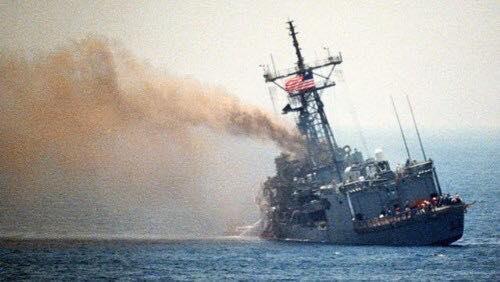
For some reason, the sea-skimming missiles were not detected by the Stark’s sophisticated monitoring equipment. A lookout spotted the first Exocet just seconds before the missile struck, tearing a ten-by-fifteen-foot hole in the warship’s steel hull on the port side before ripping through the crew’s quarters. The resulting fire rushed upward into the vessel’s combat information center, disabling the electrical systems. The second missile plowed into the frigate’s superstructure.

A crewman sent a distress signal with a handheld radio that was picked up by the USS Waddell, a destroyer on patrol nearby. Meanwhile, the AWACS crew requested that two airborne Saudi F-15s pursue the Iraqi Mirage. But ground controllers at Dhahran airbase said they lacked the authority to embark on such a mission, and the Mirage was safely back in Iraqi airspace before approval could be obtained.

As fires raged aboard the Stark, Brindel ordered the starboard side Flooded to keep the gaping hole on the port side above the waterline. All through the night the fate of the stricken frigate was in doubt. Once the inferno was finally under control, the Stark limped back to port.

The Navy immediately launched an investigation into an incident that had cost 37 American seamen their lives. The Stark was endowed with an impressive array of defenses — an MK92 fire control system that could intercept incoming aircraft at a range of 90 miles; an OTO gun that could fire three-inch anti-aircraft shells at a rate of 90 per minute; electronic defenses that could produce bogus radar images to deceive attackers; and the Phalanx, a six-barreled gun that could fire 3,000 uranium rounds a minute at incoming missiles. Brindel insisted that his ship’s combat system was fully operational, but Navy technicians in Bahrain said the Stark’s Phalanx system had not been working properly when the frigate put out to sea. (Brindel was relieved of duty and later forced to retire.)
17992059_1832539540339496_8356336904851153974_n.jpg

A, C-141/B Starlifter carried 35 flag-draped caskets to the Stark’s home base at Mayport, Florida. (Two of the crewmen were lost at sea during the attack.)

President Reagan and the First Lady were on hand to extend condolences to grieving families.

Standard

USS Independence

USS Independence

By: Garland Davis

USS_Independence_(CV-62)_at_sea_during_the_later_1980s_or_early_1990s_(NH_97715).jpg

The fifth USS Independence (CV/CVA-62) was an aircraft carrier of the United States Navy. She was the fourth and final member of the Forrestal class of conventionally powered supercarriers. She entered service in 1959, with much of her early years spent in the Mediterranean Fleet.

Independence made a single tour off the coast of Vietnam in 1965 during the Vietnam War and also carried out airstrikes against Syrian forces during the Lebanese Civil War and operations over Iraq during Operation Southern Watch, the enforcement of the no-fly zone over southern Iraq.


download (82).jpg

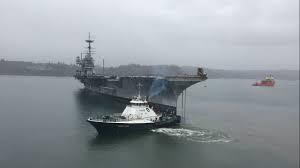
Independence was decommissioned in 1998 after 39 years of active service. Stored in recent years at Puget Sound Naval Shipyard, Bremerton, Washington, the ex-Independence is currently under tow to the shipbreakers at Brownsville, Texas for dismantling.


download (79).jpg

USS Independence (1814) was a wooden-hulled, three-masted ship, (originally a ship of the line) and the first to be commissioned by the United States Navy. In 1836 she was cut down by one deck and re-rated as a 54-gun frigate, (Originally 90). Launched on 22 June 1814 in the Boston Navy Yard, she immediately took on guns and was stationed with frigate USS Constitution to protect the approaches to Boston Harbor.

Independence_hulk_Mare_Island_1890s.jpg

Placed in ordinary at New York on 3 July 1852; retired to the Mare Island Navy Yard on 2 October 1857, served as receiving ship there until decommissioned on 3 November 1912.

Plans to renovate and use her as a restaurant for the Panama–Pacific International Exposition in 1915 never came to fruition. On the night of 20 September 1915, Independence was burned on the Hunter’s Point mudflats to recover metal fittings.

Standard

A Freshly Minted Snipe

A Freshly Minted Snipe

By: Jon Petersen mm-rate.gif download (78).jpg

A freshly minted Snipe, I am, my first ship I am on.

Everything’s so new to me, my comfortable life now gone.

The ‘CHENG’ he’s called, hardened, cold and stiff as a board,

without remorse, he barks “To the hole you go, and oh yeah, welcome aboard”.

I look down through the hatch, down that endless ladder,

seeing nothing but pipes and cables, and the noise disturbs my bladder!

Apprehensively descending into a world most would call unfit,

I now find myself in the place all call Hell, known as the pit.

It’s strange, this place, the smells, the heat , the hellish turbine scream,

pumps, engines and evaps, all run by deadly steam.

I learn on the spot that sleep will come in short and restless hours,

One needs to eat, and maybe have time to pray and hit the showers.

“You’ll trace all lines, fuel, oil and water, reaching from stem to stern,

and don’t forget the steam and firemain, these all you will learn”.

“You’ll wipe the oil, pump the bilges, This hole is no place for complainers,

and now is the time, young Snipe, to shift and clean the Lube Oil strainers”.

And thus I learn, on a continual basis,

All the pipes, valves and gauges of this hellish oasis.

You have fun with me, the one called ‘Boot’,

sudden errands for strange things all find to be a hoot.

A squeegie sharpner, a BT punch. A bucket of live steam.

A bottle of A.I.R. What the hell does all this mean?

“You’re a Snipe, you live in the hole, your rack is just a reprieve.

You breath oily air, sweat out 2190, ’tis a life those above can’t conceive.

6 on and 6 off, for months at a time, ensuring that shaft turns and turns,

for if it stops the ships does as well, and the wrath from above simply burns”.

This young Snipe learned very fast that my job is more than just being there;

For if I fail in my duties to keep the engines running,

this ship and all onboard are no more than enemy fare.

I’ll continue to sweat, endure the sleepless night,

for my job as a Snipe no matter what it takes enables my ship to fight!

MM1 J Petersen

Standard

China Hand: A book review

China Hand: A book review

By: Garland Davis

photo_preview_3095_58f15e6819ff2.jpg

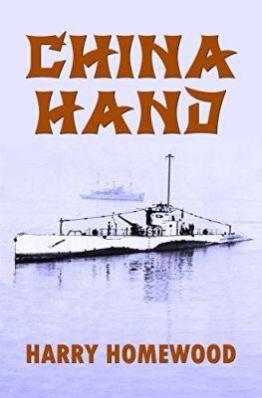
I just finished reading China Hand. An enjoyable story. I don’t doubt that it correctly described life and operations aboard submarines homeported in Asia during the depression years of the thirties. The boats and their tender, USS Canopus AS-34, spent their winters in Cavite and Olongapo and their summers in Tsingtao, China (I was serving in USS Reeves CG-24 in 1986 when we visited that port). Much of the book deals with the politics of China and the Japanese threat and the machinations of a wealthy Chinese merchant to profit by gaining intelligence information from two sailors to sell to the Japanese.

No Sand Pebbles, but a pleasant few hours. I would recommend it.

Standard

A Sailor’s Language

A Sailor’s Language

download (77).jpg

by: Garland Davis

I have been told that sailors use injudicious and inappropriate language. Inappropriate to what? Sure as hell wasn’t inappropriate to the Far East Fleet.

I recently read in a blog about life in Appalachia about by-words. By-words are words or phrases used in the place of profanity or cuss words. The most common by-word used by my shipmates and I was “Fuck.” Injudicious? Perhaps… Inappropriate? Doubtful… Make that, HELL NO! No, make that FUCK NO!

The language most sailors speak was never used by Dr. Suess, Mr. Rodgers, or Captain Kangaroo. I never rode a ship with either of them or the Muppets. If they were ever haze gray and underway, I can assure you they spoke as sailors, injudiciously and inappropriately.

Some sociologists have conceptualized a theory of social acceptability that states sailors’ communication ability and gentlemanly behavior deteriorates in direct proportion to the distance separating them from their mamas and other female relatives. The women in a sailor’s life, other than honey-kos and bar hogs, are the civilizing influences that keep him from running around naked, living in trees, and resorting to cannibalism.

There has never been a Chief Petty Officer who talked like Bill Buckley. They may exist somewhere, but if they do they are Pentagon Yeomen or light in the loafers Chaplain’s Assistants, who have never ridden old worn out haze gray steel on the Asia Station. Nobody’s Mom or Aunties were there either. If any of them had been there, many sailors would have been gargling soapy water.

Living beyond the influence of females leads to a diminution of vocabulary to a level where words like ‘fuckin’ thing’ and ‘that goddamn son-of-a-bitch’ is universally applied to practically every close by object. An amazing thing is the fact that all your shipmates understand exactly what you are talking about. For those of you who were never stretched out under a piece of machinery weighing more than a bank vault, with oil leaking all over you, it may be difficult to understand how pointing to something and saying, “Hey Hoss, hand me that Mother Fucker”, saves you the mental exercise of remembering it’s correct name.

“Kick that Piece of Shit over here” and “Hey, you up there, bear a hand and drop that big bastard down to me” are coherent requests to any idiot who ever shit between a pair of regulation shower shoes.

Pacific Fleet sailors who rode Fletcher and Forrest Sherman Class Destroyers and WWII Cruisers understand the universally applied vernacular of the Naval Service.

I wonder what influence the introduction of females into the seagoing Navy, a place that was once a man’s world, is having on the American Blue Jackets ability to converse in a language that is effective, colorful, and easily understood. I suspect that many of the girls recognize the effectiveness of a sailor’s language and readily adopt it.

For those of you trying to wade through this idiotic bullshit., let me explain. I know it’s somewhere in the New Testament, where God speaks to the first sailor… Well, maybe it wasn’t God… Maybe it was Noah’s Cheng. I don’t recall, but somebody said,

“Thou that ride Haze Gray Steel on the Far East Station shall be forgiven the use of injudicious language for ye art engaged in toil inside some of the damnedest contraptions ever created and ye shall receive blanket amnesty for verbal transgression in the performance of your assigned obligations.”

That was later extended to cover all the bars on Honcho, Magsaysay, and Wanchai. It also covers the ports of Taiwan for those of you fortunate enough to have pulled liberty in that paradise. It also includes sea stories told on liberty anywhere other than within a hundred miles of where your mother and any other female relative are currently geographically located.

I hope this Biblical reference will clear up and eliminate, for those of you seeking to save my soul for the use of naughty words, the need to communicate your concern.

Many of our shipmates have already reported to the fleet of the Supreme Commander. I am sure the folks who run the squadron up there are perceptive. By now, some damn Machinist Mate has to have dropped a harp on his toe or misplaced his wings, so the language cannot come as a startling revelation

download (76).jpg

To follow Tales of an Asia Sailor and get e-mail notifications of new posts, click on the three white lines in the red rectangle above, then click on the follow button.

A native of North Carolina, Garland Davis has lived in Hawaii since 1987. He always had a penchant for writing but did not seriously pursue it until recently. He is a graduate of Hawaii Pacific University, where he majored in Business Management. Garland is a thirty-year Navy retiree and service-connected Disabled Veteran.

Standard

VIET NAM IMMIGRANT

VIET NAM IMMIGRANT

On Saturday, July 24th, 2010 the town of Prescott Valley, AZ, hosted a Freedom Rally. Quang Nguyen was asked to speak on his experience of coming to America and what it means. He spoke the following in dedication to all Viet Nam Veterans. Thought you might enjoy hearing what he had to say:

download (75).jpg

“35 years ago, if you were to tell me that I am going to stand up here speaking to a couple thousand patriots, in English, I’d laugh at you. Man, every morning I wake up thanking God for putting me and my family in the greatest country on earth.

“I just want you all to know that the American dream does exist and I am living the American dream. I was asked to speak to you about my experience as a first generation Vietnamese- American, but I’d rather speak to you as an American.

“If you hadn’t noticed, I am not white and I feel pretty comfortable with my people.

“I am a proud US citizen and here is my proof. It took me 8 years to get it, waiting in endless lines, but I got it, and I am very proud of it.

“I still remember the images of the Tet offensive in 1968, I was six years old. Now you might want to question how a 6-year-old boy could remember anything. Trust me, those images can never be erased. I can’t even imagine what it was like for young American soldiers, 10,000 miles away from home, fighting on my behalf.

“35 years ago, I left South Viet Nam for political asylum. The war had ended. At the age of 13, I left with the understanding that I may or may not ever get to see my siblings or parents again. I was one of the first lucky 100,000 Vietnamese allowed to come to the US . Somehow, my family and I were reunited 5 months later, amazingly, in California. It was a miracle from God.

“If you haven’t heard lately that this is the greatest country on earth, I am telling you that right now. It was the freedom and the opportunities presented to me that put me here with all of you tonight. I also remember the barriers that I had to overcome every step of the way. My high school counselor told me that I cannot make it to college due to my poor communication skills. I proved him wrong. I finished college. You see, all you have to do is to give this little boy an opportunity and encourage him to take and run with it. Well, I took the opportunity and here I am.

“This person standing tonight in front of you could not exist under a socialist/ communist environment. By the way, if you think socialism is the way to go, I am sure many people here will chip in to get you a one-way ticket out of here. And if you didn’t know, the only difference between socialism and communism is an AK-47 aimed at your head. That was my experience.

“In 1982, I stood with a thousand new immigrants, reciting the Pledge of Allegiance and listening to the National Anthem for the first time as an American. To this day, I can’t remember anything sweeter and more patriotic than that moment in my life.

“Fast forwarding, somehow I finished high school, finished college, and like any other goofball 21 year old kid, I was having a great time with my life. I had a nice job and a nice apartment in Southern California . In some way and somehow, I had forgotten how I got here and why I was here.

“One day I was at a gas station, I saw a veteran pumping gas on the other side of the island. I don’t know what made me do it, but I walked over and asked if he had served in Viet Nam . He smiled and said yes. I shook and held his hand. The grown man began to well up. I walked away as fast as I could and at that very moment, I was emotionally rocked. This was a profound moment in my life. I knew something had to change in my life. It was time for me to learn how to be a good citizen. It was time for me to give back.

“You see, America is not just a place on the map, it isn’t just a physical location. It is an ideal, a concept. And if you are an American, you must understand the concept, you must accept this concept, and most importantly, you have to fight and defend this concept. This is about Freedom and not free stuff. And that is why I am standing up here.

“Brothers and sisters, to be a real American, the very least you must do is to learn English and understand it well. In my humble opinion, you cannot be a faithful patriotic citizen if you can’t speak the language of the country you live in. Take this document of 46 pages – last I looked on the Internet, there wasn’t a Vietnamese translation of the US Constitution. It took me a long time to get to the point of being able to converse and until this day, I still struggle to come up with the right words. It’s not easy, but if it’s too easy, it’s not worth doing.

“Before I knew this 46-page document, I learned of the 500,000 Americans who fought for this little boy. I learned of the 58,000 names scribed on the black wall at the Viet Nam Memorial. You are my heroes. You are my founders.

“At this time, I would like to ask all the Viet Nam veterans to please stand. I thank you for my life. I thank you for your sacrifices, and I thank you for giving me the freedom and liberty I have today. I now ask all veterans, firefighters, and police officers, to please stand. On behalf of all first generation immigrants, I thank you for your services and may God bless you all.”

Quang Nguyen

Creative Director/Founder

Caddis Advertising, LLC

Notice that he referred to himself as an American, NOT Vietnamese – American.

How good it would be here in America if all of the immigrants—no, EVERYONE — felt like Quang Nguyen.

” God Bless America ”

“One Flag, One Language, One Nation Under God”

download (74).jpg

Standard

USS Thresher

USS Thresher

By: Garland Davis

Thresher1.jpg

I was stationed at NAS Lemoore out of Recruit Training. I was there for a one-year special tour of shore duty. Lemoore was a brand new station. They shipped a number of “boots’ there to do the mess cooking and coop cleaning duties. I spent nine of the twelve months in the galley as a mess cook and as a Commissaryman striker. During that time I was assigned to the same berthing cubicle (four bunks and locker per cubicle) with a CS3, later CS2 Ronald A. Muise.

“Moose” helped me learn the rudiments of the CS rate and his advice was very helpful in my battle to become a cook striker. We became good friends. He was attached to one of the training squadrons and was transferring the same month that I was. We both filled out our “dream sheets” on the same day. I requested ships homeported on the west coast and in Hawaii. Moose applied for Submarine School. We received our orders the same day. His to Groton Connecticut foeightr Sub School and mine to the USS Vesuvius, an ammunition ship homeported in Port Chicago, CA.

I checked out of the base the same day he checked out of his squadron. A friend of his gave us a ride to the bus station in Hanford. We shook hands and vowed to keep in touch. He was going on leave to his home in New York and I was going to San Francisco.

We traded a couple of letters over the next few months. I still have the last postcard he sent. It read: “Dave, I graduated Sub School. Getting a few days leave before I report to my first boat. I will be coming back here to report to the USS Thresher.” The postcard was dated March 27, 1963.

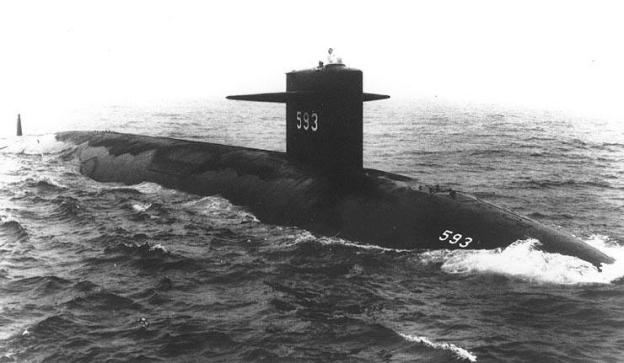
On 9 April 1963 Thresher, got underway from Portsmouth at 8 am and rendezvoused with the submarine rescue ship Skylark at 11 am to begin its initial post-overhaul dive trials. That afternoon Thresher conducted an initial trim dive test, surfaced and then performed a second dive to half test depth. It remained submerged overnight and re-established underwater communications with Skylark at 6:30 am on the 10th to commence deep-dive trials. Following standard practice, Thresher slowly dived deeper as it traveled in circles under Skylark – to remain within communications distance – pausing every additional 100 feet of depth to check the integrity of all systems. As Thresher neared her test depth, Skylark received garbled communications over underwater telephone indicating “… minor difficulties, have positive up-angle, attempting to blow”, and then a final even more garbled message that included the number “900”.[ When Skylark received no further communication, surface observers gradually realized Thresher had sunk. By mid-afternoon, a total of 15 Navy ships were en route to the search area. At 6:30 pm, the Commander Submarine Force Atlantic sent word to Portsmouth Naval Shipyard to begin notifying next-of-kin that Thresher was “missing.” By morning the next day all hope of finding Thresher was abandoned and at 10:30 am the Chief of Naval Operations went before the press corps at the Pentagon to announce that the submarine was lost with all hands.

Today marks the fifty-eighth anniversary of Thresher’s loss. Today my flag flies at half-staff in honor of the USS Thresher and my friend and shipmate Ronald A (Moose) Muise.

Standard

Asia Sailor’s Rules

Asia Sailor’s Rules

By: Garland Davis

dfc9b7ec63f4f9698eab1b040b63d72e.jpg

The following rules are promulgated to guide the societal actions of the Asia Sailor:

  1. Under no circumstances may an Asia Sailor share an umbrella with another man
  2. An Asia Sailor may cry ONLY under the following circumstances:
  3. When a heroic dog dies to save its master.
  4. The moment Salena Gomez starts unbuttoning her blouse.
  5. At the decommissioning of a proud old ship.
  6. At the final memorial for a shipmate.
  7. An Asia Sailor may legally kill anyone who brings a camera to a party in the Barrio.
  8. Unless he murdered someone in the Asia Sailor’s family. The Asia Sailor must bail a shipmate out of jail within twelve hours.
  9. An Asia Sailor’s shipmate’s daughter or sister is off limits unless he actually marries her.
  10. An Asia Sailor must never complain about the brand of free beer in a shipmate’s fridge. However, bitching is permissible if the temperature of said beer is unsuitable.
  11. No Asia Sailor shall ever be required to buy a birthday present for another man.
  12. On a road trip, the Asia Sailor with the strongest bladder determines pit stops, not the LantFlt Yeoman with the weakest bladder.
  13. An Asia Sailor stumbling upon a shipmate watching a sporting event, may ask the score of the game but never ask who is playing.
  14. There is never a valid reason for an Asia Sailor to watch men’s ice skating or men’s gymnastics. Ever! However, watching Michelle Wie play golf is permissible.
  15. It is permissible for an Asia Sailor to drink a fruity alcohol beverage only when it is MOJO and he is sunning on a tropical beach in Barrio Barretto, and the beverage is prepared and delivered by a topless LBFM and only if another Asia Sailor paid for it.
  16. An Asia Sailor always accepts free drinks.
  17. Only in situations of moral and or physical peril is an Asia sailor permitted to kick another man in the nuts.
  18. Asia Sailors never wear Speedos and never lets a shipmate do so. This issue is closed.
  19. If another sailor’s fly is unzipped, that’s his problem. An Asia Sailor doesn’t notice such things.
  20. Female sailors who claim to be Asia Sailors are to be treated as spies until they demonstrate the ability to pull a Seventy-Two in the Barrio and drink as much San Miguel as the Male Asia Sailor.
  21. When an Asia Sailor compliments a shipmate on his six-pack, of course, he is talking about the beer the shipmate is carrying.
  22. An Asia Sailor talking to a hot suggestively dressed LBFM in a club must always have enough Pesos for the Bar Pine.
  23. An Asia Sailor never hesitates to reach for the last San Miguel or the last stick of Monkey Meat, but not both, that is just greedy.
  24. An Asia Sailor never joins his wife or girlfriend in discussing a shipmate, unless she is withholding sex pending his response.
  25. An Asia Sailor never talks to another man in the head unless they are on equal footing (i.e., both urinating, both waiting in line, etc.). For all other situations, only an almost imperceptible nod is appropriate.
  26. An Asia Sailor never lets a telephone conversation with his wife or present shack up to go longer than he can have sex with her. Hang up when necessary.
  27. The morning after an Asia Sailor and a female who was formerly “just a friend” have carnal, drunken, monkey sex and the fact that they are feeling weird and guilty is no reason not to nail each other again before the discussion occurs about what a big mistake it was.
  28. It is acceptable for an Asia Sailor to drive a woman’s car. It is never acceptable for her to drive his.
  29. An Asia Sailor never buys a brown, pink, lime green, orange, or sky blue car. Never!
  30. A woman who replies to the question, “What do you want for Christmas?” with “If you love me, you will know what I want!” gets laid Christmas morning by her Asia Sailor. End of story.

We sincerely hope this clears up any confusion.

The Asia Sailor Westpac’rs Association, Ltd.

P.S. Add something about an Asia Sailor never rubbing sunblock on another dude!

side.jpg

To follow Tales of an Asia Sailor and get e-mail notifications of new posts, click on the three white lines in the red rectangle above, then click on the follow button.

A native of North Carolina, Garland Davis has lived in Hawaii since 1987. He always had a penchant for writing but did not seriously pursue it until recently. He is a graduate of Hawaii Pacific University, where he majored in Business Management. Garland is a thirty-year Navy retiree and service-connected Disabled Veteran.

Standard

Beer for Breakfast

Beer for Breakfast

17800064_1608538539218122_5680534141017671907_n.jpg

Beer for Breakfast

Garland Davis

Early one day when the sun wouldn’t shine

I walked into the Hole in the Wall not feeling too fine

I saw two sailors with two honey-ko’s an’ San Miguel before ’em

And this was the song that I heard them singing


Chief forgive us and protect us,

We’ve been drinking beer for breakfast


Well my LBFM and I stopped by the table where they was sitting

And I couldn’t believe how drunk they were getting

I said “shipmates, have you been drinking long?”

They said ‘Just long enough to be singing this song”


Chief forgive us and protect us,

We’ve been drinking beer for breakfast


Well they passed me a bottle and I took a little sip

And it felt so good I just couldn’t quit

I drank some more and next thing I knew

All of us were sitting there singing this tune


Chief forgive us and protect us,

We’ve been drinking beer for breakfast


One by one every shipmate who could hear the sound

Heard our ruckus and they came around

And pretty soon the Hole was ringing

With the sound of the every sailor laughing and singing


Chief forgive us and protect us,

We’ve been drinking beer for breakfast

Standard

Snipes

Snipes

By: Garland Davis

download (72).jpg

They were the engineers who made the steam, the electricity, the water, ran the auxiliary machinery and made the ships go. They were the MM’s, BT’s, EM’s, EN’s, HT’s, IC men, MR’s and some that I have probably forgotten. They took on the fuel that they turned into the steam that moved the ship and made the electricity. They inhabited the lower levels of engineering spaces, crawled through bilges and other tight places into which only an idiot would enter… Sweating, joking and cussing the whole time. They tore clothes, skinned their knuckles and burned themselves with steam and hot water. Through cold northern seas and the sweltering tropic oceans, they kept the ships moving and the machinery operating.

They were not all greasy apes with an oily rag in one hand and a stolen crescent wrench in the other. They were intelligent young men with pride in their spaces and the jobs they did. The brightest of them ended up as doctors, lawyers and college professors. I knew an ENFN that went on to earn a PHD and was involved with the Space and Shuttle programs at Jet Propulsion Laboratories.

They were usually referred to as Fuckin’ Snipes by their fellow crewmembers. They were Snipes because they wanted to be.

They happily tended the machinery of their hot, noisy world. They crawled through small nasty places. They were shocked, pinched and thrown about. They were wet and cold, wet and hot, wet and oily. The humidity of their spaces was always at one hundred percent.

download (73).jpg

They routinely worked around the clock to get a piece of machinery fixed that some officer had just told them would take yard birds and naval engineers to repair. However, they fixed it anyway and sent a “fuck you” off to the naval engineers. During these marathons, they lived on “black gang coffee” and baloney sandwiches eaten with greasy hands. They smoked cigarettes only half way down before forgetting or the smokes became too nasty to smoke from the oil on their fingers.

At times, they did their work with the delicate skill of a surgeon and at other times with the force of pry bars and large hammers. They often lifted extremely heavy weights in spaces too small for the number of men needed to do the job safely. They stuck their hands in places where wayward electrons might be waiting to kill. They were contortionists having to get in the most awkward positions to fix things placed in stupid places by those brilliant naval engineers and yard birds. “Fuck’em.”

They wore their badge of office with pride. The torn, greasy and acid-eaten dungarees… their hands always black with grease in the pores and cracks of their knuckles.

Shipmates in the “Basement.”

em-rate.gifen-rate.gifht-rate.gifmr-rate.gific-rate.gif

Standard