USS Liberty (AGTR-5)
USS Liberty was originally the 7,725 long tons (7,849 t) (light) civilian cargo vessel Simmons Victory, a mass-produced, standard-design Victory Ship, the follow-on series to the famous Liberty Ships that supplied the Allies with cargo during World War II. It was acquired by the United States Navy and converted to an auxiliary technical research ship (AGTR), a cover name for National Security Agency (NSA) “spy ships” carrying out signals intelligence missions. It began its first deployment in 1965, in waters off the west coast of Africa. It carried out several further operations during the next two years.
Attack on the Liberty
Events leading to the attack
During the Six-Day War between Israel and several Arab nations, the United States of America maintained a neutral country status. Several days before the war began, the USS Liberty was ordered to proceed to the eastern Mediterranean area to perform a signals intelligence collection mission in international waters near the north coast of Sinai, Egypt. After the war erupted, due to concerns about its safety as it approached its patrol area, several messages were sent to Liberty to increase its allowable closest point of approach (CPA) to Egypt’s and Israel’s coasts from 12.5 and 6.5 nautical miles (14.4 and 7.5 mi; 23.2 and 12.0 km), respectively, to 20 and 15 nautical miles (23 and 17 mi; 37 and 28 km), and then later to 100 nautical miles (120 mi; 190 km) for both countries. Unfortunately, due to ineffective message handling and routing, these messages were not received until after the attack.
According to Israeli sources, at the start of the war on 5 June, General Yitzhak Rabin, Israeli Air Force (IAF) chief of staff informed Commander Ernest Carl Castle, the American naval attaché in Tel Aviv, that Israel would defend its coast with every means at its disposal, including sinking unidentified ships. He asked the U.S. to keep its ships away from Israel’s shore or at least inform Israel of their exact positions.
American sources said that no inquiry about ships in the area was made until after the attack on Liberty. In a message sent from U.S. Secretary of State Dean Rusk to U.S. Ambassador Walworth Barbour in Tel Aviv, Israel, Rusk asked for “urgent confirmation” of Israel’s statement. Barbour responded: “No request for info on U.S. ships operating off Sinai was made until after Liberty incident.” Further, Barbour stated: “Had Israelis made such an inquiry it would have been forwarded immediately to the chief of naval operations and other high naval commands and repeated to Department of State. With the outbreak of war, Captain William L. McGonagle of Liberty immediately asked Vice Admiral William I. Martin at the United States Sixth Fleet headquarters to send a destroyer to accompany Liberty and serve as its armed escort and as an auxiliary communications center. The following day, Admiral Martin replied: “Liberty is a clearly marked United States ship in international waters, not a participant in the conflict and not a reasonable subject for attack by any nation. Request denied.] He promised, however, that in the unlikely event of an inadvertent attack, jet fighters from the Sixth Fleet would be overhead in ten minutes.
Meanwhile, on 6 June, at the United Nations, in response to United Arab Republic complaints that the United States was supporting Israel in the conflict, U.S. Ambassador Arthur Goldberg told the Security Council that vessels of the Sixth Fleet were several hundred miles from the conflict. When the statement was made this was the case, since Liberty, now assigned to the Sixth Fleet, was in the central Mediterranean Sea, passing between Libya and Crete. It would ultimately steam to about 13 nm (15 mi; 24 km) north of the Sinai Peninsula.
On the night of 7 June Washington time, early morning on 8 June, 01:10Z or 3:10 am local time, the Pentagon issued an order to Sixth Fleet headquarters to tell Liberty to come no closer than 100 nautical miles (120 mi; 190 km) to Israel, Syria, or the Sinai coast. According to the Naval Court of Inquiry and the National Security Agency official history, the order to withdraw was not sent on the radio frequency that Liberty monitored for her orders until 15:25 Zulu, several hours after the attack, due to a long series of administrative and message routing problems. The Navy said a large volume of unrelated high-precedence traffic, including intelligence intercepts related to the conflict, were being handled at the time; and that this combined with a shortage of qualified radiomen contributed to the delayed transmission of the withdrawal message.
Visual contact
Official testimony combined with Liberty ’s deck log establishes that throughout the morning of the attack, 8 June, the ship was overflown, at various times and locations, by IAF aircraft. The primary aircraft type was the Nord Noratlas; there were also two unidentified delta-wing jets at about 9:00 am Sinai time (GMT+2). Liberty crewmembers say that one of the Noratlas aircraft flew so close to Liberty that noise from its propellers rattled the ship’s deck plating, and that the pilots and crewmembers waved to each other. It was later reported, based on information from IDF sources, that the over-flights were coincidental, and that the aircraft was hunting for Egyptian submarines that had been spotted near the coast.
At about 5:45 am Sinai time, a ship-sighting report was received at Israeli Central Coastal Command (CCC) in respect of Liberty, identified by an aerial naval observer as “apparently a destroyer, sailing 70 miles [110 km] west of Gaza”.The vessel’s location was marked on a CCC control table, using a red marker, indicating an unidentified vessel. At about 6:00 am, the aerial naval observer, Major Uri Meretz, reported that the ship appeared to be a U.S. Navy supply ship; at about 9:00 am the red marker was replaced with a green marker to indicate a neutral vessel. About the same time, an Israeli jet fighter pilot reported that a ship 20 miles (32 km) north of Arish had fired at his aircraft after he tried to identify the vessel. Israeli naval command dispatched two destroyers to investigate, but they were returned to their previous positions at 9:40 am after doubts emerged during the pilot’s debriefing] After the naval observer’s Noratlas landed and he was debriefed, the ship he saw was further identified as the USS Liberty, based on its “GTR-5” hull markings.[25] USS Liberty’s marker was removed from CCC’s Control Table at 11:00 am, due to its positional information being considered out of date.
At 11:24 am, the Israeli chief of naval operations received a report that Arish was being shelled from the sea. An inquiry into the source of the report was ordered to determine its validity. The report came from an air support officer in Arish. Additionally, at 11:27 am the Israeli Supreme Command head of operations received a report stating that a ship had been shelling Arish, but the shells had fallen short. (The investigative journalist James Bamford points out that Liberty had only four .50 caliber machine guns mounted on her decks and, thus, could not have shelled the coast.) The Head of Operations ordered that the report be verified and that it be determined whether or not Israeli Navy vessels were off the coast of Arish. At 11:45 am, another report arrived at Supreme Command saying two ships were approaching the Arish coast.
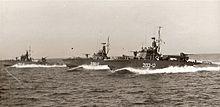
Israeli Motor Torpedo Boats (MTBs) in formation, c. 1967. These were the MTBs that attacked USS Liberty.
The shelling and ship reports were passed from Supreme Command to Fleet Operations control center.[27] The Chief of Naval Operations took them seriously, and at 12:05 pm torpedo boat Division 914 was ordered to patrol in the direction of Arish. Division 914, codenamed “Pagoda”, was under the command of Commander Moshe Oren. It consisted of three torpedo boats numbered: T-203, T-204, and T-206. At 12:15 pm, Division 914 received orders to patrol a position 20 miles (32 km) north of Arish.[27] As Commander Oren headed toward Arish, he was informed by Naval Operations of the reported shelling of Arish and told that IAF aircraft would be dispatched to the area after the target had been detected. Chief of Staff Yitzhak Rabin was concerned that the supposed Egyptian shelling was the prelude to an amphibious landing that could outflank Israeli forces. Rabin reiterated the standing order to sink any unidentified ships in the area, but advised caution, as Soviet vessels were reportedly operating nearby.
At 1:41 pm, the torpedo boats detected an unknown vessel 20 miles northwest of Arish and 14 miles (23 km) off the coast of Bardawil. The ship’s speed was estimated on their radars. The combat information center officer on T-204, Ensign Aharon Yifrah, reported to the boat’s captain, Commander Moshe Oren, that the target had been detected at a range of 22 miles (35 km), that her speed had been tracked for a few minutes, after which he had determined that the target was moving westward at a speed of 30 knots (56 km/h; 35 mph). These data were forwarded to the Fleet Operations control center.
The speed of the target was significant because it indicated that the target was a combat vessel. Moreover, Israeli forces had standing orders to fire on any unknown vessels sailing in the area at over 20 knots (37 km/h; 23 mph), a speed which, at the time, could only be attained by warships. The Chief of Naval Operations asked the torpedo boats to double-check their calculations. Yifrah twice recalculated and confirmed his assessment.A few minutes later, Commander Oren reported that the target, now 17 miles (27 km) from his position, was moving at a speed of 28 knots (52 km/h; 32 mph) on a different heading Bamford, however, points out that Liberty‘s top speed was far below 28 knots. His sources say that at the time of the attack Liberty was following her signal-intercept mission course along the northern Sinai coast, at about 5 knots (9.3 km/h; 5.8 mph) speed.
The data on the ship’s speed, together with its direction, gave the impression that it was an Egyptian destroyer fleeing toward port after shelling Arish. The torpedo boats gave chase but did not expect to overtake their target before it reached Egypt. Commander Oren requested that the Israeli Air Force dispatch aircraft to intercept. At 1:48 pm, the Chief of Naval Operations requested dispatch of fighter aircraft to the ship’s location.
The IAF dispatched two Mirage III fighter jets that arrived at Liberty at about 2:00 pm. The formation leader, Captain Iftach Spector, attempted to identify the ship. He radioed to one of the torpedo boats his observation that the ship looked like a military ship with one smokestack and one mast. He also communicated, in effect, that the ship appeared to him like a destroyer or another type of small ship. In a post-attack statement, the pilots said they saw no distinguishable markings or flag on the ship.
At this point, a recorded exchange took place between a command headquarters weapons systems officer, one of the air controllers, and the chief air controller questioning a possible American presence. Immediately after the exchange, at 1:57 pm, the chief air controller, Lieutenant-Colonel Shmuel Kislev, cleared the Mirages to attack.
Air and sea attacks
After being cleared to attack, the Mirages dove on the ship and attacked with 30-mm cannons and rockets. The attack came a few minutes after the crew completed a chemical attack drill, with Captain McGonagle on the command bridge. The crew was in “stand-down mode”, with their helmets and life jackets removed. Battle readiness “modified condition three” was set, which meant that the ship’s four .50 caliber machine guns were manned and ammunition was ready for loading and firing. Eight crewmen were either killed immediately or received fatal injuries and died later, and 75 were wounded. Among the wounded was McGonagle, who was hit in the right thigh and arm. During the attack, antennas were severed, gas drums caught fire, and the ship’s flag was knocked down. McGonagle sent an urgent request for help to the Sixth Fleet, “Under attack by unidentified jet aircraft, require immediate assistance”.
The Mirages left after expending their ammunition and were replaced by two Dassault Mysteres armed with napalm bombs, flown by Captain Yossi Zuk and his wingman, Yaakov Hamermesh. The Mysteres released their payloads over the ship and strafed it with their cannons. Much of the ship’s superstructure caught fire.] The Mysteres were readying to attack again when the Israeli Navy, alerted by the absence of return fire, warned Kislev that the target could be Israeli. Kislev told the pilots not to attack if there was any doubt about identification, and the Israeli Navy quickly contacted all of its vessels in the area. The Israeli Navy found that none of its vessels were under fire, and the aircraft were cleared to attack. However, Kislev was still disturbed by a lack of return fire and requested one last attempt to identify the ship. Captain Zuk made an attempt at identification while strafing the ship. He reported seeing no flag but saw the ship’s GTR-5 marking. Kislev immediately ordered the attack stopped. Kislev guessed that the ship was American.
The fact that the ship had Latin alphabet markings led Chief of Staff Rabin to fear that the ship was Soviet. Though Egyptian warships were known to disguise their identities with Western markings, they usually displayed Arabic letters and numbers only. Rabin ordered the torpedo boats to remain at a safe distance from the ship and sent in two Hornet (Aérospatiale Super Frelon) helicopters to search for survivors. These radio communications were recorded by Israel. The order was also recorded in the torpedo boat’s log, although Commander Oren claimed not to have received it. The order to cease fire was given at 2:20 pm, twenty-four minutes before the torpedo boats arrived at the Liberty‘s position.
During the interval, crewmen aboard Liberty hoisted a large American flag. During the early part of the air attack and before the torpedo boats were sighted, Liberty sent a distress message that was received by Sixth Fleet aircraft carrier USS Saratoga. Aircraft carrier USS America dispatched eight aircraft. The carrier had been in the middle of strategic exercises. Vice-Admiral William I. Martin recalled the aircraft minutes later.
McGonagle testified at the naval court of inquiry that during
the latter moments of the air attack, it was noted that three high-speed boats were approaching the ship from the northeast on a relative bearing of approximately 135 [degrees] at a distance of about 15 [nautical] miles. The ship at the time was still on [westward] course 283 [degrees] true, speed unknown, but believed to be in excess of five knots.[19]:38
McGonagle testified that he “believed that the time of the initial sighting of the torpedo boats … was about 14:20”, and that the “boats appeared to be in a wedge type formation with the center boat the lead point of the wedge. Estimated speed of the boats was about 27 to 30 knots [50 to 56 km/h]”, and that it “appeared that they were approaching the ship in a torpedo launch attitude”.
When the torpedo boats arrived, Commander Oren could see that the ship could not be the destroyer that had supposedly shelled Arish or any ship capable of 30 knots (56 km/h) speed. According to Michael Limor, an Israeli naval reservist serving on one of the torpedo boats, they attempted to contact the ship by heliograph and radio but received no response. At 6,000 meters (20,000 ft), T-204 paused and signalled “AA”, which means “identify yourself”. Due to damaged equipment, McGonagle could only reply using a handheld Aldis lamp. Oren recalled receiving a similar response from the Ibrahim el Awal, an Egyptian destroyer captured by Israel during the Suez Crisis, and was convinced that he was facing an enemy ship. He consulted an Israeli identification guide to Arab fleets and concluded the ship was the Egyptian supply ship El Quseir, based on observing its deck line, midship bridge and smokestack. The captain of boat T-203 reached the same conclusion independently. The boats moved into battle formation but did not attack.
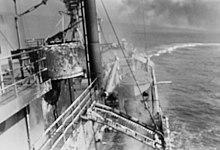
Liberty turns to evade Israeli torpedo boats
As the torpedo boats rapidly approached, Captain McGonagle ordered a sailor to proceed to machine gun Mount 51 and open fire.[19]:38 However, he then noticed that the boats appeared to be flying an Israeli flag, and “realized that there was a possibility of the aircraft having been Israeli and the attack had been conducted in error”.[19]:39 Captain McGonagle ordered the man at gun mount 51 to hold fire, but a short burst was fired at the torpedo boats before the man understood the order.[19]:39
McGonagle observed that machine gun Mount 53 began firing at the center torpedo boat at about the same time gun mount 51 fired and that its fire was “extremely effective and blanketed the area and the center torpedo boat”. Machine gun mount 53 was located on the starboard amidships side, behind the pilot house. McGonagle could not see or “get to mount 53 from the starboard wing of the bridge”. So, he “sent Mr. Lucas around the port side of the bridge, around to the skylights, to see if he could tell [Seaman] Quintero, whom [he] believed to be the gunner on Machine gun 53, to hold fire”. Ensign Lucas “reported back in a few minutes in effect that he saw no one at mount 53.” Lucas, who had left the command bridge during the air attack and returned to assist Captain McGonagle, believed that the sound of gunfire was likely from ammunition cooking off, due to a nearby fire. Previously, Lucas had granted a request from Quintero to fire at the torpedo boats, before heat from a nearby fire chased him from gun mount 53. McGonagle later testified, at the Court of Inquiry, that this was likely the “extremely effective” firing event he had observed.
After coming under fire, the torpedo boats returned fire with their cannons, killing Liberty’s helmsman. The torpedo boats then launched five torpedoes at the Liberty. At 1235Z (2:35 local time) a torpedo hit Liberty on the starboard side forward of the superstructure, creating a 40 ft (12 m) wide hole in what had been a cargo hold converted to the ship’s research spaces and killing 25 servicemen, almost all of them from the intelligence section, and wounding dozens. It has been said the torpedo hit a major hull frame that absorbed much of the energy; crew members reported that if the torpedo had missed the frame the Liberty would have split in two. The other four torpedoes missed the ship.
The torpedo boats then closed in and strafed the ship’s hull with their cannons and machine guns. According to some crewmen, the torpedo boats fired at damage control parties and sailors preparing life rafts for launch. (See disputed details below.) A life raft which floated from the ship was picked up by T-203 and found to bear US Navy markings. T-204 then circled Liberty, and Oren spotted the designation GTR-5 but saw no flag. It took until 3:30 pm to establish the ship’s identity. Shortly before the Liberty‘s identity was confirmed, the Saratoga launched eight aircraft armed with conventional weapons towards Liberty. After the ship’s identity was confirmed, the General Staff was notified and an apology was sent to naval attaché Castle. The aircraft approaching Liberty were recalled to the Saratoga.







 Tales of an Asia Sailor