U. S. Navy

Thursday, October 13, 2016, marks the Two Hundred Forty-First birthday of the United States Navy.  I have compiled a history of the Navy from its inception through the present.  The entire document comprises over eleven thousand words and twenty pages.  I will post it here in four installments culminating in the final posting on October 13.


U. S. Navy

The Beginning Through 1812

Compiled and Authored by:  Garland Davis

The Navy claims 13 October 1775 as the date of its official establishment, when the Second Continental Congress passed a resolution creating the Continental Navy. With the end of the American Revolutionary War, the Continental Navy was disbanded. Under President George Washington threats to American merchant shipping by Barbary pirates from four North African Muslim States, in the Mediterranean, led to the Naval Act of 1794, which created a permanent standing U.S. Navy. The original six frigates were authorized as part of the Act. Over the next 20 years, the Navy fought the French Navy in the Quasi-War (1798–99), Barbary states in the First and Second Barbary Wars, and the British in the War of 1812. After the War of 1812, the U.S. Navy was at peace until the Mexican War in 1846, and served to combat piracy in the Mediterranean and Caribbean seas, as well fighting the slave trade. In 1845, the Naval Academy was founded. In 1861, the American Civil War began, and the U.S. Navy fought the small Confederate Navy with both sailing ships and ironclad ships while forming a blockade that shut down the Confederacy’s civilian shipping. After the Civil War, most of its ships were laid up in reserve, and by 1878, the Navy was just 6,000 men.

In 1882, the U.S. Navy consisted of many outdated ship designs. Over the next decade, Congress approved building multiple modern armored cruisers and battleships, and by around the start of the 20th century had moved from twelfth place in 1870 to fifth place regarding numbers of ships. After winning two major battles during the 1898 Spanish-American War, the Navy continued to build more ships, and by the end of World War I had more men and women in uniform than the Royal Navy. The Washington Naval Conference recognized the Navy as equal in capital ship size to the Royal Navy, and during the 1920s and 1930s, the Navy built several aircraft carriers and battleships. The Navy was drawn into World War II after the Japanese Attack on Pearl harbor on 7 December 1941, and over the next four years fought many historic battles including the Battle of the Coral sea, the Battle of Midway, multiple naval battles during the Guadalcanal Campaign, and the largest naval battle in history, the Battle of Leyte Gulf. Much of the Navy’s activity concerned the support of landings, not only with the “island hopping” campaign in the Pacific but also with the European landings. When the Japanese surrendered, a large flotilla entered Tokyo Bay to witness the formal ceremony conducted on the battleship Missouri, on which officials from the Japanese government signed the Japanese Instrument of Surrender. By the end of the war, the Navy had over 1,600 warships.

After World War II had ended, the U.S. Navy entered the Cold War and participated in the Korean War, the Vietnam War, the Persian Gulf War, and the Iraq War. Following the collapse of the Soviet Union, the Soviet Navy fell apart, which made the United States the world’s undisputed naval superpower. Nuclear power and ballistic missile technology led to new ship propulsion and weapon systems, which were used in the Nimitz-class aircraft carriers and Ohio-class submarines. By 1978, the number of ships had dwindled to less than 400, many of which were from World War II, which prompted Ronald Reagan to institute a program for a modern, 600 ship Navy. Today, the United States is the world’s undisputed naval superpower, with the ability to engage and .project power in two simultaneous limited wars along separate fronts. In March 2007, the U.S. Navy reached its smallest fleet size, with 274 ships, since World War I. Former U.S. Navy admirals who head the U.S. Naval Institute have raised concerns about what they see as the ability to respond to ‘aggressive moves by Iran and China.


 Continental Navy (1775–1785)

The Navy was rooted in the American seafaring tradition, which produced a large community of sailors, captains, and shipbuilders in the colonial era. During the Revolution, several states operated their own navies. On 12 June 1775, the Rhode Island General Assembly passed a resolution creating a navy for the colony of Rhode Island. The same day, Governor Nicholas Cooke signed orders addressed to Captain Abraham Whipple, commander of the sloop Katy, and Commodore of the armed vessels employed by the government.

The first formal movement for the creation of a Continental Navy came from Rhode Island because the states merchants’ widespread smuggling activities had been severely harassed by British frigates. On 26 August 1775, Rhode Island passed a resolution that there be a single Continental fleet funded by the Continental  Congress The resolution was introduced in the Continental Congress on 3 October 1775 but was tabled. In the meantime, George Washington had begun to acquire ships, starting with the schooner USS Hannah that was paid for out of Washington’s pocket. Hannah was commissioned and launched on 5 September 1775, from the port of Marblehead, Massachusetts.

Resolved, That a swift sailing vessel, to carry ten carriage guns, and a proportional number of swivels, with eighty men, be fitted, with all possible dispatch, for a cruise of three months, and that the commander be instructed to cruise eastward, for intercepting such transports as may be laden with warlike stores and other supplies for our enemies, and for such other purposes as the Congress shall direct.
That a Committee of three be appointed to prepare an estimate of the expense, and lay the same before the Congress, and to contract with proper persons to fit out the vessel.
Resolved, that another vessel be fitted out for the same purposes, and that the said committee report their opinion of a proper vessel, and also an estimate of the expense.

Resolution of the Continental Congress that marked the establishment of what is now the United States Navy.

The US Navy recognizes 13 October 1775 as the date of its official establishment — the date of the passage of the resolution of the Continental Congress at Philadelphia, Pennsylvania that created the Continental Navy. On this day, Congress authorized the purchase of two vessels to be armed for a cruise against British merchant ships.  Congress on 13 December 1775, authorized the building of thirteen frigates within the next three months, five ships of 32 guns, five with 28 guns and three with 24 guns.

On Lake Champlain, Benedict Arnold ordered the construction of 12 Navy vessels to slow down the British fleet that was invading New York from Canada. The British fleet did destroy Arnold’s fleet, but the U.S. fleet managed to slow down the British after a two-day battle, known as the Battle of Valcour Island, and managed to slow the progression of the British Army. By mid-1776, a number of ships, ranging up to and including the thirteen frigates approved by Congress, were under construction, but their effectiveness was limited; they were completely outmatched by the mighty Royal Navy, and nearly all were captured or sunk by 1781.

Privateers had some success, with 1,697 letters of marque being issued by Congress. Individual states, American agents in Europe and the Caribbean also issued commissions; taking duplications into account more than 2,000 commissions were issued by the various authorities. Over 2,200 British ships were taken by Yankee privateers, amounting to almost $66 million, a significant sum at the time.

One particularly notable American naval hero of the Revolution was John Paul Jones, who in his famous voyage around the British Isles defeated the British ship Serapis (1779) in the Battle of Flamborough Head. Partway through the battle, with the rigging of the two ships entangled, and several guns of Jones’ ship Bonhomme Richard out of action, the captain of Serapis asked Jones if he had struck his colors, to which Jones has been quoted as replying, “I have not yet begun to fight!”

France officially entered the war on 17 June 1778, and the ships of the French Navy sent to the Western Hemisphere spent most of the year in the West Indies, and only sailed near the Thirteen Colonies during the Caribbean hurricane season from July until November. The first French fleet attempted landings in New York and Rhode Island but ultimately failed to engage British forces during 1778. In 1779, a fleet commanded by Vice Admiral Charles Henri, Comte d’Estaing assisted American forces attempting to recapture Savannah, Georgia.

In 1780, a fleet with 6,000 troops commanded by Lieutenant General Jean-Baptists, Comte de Rochambeau landed at Newport, Rhode Island, and shortly afterward the fleet was blockaded by the British. In early 1781, Washington and de Rochambeau planned an attack against the British in the Chesapeake Bay area to coordinate with the arrival of a large fleet commanded by Vice-Admiral Francois, Comte de Grasse. Successfully deceiving the British that an attack was planned in New York, Washington, and de Rochambeau marched to Virginia, and de Grasse began landing forces near Yorktown, Virginia. On 5 September 1781, a major naval action was fought by de Grasse and the British at the Battle of the Virginia Capes ending with the French fleet in control of the Chesapeake Bay. The U.S. Navy continued to interdict British supply ships until peace was finally declared in late 1783.


Disarmament (1785–1794)

The Barbary War was ended by the Treaty of Paris in 1783, and by 1785 the Continental Navy was disbanded, and the remaining ships were sold. The frigate Alliance, which had fired the last shots of the American Revolutionary War, was also the last ship in the Navy. A faction within Congress wanted to keep the ship, but the new nation did not have the funds to keep her in service. Other than a general lack of money, other factors for the disarmament of the Navy were the loose confederation of the states, a change of goals from war to peace, and more domestic and fewer foreign interests.

After the American Revolutionary War, the brand-new United States struggled to stay financially afloat. National income was desperately needed, and most came from tariffs on imported goods. Because of rampant smuggling, the need was immediate for strong enforcement of tariff laws. On 4 August 1790, the United States Congress urged on by Secretary of the Treasury Alexander Hamilton, created the Revenue-Marine, the forerunner for the United States Coast Guard, to enforce the tariff and all other maritime laws. Ten cutters were initially ordered. Between 1790 and 1797 when the Navy Department was created, the Revenue Marine was the only armed maritime service for the United States. American merchant shipping had been protected by the British Navy, and as a consequence of the Treaty of Paris and the disarmament of the Continental Navy, the United States no longer had any protection for its ships from pirates. The fledgling nation did not have the funds to pay annual tribute to the Barbary States, so their ships were vulnerable to capture after 1785. By 1789, the new Constitution of the United States authorized Congress to create a navy, but during George Washington’s first term (1787–1793) little was done to rearm the navy. In 1793, the French Revolutionary Wars between Great Britain and France began, and a truce negotiated between Portugal and Algiers ended Portugal’s blockade of the Strait of Gibralter which had kept the Barbary pirates in the Mediterranean. Soon after, the pirates sailed into the Atlantic and captured 11 American merchant ships and more than a hundred seamen.

In reaction to the seizure of the American vessels, Congress debated and approved the Naval Act of 1794, which authorized the building of six frigates, four of 44 guns and two of 36 guns. Supporters were mostly from the northern states and the coastal regions, who argued the Navy would result in savings in insurance and ransom payments, while opponents from southern states and inland regions thought a navy was not worth the expense and would drive the United States into more costly wars.


Establishment (1794–1812)

After the passage of the Naval Act of 1794, work began on the construction of the six frigates: USS United States, President,Constellation, Chesapeake, Congress, and Constitution. Constitution launched in 1797 and the most famous of the six, was nicknamed “Old Ironsides” and, thanks to the efforts of Oliver Wendell Holmes, Sr., is still in existence today, anchored in Boston harbor. Soon after the bill was passed, Congress authorized $800,000 to obtain a treaty with the Algerians and ransom the captives, triggering an amendment of the Act which would halt the construction of ships if peace was declared. After considerable debate, three of the six frigates were authorized to be completed: United States, Constitution, and Constellation. However, the first naval vessel to sail was USS Ganges, on 24 May 1798.

At the same time, tensions between the U.S. and France developed into the Quasi-War, which originated from the Treaty of Alliance (1778) that had brought the French into the Revolutionary War. The United States preferred to take a position of neutrality in the conflicts between France and Britain, but this put the nation at odds with both Britain and France. After the Jay treaty was authorized with Britain in 1794, France began to side against the United States and by 1797 they had seized over 300 American vessels. The newly inaugurated President John Adams took steps to deal with the crisis, working with Congress to finish the three almost-completed frigates, approving funds to build the other three, and attempting to negotiate an agreement similar to the Jay Treaty with France. The XYZ Affair originated with a report distributed by Adams where alleged French agents were identified by the letters X, Y, and Z who informed the delegation a bribe must be paid before the diplomats could meet with the foreign minister, and the resulting scandal increased popular support in the country for a war with France. Concerns about the War Department’s ability to manage a navy led to the creation of the Department of the Navy, which was established on 30 April 1798.

The war with France was fought almost entirely at sea, mostly between privateers and merchant ships. The first victory for the United States Navy was on 7 July 1798 when USS Delaware captured the French privateer Le Croyable, and the first victory over an enemy warship was on 9 February 1799 when the frigate Constellation captured the French frigate L’Insurgente. By the end of 1800, peace with France had been declared, and in 1801, to prevent a second disarmament of the Navy, the outgoing Federalist administration rushed through Congress an act authorizing a peacetime navy for the first time, which limited the Navy to six active frigates and seven in ordinary, as well as 45 officers and 150 midshipmen. The remainder of the ships in service were sold and the dismissed officers were given four months’ pay.

The problems with the Barbary States had never gone away, and on 10 May 1801, the Tripolitans declared war on the United States by chopping down the flag in front of the American Embassy, which began the First Barbary War. USS Philadelphia was captured by the Moors but then set on fire in an American raid led by Stephen Decatur. The Marines invaded the “shores of Tripoli” in 1805, capturing the city of Derna, the first time the U.S. flag ever flew over a foreign conquest.This Act was enough to induce the Barbary rulers to sign peace treaties. Subsequently, the Navy was reduced for reasons of economy, and instead of regular ships, many gunboats were built, intended for coastal use only. This policy proved completely ineffective within a decade.

President Thomas Jefferson and his Republican party opposed a strong navy, arguing that small gunboats in the major harbors were all the nation needed to defend itself. They proved useless in wartime.

The Royal Navy continued to illegally press American sailors into the Royal Navy; an estimated 10,000 sailors between 1799 and 1812. In 1807, in the Chesapeake-Leopard affair, HMS Leopard demanded that USS Chesapeake submit to an inspection, ostensibly looking for British citizens but in reality looking for any suitable sailors to press into the Royal Navy. Leopard severely damaged Chesapeake when she refused. The most violent of many such encounters, the affair further fueled the tensions, and in June 1812 the U.S. declared war on Britain.



Standard

Snipe’s Lament

Snipe’s Lament

Author:  Unknown
Now each of us from time to time has gazed upon the sea.                                                          And watched the warships pulling out, to keep this country free.
And most of us have read a book or heard a lusty tale.
About the men who sail these ships, through lightning, wind, and hail.
But there’s a place within each ship that legend fails to reach.
It’s down below the waterline and takes a living toil-
A hot metal, living hell, which sailors call the “HOLE.”
It houses engines run by steam, that make the shafts go ’round.
A place of fire and noise and heat that beats your spirits down.
Where boilers like a hellish heart, with blood of angry steam
Are of molded gods without remorse are nightmares in a dream.
Whose threat that from the first roar, is life living doubt,
That any minute would with scorn, escape and crush you out.
Where turbines scream like tortured souls, alone and lost in hell,
As ordered from above somewhere, they answer every bell.
The men who keep the fires lit, and make the engine run.
Are strangers to the world of night and rarely see the sun.
They have no time for man or God, no tolerance for fear,
Their aspect pays no living thing, the tribute of a tear.
For there’s not much that men can do, that these men haven’t done.
Beneath the decks, deep in the holes, to make the engines run.
And every hour of every day, they keep their watch in hell,
For if the fires ever fail, their ship’s a useless shell.
When ships converge to have a war, upon an angry sea,
The men below just grimly smile, at what their fate might be.
They’re locked in below like men foredoomed, who hear no battle cry,
It’s well assumed that if they’re hit, the men below will die.
For every day’s a war down there when the gauges all read red,
Twelve hundred pounds of superheated steam can kill you mighty dead.
So if you ever write their sons, or try to tell their tale,
the very words would make you hear, a fired furnace’s wail.
These men of steel the Public never gets to know
So little’s heard about the Place, that sailors call the hole.
But I can sing about the place, and try to make you see
The hardened life of men down there, cause one of them is me.
I’ve seen these sweat-soaked heroes fight, in superheated air.
To keep their ship alive and right, though no one knows they’re there.
And thus they’ll fight for ages on, til steamships sail no more,
Amid the boiler’s mighty heat and turbines hellish roar.
So when you see a ship pull out to meet a warship foe.
Remember faintly, if you can, the men who sail below.
author unknown

Standard

Is Change Always Good?

Is Change Always Good?

By:  Garland Davis


Someday, probably sooner than later, some progressive son-of-a-bitch looking to change something for change sake will take a look at the impractical white hat and throw it in the lucky bag along with the flat hat, the blue working hat, and the knit watch cap, if that is still a thing.  Someone will probably call a maven of high fashion and Haute Couture who will inform them that the white hat is not in line with the fashionable naval forces of the world.

American sailors will probably end up with a European inspired piece of shit instead of the versatile white hat.  Progressives seem to like substituting overseas loser crap like berets and camo uniforms with bloused trousers over combat boots for sensible and comfortable dungaree uniforms with a white hat or a blue working cap.  I’ll bet there is an asshole somewhere in the Navy department who just loves those French pouf hats with the red pompoms.

Take a look at the legends of World War II, Nimitz, Halsey, Spruance, Cutter, Lockwood and others.  These giants wore over their left breast a handful of ribbons that meant something, accompanied by Gold Wings or Dolphins.  Now look at the, literally, hundreds of no combat Flag Officers of today.  They are wearing so many ribbons, qualification pins and other meaningless crap that they walk with a port list.

The practice of awarding everyone for everything has proliferated down to the lowest levels.  Seamen graduating from boot camp can receive a ribbon just for accomplishing something that millions before them have done and under more stringent conditions.  I was at a Denny’s for breakfast a few weeks ago.  A group of shore duty sailors came.  Yeah, the shore duty stations have a shoulder patch identifying the command these days.  A non-designated female Seaman was with the group.  She was wearing four ribbons, including the Navy Achievement Ribbon as well as the ESWS pin.  I had eight years in the Navy before I had any ribbon other than the Good Conduct and I only had one of those.  (How the fuck does an E-3 qualify for ESWS on shore duty?)

Our Navy held our own and contributed to winning the cold war at the same time fighting a hot war in Vietnam and responding to incidents such as the SS Mayaguez incident. Yeah, we not only won the cold war, but it also looks as if our leaders are hell bent on winning the World Wide Naval Silly Shit Awards Race.  Looking around, we must be ahead.

You can have a dumbshit commanding a pisser and shitter rehabilitation depot in East Bumfuck who looks like one of Bonaparte’s Field Marshalls.  I wonder if the bastards wearing all that hokey garbage fool themselves into thinking it makes them relevant in the competency game while deep down they know they are posers and losers.  Do the medals make the man?  Are subordinates impressed with all the colored ribbons and shiny doo-dads?

“Hey Chief, is Ensign Stumbles getting another medal at quarters today?  What did he do for this one?”

“Hell, I don’t know.  Got up at reveille or wiped his own ass.  Who cares, the damned things don’t mean shit.”

You know, it is a damned shame.  Medals and ribbons once meant a lot.  These awards were worn by men who earned them in Harm’s Way.  They were more than souvenirs that say, “I have been there and done that.”

We have diminished the standard for so much that was once so meaningful to Americans. The political and Naval leadership has become complacent and have stood by uncaringly while many of our important traditions are cheapened or discarded like so many leaves in the wind.

I guess if you accept shit, the world will hand you all you can handle.  One morning you wake to find a draft dodging, worthless, asshole in the White House getting hummers in the oval office and, overnight, it becomes “No Big Deal.”

Boy, talk about getting sidetracked, I started this about the white hat and ended up talking about “Blow Jobs.”

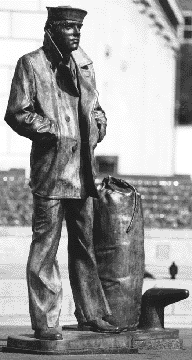
There is a memorial in Washington for the sailors of the United States Navy. There is a lone sailor, wearing a white hat, peacoat collar turned up and his hands in his pockets. A typical American Bluejacket, standing there with his seabag. I sometimes worry about him. He is so out of step with the newer, gentler, modern navy. Someone should go down some moonless night and award him eight rows of reflector tape ribbons, bolt on a G.E. refrigerator emblem and a Harley ornament to make him conform to the present day Navy.

The last time I saw him, he had three inches of snow on his white hat and shoulders.  If you are in DC and heading to San Diego, you might consider giving the poor bastard a ride to a warmer climate before he freezes to death.

Standard

The Gun Line and Subic Bay

The Gun Line and Subic Bay

By: Garland Davis


There came the point after the snipes had been on port and starboard six on six off watches for two or three weeks when they turned the lights on in hole snipes berthing to shovel the place out.  The place looked like the dump.  Magazines, overflowing butt kits, sour towels and a collection of dirty underwear that had started growing a new life form of green stuff.

It was at a point like this, where the ship had been on the gun line long enough to miss a couple of stores on loads, the evaporators were acting up, and the boilers were demanding an inordinate amount of feed water and of course water hours was mandated.  Water hours meant infrequent or no showers, no fresh laundry (as if anything other than the CO’s and XO’s clothes could ever come out of the laundry categorized as fresh).

It began with an itch in the crotch and a funky smell from the armpits.  Once you were down to your last clean shirt, you outright stunk.  Or most of those of us who worked up in the world did.  Miraculously those mangy, greasy hole snipes exited their little slice of hell each watch clean and smelling of Dial soap and Right Guard Defunk.  Their clothes were even reasonably clean.  Could it be that the very people responsible for making and storing water for the comfort of their betters, i.e. us, were hoarding said liquid for their own nefarious purposes?

I am in a position to answer that question.  Having been one of the few people with a commodity that hole snipes were willing to trade for, fresh bread and cinnamon rolls, I became privy to their clandestine shower and the steam hose used to clean their clothing.  Only their shirts and pants.  If there was a snipe who wore skivvies, I doubt if I ever met him.  Which raises the question, are the female snipes in our squeaky clean new Navy wearing skivvies?

After two months of this life of deprivation and hardship with daily rearming and refueling and the infrequent stores on loads, sometimes, you even got ice cream, you learn that the ship has been extended on the gun line for an additional month.  It is at this point that your best friend Thompkins’ face starts to look so stupid that you just want to knock it off his head.  And what’s with BM2 Patterson? All you said was, “Good morning, Pat.”  That didn’t rate his reply of, “Fuck you, Davis, just fuck you.”

So you gritted your teeth, took a deep breath and endured it for another month.  And finally, the day came when the ship was detached for transit to Subic Bay.  The short transit of the South China Sea took almost as long as the ninety-day gun line period.

The morning of entering port, miraculously the Sea Detail fell out in clean, neat dungaree uniforms that had been hoarded for the event.  The evening before, white uniforms and civilian clothing had been removed from the deepest reaches of lockers and inspected in preparation for liberty.  The previous morning the Disbursing Officer had held a special payday so crewmembers could draw off all the monies they had “left on the books” for this special port call.

As soon as the ship was tied up and word passed through the ship that fresh water was coming from the pier an orgy of ‘Hollywood and Hotel” showers began.

“Hurry up in that shower, you been in there half the morning. No jacking off, I’m next, and I don’t want to be slipping and sliding.  It’s hard enough walking without this mother fucker rocking and rolling.”

“Fuck You!”

“Hey does somebody have a razor blade that I can borrow?”

“Let me use your Rat Guard man; I don’t think this Lifebuoy can cut through the stink I built up after three months of water hours.”

“Jones D. L.?  Whose skivvy shirt is that man?”

“I don’t know, got it out of the Lucky Bag.  What, you writing a fucking book?”

“Maybe someday.  Who knows?”

Nah, who’d give a shit about reading a book about a bunch of idiots?  Besides, no one would believe it.  Once upon a time I lived among people who volunteered to live like enslaved primates in metal boxes, with lousy shared sleeping conditions, crappy food, oil flavored drinking water.  Then the whole thing rolled and pitched around like a warped agitator in a washing machine.  And they did all this for less money than it cost to buy a couple of Happy Meals.  Nobody would read crap like that.

When the Goddesses of Hygiene, Payday, and Liberty in Subic looked down and blessed the residents of an old Forrest Sherman tin can all was right with the world.

It was also good to live amongst men who were right where they wanted to be. No one kidnapped and drug them off to San Diego or Great Lakes.  They weren’t victims of the Selective Service Board.  They were volunteers.  Most of the world didn’t know they were there, out on the far rim of the Pacific, willing to do whatever necessary to keep nasty people with strange political ideas from your hometown.

They were my Shipmates, some of the finest Goddamned men who ever lived.  It is an honor and a privilege to have known and served with such men.

Standard

Thereby Grows a Sea Story

Thereby Grows a Sea Story

By:  Garland Davis

A popular country song begins with the following stanza.  It pretty much describes every liberty I pulled in Subic Bay.  You remember, back in the day


“I’ve woke up in places I couldn’t remember

Who’s lying next to me

Or how the hell I got there

It’s hard to believe that’s the way I used to roll”


It was Friday, your ship was tied up to Alava Pier at the Naval Station Subic Bay, Republic of the Philippines.  If you were lucky, the XO was happy, your Department Head and Division Officers had an early tee time, the Chief was thirsty, and the planets were in the right houses, they put down liberty at 1300.

For a non-rated North American Bluejacket, there was only one way to see the lovely ladies of Olongapo in the bright light of day.  That was through the contents of numerous brown bottles labeled San Miguel Pale Pilsner. It was never more true any other place in the world, the girls did get prettier as the day and night wore on.  By curfew, at midnight, they were downright beautiful.

There was a short walk to the gate and the bridge to a paradise that one finds only once in a lifetime.  But, lo and behold, there was a watering hole on the way known as the Sampaguita, where one could slake the thirst of the journey.  A stop to prime the pump with a few and then on to the gate.

One had to get past the hurdle of the Marine sentry.  Square your white hat, show that you weren’t going to corrupt the local economy with American cigarettes and you were past that hurdle.  Next came an assault on your olfactory organs, in other words, the delicate aroma of Shit River.

Somewhere between 1300 and sunset on Friday half the vessels of the Seventh Fleet dumped their liberty sections on the beach.  I would bet that an aerial view of Magsaysay Street and all the white hats moving up and down the street would resemble maggots crawling around a rotting carcass. As a matter of fact, the carcass would have smelled better than some areas of the town.

By the time you hit the first three shit kicking or rock bars, you had probably been in love at least twice and had already started negotiating short time fees.

By 2000 you were desperately searching for one of the guys from the ship who ran a slush fund.  You had enough money for two more beers and then you would have to go back to the ship.  All you needed to do was borrow enough for another short time and a few more beers.

Finally, about 2200 you drag your sorry ass back through the gate and stop by the Sampaguita in hopes of cadging a couple of beers from a shipmate.  A few beers there and you and your new friend stagger back to the ship.

The next morning, you and your shipmates tell each other what a great liberty it had been.  The story grows with each retelling.  You spent the evening with the most beautiful girl on the street.  She bought you many beers and you were such a great lover that she didn’t even charge you for all night and paid your jeepney fare to the gate the next morning.

By the last retelling fifty years later, she and her twin sister had become your steady girls and liberty in Subic never cost you a thing after that night.

Thereby grows a Sea Story.


Standard

Maritime Extinction Redux

Okie Bob rewrote and expanded his thoughts on his previous post.
Maritime Extinction Redux
By: Robert “Okie Bob” Layton
Let me be clear I’m not talking about the endangered Marine species such as Whales, Manatees, Sea Turtles and Sharks. That’s a whole different subject. What I’m concerned about is the elimination of the United States Sailor the “USN North American Blue Jacket”. Well, it looks like the Navy has shit canned its 91 enlisted ratings in favor of a gender-ambiguous Navy. The change was approved by Navy Secretary Ray Mabus.
It began by a directive from Mabus to find gender-neutral ratings. Titles that stripped the word “man” from the rating IE “Corpsman”. Remember POTUS had a hard time pronouncing the word Corpsman! In an effort to be more inclusive to women sailors Mabus issued a directive to strip the word “man.” The driving force for these changes was the now retired Master Chief Petty Officer of the Navy Mike Stevens. A formal professional ass kisser who insured himself a post-Naval career high paying job by being retained on as a consultant for the changes.
When challenging, opinions surfaced the goal was quickly shifted from gender-neutral to let’s realign the Navy enlisted structure so we can build sailors for civilian job markets. Civilian Jobs WTF are we a Military Armed service or a National Vo-Tec? What a bunch of hypocrites! Are we going to replace the word woman because it has the word “man” in it, or maybe female because it’s got “male” in it? How about the commending term “Shipmate”? The rush to become a more androgynous Navy has driven the best leadership male and female from the service. For what purpose? To satisfy the complaints of a very few number of individuals! Are Naval regulations about the whims of the current political powers? Adjusted and used as a social experiment? Jesus fucking Christ!!!– when is this PC shit going to stop?
Maybe we can be like federally funded schools and have joint heads on-board ship. We already are giving childbirth on board! I’m sure our Commander in Chief and Secretary Mabus applauds to that! The almost eight years of Purging out the military has made sure, that only the best liberal thinking cronies are holding top jobs. Am I old and fear change? Could be Like the sailors before me do I perceive changes as Bad for the Navy? Maybe Will my beloved Navy sink into the depths of political correctness? We are going to have to do some serious bailing and are in bad need of a “Handy Billy”!
As a retired Master Chief thirty years removed from my service, ignored for being antiquated, unwanted like a broken-down athlete, and muted because of inappropriate dialogue. I can only observe– for I am no longer in the decision-making process. I feel my Nautical uniqueness among my military brethren was stolen! Taken away by official Navy Policy, changed by deleterious decree. I am fearful that the future sailors will have lost identities. No heritage, and like a bastard child no parental guidance!
The exclusivity of being a sailor will be forever lost. New expressions invented, language changed and used to portray single all-inclusive military with a one world goal. I worry that our nautical heritage is doomed for extinction. A hundred years from now will the old sailors of my day be looked back on as the unenlightened? We can only guess! Passing on of the traditions of the sea have been the mainstay of the US Navy.
Those distinctive customs unique only to the Navy instilled pride in the North American Blue Jacket. Our uniform, our talk, our way of life, our mission is distinctively different from the other services! That was our arrogance, our reason for becoming a sailor! The bean counters in Washington have no clue as to the mindset of true seagoing sailors for they have not stood the watches and faced the ocean tempest. Putting on the dress blues, bell bottom pants, thirteen buttons with wallet over the top, cigarettes in your socks, spit-shined shoes, white piping tight jumper, liberty cuffs, rolled neckerchief and topped with tilted rolled white hat was standard issue for the sea going sailors of my day.
One thing that made the distinctiveness was the Petty Officer Crow with the rating insignia over the chevron. Be it crossed Guns for Gunner’s Mate or Wings and Propeller for Aviation Machinist’s Mate, add red or gold hash marks and Navy unit identification mark on the shoulder [USS Haze Gray and underway] gave it that special swagger for any sailor hitting the beach. Stripping away the distinctive Sailor Ratings is just a step to put all the services into one big bag——- A Shit Bag!!!
Fifty years ago as an undesignated striker I worked hard to earn the title of Aviation Machinist’s Mate Jet Engine Mechanic [ADJ3]. Years later after I was promoted to Master Chief Aircraft Maintenanceman [AFCM] I still identified myself with the old designation for I earned the right to call myself an “Aviation Machinist’s Mate”. No bean counting, brown nose, suck up SOB, in Washington can ever touch that. If they want to reinvent themselves and do away with Naval designations and become gender ambiguous let em have it. This is not what I remember the US Navy as being.
I would most certainly not recommend the present Navy to any red blooded American Male or Female. As for me? When asked what I was in the Navy? I always answer unhesitating first—– “I was an Aviation Machinist’s Mate” The salt gets in your soul——– and can change a rural farm boy into a Sailor forever!
Master Chief Aircraft Maintenanceman AFCM Robert L Layton USN Ret.
Standard

Where in Hell Did They Go?

I wrote the first version of this one about five years ago.  It has been published on FaceBook and some other sites, sometimes giving me credit, sometimes not.  All the furor about this past week’s changes to the personnel and rating system brought it to mind.


Where in Hell Did They Go?

By:  Garland Davis

They were famous throughout the Navy.  The Gut in Barcelona; East Main Street in Norfolk; Flatbush Ave in Brooklyn; The Combat Zone in Boston; The Pike in Long Beach; Market Street in San Francisco; Broadway Street in San Diego; Hotel (Shit Street) in Honolulu; The Honcho in Yokosuka, China Town and Sakuragi-cho in Yokohama; Wanchai in Hong Kong; Buggis Street in Singapore; Magsaysay in Olongapo; and all the other places where fleet sailors congregated.  People ask, “Where did they go?”  Well, shipmate, they didn’t go anywhere.  You are asking the wrong question.  You should ask, “Where did all the fleet sailors go?”

Long ago, on a payday night and in the nights following, these streets were a paradise to the North American Blue Jacket.  A person could look down the street and see neon signs advertising beer and bars and a sea of white hats bobbing up and down as sailors made their way from bar to bar.  At liberty call, these became a shopping center for intoxicating beverages and sex.  And in some places a PO2 could get that new First Class crow sewn on or that old Third Class crow sewn back on.  No need for crows these days.  It is all collar and hat devices.   Hell, I don’t see much need for dress canvas these days.  The only time I see it worn is when a ship is leaving or returning from a deployment. With all the straight sailors and females, the gays and lesbians and “don’t knows” aboard these days, I figure sailors are shopping for sex closer to home.

The smoking lamp is cold and probably over the side or being saved for recycling or Mary Soo (forget her, CumShaw is Fraud, Waste, Abuse and misappropriation of government property. I’ll tell a story about the consequences of CumShaw some time.) Instead of trading useless gear to Mary Soo for painting the ship, the Navy now recycles and lets a multi-thousand dollar contract to get the job done.  Smoking is now frowned upon.  Surface ships limit smoking to a tiny, uncomfortable topside space.  My shipmates in the Bubble Head world can no longer smoke anyplace aboard the boat.  Municipalities and states have jumped on the bandwagon and banned smoking in bars and restaurants.  Drive past any bar or lounge, and you will see a group standing on the corner smoking and no, they cannot bring their drinks outside. It is against the law to drink in public.

Drinkers are now pariahs in our modern Navy.  The clubs are closed.  They no longer exist or have been converted to MWR game rooms where the strongest drink available is a fucking Red Bull.  Quarterdecks of ships, in addition to a podium, log books, long glass, and weapon are now equipped with Breathalyzer and probably a watch stander to operate it.  Many commands are requiring that sailors refrain from drinking the day prior to a duty day.

Back in the day, a sailor ashore knew that his shipmates had his back.  Whether in a confrontation with a sailor from another ship, marines, or Limeys, he knew his shipmates would stand with him.  Too much to drink!  A shipmate would help you back aboard and even help you to your rack. You would do the same for him when necessary.  These days, you are assigned a “Liberty Buddy.”  You are to stay together and, I guess, keep each other from drinking or smoking.  With the repeal of “Don’t Ask, Don’t Tell,” I guess a dalliance with a “Rump Ranger” would be okay.  But, before you go ashore, you have to formulate a “Liberty Plan” and get it approved by your Department/Division Liberty Coordinator.  If during your liberty, you or your, Liberty Buddy change your plan, you must contact your Liberty Coordinator and get the change approved.  I surmise that, “I’ll be in the Barrio some place getting fucked up, a blow job, and laid.” Would not be an acceptable liberty plan. It always worked for me!

They were more than streets bars. First and foremost, they were the repositories of small bits and pieces of the history of America’s forces afloat. They were the unofficial clubhouses of those of us who went to sea on old gray steel under the flag of the United States. They were places where a thirsty bluejacket could go and park his ass where sailors heroes of earlier fleets theirs. They were the poor man’s Valhalla, where lads who plowed deep salt water, could go and share fellowship and sea stories with fellow sailors… A place where the well-intentioned lie and the bullshit-gilded flawed recollection were readily forgiven and accepted.

They were places where lonely strays could tie up alongside a warm and willing honey-ko on a cold night… For less than forty bucks.

Where did the streets and the bars go you ask?  Where the fuck did the sailors, go?

Standard

Maritime Extinction

Maritime Extinction

By: Robert “Okie Bob” Layton

Let me be clear I’m not talking about the endangered Marine species such as Whales, Manatees, Sea Turtles and Sharks. That’s a whole different subject. What I’m concerned about is the elimination of the United States Sailor the “USN Blue Jacket”.

Well looks like the Navy has shit canned its 91 enlisted ratings in favor of a gender neutral Navy. The change was approved by Navy Secretary Ray Mabus. It began by a directive from Mabus to find gender-neutral ratings titles that stripped the word “man” from the rating IE “Corpsman”. Remember POTUS had a hard time pronouncing the word Corpsman!
In an effort to be more inclusive to women sailors Mabus issued a directive to strip the word “man”.

What a bunch of hypocrites are we going to replace the word woman because its got the word “man” in it, or maybe female because it’s got “male” in it? How about the commending term “Shipmate”?

Jesus fucking Christ!!!– when is this PC shit going to stop? Maybe we can be like schools and have neutral heads onboard ship. We already are giving birth on board! I’m sure our commander in chief and Mabus applauds to that!
The almost 8 years of Purging out the military has made sure that only the best liberal thinking cronies are holding top jobs.

Am I old and fear change? Could be

Like the sailors before me do I perceive changes as Bad for the Navy? Maybe

Will my beloved Navy sink into the depths of political correctness? We are going to have to do some serious bailing!

As a retired Master Chief thirty years removed from my service, ignored for being antiquated, unwanted like a broken-down athlete, and muted because of inappropriate dialogue. I can only observe– for I am not longer in the decision making process.
I feel my Nautical uniqueness among my military brethren has been stolen away by official Navy Policy change.

I am fearful that the future sailors will have lost identities. No heritage, and like a bastard child no parental guidance!

The exclusivity of being a sailor will be forever lost. New expressions invented to portray all-inclusive military with a one world goal.

I worry that our nautical heritage is doomed for extinction.

A hundred years from now will the old sailors of my day be looked back on as the unenlightened? We can only guess!

Passing on of the traditions of the sea have been the mainstay of the US Navy.
Those distinctive customs unique only to the Navy instilled pride in the Blue Jacket.
Our uniform, our talk, our way of life, our mission is distinctively different from the other services!

That was our arrogance, our reason for becoming a sailor.

The bean counters in Washington have no clue as to the mind set of true sea going sailors for they have not stood the watches and faced the ocean tempest.

Putting on the dress blues, bell bottom pants, thirteen buttons with wallet over the top, cigarettes in your socks, spit shined shoes, white piping tight jumper, liberty cuffs, rolled neckerchief and topped with tilted rolled white hat was standard issue for the sea going sailors of my day.

One thing that made the distinctiveness was the Petty Officer Crow with the rating insignia over the chevron. Be it crossed Guns for Gunner’s Mate or Wings and Propeller for Aviation Machinist’s Mate, add a red or gold hash marks and Navy unit identification mark on the shoulder [USS Haze Gray and underway] gave it that special swagger for any sailor hitting the beach.

Stripping away the distinctive Sailor Ratings is just a step to put all the services into one big bag. A Shit Bag!!!

Fifty years ago as an undesignated striker I worked hard to earn the title of Aviation Machinist’s Mate Jet Engine Mechanic [ADJ3]. Years later after I was promoted to Master Chief Aircraft Maintenanceman [AFCM] I still identified myself with the old designation for I earned the right to call myself an “Aviation Machinist’s Mate”.

No bean counting, brown nose, suck up SOB, in Washington can ever touch that. If they want to reinvent themselves and do away with Naval designations and become gender neutral let em have it. This is not what I remember the US Navy as being. I would most certainly not recommend the present Navy to any red blooded American Male or Female.

As for me? when ask what I was in the Navy? I always answer unhesitating first—– “I was an Aviation Machinist’s Mate”

The salt gets in your soul and can change a rural farm boy into a shipmate forever!

Master Chief Aircraft Maintenanceman
Robert L Layton USN Ret.

Standard

Navy Ratings

Navy Ratings
Pay Grades
Ratings
Introduction

Rating Structure
The U.S. Navy rating structure is confusing to most people outside the organization. A brief overview of Navy enlisted rate and ratings follows. Two similar sounding terms are used to describe Navy enlisted status – rate and rating. Rate equates to military pay grade and rating is one’s occupational specialty. Petty officer third class (PO3) is a rate. Boatswain Mate is a rating. Used in combination, Boatswain Mate Third Class (BM3), defines both the rate, petty officer third class, and rating Boatswain Mate.
Pay Grade
Pay grade constitutes a numbering system from junior to senior, and is linear across all five branches of the U.S. military. The lowest military enlisted pay grade is E-1 and the highest E-9 in the Army as well as the Navy. Officer pay grades include W-1 through W-5 for warrant officers and O-1 through O-10 for officers. Enlisted personnel may be promoted from enlisted to warrant officer status and in some cases directly to officer status. In example, this writer served as an E-1 through E-7, W-1 through W-4, and O-2 through O-6, sixteen different pay grades in a four decade career.

Rate or rank?
Rate, such as First Class Petty Officer, describes the Navy enlisted pay grade E-6. Officers do not have rates but are said to have rank. Lieutenant (rank) describes a Naval officer of pay grade O-3. The officer’s occupational specialty is described in a numerical code.

Rating
A Navy rating is defined as an occupation that consists of specific skills and abilities. Each rating has its own specialty badge which is worn on the left sleeve by all qualified men and women in that field. In the Navy and Coast Guard, pay grades E-4 through E-9 fall within a rating and reflect a distinct level of achievement within the promotion pyramid.

General ratings. Broad occupational fields such as Electronics Technician, Machinist Mate or Electrician are general ratings. During World War I the Navy survived with but thirteen ratings. Through the years the Navy has used over 100 ratings with 60+ remaining in use today. In some cases ratings combine at the Senior Chief Petty Officer (E-8) or Master Chief Petty Officer (E-9) level. In example, CU Constructionman combines the Builder (BU), Engineering Aide (EA and) Steelworker (SW) Seabee ratings at the Senior Chief and Master Chief Petty Officer levels.

Service ratings. Service ratings are sub categories of general ratings that require further specialized training and qualifications. They are established and deleted with service requirements and changes in personnel management philosophy. In example, Gunner’s Mate, a general rating, has been at times divided into the service ratings of Gunner’s Mate Guns (GMG) and Gunner’s Mate Missiles (GMM). Service ratings are most used in the E-4 and E-5 pay grade with the ratings merging at the senior Petty Officer level.

Navy Enlisted Classifications (NEC). Numerical codes appended to a rating are heavily used in the modern Navy to indicate specialized qualifications. For example, a Master-at-Arms First Class with a specialty of handling drug detecting dogs, is a MA1 (9542). A list of these NEC codes is provided in the Navy Personnel Command’s reference library in NAVPERS 180086F. (pdf file located off site).

Emergency ratings. Emergency ratings may be established in time of war. World War Two saw twenty-two Navy Specialist ratings and the Coast Guard used six additional Specialist ratings. The term Specialist evolved to Emergency Service Rating and finally to Emergency Rating in the thirty-two years of use. Emergency rating badges are distinguished by a letter of the alphabet enclosed in a diamond below the eagle. One example is Welfare & Recreation Leader, a “W” inside a diamond. This emergency rating most often worked with the chaplain. The rate was discontinued following World War Two. For a number of years the chaplain’s assistant was a Yeoman with NEC 2525. The YN (2525) became a full fledged rating in 1979 as the present day Religious Program Specialist, RP.

Non rate
A non rate (not rated) is one serving in pay grade E-1 to E-3. The non rate is further subdivided by a general career path, aviation (airman), deck (seaman), engineering (fireman), construction (constructionman), and medical (hospitalman).

Many bluejackets enter advanced training schools following recruit training to complete the entry level requirements for a career field. Graduates are designated in an occupational specialty even though they have not achieved Petty Officer status of pay grade E-4 and up. CSSN Jane P. Jones has passed the specific career field qualifications for entry into the general rating of Culinary Specialist, but is not a petty officer. CS denotes the career field of Culinary Specialist and SN is the abbreviation for Seaman, the non rated E-3 pay grade.

Sailors who go directly to a station, ship or squadron without specialized school training following recruit training are encouraged to select a career field. Through correspondence courses provided for self study and on-the-job training (OJT), they may qualify for entry into a rating. This path is called “striking for rate.” A seaman working in the deck department of a ship will by work assignment find herself most often in training for the deck rating of Boatswain Mate. Many “strikers” will venture into other departments to become a Yeoman, Damage Controlman or other rating as openings occur. Many technical ratings are restricted to formal school graduates and thereby closed to “strikers.” Having experienced the width and depth of Navy life, most “strikers” become excellent petty officers.

Pay Grades

Non Rated Rated
E-1:
Seaman Recruit (SR)
Fireman Recruit (FR)
Airman Recruit (AR)
Construction Recruit (CR)
Hospital Recruit (HR) No insiginia E-4:
Petty Officer Third Class (PO3)
E-2:
Seaman Apprentice (SA) white
Hospital Apprentice (HA) white
Fireman Apprentice (FA) red
Airman Apprentice (AA) green
Construction Apprentice (CA) blue E-5:
Petty Officer Second Class (PO2)
E-3:
Seaman (SN) white
Hospitalman (HN) white
Fireman (FN) red
Airman (AN) green
Constructionman (CN) blue
E-6:
Petty Officer First Class (PO1)
E-7:
Chief Petty Officer (CPO)
E-8:
Senior Chief Petty Officer (SCPO)
E-9:
Master Chief Petty Officer (MCPO)

E-9:
Master Chief Petty Officer
of the Navy (MCPON)
Notes:
1. E-1 formerly issued one stripe insignia white for SR, HR, DR, TR; red for FR; green for AR; and blue for CR.
2. Steward (TR, TA & TN) leading to the rating Steward (SD) discontinued in 1975.
3. Dental (DR, DA & DN) leading to the rating Dental Technician (DT) discontinued in 2005.
4. Petty officer ratings shown are BM3, BM2, BM1, QMC, QMCS, QMCM
5. One Master Chief Petty Officer is selected as the Master Chief Petty Officer of the Navy (Gold star in rating badge).
Ratings

General Ratings.
Ratings may have evolved through several names to reflect changes in skill sets. Most of these ratings no longer exist. Logos indicate an active rating.

Service Ratings.
Service ratings are subspecialties under general ratings. Service ratings generally merge into a single rating at the E-6 to E-9 level. Most of the service ratings listed no longer exist.
ABM Aviation Boatswain’s Mate (1944-1948)
(AB Rate subdivided 1948 to service ratings >)
ABCM Master Chief Aviation Boatswain’s Mate (E-9 only) ABH Aviation Boatswain’s Mate Aircraft Handling
ABF Aviation Boatswain’s Mate Fuels
ABE Aviation Boatswain’s Mate Launch & Recovery Equipment
ABU Aviation Boatswain’s Mate Utility

AC Air Controlman (1948-1977)
AC Air Traffic Controller (1977- ) ACT Aircontrolman Tower
ACW Aircontrolman Early Warning
ACM Aviation Carpenter’s Mate (1921-1940) (to AM)

AD Aviation Machinist’s Mate (1948- ) ADE Aviation Machinist’s Mate Engine Mechanic
ADF Aviation Machinist’s Mate Flight Engineer
ADG Aviation Machinist’s Mate Carburetor Mechanic
ADJ Aviation Machinist’s Mate Jet Engine Mechanic
ADR Aviation Machinist’s Mate Reciprocating Engine Mechanic
ADP Aviation Machinist’s Mate Propeller Mechanic

AEM Aviation Electrician’s Mate (1942-1948)
AE Aviation Electrician’s Mate (1948- )
AF Photographer’s Mate (1948-1950) (to PH)
AFCM Master Chief Aircraft Maintenanceman (E-9 only) (1963- )

Aerog Aerographer (1923-1942)
AerM Aerographer’s Mate (1942-1948)
AG Aerographer’s Mate (1948- )
AK Aviation Storekeeper (1948-2003) (to SK)
AL Aviation Electronicsman (1948-1959) (to AT)

AM Aviation Metalsmith (1921-1948)
(AM Rate subdivided 1948 to service ratings >)
AM Aviation Structural Mechanic (E-8 only) AMH Aviation Structural Mechanic Hydraulic Mechanic (1948-2001)(to AM)
AME Aviation Structural Mechanic Safety Equipment
AMS Aviation Structural Mechanic Structures (1948-2001)(to AM)
MMA Machinist’s Mate (Aviation) (1917-1921)
AMM Aviation Machinist’s Mate (1921-1948) (to AD) AMMC Aviation Machinist’s Mate Carburetor Mechanic
AMMF Aviation Machinist’s Mate Flight Engineer
AMMH Aviation Machinist’s Mate Hydraulic Mechanic
AMMI Aviation Machinist’s Mate Instrument Mechanic
AMMP Aviation Machinist’s Mate Propeller Mechanic
AMMT Aviation Machinist’s Mate Gas Turbine Mechanic

AOM Aviation Ordnanceman (1921-1948)
AO Aviation Ordnanceman (1948- ) AOMB Aviation Bombsight Mechanic (1943-1944)
AOMB Aviation Bombsight and Fire Control Mechanic (1944- )
AOMT Aviation Ordnanceman Turrets
AOF Aviation Ordnanceman Fire Control
AOT Aviation Ordnanceman Turrets
AOU Aviation Ordnanceman Utility
AQ Aviation Fire Control Technician (1954-1991) (to AT) AQB Aviation Fire Control Technician Bomb Director
AQF Aviation Fire Control Technician Fire Control
AP Aviation Pilot (1924-1933) (1942-1948)
(Naval Aviation Pilot (NAP) & AP History) CAP Chief Aviation Pilot (1924-1933)
AP First Class Aviation Pilot (1927-1933)
APA Aviation Pilot Airship
AR Quartermaster (Aviation) (1917-1921)
AR Aviation Rigger (1921-1927)
AR Airship Rigger (1943-1948) (to AM)
ARM Aviation Radioman (1942-1948) (to AL)

AS Aviation Support Equipment Technician (1966- ) ASE Aviation Support Equipment Technician Electrical
ASH Aviation Support Equipment Technician Hydraulics and Structure
ASM Aviation Support Equipment Technician Mechanical

ART Aviation Radio Technician (1942-1945)
AETM Aviation Electronic Technician’s Mate (1945-1948)
AT Aviation Electronics Technician (1948- ) ATA Aviation Electronics Technician Aircraft Equipment
ATG Aviation Electronics Technician Ground Equipment
ATN Aviation Electronics Technician Radio & Radio Navigation Equipment
ATO Aviation Electronics Technician Ordnance
ATR Aviation Electronics Technician Radar and Radar Navigation Equipment
ATW Aviation Electronics Technician Airborne CIC Equipment
AVCM Master Chief Avionics Technician (E-9 only)

AW Aviation Antisubmarine Warfare Operator (1968-1993)
AW Aviation Warfare Systems Operator (1993 -2008)
AW Master Chief Naval Aircrewman (2008- ) (E-9 only) AWF Naval Aircrewman Mechanical
AWO Naval Aircrewman Operator
AWS Naval Aircrewman Helicopter
AWR Naval Aircrewman Tactical Helicopter
AWV Naval Aircrewman Avionics
AX Aviation Antisubmarine Warfare Technician (1962-1991) (to AT)

AZ Aviation Maintenance Administrationman (1964- )

BM Boatswain’s Mate (1893- ) BMA Boatswain’s Mate Master-at-Arms
BMB Boatswain’s Mate Seabee
BMG Boatswain’s Mate Shipboard
BMK Boatswain’s Mate Canvasman
BMR Boatswain’s Mate Rigger
BMS Boatswain’s Mate Stevedore
BMSTR Bandmaster
B Boilermaker
BR Boilermaker (1956-1971)
BT Boilerman (to WT Watertender)
BT Boiler Tender
BT Boiler Technician (1976-1996) (to MM) BTG Shipboard Boilerman
BTR Boiler Repairman
BUG Bugler (1871-1948)
BUGMSTR Buglemaster (1927-1948)

BU Builder (1948- ) BUR Builder Concrete
BUH Builder Heavy
BUL Builder Light

CE Construction Electrician’s Mate (1948-1958)
CE Construction Electrician (1958- ) CEG Construction Electrician General
CEL Construction Electrician Communications Lineman
CEP Construction Electrician Power Lineman
CES Construction Electrician Shop
CET Construction Electrician Telephone
CEW Construction Electrician Wiring
CM Carpenter’s Mate (1885-1948) (to DC)

CMA Carpenter’s Mate Aviation
CMCBB Carpenter’s Mate Construction Battalion Builder
CMCBD Carpenter’s Mate Construction Battalion Draftsman
CMCBE Carpenter’s Mate Construction Battalion Excavation Foreman
CMCBS Carpenter’s Mate Construction Battalion Surveyor
CMPx Carpenter’s Mate Painter
CMPx Carpenter’s Mate Patternmaker
CMPx Carpenter’s Mate Plumber Fitter
CMSRB Carpenter’s Mate Ship Repair Boatbuilders Wood
CMSRC Carpenter’s Mate Ship Repair Carpenters
CMSRJ Carpenter’s Mate Ship Repair Joiners
CMSRN Carpenter’s Mate Ship Repair Cement Workers
CMSRK Carpenter’s Mate Ship Repair Caulkers Boats
CMSRS Carpenter’s Mate Ship Repair Shipwrights

CM Construction Mechanic (1958- ) CMA Construction Mechanic Automotive
CMD Construction Mechanic Diesel Engine
CMG Construction Mechanic Gasoline Engine
CMH Construction Mechanic Construction
CMC Command Master Chief (E-9 only) CMDCM Command Master Chief Petty Officer
CNOCM CNO Directed Command Master Chief
FLTCM Fleet Master Chief Petty Officer
FORCM Force Master Chief Petty Officer
MCPON Master Chief Petty Officer of the Navy

CS Commissary Steward (1902-1948)
CS Commissaryman (1948-1974) (to MS)
CS Culinary Specialist (2004- ) CSB Commissaryman Butcher
CSG Commissaryman Ship’s Cooks
CSR Commissaryman Bakers

CT Communication Technician (1948-1976)
CT Cryptologic Technician (1976- )
CTA Communications Technician Administration (1948-1976)
CTA Cryptologic Technician Administration (1976-2008) (to YN)
CTI Communications Technician Interpretive (1948-1976)
CTI Cryptologic Technician Interpretive (1976- )
CTM Communications Technician Maintenance (1948-1976)
CTM Cryptologic Technician Maintenance (1976- )
CTN Cryptologic Technician Networks (2004- )
CTO Communications Technician Communications (1948-1976)
CTO Cryptologic Technician Communications (1976-2006) (to IT)
CTR Communications Technician Collection (1948-1976)
CTR Cryptologic Technician Collection (1976- )
CTS Communications Technician Special Devices Operator (1948-?)
(to MA – Machine Accountant)
CTT Communications Technician Technical (1948-1976)
CTT Cryptologic Technician Technical (1976- )
CTY Communications Technician Clerk (1948-1976) (to CTA)
CU Constructionman (E-8, E-9 only) (from BUC, EAC, SWC)

DC Damage Controlman (1948-1972) (to HT) (19??- ) DCG Damage Controlman Shipboard
DCP Damage Controlman Painter
DCW Damage Controlman Carpenter
DK Disbursing Clerk (1948-2005) (to PS)
DM Illustrator Draftsman (1961-2006) (to MC) DME Draftsman Electrical
DMI Draftsman Illustrator
DML Draftsman Lithographic
DMM Draftsman Mechanical
DMS Draftsman Structural
DMT Draftsman Topographic
DP Data Processing Technician (1967-1998) (to RM)
DS Data Systems Technician (1961-1998) (to ET or FC)
DT Dental Technician (1948-2005) (to HM) DTG Dental Technician General
DTP Dental Technician Prosthetic
DTR Dental Technician Repair

EA Engineering Aide (1961- ) EAD Engineering Aids Draftsman
EAS Engineering Aids Surveyor

EM Electrician Mate (1921- ) EMCBC Electrician’s Mate Construction Battalion Communication
EMCBD Electrician’s Mate Construction Battalion Draftsman
EMCBG Electrician’s Mate Construction Battalion General
EMCBL Electrician’s Mate Construction Battalion Line and Station
EMSRG Electrician’s Mate Ship Repair General Electrician
EMSRS Electrician’s Mate Ship Repair Shop Electrician
EMSRT Electrician’s Mate Ship Repair Interior Communications Repairman
EMP Electrician’s Mate Power and Light
EMS Electrician’s Mate Shop

EN Engineman (1948- ) ENA Engineman Aviation
END Engineman Diesel
ENG Engineman Gasoline

EO Equipment Operator (1958- ) EON Equipment Operator Construction Equipment
EOH Equipment Operator Hauling

EOD Explosive Ordnance Disposal Technician (2006- )
EQCM Master Chief Equipmentman (E-9 only)
EW Electronic Warfare Technician (1971-2003) (to CTT)

ET Electronics Technician (1948- ) ETN Electronics Technician Communications
ETN Electronics Technician Navigation (Ballistic Missile Submarine (to c1980)
ETR Electronics Technician Radar
ETS Electronics Technician Sonar
FC Fire Controlman (1921-1955)
FT Fire Control Technician (1955-1985) (split to FC FT)

FC Fire Controlman (1985 – ) [Surface]

FT Fire Control Technician (1985- ) [Submarine] FCO Fire Controlman Operator
FCR Fire Controlman Range Finder
FCS Fire Controlman Surface (to 1948)
FCS Fire Controlman Submarine (from 1948)
FCU Fire Controlman Underwater Weapons
FTA Fire Control Technician Automatic Directors
FTB Fire Control Technician Ballistic Missile Fire Control
FTG Fire Control Technician Gun Fire Control
FTM Fire Control Technician Surface Missile Fire Control
FTU Fire Control Technician Underwater
FP Pipefitter (1948-1958) (to SF) FPB Pipefitter Coppersmith
FPG Pipefitter Shipboard
FPP Pipefitter Plumber
FPS Pipefitter Steamfitter
GF Aviation Guided Missleman (1953-1960)

GM Gunner’s Mate (1885- ) (E-7 to E-9 only) GMA Gunner’s Mate Aviation (to 1926)
GMCB Gunner’s Mate Construction Battalion
GMCBG Gunner’s Mate Construction Battalion Armorer
GMCBP Gunner’s Mate Construction Battalion Powderman
GMSRP Gunner’s Mate Ship Repair Powderman
GMA Gunner’s Mate Armorers (1948-?)
GMM Gunner’s Mate Mounts (to 1957)
GMM Gunner’s Mate Missiles (1957-present)
GMT Gunner’s Mate Torpedo (to 1921)
GMT – Gunner’s Mate (Turrets) (1922-1952)
GMT Gunner’s Mate Technician (1962-1986)
GMG Gunner’s Mate Guns ( -present)
GS Guided Missileman (1953-1961) (to MT)

GS Gas Turbine System Technician (1978- ) GSE Gas Turbine System Technician Electrical
GSM Gas Turbine System Technician Mechanical

HM Hospital Corpsman (1948- )
Hospital Corpsman History

HT Hull Technician (1972- )

IC Interior Communications Electrician (1948- )
IM Instrumentman (1961-1999) (to IC, EM, ET or AT) IMI Instrumentman Instrument Repair
IMO Instrumentman Office Machine Repairman
IMW Instrumentman Watch and Clock Repairman

IT Information Systems Technician (1999- ) ITS Information Systems Technician Submarines (2011- )

IS Intelligence Specialist (1975- )
JO Journalist (1948-2006) (to MC)
LI Lithographer (1948-2006) (to MC) LIP Lithographer Pressman
LIT Lithographer Cameraman and Platemaker

LN Legalman (1973- )

LS Logistics Specialist (2009- )

MA Master-at-Arms
MA Machine Accountant (1948-1967) (to DP)

MC Mass Communications Specialist (2006- )
ML Molder (1917-1929) (1943-??) MLSRC Molder Ship Repair Cupola Tenders
MLSRF Molder Ship Repair Foundryman
MLSRM Molder Ship Repair Molder
MldrA Molder Aviation

MoMM Motor Machinist’s Mate
MM Machinist’s Mate (1893- ) MoMMSRD Motor Machinist’s Mate Ship Repair Diesel Engine Mechanic
MoMMSRG Motor Machinist’s Mate Ship Repair Gasoline Engine Mechanic
MMA Machinist’s Mate Aviation
MMAGE Machinist’s Mate Aviation Bombing
MMAH Machinist’s Mate Aviation Hydrogen
MMAP Machinist’s Mate Aviation Photographic
MMCBE Machinist’s Mate Construction Battalion Equipment Operator
MMMB Machinist’s Mate Motor Boat
MMO Machinist’s Mate Optician
MMSRE Machinist’s Mate Ship Repair Engine Operator
MMSRI Machinist’s Mate Ship Repair Instrument Maker
MMSRO Machinist’s Mate Ship Repair Outside Machinist
MMSRS Machinist’s Mate Ship Repair Inside Machinist
MMW Machinist’s Mate Watchmaker
MME Machinist’s Mate Engineman
MMG Machinist’s Mate Industrial Gas Generating
MML Machinist’s Mate General
MMR Machinist’s Mate Refrigeration Mechanic
MMS Machinist’s Mate Shop Mechanic
MMA Machinists Mate Non-Nuclear, Submarine Auxiliary
MMW Machinists Mate, Non-Nuclear, Submarine Weapons
MMN Machinists Mate, Nuclear Power

MN Mineman (1943-1947) (1948- )

MR Machinery Repairman (1948- )
MS Mess Management Specialist (1974-2004) (to CS)
M Metalsmith
ME Metalsmith MSRB Metalsmith Ship Repair Blacksmith
MSRC Metalsmith Ship Repair Coppersmith
MSRF Metalsmith Ship Repair Forgers Anglesmiths
MSRS Metalsmith Ship Repair Sheet Metal Workers
MEB Metalsmith Blacksmith
MEG Metalsmith Shipboard
MES Metalsmith Sheet Metal Worker
MEW Metalsmith Welder

MT Missile Technician (1961- )

MU Musician (1948- )

NC Navy Counselor NC(CRF) Navy Counselor (Career Recruiter Force)
NC(FC) Navy Counselor (Fleet Counselor)
NCC Navy Counselor Career
NCR Navy Counselor Recruiter

ND Navy Diver (2006- )
NW Nuclear Weaponsman (to GMT, WT)
OM Opticalman (1948-2004)

OS Operations Specialists (1972- )
OT Ocean Systems Technician (E-9 only) (1970-??) to ? OTA Ocean Systems Technician Analyst
OTM Ocean Systems Technician Maintainer
PC Postal Clerk (1959-2010) (to LS)
P Photographer (1921-1942)
PhoM Photographer’s Mate (1942-1948)
AF Photographer’s Mate (1948-1950)
PH Photographer’s Mate (1950-2006) (to MC) APH Aviation Photographers Mate (1948-52)
PHG Photographer’s Mate Cameraman
PHL Photographer’s Mate Laboratory Technician
PHM Photographer’s Mate Microfilm Photographer
PhM Pharmacist’s Mate (to HM) (1916-1948)
PI Printer (see LI)
PICM Master Chief Precision Instrumentman (E-9 only)
PM Patternmaker ( -2007) PMSRP Patternmaker Ship Repair Patternmaker
PN Personnelman ( -2005) (to PS) PNA Personnelman Records Clerk
PNI Personnelman Classification Interviewer
PNR Personnelman Recruiter
PNS Personnelman Personal Supervisor Women’s Reserve
PNT Personnelman Training Assistant
PNW Personnelman Chaplain’s Assistant

PR Parachute Rigger (1942-1965)
PR Aircrew Survival Equipmentman (1965- )

PS Personnel Specialist (2005- )
PT Photo Intelligenceman (1957-1975) (to IS)

QM Quartermaster QMD Quartermaster Dirigible
QML Quartermaster Listening
QMN Quartermaster Navigation
QMP Quartermaster Pigeon
QMQ Quartermaster Quartermaster
QMS Quartermaster Signal
RD Radarman (1943-1972) (to OS)
RM Radioman (1921-1999) (to IT) RMN Radioman Radioman
RMT Radioman Telegrapher
CYN Communications Yeoman (1964-c1974) (E-4 only)

RP Religious Program Specialist (1979- )
RT Radio Technician (to ET) RTSR Radio Technician Ship Repair
SA Special Artificer (to 1948)
SAD Special Artificer Special Devices
SADMG Special Artificer Special Devices Machine Gun Trainer
SAI Special Artificer Instrument
SAITR Special Artificer Typewriter and Office Equipment
SAIWR Special Artificer Watch Repairman
SAO Special Artificer Optical

SB Special Warfare Boat Operator (2006- )
SC Ship’s Cook (1893-1948) (to CS) SCB Ship’s Cook Butcher
St Steward
StM Steward’s Mate
SD Steward (1943-1975) (to MS) SDG Steward Cook
SDS Steward Stateroom
SF Shipfitter (1901-1948) (to ME, FP) (1958-?) SFA Shipfitter Aviation
SFCBB Shipfitter Construction Battalion Blacksmith
SFCBM Shipfitter Construction Battalion Mechanical Draftsman
SFCBP Shipfitter Construction Battalion Pipefitter and Plumber
SFCBR Shipfitter Construction Battalion Rigger
SFCBS Shipfitter Construction Battalion Steelworker
SFCBW Shipfitter Construction Battalion Welder
SFSRP Shipfitter Ship Repair Pipefitter and Plumber
SFSRR Shipfitter Ship Repair Riveters
SFSRS -Shipfitter Ship Repair Shipfitter
SFSRW Shipfitter Ship Repair Welder
SFM Shipfitter Metalsmith
SFP Shipfitter Pipefitter ( -1948) (to FP)

SH Ship’s Serviceman (1943- ) SSMB Ship’s Service Man Barber
SSMC Ship’s Service Man Cobbler
SSML Ship’s Service Man Laundryman
SSMT Ship’s Service Man Tailor
SK Storekeeper (1916- 2009) (to LS) SKD Disbursing Storekeeper ( -1948) (to DK)
SKV Aviation Storekeeper (1943-1948) (to AK)
SK(CBS) – Storekeeper (Construction Battalion) (Stevedore)
SKE Storekeeper Engineer
SKG Storekeeper General
SKT Storekeeper Technical
SM Signalman (1921-1948 (to QM) (1956-2003) (to QM)
SPCM Master Chief Steam Propulsionman (E-9 only)

SO Special Warfare Operator (2006- )

SoM Soundman
SO Sonarman (1943-1964)
ST Sonar Technician (1964- ) SOG Sonarman Sonar
SOH Sonarman Harbor Defense
SOMH Sonarman Harbor Defense
STS Sonar Technician Submarine
STG Sonar Technician Surface
SV Surveyor (1948-1959) (to EA)

SW Steelworker (1948- ) SWE Steelworker Erector
SWF Steelworker Fabricator
SWR Steelworker Construction Rigger
SWS Steelworker Structural
T Telegrapher (1926-1948) (to TE)
TC Turret Captain (1903-1948) (to GM)
TD Tradevman (Training Devicesman) (1948-1984) TDI Tradevman Instructor Non-Aviation
TDR Tradevman Repairman Non-Aviation
TDU Tradevman Instructor Aviation
TDV Tradevman Repairman Aviation
TE Teleman (1948-1962) (to RM or YN) TEL Teleman Communications Clerk
TEM Teleman Mailman
TEP Teleman Registered Publications Clerk
TEQ Teleman Cryptographer
TET Teleman Teletypist
TM Torpedoman (1921-1942)
TM Torpedoman’s Mate (1942-2007) (to MM or GM) TME Torpedoman’s Mate Electrical
TMO Torpedoman’s Mate Operator
TMS Torpedoman’s Mate Special Torpedoes
TMT Torpedoman’s Mate Technician
TMV Torpedoman’s Mate Aviation

UT Utilitiesman (1948- ) UTA Utilitiesman Air Conditioning
UTB Utilitiesman Boilerman
UTP Utilitiesman Plumber
UTW Utilitiesman Water and Sanitation
WT Watertender (1884-1948) to BT WTCB Water Tender Construction Battalion
WT Weapons Technician (1986-1995)

Y Yeoman
YN Yeoman YNS Yeoman Stenographer
YNT Yeoman Typist

Standard

Petty Officer What?

Petty Officer What?

By Garland Davis


The Navy deep-sixed all of its 91 enlisted ratings titles Thursday, marking the beginning of an overhaul of the rigid career structure that has existed since the Continental Navy in a radical shift sure to reverberate through the fleet and the veterans community beyond.

Sailors will no longer be identified by their job title, say, Fire Controlman 1st Class Joe Sailor, effective immediately. Instead, that would be Petty Officer 1st Class Joe Sailor.

“We’re going to immediately do away with rating titles and address each other by just our rank as the other services do,” said Chief of Naval Personnel Vice Adm. Robert Burke in a Sept. 19 interview. “We recognize that’s going to be a large cultural change, it’s not going to happen overnight, but the direction is to start exercising that now.”

The three paragraphs above were excerpted from an article in Navy Times dated September 29, 2016.  Shipmates it looks as if the social engineers are going to win.  First, they fuck with the uniforms trying to develop unisex attire that looks good on women regardless of the fact that men and women are of two distinct body types.  Now they are removing all references to men in Naval Ratings by just eliminating the ratings.

I loved our Navy when I could meet another sailor and just a quick glance at the crow and rating device would tell me just about all I needed to know about him.  I knew what type of duties he performed, I knew in what area of the ship he worked, I knew where his berthing area is located, and the patch on the opposite shoulder told me where he served.

If you have ever been around a group of soldiers, you hear things like “What’s your MOS, Eleven Bravo?” Soldiers wear devices on their dress uniforms that signify whether they are medics, infantry, engineers, quartermaster corps, etc.  The Navy and the Coast Guard were the two services that identified the particular specialty.

Another of the differences that made us unique from the other services gone.

As an old Commanding Officer once told me, “Chief, it’s an ever-changing Navy!”

Standard