Gimme Shelter

Gimme Shelter
CAPT John Wallace, USN (Retired)

Have you ever wondered why the military gives harmless sounding nicknames to its operations? I’ve always suspected it’s to lull the participants into a false sense of security (“Hey, guys, we get to go on Operation Benign Puppy”)

In the summer of 1962, my ship, USS Polk County, was ordered to participate in Operation Dominic (Hey, guys, we get to go on Operation Dominic)! Dominic, a Pacific Ocean operation, involved nuclear weapons testing in the vicinity of British owned Christmas Island, for air-dropped weapons, and U.S. owned Johnston Atoll for the ambitious, first-time-ever nuclear blast in the earth’s outer atmosphere.

My ship was one of several assigned to the scientific element of the operation, which meant we were loaded with instrumented vans, arrayed with a variety of antennas, and directed to steam around beneath the nuclear burst. The nuclear weapon was to be carried aloft on a rocket launched from Johnston Atoll. As D-day and H-hour approached, the anxiety level aboard ship increased noticeably . The major danger, we were told, would not be from the nuclear explosion, but from the barrage of instrumented Nike missiles which would be launched to take readings on the detonation. The impact points for these missiles were unpredictable. (I shot a Nike in the air, and where it fell…) Heavy steel I-beams were stacked on top of the instrumented vans to minimize damage should one or more of these unguided missiles land on us. We un-instrumented people were on our own.

As launch time approached, the ship went to General Quarters which put me in the unprotected after gun tub. The uniform for guys about to witness e=mc squared up close and personal was: long sleeve khaki shirt  buttoned at the neck and wrists; steel helmet (not as reassuring as an I-beam, but what the heck); and high-density goggles, which, even during hours of daylight, rendered you completely sightless. The countdown for missile launch proceeded without a hitch and we watched the rocket with its lethal load (the physics package, as the euphemists dubbed it) ride its flame towards a destination above Johnston.

As the countdown for the burst was broadcast over the ship’s 1MC, we were directed to don the goggles, close our eyes and direct our faces down and away from the impending burst. In spite of these measures, the light at detonation was as intense as a strobe and was seen over 800 miles away in Hawaii. Immediately after the detonation, with goggles removed, I looked up into a nighttime, blood-red sky from horizon to horizon, with multiple yellow striations crisscrossing the night sky as small iron rods, which were released with the burst, aligned themselves with the magnetic lines of force around the earth. What an awesome physics lesson!

We “survivors” of the first and hopefully last outer atmosphere nuclear weapons test went on about our military careers with no ill effects. Our medical records were flagged and for several years results of my annual physical received special scrutiny. The visual effects of that event are firmly imprinted on my mind even today; but when I try to recapture my thoughts as I gazed up into that blood-red sky, the only thing I recall thinking was…I wonder where those Nike missiles are…


Entered the Naval Air Reserve out of high school in 1955, serving with VF-782 as an AT striker at Los Alamitos NAS, CA.
After graduation from college, attended OCS and was commissioned in March 1961. His duty assignments included USS Polk County (LST 1084)as Deck and Gunnery Officer; Navy Language School in Anacostia, MD, studying the Russian language; ACNSG Fort Meade, MD. as a submarine rider; NSGA Bremerhaven, Germany as Communications Officer; Vietnam as OIC of Special Support Group to MACV SOG; NSG HQ in Washington, DC; Naval Postgraduate School in Monterey, CA; NCS Rota, Spain as Operations Officer; NSG HQ; ACNSG at Fort Meade; CINCUSNAVEUR London, UK as Deputy DNSGEur; NSGA Puerto Rico as Commanding Officer; NSA Fort Meade; NCPAC Hawaii as Deputy NCPAC.
Retired in January 1989 and remains in Hawaii.
Standard

WestPac

WestPac

By: Garland Davis


It was summer when she left the yards,
The deal is we can go, if we
Keep her clean, keep her running,
Heading west, to WestPac

We pass Hawaii on old tired boilers,
Shipmates together on this old gray iron,
Mac smiling that shit-eating grin,

When we finally make it.

To WestPac, boys stand up,
San Miguel in your hand, here’s to turning to,
Slowing down and girls that lay us down,

Living and laughing; drinking and wishing,
On the edge of shitfaced as that brow is raising,
Sure would like to stay in, WestPac,

Like a typhoon, the days and years roll on,
You can’t pause as we once did.
Few days in life stand out,
But life’s about days like those

In WestPac.


To follow Tales of an Asia Sailor and get e-mail notifications of new posts, click on the three white lines in the red rectangle above, then click on the follow button.  To see a menu of previously published articles, click on the three white lines in the red rectangle above.

A native of North Carolina, Garland Davis has lived in Hawaii since 1987. He always had a penchant for writing but did not seriously pursue it until recently. He is a graduate of Hawaii Pacific University, where he majored in Business Management. Garland is a thirty-year Navy retiree and service-connected Disabled Veteran.

Standard

Toys

Toys

by: Garland Davis

While visiting a friend’s house recently, I was talking with his nine-year-old grandson about the boy’s possessions.  He showed me an I-pad, (required by the school he attends), an Android Smartphone, an X-Box, but told me he also wants a PS4 (whatever that is). He also told me that he plays lots of different games.     It took a minute before I realized he was talking about electronic games.  He doesn’t play any sports. His parents feel that sports are too rough and have discouraged him from playing football or baseball, although they did let him play soccer for a while.  Because they both work, they don’t have the time to take him to practice and games.  They don’t let him go out alone or with other kids his age.  He said that was fine with him, he would rather play with his X-Box or watch TV. He is pretty much relegated to the house and his electronics.  After a time, he excused himself.  He said he wanted to Skype a friend and watch a favorite program, Lab Rats, on the Disney Channel.

I believe today’s children are missing something in their life.  There are three parks within three miles of my house.  They are empty of children unless parents are with them. I got to thinking back to my childhood and comparing my yesterdays to their today’s.  It seems as if the kids of today are surrounded by high technology gadgets that waste/consume their time.  They play games about mad birds, candy drops, stealing cars, and Warcraft with their electronic toys.  They meet and talk with friends in the ether.  The only physical and personal interactions are at school.  I think this must leave a hole in their psyche.

The only electronic device that I remember from my childhood was the transistor radio but their cost of eight dollars was a fortune and outside the reach of a North Carolina farm boy.  The most sophisticated toy I had was a Daisy Red Ryder BB gun and it took years of begging before it showed up for my eleventh birthday.

During the fifties, a boy’s toys were ten cent yoyo’s, nickel bags of marbles, an old baseball missing its cover, and a bat with electrical tape holding it together where it had cracked.  We were envious of the guys that had gloves.  My uncle gave me an old glove that I repaired with electrical tape to make it quasi-usable. We would have loved a manicured park to use as a baseball diamond. Our playing field was the cow pasture (keep an eye out for the bull) and the bases were dried cow flops.  We were Duke Snider, Gil Hodges or Pee Wee Reese through many summer afternoons.  Yeah, that’s right.  We were all Brooklyn Dodgers’ fans.

I was eight years old when I saw my first television program.  I was nine when my Dad bought a used seventeen-inch TV from an uncle.  We could get two channels regularly. Sometimes we could get a third channel from Charlotte.  I guess the wind had to be blowing from the right direction to get it. Our TV watching was severely limited.  Chores, homework, and bedtime took precedence.   On rainy days, I remember watching the test pattern waiting for the National Anthem to start the day’s programming.  There was always the Saturday Game of the Week with Dizzy Dean.  It was extra special if they were showing the Brooklyn Dodgers.

My treasures were a fifty cent pocket knife, missing one side of its genuine plastic imitation bone handle.  After hours of working with my Dad’s whetstone, that knife was as sharp as a razor.

An old inner tube, a pair of discarded leather shoes or boots, some fishing twine, and a pair of forks cut from a sapling were essentials in the repertoire of a formidable weapon in the hands of a pre-teen boy.  The slingshot!

When in the woods, we were always on the alert for that most critical of components of the slingshot, the perfect sized branch that forked into a “V”.  It was best to cut the fork and let it cure before constructing the slingshot.  It was always good to have a backup weapon, in case the one you were using broke.  Every boy I knew had at least two standby slingshots.

With these slingshots we were ferocious hunters, roaming the woods, wantonly slaughtering birds, squirrels, and other small animals.  This is something that I now deeply regret and hope to be forgiven for someday.

I am not sure what modern day children are learning from their electronic world.  In the woods and on the baseball diamond, my generation learned to shake it off when you were hit with the baseball. We learned to function as a member of a team.  We learned leadership and how to function in a lead position, whether on a sports team or in the tobacco fields.

I believe, upon attaining adulthood we were better prepared for life than the coddled and sequestered children of the modern generation.


To follow Tales of an Asia Sailor and get e-mail notifications of new posts, click on the three white lines in the red rectangle above, then click on the follow button.  To see a menu of previously published articles, click on the three white lines in the red rectangle above.

A native of North Carolina, Garland Davis has lived in Hawaii since 1987. He always had a penchant for writing but did not seriously pursue it until recently. He is a graduate of Hawaii Pacific University, where he majored in Business Management. Garland is a thirty-year Navy retiree and service-connected Disabled Veteran.

Standard

XO’s I and CO’s Mast

XO’s I and CO’s Mast

By:  Garland Davis


The first CO’s mast that I ever attended was in USS Vesuvius as a newly minted CS3 and the accused’s immediate supervisor.  There were two people to be seen at Mast that morning, both for unauthorized absence.  The first miscreant was brought before the Captain.  He made the excuse that he had forgotten to set his alarm and had overslept.  The CO awarded him two weeks’ restriction to the ship.

My cook striker was brought in and stated the he drank too much the previous night and somewhere he had lost his neckerchief.  He stated that he would have made it to the ship on time, but the Marines at the gate held him up hassling him about an improper uniform.  The CO thought for a minute then asked me, the Chief, and the Division Officer about his performance.  After our replies, he dismissed the charges and said, “Son, the next time you go drinking, take better care of your uniform items.”

Yes, there was a time in the Navy when drinking too much could be used as a credible reason and wasn’t held against miscreants at Mast!

*******************************

In Midway, XO’s Investigation was conducted aft on the first deck, just aft of the legal office.  There was a large space just forward where witnesses and divisional representatives gathered and waited for their miscreant to be called.  There was usually quite a crowd and the wait could be protracted.  I was there with Red, an airdale AECS, waiting for our dirtbags to be summoned.  I usually attended because as Assistant Food Service Officer, I was rewarded with attending for each Cook and Mess Cook who was summoned.  Red and I were bullshitting when a brand new Ensign approached. He introduced himself and informed us he was the newest addition to B Division.  He was seeking advice on how to conduct himself as he had never before attended one of these functions.

Red immediately says, “Sir, the XO has to make a decision whether the person you are going with is guilty.  To do this, he needs as much detailed information as you can give him.”

I jumped in and seconded Red’s recommendation.

In actuality, the XO didn’t want any bullshit.  He just wanted to hear “good Guy, who messed up” or “dirtbag whom the Navy would be better without.” He had forty or fifty sailors to process and just didn’t have a lot of time.

The Ensign’s criminal was called before ours. He was almost shaking as he went in to the function.  He was shaking when he came out.  He told me and Red. “I don’t know what happened.  I was giving the XO the information about the FN and suddenly he told me to shut up and sent the FN to mast.  I don’t understand.”

Red says, “Sir, I’m glad I’m not you.  The XO hates you.”

********************************

Another time, another XO “I”.  Red and I together again.  The same Ensign comes over and says, “I hope this doesn’t take too long today.  I’ve got paperwork to do before entering Yokosuka tomorrow.  It is going to be good to get back to Japan.”

“Pisses me off”, says Red.

“Why?” questions the Ensign.

“Cause we don’t get our sea pay when we are in port.” goes Red.

The Ensign says, “Of course you draw sea pay while you are attached to the ship whether you are in port or at sea.”

“Me and Dave don’t believe we can morally accept sea pay unless the ship is actually at sea.  They pay us the sea pay for inport days and we return it to the Disbursing Officer,” Red says.

“Really, that’s amazing.” From the Ensign.

“Let me explain our theory of Sea Duty,” Says Red.   “The earth is seventy-five percent water; if you spend your first twenty-five years ashore then you owe seventy-five years’ sea duty.

Later that evening we are in the CPO Mess having coffee when BTC Mudge comes in, pours a cup, sits down and says, “Will you two clowns stop fuckin’ with my Ensign, I am trying to train him and you are fucking him up. Right now he is in awe of Chiefs and for some reason thinks the two of you have your shit together.”

“Mudge, anything we can do to improve your world is our goal in life.” I said.

********************************

Captain Owens was CO of Midway.  Mast was usually held in a ready room.  Divisional Representatives could take a seat and observe until their “Dirt Bag” was called for punishment.  One particular mast, the first three cases were called and their Division Officers, Division Chiefs, and Petty Officers lauded their men as outstanding examples of the North American Blue Jacket.

After the third one was adjudicated, Captain Owens told the CMAA to hold the next one for a moment.  He clutched the podium, glared at us and said, “All right gentlemen, let’s knock this shit off.  If these were such sterling characters they wouldn’t be up here this morning.”                                                                                                   *********************************                                                                                       There was another time we were gathered in a ready room, again, with Captain Owens.  The first case took about thirty minutes and the second one was dragging on.  At the rate it was going, we would be there most of the day.  After finally clearing the second case, Captain Owens told the CMAA to wait a minute, looked at everyone and said, “I can’t take any more of this today. Dismissed.”

**************************************

Another time we were gathered in a ready room for Mast.  Again with Captain Owens.  The accused was a BTFR.  He is brought in front of the CO and is joined by the Division Officer, his Chief and a BT1. The charges are read, and the FN’s statement given.  The Division Officer told the CO that the FN was one of the division’s poorest performers.  The Chief reiterated the DO’s statement.

The PO1, when asked about the offender exclaimed, “Look at him, just look at him, he’s a scrounge.”

We all saw a clean, neatly dressed sailor in a perfect uniform.  The BT1, almost dancing around pointing out various items, goes on, “Those are my pants, the hat, shirt and shoes are borrowed.  He doesn’t have any skivvies and I had to buy the socks.  I bribed the SH1 to get him a haircut and threatened him with bodily harm if he didn’t take a shower. I thought about letting him come up here as he was, but I was too ashamed that someone in my division was that fucked up, sir.”

The CO asks the BT1, “What do you think we should do with him BT1?”

Shit can him, Captain,” replies the BT.

And it was done.


To follow Tales of an Asia Sailor and get e-mail notifications of new posts, click on the three white lines in the red rectangle above, then click on the follow button.  To see a menu of previously published articles, click on the three white lines in the red rectangle above.

A native of North Carolina, Garland Davis has lived in Hawaii since 1987. He always had a penchant for writing but did not seriously pursue it until recently. He is a graduate of Hawaii Pacific University, where he majored in Business Management. Garland is a thirty-year Navy retiree and service-connected Disabled Veteran.

Standard

Prince and Purple Rain

Prince and Purple Rain

By:  Garland Davis


The news today about the death of entertainer Prince brought memories of a time when Prince and Purple Rain almost got my ass kicked.

I was on my twilight tour completing thirty years in the Navy.  I was assigned as Bachelor Quarters Officer at a base in Hawaii.  A major inspection of the BEQ and BOQ operations and facilities was scheduled for December, a little over thirty days before I retired.  The sweat pumps were running at full capacity because a good grade would put us in competition for the award for best Bachelor Quarters in the Navy. An award similar to the Ney Award.

One afternoon, the Commander comes into my office and asks, “Chief, when did you attend BEQ/BOQ Management School? I don’t have that information in the files.

“I never attended the school sir,” was my reply.

“But, the school is a requirement for your billet.  This is a major discrepancy on the inspection.  Why didn’t you attend?” He asked.

“The command was supposed to get a school quota for me after I reported, but the Commander, at the time, said it wasn’t important.  And besides, we had a couple of major projects with the opening of the new BEQ and later the BOQ Annex.  The school was forgotten and just fell through the cracks.” I said.

The Commander said, “I have to figure out how to fix this.” and left.

About an hour later he called and asked me to come over to the Supply building to his office.  Upon my arrival, he said, “Chief, it is a four-week school.  I have got a quota for you in the class beginning next week.  You will leave here Saturday.”

I protested that it would be a great waste of money since I would retire less than two months after completing the course.  He told me that the Captain was adamant that the discrepancy be corrected and the subject wasn’t open for discussion.  So I went home and packed my bags for the trip to NAS Memphis, Tennessee. I dug out my dress blues and winter working blues. I packed some Levi’s, polo shirts and a jacket.  I didn’t have any long sleeved shirts.  It would be cold in Tennessee.  Something that Hawaii didn’t prepare one for.

Arriving in Millington Sunday morning, I was assigned a room in the CPO quarters.  A number of the other CPO’s were there for the same reason I was. Bachelor Quarters School.  With the exception of two PO1’s the entire class consisted of Chiefs.

Like all Navy schools that I have attended, this course gave you a lot of material in a short time.  After the first two weeks, the pace slackened and the Chiefs in the class relaxed and started talking about a liberty run to the FRA for Friday night.  One of them had driven and had his car there. The problem was, if they were going drinking, they needed a designated driver.  Tennessee was hell on DUI. At the time, I was training for a half marathon and was going through one of my no drinking phases.  I volunteered to drive them.

The FRA Club at Millington was off the beaten track, out in the boonies.  Because of the crackdown on DUI, the club was faring poorly financially.  In an effort to increase revenue, management turned a blind eye to checking the membership credentials of the patrons. So when we arrived the clientele consisted of a mixture of active and retired Navy members as well as a group of locals.

It was typical of Navy bars worldwide, stools at the bar, a few tables, and a jukebox spewing country music.  We went in and found a table. There being no one to wait tables, we trooped to the bar and ordered.  After my fellow Chiefs had their drinks, I told the lady behind the bar that I was driving and would just have a Club Soda. She put a lemon wedge in the Club Soda, she said it looked like I was drinking and would avert questions. She told me it was no cost to the designated driver and I could get a refill anytime I wanted.

As the evening moved on, we mingled with the retirees and locals talking, telling stories, and drinking.  I was at the bar talking with a local fellow and his girlfriend.  They were fascinated that I lived in Hawaii and were asking questions about the place.  I asked the bartender for another drink, she took my glass and returned it with Club Soda and a lemon wedge.

This fellow who had been sitting at the end of the bar drinking alone all evening got up walked over and asked the bartender, “Why don’t he have to pay for his drinks?  I been watching yall and you been giving him free drinks all night long.”

The bartender told him that I was just drinking soda because I was driving and that it was free to designated drivers.  He turned to me and said, “What do you want to drink, I’ll buy you some real likker.”

I said, “I appreciate the offer, but I’m not drinking, I am the driver tonight.”

He said, “That’s what I figured you’d say.  You must be a Yankee. No balls.”

“What makes you say that, sir?” I asked.

“Well, you ain’t drinkin’, you got all that Jewelry on.”  I was wearing a watch, a gold bracelet, my wedding ring and a birthstone ring.  “An’ you’re wearing a short-sleeved shirt and you ain’t got no socks on.  It’s colder than a well diggers ass in Tennessee in December and you ain’t got no goddam socks on.  You must be from up north somewhere.”

I said, “Sir you are right I am from North.”

He asked, “Where up north?”

“North Carolina.”

Everyone in the bar had been listening and burst out laughing when I said, North Carolina.

The local fellow got red in the face and said, “I don’t take to people funning me.  I’m gonna whup your ass.”

The other locals in the bar grabbed him and settled him down. He went back to his position at the bar.  I kept a wary eye on him.  He seemed to be paying a lot of attention to me.  I had grown up among rednecks and knew how they felt about being belittled and having people laugh at them.

I walked over to the jukebox dropped some coins in and looked over the music selections.  The first thing that caught my eye was “Purple Rain” by Prince.  I played it and a couple by Willie.  As I walked back to the bar, the song Purple Rain began.  That redneck yelled, “I knowed you was a goddam Yankee, and that Yankee song proves it.”

Suddenly, I was ducking and blocking punches until his friends grabbed him and hustled him out of the place.  We figured it was time to go also.  My passengers were hungry and wanted to go find Wendy’s.

And that is my greatest memory of Prince.


To follow Tales of an Asia Sailor and get e-mail notifications of new posts, click on the three white lines in the red rectangle above, then click on the follow button.  To see a menu of previously published articles, click on the three white lines in the red rectangle above.

A native of North Carolina, Garland Davis has lived in Hawaii since 1987. He always had a penchant for writing but did not seriously pursue it until recently. He is a graduate of Hawaii Pacific University, where he majored in Business Management. Garland is a thirty-year Navy retiree and service-connected Disabled Veteran.

Standard

Pearl City Tavern

Pearl City Tavern

By John Wallace
Capt. U.S. Navy 1955 – 1989

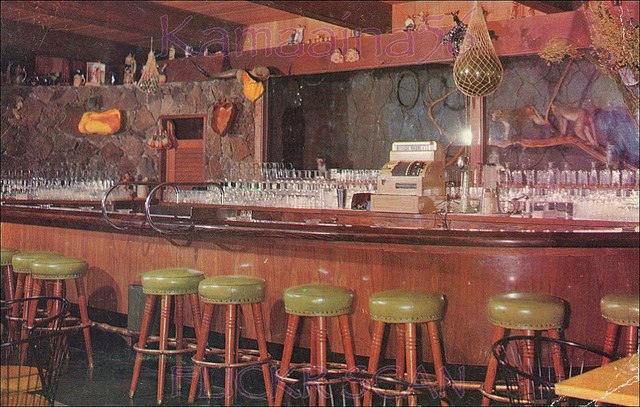
In the summer of 1962, as USS Polk County made preparations for deployment from homeport San Diego to Pearl Harbor, old timers were looking forward to the chance to sip a few cool ones at the legendary “Monkey Bar” in the Pearl City Tavern (PCT). Making my first visit to the islands as a fresh-caught Ensign, I was intrigued by the idea of live monkeys in the bar and I put it high on my list of things to see and do in Hawaii. Little did I suspect that the PCT was going to leave an indelible mark on my career in the Navy – an innocent led astray by a member of the U.S. Marine Corps.

Lt. Nelson B., USMC, when sober and at sea, flew helicopters off USS Iwo Jima. When ashore, “Nels” was a party guy. For some reason which escapes me to this day, I found myself beach crawling with old Nels, finishing up an extended evening at the Monkey Bar; and there indeed were live monkeys behind the bar (not tending bar, just doing monkey things behind the glass enclosure), providing the live entertainment for this popular watering hole. With the proper blood alcohol level, one could while away many hours observing the social interaction of these sometimes shameless primates (this may be where Jane Goodall got her inspiration).

On this particular evening (probably early morning by then), having finally tired of the simian follies, Nels went off to call us a cab to return to Pearl Harbor. After an extended wait, I suspected he had run into problems and went off to track him down, arriving just in time to see him rip the last of three pay phones from the wall of the PCT lobby (Marines define “fun” differently than the rest of us). My arrival coincided with that of the HASP (Hawaiian Armed Services Police), summoned by the manager after phone number one bit the dust. The HASP, a select group of military police established specifically to deal with miscreant military service members, were all big, no-nonsense, intimidating guys, selected primarily for their size and inability to smile.

“They did it,” yelled the manager, pointing at a grinning Nels and an innocent me. A short walk later, encouraged along the way by our stone-faced escorts, we found ourselves at HASP Headquarters being fingerprinted and photographed. We barely escaped an overnighter when Nels arranged to reimburse the phone company and wrote a check on the spot.

That brush with the law had a permanent and not necessarily negative impact on the rest of my naval career, although from that day forward, whenever I was required to answer the question “Have you ever been arrested?”, I had to check the “yes” box and attempt to explain away in great detail my association with fun-loving Nels and the Monkey Bar incident. On the positive side, I think the experience made me more understanding and receptive to “extenuating and mitigating circumstances” when I was later in a position to pass judgement on sailors accused of disciplinary infractions or violations of the Uniform Code of Military Justice. As a Commanding Officer with Article 15 authority and authority to refer cases to courts martial, I think having been on the wrong side of the system, however briefly, stimulated a compassion that might not otherwise have been there.

As for Nels, we never crossed paths again; and after only a few years I was able to say “Marine” without adding any colorful adjectives. The Monkey Bar is long gone, replaced by a Japanese restaurant, then a used car lot and more recently bulldozed to make way for some other more mundane enterprise. I think the monkeys were moved to a small island in Kaneohe Bay (oddly enough named Monkey Island) and are the subjects of behavioral research by the University of Hawaii.

The HASP still strikes fear into the hearts of military members gone astray in Hawaii but their image and tactics have softened over the years. Some say former HASP members have been spotted on Monkey Island trying to intimidate the inhabitants into more acceptable behavior.


Entered the Naval Air Reserve out of high school in 1955, serving with VF-782 as an AT striker at Los Alamitos NAS, CA.
After graduation from college, attended OCS and was commissioned in March 1961. His duty assignments included USS Polk County (LST 1084)as Deck and Gunnery Officer; Navy Language School in Anacostia, MD, studying the Russian language; ACNSG Fort Meade, MD. as a submarine rider; NSGA Bremerhaven, Germany as Communications Officer; Vietnam as OIC of Special Support Group to MACV SOG; NSG HQ in Washington, DC; Naval Postgraduate School in Monterey, CA; NCS Rota, Spain as Operations Officer; NSG HQ; ACNSG at Fort Meade; CINCUSNAVEUR London, UK as Deputy DNSGEur; NSGA Puerto Rico as Commanding Officer; NSA Fort Meade; NCPAC Hawaii as Deputy NCPAC.
Retired in January 1989 and remains in Hawaii.


Standard

Everything I Need To Know, I Learned In The Navy

Everything I Need To Know, I Learned In The Navy

By:  Garland Davis


Growing up in rural North Carolina, I learned many things to help me cope with my environment.  I learned about farming, making barbecue and ice cream.  I learned to cook and bake.  The food skills turned out to very beneficial in my Navy life.

I also learned to make Moonshine Whiskey.  Haven’t really used this knowledge although I did employ some of the rudiments making Raisin-Jack in USS Vesuvius.

The things I learned helped me reach my seventeenth birthday and my enlistment. Everything I needed to know about life I learned in the Navy.

  1. Never lie, even if it means you will get in the shits. It is permissible to stretch the truth when having a few cool ones with shipmates and telling stories of events that transpired during other drinking bouts with other shipmates.
  1. Stealing from a shipmate is the worst thing you could ever do. There is nothing more to be said on this subject.
  1. If you say you are going to do something, do it. Live by your word. Your reputation is built on doing what you promise. Don’t claim you will do something that you know you cannot do.  In other words, “Don’t let your alligator mouth overload your hummingbird ass.”
  1. Clean up after yourself, and remind your shipmates to do the same. Don’t be a scrounge and don’t permit others to become a scrounge. During much of your career, you will have to clean up messes.  Don’t become the person who leaves a mess for others to clean up. If you see a mess, clean it up regardless of who left it.
  1. Procedures are tried and tested. Always, follow the procedure. If it goes to shit, the procedure will cover your ass. Now is the time to point out the error in procedures and show your better method. If you try to change the procedure beforehand and it goes to shit, it is your fault because you didn’t follow procedure.
  1. It isn’t who you are, or whom you know……, but what you know. Learn what is required to perform your duties properly. Also, learn as much as you can about what others do. You will be a better shipmate by doing your job and having the ability to help others.
  1. Don’t take yourself too seriously. Your shipmates sure won’t. You are no more or less important than they are.
  1. Don’t brag – let your actions speak for themselves. Don’t make a big deal out of what you did or what you intend to do. Just do it. Talking about is doing the easy part.  This comes back to the alligator mouth analogy.
  1. There isn’t a lot of personal space on the ships. Respect your shipmate’s space literally and figuratively. Don’t get in a shipmate’s face over nickel and dime matters. If you dish it out, you had better be able to take it. Don’t ridicule or denigrate a shipmate and not expect ridicule and denigration yourself.
  1. Take care of your shipmates. Don’t leave a shipmate behind, and keep an eye out for him and he will keep an eye out for you.

.   11. Help your shipmate to his rack when he’s drunk. Help him clean himself up and                     make it to quarters on time. He’ll do the same for you when circumstances require it.

  1. If you borrow something, return it, in better condition than when you received it. If you break it return a new one.
  1. Punctuality! Be on time – always, for everything. Need to say nothing more on this subject.
  1. Don’t make a lot of noise in berthing; your shipmates may be sleeping.
  1. Don’t be a slacker – pull your own weight. Do the work you are supposed to do and do whatever you promise to do. Help your shipmates.
  1. Be confident, but don’t be afraid to say I don’t know. And don’t be afraid to go learn what you don’t know because there will come another time when you will need it.
  1. Life in the Navy isn’t fair – get used to it. Actually, life anywhere isn’t fair. If you follow these suggestions, it will make life a bit better in and out of the Navy.


To follow Tales of an Asia Sailor and get e-mail notifications of new posts, click on the three white lines in the red rectangle above, then click on the follow button.  To see a menu of previously published articles, click on the three white lines in the red rectangle above.

A native of North Carolina, Garland Davis has lived in Hawaii since 1987. He always had a penchant for writing but did not seriously pursue it until recently. He is a graduate of Hawaii Pacific University, where he majored in Business Management. Garland is a thirty-year Navy retiree and service-connected Disabled Veteran.

Standard

Smoker

Smoker

By:  David ‘Mac’ McAllister


I was stationed aboard a ship home ported out of Bremerton, WA while serving out a GOJ imposed exile from Japan in the early 70’s (food for another story). We were on deployment to Westpac and as a multi-product auxiliary, we had spent all of our time in Nam. The battle groups loved us for we served as one stop shopping; while the single product ships consolidated from Subic and other ports of call, kept us replenished with oil, ammo, fresh fruits, and vegetables. Since our sister ship had been unable to sail on time to relieve us, we had been extended for two months, but were now homeward bound.

“Good morning gents this is the Captain” the 1MC announcement fell upon wary ears, for we knew this was not going to be good. Seems our relief was still high and dry on all those coffee grounds that had built up under her keel in Alameda and unable to escape the vacuum created by the United States holding her fast to the pier. Unable to meet her deployment, we were altering course. We were going back!

Morale took a nose dive as we had not seen much liberty in eight months; the promise of a few days in Subic before proceeding back to the gun line helped but the crew needed to let off some steam now. The notice in the POD could very well be the ticket – Smokers.

Smokers, for those that have led a sheltered life, are sea jargon for boxing. The rules for smokers were pretty much open. Challenges could be made by fellas of equal weights, a smaller guy could challenge a bigger guy and juniors and seniors could challenge each other. This was not only going to be fun; it had profit potential.

In the First Class Mess, BM1, BT1 and I had been slushing out funds during the cruise to cover gambler’s debts and had amassed a small fortune of a few thousand dollars. We had a scheme in mind that, if we could pull it off, would double our little fund. As on most ships, deck and engineering had a strong long-running rivalry going on and we were going to make it benefit us.

Our Warrant Boatswain was tough. He was one of those individuals that you would have to kill before he realized he was hurt. I have seen him walk up and down deck while all others were taking cover in preparations for shot lines; only to be hit in the head by one. Reaching down he would pick up the baton like some pesky mosquito, hand it to a deck seaman, and never stumble or lose his stride.

Down in the fireroom lived FN. FN was from Philly, a Golden Gloves contender and a dead ringer for Mohammed Ali. Quite shy by nature, very few knew of his boxing prowess and we were going to exploit that fact of life. It took many long conversations while on watch with him by BT1 and me to convince him that he should challenge the Boatswain to a Smoker.

Finally, the challenge was made via a second on each man’s part and the match was set. BM1, BT1 and I started hyping this thing better than Don King and soon the engineering and deck departments were at each other’s throats over the outcome. The betting preceded the event by days and we lent money hand over fist, saving a reserve for fight day naturally.

Fight day arrived on one of those brilliantly, bright, blue pacific days we’ve all experienced. Not a cloud in the sky, slack breeze, and calm sea – perfect at sea boxing conditions. Mats were laid out, while the spectators serving as the ring, made for a close environment for the fighters. Our heavyweights were fighting last, giving us ample time to ramp up the crowd and cover those last minute odds bets. Suddenly, BM1 flipped his role as outraged deck ape instigating bets against FN and started covering side bets in favor of FN. This naturally outraged the deck types and the odds escalated astronomically out of control. Soon our reserve was gone and we were covering bets with money we didn’t have. Mercifully, our fight was announced and everyone settled down to watch.

The Boatswain swaggered out confident and cocky as usual, FN shyly took his place and as they met in the center of the ring for referee instructions my legs felt like rubber. I had no idea how over leveraged we were; if this didn’t work I could be swimming by daylight and FN was not exuding confidence.

At the bell they met in a flurry of punches; thrown totally by the Boatswain. FN was covering up and taking the punishment of the Boatswain’s blows to his arms and body. Boatswain was “floating like a butterfly; stinging like a bee” while our Ali clone was as lead-footed as a farmer. Finally, the first round was over; fighters to corners and more (Oh Shit!) betting as the odds soared in the Boatswains favor.

Round Two. Same shit, the Boatswain is tearing up FN; although, our “Philly Cheese Steak” is still doing a good job of covering up. Just as I was thinking “Is this what they learn in Golden Gloves”, I noticed that every punch the Boatswain threw now was being trapped and held close to his body by FN. In effect, the Boatswain, having to pull his punches free, was doing double duty. The workout in the close steamy ring environment left the Boatswain winded and slowed by the end of the round.

The last round started with a fresh looking FN still taking aggravation from a recovered Boatswain. However, more of the same tactics from FN soon had the Boatswain feeling the weight of those ten-ounce gloves. When it happened it was like unleashing bottled lightning. As the Boatswain’s arms dropped ever so slightly, FN reached out and touched him one time with the speed of a mongoose on a cobra.

“Oh, somewhere upon the deep blue sea, the sun is shining bright,
A band is playing in a bar in Subic, where the girls are a delight,
And somewhere sailors laugh, while the bargirls twist and shout;
But there is no joy in deck today — the Boatswains lights are out.”

FN stood expressionless in the ring as he was mobbed by the engineers. To the Boatswains credit, after Doc waved the smelling salts under his nose, he was up and fighting again; only to be informed that it was over and he had missed it. Deck hands were reaching into their wallets and BM1, BT1 and I spent the next week collecting on bets we could not have covered otherwise.


David “Mac” McAllister a native of California, now resides in the Ozark Mountains of Southwest Mo. Having served in Asia for the majority of his 24-year Navy career, he now divides his time as an over the road trucker, volunteer for local veteran repatriation events and as an Asia Sailor Westpac’rs Association board member and reunion coordinator. In his spare time, he enjoys writing about his experiences in Westpac and sharing them online with his Shipmates.


Standard

Another story of USS George K. Mackenzie

Another story of USS George K. Mackenzie

By:  Jim Barton


April 17, 1972. It has been 44 years. Amazing. There are many days I remember in the Vietnam War. I try to remember this one every year. It was not the most intense day of combat but it was noteworthy in the excitement and in the loss.

We were young and sailors once. I was overdue in returning from a 1971-1972 WESTPAC deployment as a 25-year-old Operations Officer and General Quarters (GQ) Officer of the Deck aboard USS George K. Mackenzie (DD-836).

After refueling on the 17th we joined the Task Unit (77.1.2) made up now of USS Buchanan (DDG-14), USS Benjamin Stoddert (DDG-22), USS Hamner (DD-718) and us. We were conducting gunfire operations near the city of Vinh about 175 miles north of the DMZ. Vinh was a priority target because of its airfield, fuel storage sites and military installations including a PT boat base in the harbor area. There were also three offshore islands, Hon Mat, Hon Nhieu (Ngu) and Hon Me, known to have coastal artillery.

The southernmost of these islands was Hon Mat suspected to have long range artillery hidden in caves.

We began our run at Vinh in a line abreast at GQ around noon in a circuitous route from the north to a point offshore of the mouth of the Lam Song River where we were to begin firing and then regress seaward. Mackenzie was the northernmost of the Freedom Train ships.

At 1255, we opened up on Hon Me Island about 5 miles on our starboard beam from which we had been receiving what we believed was heavy machine gun or 20mm fire. We ceased fire about 5 minutes later noting secondary explosions on the island. Having now turned to our firing course, our job was to protect the column to the north from counter battery fire which had begun from a position ashore. We engaged the counter battery while Buchanan and Stoddert continued their direct fire on the principal target, the PT boat base, with their longer range 5”54 guns (approximately 6000 yards’ greater range than ours). Incoming hostile fire was noted all around our formation but all ships held steady with the mission.

We noted secondary explosions in the vicinity of the target which we believed might have been coming from the oil storage area. Almost immediately the lookouts and I observed two incoming PT boats at a distance of 11000 yards, our maximum effective gun range. I identified these boats as Soviet-style North Vietnamese Project 183 (P-6) boats. The boats were equipped with two twin 25mm cannons forward and aft (range about one mile) and banks of torpedo tubes port and starboard. The latter was the biggest threat. The torpedoes were advertised as having a maximum range of about 3 miles (6000 yards). To be effective they had to be launched much closer.

This meant the boats would be under the arc of our radar controlled guns. Being the closest ship with the best angle, we shifted targets with our aft gun mount (Mt. 52) with its two barrels from the counter battery ashore to the incoming boats which were being tracked at a speed of 45 knots. We held our speed in the firing formation at 17 knots. Because of this, the PT boats were closing fast.

At the Captain’s directions, I maneuvered Mackenzie slightly to starboard toward the coast in order to bring Mt. 51 to bear on the boats. Now we could fire at them with four 5 inch guns instead of two. With the barrels nearly pointed back toward my position on the Bridge of the ship I looked down and saw the Mt 51 Mount Captain Boatswain Mate First Class Salada with his head poking out of the hatch atop his mount; he looked at me, smiled, gave a thumbs-up and commenced fire on the PT boats.

Aft in Mt. 52 as Mount Captain was Stanley “Bags” Baggett, a 2nd Class Gunners Mate. Stan had already opened up on the boats. Stan and I have talked about this engagement over the years. We are friends to this day. He was in the best firing position aft and told me Salada loved the extra angle he got from me so he could bring his mount to bear on the PT boats. Over the course of the next few minutes, we poured considerable 5-inch ammunition down on the boats in a mix of variable time fuse ammo set to trigger off the mechanical time fused explosions from the high capacity ammo we were firing. We were creating a wall of steel designed to kill the personnel on board and/or sink the boats.

The lead boat soon went up in an explosion and the second boat turned to shore. By this time, the primary firing mission had completed, the task group commander ordered a turn and we were racing from the coast at a speed of 34 knots, weaving furiously as we were taking considerable incoming fire from the installations ashore and from the offshore islands. We continued firing at the second boat as we turned away. But we could not confirm a kill because we shifted our attention and fire counter-battery at the coastal artillery sites. We later received confirmation of the second PT Boat kill.

We were receiving incoming on our port and starboard quarters and astern, as were the other U.S. ships. The closest of these rounds was impacting within 25-50 yards so that we were getting sprayed by some of the fragmentation. We had no direct hits. Captain Anderson was moving from one Bridge wing to the other while I was ordering the maneuvers for the ship and executing the weave. Occasionally he would ask, “How are we doing Jimmy?” I would respond, “Real good Skipper”. The energy level among the Bridge team members was high. I tried to remain calm and concentrated on the task at hand with incoming landing seemingly everywhere.

At 1337, about 1 ½ hours into the operation on the way out of the area, Buchanan reported being hit by incoming. The shell penetrated the superstructure between the aft gun mount and missile launcher and exploded in the middle of the damage control party killing Seaman Leonard R. Davis and slightly wounding seven other personnel. Damage was isolated. Leonard Davis had received the full impact of the incoming artillery blast.

Just before 1500, the ships were far enough from the coast to slow down and regroup. One thing was clear and that was these daytime strikes without air cover could be hazardous to your health. Mackenzie had fired nearly 350 rounds of 5-inch ammunition. Buchanan left for Da Nang for repairs and for transfer of Seaman Davis’ remains. The remainder of the ships regrouped for another raid that evening. And so it went.

I salute you Leonard Davis and I remember you this day and every day. You made the ultimate sacrifice.


The author is a retired career US Navy Surface Warfare Officer whose assignments at sea include duty in all Line Departments in the Destroyer and Auxiliary Forces up to and including command of a Frigate. Ashore he served in key national policy positions on the staff of the Chief of Naval Operations.

Standard

Thunder Mugs and Freckle Makers

Today I am borrowing from ‘Dex’ Armstrong who articulately tells the Diesel Boat submariner’s story.


Thunder Mugs and Freckle Makers

by Bob ‘Dex’ Armstrong


At some point, I knew I would come face to face with the problem of revelation of deeply held smoke boat secrets. What I am about to lay before you will rank with the most sacred Masonic goodies and the secret signs of the Baltimore Orioles. In the past, what I am about to reveal was passed from the Grand Master of Smoke Boat-a-tarianism to an apprentice practitioner under a one-half inch thick lead blanket in the bottom of a mile-deep coal mine.

A submarine was a miniature municipality. The skipper was the mayor… Wardroom, the city council. The snipes handled the utilities. The COB was the sheriff… The rated men were the responsible citizens most of the time… Part of the time? Now and then? A few times a year? On Groundhog Day? Well anyway, at the absolute bottom of the social structure, you had the non-rated alley rats… The bums… Hobos… Homeless people… The nomadic tribe who moved from flash pad to flash pad in search of an uninterrupted night’s sleep.

In India, the human equivalent of non-rated people is called ‘the untouchables’… Many have leprosy. Hogan’s Alley on the Requin was a hybrid leper colony and primate cage. One of our multitude of extremely important responsibilities was care, maintenance and cleaning of our municipal sewer system. You eat… You poop. Cooks handled the former… We took care of the residual byproduct.

To fully appreciate the importance of this feature of our assigned duty, you must first understand the complex world of subsurface poop moving.

Everything that eventually found its way to one of our three sanitary tanks, made its way through a system of gravity drains. The scuttlebutt (water fountain for non-quals) … Cook’s and messcook’s sinks… Coffee urn… Air conditioning condensate drains… Head sinks… Urinals… Shower drains… And probably some stuff I forgot (Old age – CRS) … And finally, the heads (a.k.a. poopers, shitters, thrones, best-seat-in-the-house, the perch, commode, toilet… You got it, the next to the last stop for processed Spam. To us, they were the ‘thunder mugs and freckle makers.’

Once you got rated and qualified, you became a below decks watch stander. This honor took you out of the topside watch rotation and was an indication that the COB had found a small spark of intelligence that with his expert advice and guidance, could be fanned into the flame of Naval leadership. Or as in my case, he was short on below decks watch standers and rolled the dice on whether, given the opportunity, I could sink the ship or trigger a mutiny. I was given a clipboard – the vestment of below decks authority… And with the help of rig bills and intuitive awareness, I went forth to check bilges, wake up ungrateful bastards, render ‘on service’ fuel status reports, make one and two-way surface dump requests, and blow sanitaries.

There was an art to blowing sanitaries.

First, you rigged the tank for blowing. That consisted of following a rig bill and closing all master and backup drain lines valves in lines leading to the sanitary tank. If some clown was in the shower, you did not say,

“Hey champ, I’ll catch the rest of the line-up and be back to pull the drain screen and T-handle the deck drain closed.”

Why didn’t you say this? Because nine times out of ten you would forget and create either a 225lb. ships’ service air or external sea pressure fountain of high pressure decomposing doo-doo that would not increase your popularity with the shipmates in the affected compartment. Not that I was a flash in high school physics, but crap, like everything else in life, takes the path of least resistance. You leave a valve open and without fail, poop will make an unscheduled appearance.

You really knew you were in trouble when the lid on the coffee urn began a little dance signifying the arrival and percolation of partially dissolved head tissue and accompanying commodities… Maxwell House with Scotts’ Extra Fluffy just has to be consumed to really be fully appreciated.

If the 225lb. ships’ service air held and the pressure began to build slowly, all drains were secure and you could open the overboard discharge. During the next few minutes, ships’ service air overcame external sea pressure, forcing the contents of the sanitary tank out to sea. When the tank was nine-tenths clear, you secured the blow. In combat, an air bubble leaving the boat at 200 feet the size of an orange, would arrive at the surface the size of a VW bus.

So you secured the overboard discharge and vented the remaining air at whatever the external sea pressure was, back into the boat. This unique sensation can be replicated by feeding a buffalo hard-boiled eggs for a week then getting in a Chevy Nova with him and rolling the windows up. Someone once said we earned our sub pay based on inboard venting.

The heads were flushed by way of a rotating drum valve and a long handle. At the time we rode the old Tench class boats, they were approaching twenty years old (the equivalent of a 108-year-old chorus girl or 650 dog years). By that time, the drum valves had worn to a point where a little air slipped past them, making the water seal in the head bowl percolate like a fizzing coke. If you happened to be parked on one at the time, it would leave little bubble splatters all over the cheeks of your fanny… Hence the origin of the term ‘freckle makers’.

The sanitary system was a critical one and required a hell of a lot of attention. Most of the cast parts were brass and subject to verdigris corrosion (verdigris is that weird green stuff that grows on the base of 20 gauge shotgun shells). All the stuff was connected by copper line. A large part of my early submarine career was spent wire-brushing verdigris and Brasso-ing copper pipe. At the point you were between COBs, you painted as much copper pipe as you could get away with… We looked upon it as saving the tax paying public a small fortune in Brasso… Which also gave us more time to study etiquette and opera appreciation.

There is a very exclusive club in the submarine community. Very few submariners have been given the honor of admittance. Membership guarantees induction in the Deck Force Hall of Fame. The club is called,

‘THE GRAND ORDER OF SUBMERSIBLE SHIT TANK DIVERS’

When we went into the yards in ’62, the Chief came up to me and said,

“Dex, I’m thinking of a number between one and ten. If you can guess it correctly, you get a week with Gina Lollabrigida in any hotel you choose, with 20 cases of beer and a rental car thrown in.”

“Chief, is Gina buck nekkit?”

“No son, her toenails are painted. If they weren’t, she’d be buck nekkit.”

“No cheap ‘No-name’ beer?”

“Imported beer.”

“Gas in the car?”

“Full tank.”

“Okay Chief, I’ll take a shot at guessing the number…”

“Wait…There’s something I haven’t told you…”

“Yeh Chief, what?”

“If you don’t guess the number I’m thinking of, you dive number two sanitary.”

“Dive the shit tank?”

“You got it.”

“…SIX!”

“No, but you really came close.”

We all got close a lot but nobody ever got to spend a week with buck nekkit Gina… That poor woman must have spent a helluva lot of 1962 and ’63 walking around with no clothes on, waiting for some submarine deck ape to guess the right number. We just kept losing and the COB kept winning.

I got to visit the inside of number two and scrape a lot of unidentifiable stuff off the interior surfaces. Later, the skipper put a page in my service record announcing that I had visited the inside of number two poop tank and would not have to do it again in my naval career.

Some people see Rome… Some Paris… I’ve visited inside #2 and I sign autographs.

Standard