Pearl City Tavern

Pearl City Tavern

By John Wallace
Capt. U.S. Navy 1955 – 1989

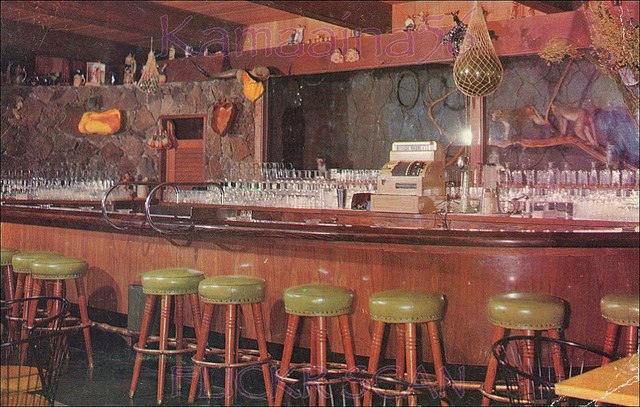
In the summer of 1962, as USS Polk County made preparations for deployment from homeport San Diego to Pearl Harbor, old timers were looking forward to the chance to sip a few cool ones at the legendary “Monkey Bar” in the Pearl City Tavern (PCT). Making my first visit to the islands as a fresh-caught Ensign, I was intrigued by the idea of live monkeys in the bar and I put it high on my list of things to see and do in Hawaii. Little did I suspect that the PCT was going to leave an indelible mark on my career in the Navy – an innocent led astray by a member of the U.S. Marine Corps.

Lt. Nelson B., USMC, when sober and at sea, flew helicopters off USS Iwo Jima. When ashore, “Nels” was a party guy. For some reason which escapes me to this day, I found myself beach crawling with old Nels, finishing up an extended evening at the Monkey Bar; and there indeed were live monkeys behind the bar (not tending bar, just doing monkey things behind the glass enclosure), providing the live entertainment for this popular watering hole. With the proper blood alcohol level, one could while away many hours observing the social interaction of these sometimes shameless primates (this may be where Jane Goodall got her inspiration).

On this particular evening (probably early morning by then), having finally tired of the simian follies, Nels went off to call us a cab to return to Pearl Harbor. After an extended wait, I suspected he had run into problems and went off to track him down, arriving just in time to see him rip the last of three pay phones from the wall of the PCT lobby (Marines define “fun” differently than the rest of us). My arrival coincided with that of the HASP (Hawaiian Armed Services Police), summoned by the manager after phone number one bit the dust. The HASP, a select group of military police established specifically to deal with miscreant military service members, were all big, no-nonsense, intimidating guys, selected primarily for their size and inability to smile.

“They did it,” yelled the manager, pointing at a grinning Nels and an innocent me. A short walk later, encouraged along the way by our stone-faced escorts, we found ourselves at HASP Headquarters being fingerprinted and photographed. We barely escaped an overnighter when Nels arranged to reimburse the phone company and wrote a check on the spot.

That brush with the law had a permanent and not necessarily negative impact on the rest of my naval career, although from that day forward, whenever I was required to answer the question “Have you ever been arrested?”, I had to check the “yes” box and attempt to explain away in great detail my association with fun-loving Nels and the Monkey Bar incident. On the positive side, I think the experience made me more understanding and receptive to “extenuating and mitigating circumstances” when I was later in a position to pass judgement on sailors accused of disciplinary infractions or violations of the Uniform Code of Military Justice. As a Commanding Officer with Article 15 authority and authority to refer cases to courts martial, I think having been on the wrong side of the system, however briefly, stimulated a compassion that might not otherwise have been there.

As for Nels, we never crossed paths again; and after only a few years I was able to say “Marine” without adding any colorful adjectives. The Monkey Bar is long gone, replaced by a Japanese restaurant, then a used car lot and more recently bulldozed to make way for some other more mundane enterprise. I think the monkeys were moved to a small island in Kaneohe Bay (oddly enough named Monkey Island) and are the subjects of behavioral research by the University of Hawaii.

The HASP still strikes fear into the hearts of military members gone astray in Hawaii but their image and tactics have softened over the years. Some say former HASP members have been spotted on Monkey Island trying to intimidate the inhabitants into more acceptable behavior.


Entered the Naval Air Reserve out of high school in 1955, serving with VF-782 as an AT striker at Los Alamitos NAS, CA.
After graduation from college, attended OCS and was commissioned in March 1961. His duty assignments included USS Polk County (LST 1084)as Deck and Gunnery Officer; Navy Language School in Anacostia, MD, studying the Russian language; ACNSG Fort Meade, MD. as a submarine rider; NSGA Bremerhaven, Germany as Communications Officer; Vietnam as OIC of Special Support Group to MACV SOG; NSG HQ in Washington, DC; Naval Postgraduate School in Monterey, CA; NCS Rota, Spain as Operations Officer; NSG HQ; ACNSG at Fort Meade; CINCUSNAVEUR London, UK as Deputy DNSGEur; NSGA Puerto Rico as Commanding Officer; NSA Fort Meade; NCPAC Hawaii as Deputy NCPAC.
Retired in January 1989 and remains in Hawaii.


Standard

Everything I Need To Know, I Learned In The Navy

Everything I Need To Know, I Learned In The Navy

By:  Garland Davis


Growing up in rural North Carolina, I learned many things to help me cope with my environment.  I learned about farming, making barbecue and ice cream.  I learned to cook and bake.  The food skills turned out to very beneficial in my Navy life.

I also learned to make Moonshine Whiskey.  Haven’t really used this knowledge although I did employ some of the rudiments making Raisin-Jack in USS Vesuvius.

The things I learned helped me reach my seventeenth birthday and my enlistment. Everything I needed to know about life I learned in the Navy.

  1. Never lie, even if it means you will get in the shits. It is permissible to stretch the truth when having a few cool ones with shipmates and telling stories of events that transpired during other drinking bouts with other shipmates.
  1. Stealing from a shipmate is the worst thing you could ever do. There is nothing more to be said on this subject.
  1. If you say you are going to do something, do it. Live by your word. Your reputation is built on doing what you promise. Don’t claim you will do something that you know you cannot do.  In other words, “Don’t let your alligator mouth overload your hummingbird ass.”
  1. Clean up after yourself, and remind your shipmates to do the same. Don’t be a scrounge and don’t permit others to become a scrounge. During much of your career, you will have to clean up messes.  Don’t become the person who leaves a mess for others to clean up. If you see a mess, clean it up regardless of who left it.
  1. Procedures are tried and tested. Always, follow the procedure. If it goes to shit, the procedure will cover your ass. Now is the time to point out the error in procedures and show your better method. If you try to change the procedure beforehand and it goes to shit, it is your fault because you didn’t follow procedure.
  1. It isn’t who you are, or whom you know……, but what you know. Learn what is required to perform your duties properly. Also, learn as much as you can about what others do. You will be a better shipmate by doing your job and having the ability to help others.
  1. Don’t take yourself too seriously. Your shipmates sure won’t. You are no more or less important than they are.
  1. Don’t brag – let your actions speak for themselves. Don’t make a big deal out of what you did or what you intend to do. Just do it. Talking about is doing the easy part.  This comes back to the alligator mouth analogy.
  1. There isn’t a lot of personal space on the ships. Respect your shipmate’s space literally and figuratively. Don’t get in a shipmate’s face over nickel and dime matters. If you dish it out, you had better be able to take it. Don’t ridicule or denigrate a shipmate and not expect ridicule and denigration yourself.
  1. Take care of your shipmates. Don’t leave a shipmate behind, and keep an eye out for him and he will keep an eye out for you.

.   11. Help your shipmate to his rack when he’s drunk. Help him clean himself up and                     make it to quarters on time. He’ll do the same for you when circumstances require it.

  1. If you borrow something, return it, in better condition than when you received it. If you break it return a new one.
  1. Punctuality! Be on time – always, for everything. Need to say nothing more on this subject.
  1. Don’t make a lot of noise in berthing; your shipmates may be sleeping.
  1. Don’t be a slacker – pull your own weight. Do the work you are supposed to do and do whatever you promise to do. Help your shipmates.
  1. Be confident, but don’t be afraid to say I don’t know. And don’t be afraid to go learn what you don’t know because there will come another time when you will need it.
  1. Life in the Navy isn’t fair – get used to it. Actually, life anywhere isn’t fair. If you follow these suggestions, it will make life a bit better in and out of the Navy.


To follow Tales of an Asia Sailor and get e-mail notifications of new posts, click on the three white lines in the red rectangle above, then click on the follow button.  To see a menu of previously published articles, click on the three white lines in the red rectangle above.

A native of North Carolina, Garland Davis has lived in Hawaii since 1987. He always had a penchant for writing but did not seriously pursue it until recently. He is a graduate of Hawaii Pacific University, where he majored in Business Management. Garland is a thirty-year Navy retiree and service-connected Disabled Veteran.

Standard

Smoker

Smoker

By:  David ‘Mac’ McAllister


I was stationed aboard a ship home ported out of Bremerton, WA while serving out a GOJ imposed exile from Japan in the early 70’s (food for another story). We were on deployment to Westpac and as a multi-product auxiliary, we had spent all of our time in Nam. The battle groups loved us for we served as one stop shopping; while the single product ships consolidated from Subic and other ports of call, kept us replenished with oil, ammo, fresh fruits, and vegetables. Since our sister ship had been unable to sail on time to relieve us, we had been extended for two months, but were now homeward bound.

“Good morning gents this is the Captain” the 1MC announcement fell upon wary ears, for we knew this was not going to be good. Seems our relief was still high and dry on all those coffee grounds that had built up under her keel in Alameda and unable to escape the vacuum created by the United States holding her fast to the pier. Unable to meet her deployment, we were altering course. We were going back!

Morale took a nose dive as we had not seen much liberty in eight months; the promise of a few days in Subic before proceeding back to the gun line helped but the crew needed to let off some steam now. The notice in the POD could very well be the ticket – Smokers.

Smokers, for those that have led a sheltered life, are sea jargon for boxing. The rules for smokers were pretty much open. Challenges could be made by fellas of equal weights, a smaller guy could challenge a bigger guy and juniors and seniors could challenge each other. This was not only going to be fun; it had profit potential.

In the First Class Mess, BM1, BT1 and I had been slushing out funds during the cruise to cover gambler’s debts and had amassed a small fortune of a few thousand dollars. We had a scheme in mind that, if we could pull it off, would double our little fund. As on most ships, deck and engineering had a strong long-running rivalry going on and we were going to make it benefit us.

Our Warrant Boatswain was tough. He was one of those individuals that you would have to kill before he realized he was hurt. I have seen him walk up and down deck while all others were taking cover in preparations for shot lines; only to be hit in the head by one. Reaching down he would pick up the baton like some pesky mosquito, hand it to a deck seaman, and never stumble or lose his stride.

Down in the fireroom lived FN. FN was from Philly, a Golden Gloves contender and a dead ringer for Mohammed Ali. Quite shy by nature, very few knew of his boxing prowess and we were going to exploit that fact of life. It took many long conversations while on watch with him by BT1 and me to convince him that he should challenge the Boatswain to a Smoker.

Finally, the challenge was made via a second on each man’s part and the match was set. BM1, BT1 and I started hyping this thing better than Don King and soon the engineering and deck departments were at each other’s throats over the outcome. The betting preceded the event by days and we lent money hand over fist, saving a reserve for fight day naturally.

Fight day arrived on one of those brilliantly, bright, blue pacific days we’ve all experienced. Not a cloud in the sky, slack breeze, and calm sea – perfect at sea boxing conditions. Mats were laid out, while the spectators serving as the ring, made for a close environment for the fighters. Our heavyweights were fighting last, giving us ample time to ramp up the crowd and cover those last minute odds bets. Suddenly, BM1 flipped his role as outraged deck ape instigating bets against FN and started covering side bets in favor of FN. This naturally outraged the deck types and the odds escalated astronomically out of control. Soon our reserve was gone and we were covering bets with money we didn’t have. Mercifully, our fight was announced and everyone settled down to watch.

The Boatswain swaggered out confident and cocky as usual, FN shyly took his place and as they met in the center of the ring for referee instructions my legs felt like rubber. I had no idea how over leveraged we were; if this didn’t work I could be swimming by daylight and FN was not exuding confidence.

At the bell they met in a flurry of punches; thrown totally by the Boatswain. FN was covering up and taking the punishment of the Boatswain’s blows to his arms and body. Boatswain was “floating like a butterfly; stinging like a bee” while our Ali clone was as lead-footed as a farmer. Finally, the first round was over; fighters to corners and more (Oh Shit!) betting as the odds soared in the Boatswains favor.

Round Two. Same shit, the Boatswain is tearing up FN; although, our “Philly Cheese Steak” is still doing a good job of covering up. Just as I was thinking “Is this what they learn in Golden Gloves”, I noticed that every punch the Boatswain threw now was being trapped and held close to his body by FN. In effect, the Boatswain, having to pull his punches free, was doing double duty. The workout in the close steamy ring environment left the Boatswain winded and slowed by the end of the round.

The last round started with a fresh looking FN still taking aggravation from a recovered Boatswain. However, more of the same tactics from FN soon had the Boatswain feeling the weight of those ten-ounce gloves. When it happened it was like unleashing bottled lightning. As the Boatswain’s arms dropped ever so slightly, FN reached out and touched him one time with the speed of a mongoose on a cobra.

“Oh, somewhere upon the deep blue sea, the sun is shining bright,
A band is playing in a bar in Subic, where the girls are a delight,
And somewhere sailors laugh, while the bargirls twist and shout;
But there is no joy in deck today — the Boatswains lights are out.”

FN stood expressionless in the ring as he was mobbed by the engineers. To the Boatswains credit, after Doc waved the smelling salts under his nose, he was up and fighting again; only to be informed that it was over and he had missed it. Deck hands were reaching into their wallets and BM1, BT1 and I spent the next week collecting on bets we could not have covered otherwise.


David “Mac” McAllister a native of California, now resides in the Ozark Mountains of Southwest Mo. Having served in Asia for the majority of his 24-year Navy career, he now divides his time as an over the road trucker, volunteer for local veteran repatriation events and as an Asia Sailor Westpac’rs Association board member and reunion coordinator. In his spare time, he enjoys writing about his experiences in Westpac and sharing them online with his Shipmates.


Standard

Another story of USS George K. Mackenzie

Another story of USS George K. Mackenzie

By:  Jim Barton


April 17, 1972. It has been 44 years. Amazing. There are many days I remember in the Vietnam War. I try to remember this one every year. It was not the most intense day of combat but it was noteworthy in the excitement and in the loss.

We were young and sailors once. I was overdue in returning from a 1971-1972 WESTPAC deployment as a 25-year-old Operations Officer and General Quarters (GQ) Officer of the Deck aboard USS George K. Mackenzie (DD-836).

After refueling on the 17th we joined the Task Unit (77.1.2) made up now of USS Buchanan (DDG-14), USS Benjamin Stoddert (DDG-22), USS Hamner (DD-718) and us. We were conducting gunfire operations near the city of Vinh about 175 miles north of the DMZ. Vinh was a priority target because of its airfield, fuel storage sites and military installations including a PT boat base in the harbor area. There were also three offshore islands, Hon Mat, Hon Nhieu (Ngu) and Hon Me, known to have coastal artillery.

The southernmost of these islands was Hon Mat suspected to have long range artillery hidden in caves.

We began our run at Vinh in a line abreast at GQ around noon in a circuitous route from the north to a point offshore of the mouth of the Lam Song River where we were to begin firing and then regress seaward. Mackenzie was the northernmost of the Freedom Train ships.

At 1255, we opened up on Hon Me Island about 5 miles on our starboard beam from which we had been receiving what we believed was heavy machine gun or 20mm fire. We ceased fire about 5 minutes later noting secondary explosions on the island. Having now turned to our firing course, our job was to protect the column to the north from counter battery fire which had begun from a position ashore. We engaged the counter battery while Buchanan and Stoddert continued their direct fire on the principal target, the PT boat base, with their longer range 5”54 guns (approximately 6000 yards’ greater range than ours). Incoming hostile fire was noted all around our formation but all ships held steady with the mission.

We noted secondary explosions in the vicinity of the target which we believed might have been coming from the oil storage area. Almost immediately the lookouts and I observed two incoming PT boats at a distance of 11000 yards, our maximum effective gun range. I identified these boats as Soviet-style North Vietnamese Project 183 (P-6) boats. The boats were equipped with two twin 25mm cannons forward and aft (range about one mile) and banks of torpedo tubes port and starboard. The latter was the biggest threat. The torpedoes were advertised as having a maximum range of about 3 miles (6000 yards). To be effective they had to be launched much closer.

This meant the boats would be under the arc of our radar controlled guns. Being the closest ship with the best angle, we shifted targets with our aft gun mount (Mt. 52) with its two barrels from the counter battery ashore to the incoming boats which were being tracked at a speed of 45 knots. We held our speed in the firing formation at 17 knots. Because of this, the PT boats were closing fast.

At the Captain’s directions, I maneuvered Mackenzie slightly to starboard toward the coast in order to bring Mt. 51 to bear on the boats. Now we could fire at them with four 5 inch guns instead of two. With the barrels nearly pointed back toward my position on the Bridge of the ship I looked down and saw the Mt 51 Mount Captain Boatswain Mate First Class Salada with his head poking out of the hatch atop his mount; he looked at me, smiled, gave a thumbs-up and commenced fire on the PT boats.

Aft in Mt. 52 as Mount Captain was Stanley “Bags” Baggett, a 2nd Class Gunners Mate. Stan had already opened up on the boats. Stan and I have talked about this engagement over the years. We are friends to this day. He was in the best firing position aft and told me Salada loved the extra angle he got from me so he could bring his mount to bear on the PT boats. Over the course of the next few minutes, we poured considerable 5-inch ammunition down on the boats in a mix of variable time fuse ammo set to trigger off the mechanical time fused explosions from the high capacity ammo we were firing. We were creating a wall of steel designed to kill the personnel on board and/or sink the boats.

The lead boat soon went up in an explosion and the second boat turned to shore. By this time, the primary firing mission had completed, the task group commander ordered a turn and we were racing from the coast at a speed of 34 knots, weaving furiously as we were taking considerable incoming fire from the installations ashore and from the offshore islands. We continued firing at the second boat as we turned away. But we could not confirm a kill because we shifted our attention and fire counter-battery at the coastal artillery sites. We later received confirmation of the second PT Boat kill.

We were receiving incoming on our port and starboard quarters and astern, as were the other U.S. ships. The closest of these rounds was impacting within 25-50 yards so that we were getting sprayed by some of the fragmentation. We had no direct hits. Captain Anderson was moving from one Bridge wing to the other while I was ordering the maneuvers for the ship and executing the weave. Occasionally he would ask, “How are we doing Jimmy?” I would respond, “Real good Skipper”. The energy level among the Bridge team members was high. I tried to remain calm and concentrated on the task at hand with incoming landing seemingly everywhere.

At 1337, about 1 ½ hours into the operation on the way out of the area, Buchanan reported being hit by incoming. The shell penetrated the superstructure between the aft gun mount and missile launcher and exploded in the middle of the damage control party killing Seaman Leonard R. Davis and slightly wounding seven other personnel. Damage was isolated. Leonard Davis had received the full impact of the incoming artillery blast.

Just before 1500, the ships were far enough from the coast to slow down and regroup. One thing was clear and that was these daytime strikes without air cover could be hazardous to your health. Mackenzie had fired nearly 350 rounds of 5-inch ammunition. Buchanan left for Da Nang for repairs and for transfer of Seaman Davis’ remains. The remainder of the ships regrouped for another raid that evening. And so it went.

I salute you Leonard Davis and I remember you this day and every day. You made the ultimate sacrifice.


The author is a retired career US Navy Surface Warfare Officer whose assignments at sea include duty in all Line Departments in the Destroyer and Auxiliary Forces up to and including command of a Frigate. Ashore he served in key national policy positions on the staff of the Chief of Naval Operations.

Standard

Thunder Mugs and Freckle Makers

Today I am borrowing from ‘Dex’ Armstrong who articulately tells the Diesel Boat submariner’s story.


Thunder Mugs and Freckle Makers

by Bob ‘Dex’ Armstrong


At some point, I knew I would come face to face with the problem of revelation of deeply held smoke boat secrets. What I am about to lay before you will rank with the most sacred Masonic goodies and the secret signs of the Baltimore Orioles. In the past, what I am about to reveal was passed from the Grand Master of Smoke Boat-a-tarianism to an apprentice practitioner under a one-half inch thick lead blanket in the bottom of a mile-deep coal mine.

A submarine was a miniature municipality. The skipper was the mayor… Wardroom, the city council. The snipes handled the utilities. The COB was the sheriff… The rated men were the responsible citizens most of the time… Part of the time? Now and then? A few times a year? On Groundhog Day? Well anyway, at the absolute bottom of the social structure, you had the non-rated alley rats… The bums… Hobos… Homeless people… The nomadic tribe who moved from flash pad to flash pad in search of an uninterrupted night’s sleep.

In India, the human equivalent of non-rated people is called ‘the untouchables’… Many have leprosy. Hogan’s Alley on the Requin was a hybrid leper colony and primate cage. One of our multitude of extremely important responsibilities was care, maintenance and cleaning of our municipal sewer system. You eat… You poop. Cooks handled the former… We took care of the residual byproduct.

To fully appreciate the importance of this feature of our assigned duty, you must first understand the complex world of subsurface poop moving.

Everything that eventually found its way to one of our three sanitary tanks, made its way through a system of gravity drains. The scuttlebutt (water fountain for non-quals) … Cook’s and messcook’s sinks… Coffee urn… Air conditioning condensate drains… Head sinks… Urinals… Shower drains… And probably some stuff I forgot (Old age – CRS) … And finally, the heads (a.k.a. poopers, shitters, thrones, best-seat-in-the-house, the perch, commode, toilet… You got it, the next to the last stop for processed Spam. To us, they were the ‘thunder mugs and freckle makers.’

Once you got rated and qualified, you became a below decks watch stander. This honor took you out of the topside watch rotation and was an indication that the COB had found a small spark of intelligence that with his expert advice and guidance, could be fanned into the flame of Naval leadership. Or as in my case, he was short on below decks watch standers and rolled the dice on whether, given the opportunity, I could sink the ship or trigger a mutiny. I was given a clipboard – the vestment of below decks authority… And with the help of rig bills and intuitive awareness, I went forth to check bilges, wake up ungrateful bastards, render ‘on service’ fuel status reports, make one and two-way surface dump requests, and blow sanitaries.

There was an art to blowing sanitaries.

First, you rigged the tank for blowing. That consisted of following a rig bill and closing all master and backup drain lines valves in lines leading to the sanitary tank. If some clown was in the shower, you did not say,

“Hey champ, I’ll catch the rest of the line-up and be back to pull the drain screen and T-handle the deck drain closed.”

Why didn’t you say this? Because nine times out of ten you would forget and create either a 225lb. ships’ service air or external sea pressure fountain of high pressure decomposing doo-doo that would not increase your popularity with the shipmates in the affected compartment. Not that I was a flash in high school physics, but crap, like everything else in life, takes the path of least resistance. You leave a valve open and without fail, poop will make an unscheduled appearance.

You really knew you were in trouble when the lid on the coffee urn began a little dance signifying the arrival and percolation of partially dissolved head tissue and accompanying commodities… Maxwell House with Scotts’ Extra Fluffy just has to be consumed to really be fully appreciated.

If the 225lb. ships’ service air held and the pressure began to build slowly, all drains were secure and you could open the overboard discharge. During the next few minutes, ships’ service air overcame external sea pressure, forcing the contents of the sanitary tank out to sea. When the tank was nine-tenths clear, you secured the blow. In combat, an air bubble leaving the boat at 200 feet the size of an orange, would arrive at the surface the size of a VW bus.

So you secured the overboard discharge and vented the remaining air at whatever the external sea pressure was, back into the boat. This unique sensation can be replicated by feeding a buffalo hard-boiled eggs for a week then getting in a Chevy Nova with him and rolling the windows up. Someone once said we earned our sub pay based on inboard venting.

The heads were flushed by way of a rotating drum valve and a long handle. At the time we rode the old Tench class boats, they were approaching twenty years old (the equivalent of a 108-year-old chorus girl or 650 dog years). By that time, the drum valves had worn to a point where a little air slipped past them, making the water seal in the head bowl percolate like a fizzing coke. If you happened to be parked on one at the time, it would leave little bubble splatters all over the cheeks of your fanny… Hence the origin of the term ‘freckle makers’.

The sanitary system was a critical one and required a hell of a lot of attention. Most of the cast parts were brass and subject to verdigris corrosion (verdigris is that weird green stuff that grows on the base of 20 gauge shotgun shells). All the stuff was connected by copper line. A large part of my early submarine career was spent wire-brushing verdigris and Brasso-ing copper pipe. At the point you were between COBs, you painted as much copper pipe as you could get away with… We looked upon it as saving the tax paying public a small fortune in Brasso… Which also gave us more time to study etiquette and opera appreciation.

There is a very exclusive club in the submarine community. Very few submariners have been given the honor of admittance. Membership guarantees induction in the Deck Force Hall of Fame. The club is called,

‘THE GRAND ORDER OF SUBMERSIBLE SHIT TANK DIVERS’

When we went into the yards in ’62, the Chief came up to me and said,

“Dex, I’m thinking of a number between one and ten. If you can guess it correctly, you get a week with Gina Lollabrigida in any hotel you choose, with 20 cases of beer and a rental car thrown in.”

“Chief, is Gina buck nekkit?”

“No son, her toenails are painted. If they weren’t, she’d be buck nekkit.”

“No cheap ‘No-name’ beer?”

“Imported beer.”

“Gas in the car?”

“Full tank.”

“Okay Chief, I’ll take a shot at guessing the number…”

“Wait…There’s something I haven’t told you…”

“Yeh Chief, what?”

“If you don’t guess the number I’m thinking of, you dive number two sanitary.”

“Dive the shit tank?”

“You got it.”

“…SIX!”

“No, but you really came close.”

We all got close a lot but nobody ever got to spend a week with buck nekkit Gina… That poor woman must have spent a helluva lot of 1962 and ’63 walking around with no clothes on, waiting for some submarine deck ape to guess the right number. We just kept losing and the COB kept winning.

I got to visit the inside of number two and scrape a lot of unidentifiable stuff off the interior surfaces. Later, the skipper put a page in my service record announcing that I had visited the inside of number two poop tank and would not have to do it again in my naval career.

Some people see Rome… Some Paris… I’ve visited inside #2 and I sign autographs.

Standard

They Were Expendable

They Were Expendable

How Many Remember Watching John Wayne In The Movie “They Were Expendable”

Although a work of fiction the screenplay was loosely based in fact:

John D. Bulkeley was one of the most decorated naval officers of World War Two. Bulkeley received the Medal of Honor for actions in the Pacific Theater during the war. He was also the PT boat skipper who evacuated General Douglas MacArthur from Corregidor in the Philippines and commanded a PT- Boat Squadron at the Battle of La Ciotat.

At the dawn of World War II, Bulkeley was a lieutenant in command of Motor Torpedo Boat Squadron Three, a Philippine-based detachment of six motor torpedo boats. He hit his stride as a daring, resourceful and courageous leader. He picked up General Douglas MacArthur, his family, and his immediate staff, who had been ordered to flee the Philippines, and took them aboard PT 41 and other 77-foot motor torpedo boats through over 600 nautical miles of open ocean. On arriving at Mindanao, MacArthur said, “You have taken me out of the jaws of death. I shall never forget it.”

Bulkeley earned many of his array of decorations while in command of that squadron and a subsequent one.

In 1944, he took part in the Normandy invasion. Bulkeley led torpedo boats and minesweepers in clearing the lanes to Utah Beach, keeping German E-boats from attacking the landing ships along the Mason Line, and picking up wounded sailors from the sinking minesweeper USS Tide (AM-125), destroyer escort USS Rich (DE-695), and destroyer USS Corry (DD-463).

As invasion operations wound down, he received command of his first large ship, the destroyer USS Endicott (DD-495). One month after D-Day, he came to the aid of two British gunboats under attack by two German corvettes. Charging in with only one gun working, he engaged both enemy vessels at point-blank range, sinking both. When asked, he explained, “What else could I do? You engage, you fight, you win. That is the reputation of our Navy, then and in the future.”

Citation of Merit .. Medal of Honor

BULKELEY, JOHN DUNCAN

Rank and organization: Lieutenant Commander,
Commander of Motor Torpedo Boat Squadron 3, U.S. Navy.
Place and date: Philippine waters, 7 December 1941 to 10 April 1942.
Entered service at: Texas.
Born: 19 August 1911, New York, N.Y.
Other awards: Navy Cross, Distinguished Service Cross, Silver Star, Legion of Merit.

Citation:
For extraordinary heroism, distinguished service, and conspicuous gallantry above and beyond the call of duty as commander of Motor Torpedo Boat Squadron 3, in Philippine waters during the period 7 December 1941 to 10 April 1942.
The remarkable achievement of Lt. Comdr. Bulkeley’s command in damaging or destroying a notable number of Japanese enemy planes, surface combatant and merchant ships, and in dispersing landing parties and land-based enemy forces during the 4 months and 8 days of operation without benefit of repairs, overhaul, or maintenance facilities for his squadron, is believed to be without precedent in this type of warfare.

His dynamic forcefulness and daring in offensive action, his brilliantly planned and skillfully executed attacks, supplemented by a unique resourcefulness and ingenuity, characterize him as an outstanding leader of men and a gallant and intrepid seaman.

These qualities coupled with a complete disregard for his own personal safety reflect great credit upon him and the Naval Service.

Standard

Admiral Zumwalt and the Z-grams

Admiral Zumwalt and the Z-grams

By:  Garland Davis


There has been a protracted conversation in the Tin Can Sailors II Facebook group regarding the effects Admiral Elmo Zumwalt and his Z-gram proclamations have had, both short term and long term, on the U.S. Navy. I am writing this as one who was there before, during, and after Zumwalt. This is written from my perspective and the comments and conclusions belong to me.

Zumwalt was a 1942 graduate o/f the Naval Academy.  He saw combat on destroyers in the Pacific, where he was awarded the Bronze Star with Valor Device for heroic service in the Combat Information Center in action against Japanese battleships during the Battle of Leyte Gulf.

At the end of the war, he served as the prize crew officer of the Ataka, a 1,200-ton Japanese river gunboat with a crew of two hundred.   In this capacity, he took the first American-controlled ship since the outbreak of World War II up the Huangpu River to Shanghai, China. There, they helped to restore order and assisted in disarming the Japanese.

Zumwalt was assigned a number of Executive Officer and Commanding Officer positions in destroyers and was also assigned as Navigator in USS Wisconsin. After leaving Wisconsin in 1952 he attended the Naval War College, at Newport, Rhode Island followed by a tour in Washington at the Bureau of Naval Personnel. Completing that duty in 1955, he assumed command of a Pacific Fleet destroyer.  After this tour, he was transferred to the Department of Naval Personnel where he served as Special Assistant for Naval personnel and later added Naval Aide to his position title.

He commanded USS Dewey (DLG-14) from December 1959 until June 1961.  During the class year 1961/1962, he attended the National War College in Washington.  After graduation, he was assigned he was assigned to the Office of the Assistant Secretary of Defense (International Security Affairs) at the Pentagon where he served as Desk Officer for France, Spain, and Portugal and later as Director of Arms Control and Contingency Planning for Cuba. From December 1963 until June 21, 1965, he served as Executive Assistant and Senior Aide Secretary of the Navy, Paul H. Nitze.  For these duties, he was awarded the Legion of Merit.

After selection for Flag Rank, Admiral Zumwalt assumed command of Cruiser-Destroyer Flotilla Seven during July in San Diego.  In September 1968, he became Commander Naval Forces Vietnam and Chief of the Naval Advisory Group, U.S. Military Assistance Command Vietnam (MACV).  He was promoted to Vice Admiral of that year.

Zumwalt’s command was not a blue water force, like the Seventh Fleet; it was a brown water unit: he commanded the flotilla of Swift Boats that patrolled the coasts, harbors, and rivers of Vietnam. Among the swift-boat commanders were his son, Elmo Russell Zumwalt III, and later future Senator and U.S. Secretary of State John Kerry. Among his other forces were Task Force 115, the Coastal Surveillance Force, Task Force 116, the River Patrol Force, and Task Force 117, the joint Army-Navy Mobile Riverine Force.

In April 1970, President Richard Nixon nominated Zumwalt to be Chief of Naval Operations.  Upon being relieved of duties as Commander Naval Forces, Vietnam in May 1970, he was awarded a second Navy Distinguished Service Medal.

He assumed duties as CNO and was promoted to full Admiral on July 1, 1970, and quickly began a series of moves intended to reduce racism and sexism in the Navy. These were disseminated in Navy-wide communications known as “Z-grams”.  There were seventy “Z-grams” promulgated during the period July 1, 1970, through 21 January 1971.  Seventy proclamations in a two hundred five-day period or a Z-gram once every 2.93 days, on average.

Massive change so rapidly had the result of upending everything that tradition, daily shipboard routine, Navy discipline, grooming standards, and personal relationships, developed over almost two hundred years, was based upon.


List of Z-grams 

  • Z-gram 1 (14 July 1970): convened a junior officer retention study group.
  • Z-gram 2 (1 July 1970): Zumwalt’s remarks upon taking office as CNO.
  • Z-gram 3 (22 July 1970): Cryptographic procedures and Policy.
  • Z-gram 4 (30 July 1970): authorized 30 days leave for officers with orders for a permanent change of station (PCS).
  • Z-gram 5 (30 July 1970): instituted a test program aboard six ships to extend to First Class Petty Officers the privilege of Officers and Chief Petty Officers to keep civilian clothing aboard ship for wearing on liberty.
  • Z-gram 6 (11 August 1970): instituted a test program, funded entirely by deployed personnel to assist their families obtaining transportation and lodging to visit them in an overseas liberty port during holiday periods.
  • Z-gram 7 (11 August 1970): directed commanding officers to assign sponsors for newly arriving personnel. The sponsors were normally of the same rank or rate and with similar marital and family status to assist the arriving family establishing themselves in the new location.
  • Z-gram 8 (11 August 1970): extended the working hours of personnel writing officers’ orders from 16:30 to 21:00 so those personnel would be available to answer telephone questions after duty hours of officers expecting orders.
  • Z-gram 9 (14 August 1970): provided an alternative means of promotion to 1st class and CPO for highly motivated individuals who had five times failed the normal promotion examinations.
  • Z-gram 10 (20 August 1970): required naval air stations to have an officer or CPO meet each arriving transient aircraft to coordinate aircraft servicing and assist flight crew with dining and temporary lodging.
  • Z-gram 11 (24 August 1970): authorized continuing sea duty for enlisted men requesting it.
  • Z-gram 12 (24 August 1970): authorized wearing of civilian clothes on shore bases during and after the evening meal by all enlisted personnel except recruits in basic training.
  • Z-gram 13 (26 August 1970): directed commanding officers to grant 30 days of leave to at least half of their crew during the first 30 days following return from overseas deployment.
  • Z-gram 14 (27 August 1970): abolished 18 collateral duties traditionally assigned to junior officers (including cigarette fund officer and cold weather officer) and encouraged assignment of another 18 collateral duties (including movie officer and athletics officer) to qualified senior petty officers.
  • Z-gram 15 (28 August 1970): ordered all disbursing officers to provide all personnel with a statement of earnings prior to 30 October 1970 itemizing basic pay and allowances for clothing, quarters, sea duty, and hostile fire with taxes, deductions and allotments.
  • Z-gram 16 (2 September 1970): established a computer database to assist enlisted personnel desiring a duty swap with a similarly qualified sailor on another ship or home port.
  • Z-gram 17 (2 September 1970): raised the check-cashing limit at naval bases from $25 to $50.
  • Z-gram 18 (4 September 1970): opened the Navy Finance Center around the clock to all disbursing officers processing urgent inquiries about pay and benefits.
  • Z-gram 19 (4 September 1970): implemented an executive order from President Nixon to authorize an increased percentage of early promotions for officers.
  • Z-gram 20 (8 September 1970): required all shore bases to provide washing facilities and lockers for enlisted personnel assigned dirty work in dungarees.
  • Z-gram 21 (9 September 1970): encouraged commanding officers to provide compensatory time off for personnel standing watch on holidays.
  • Z-gram 22 (9 September 1970): authorized shore bases to organize facility improvement teams for welfare, living and parking facilities.
  • Z-gram 23 (12 September 1970): established the CPO advisory board to the CNO.
  • Z-gram 24 (14 September 1970): established procedures for Navy wives to present complaints, viewpoints, and suggestions to commanding officers of shore bases.
  • Z-gram 25 (16 September 1970): authorized ships in port to reduce watch standing rotation from one day in four to one day in six.
  • Z-gram 26 (21 September 1970): shifted responsibility for shore patrol staffing from shipboard to shore-based personnel at major naval bases.
  • Z-gram 27 (21 September 1970): eliminated routine local operations over a weekend by ships sailing from their home port.
  • Z-gram 28 (21 September 1970): was a status report on implementation of recommendations by retention study groups.
  • Z-gram 29 (22 September 1970): encouraged commanding officers to allow leave for 5% of their crew during overseas deployments.
  • Z-gram 30 (23 September 1970): established “hard-rock” officers’ clubs for junior officers at five naval bases and encouraged other naval base officers’ clubs to allow at least one room for casual dress, encourage unescorted young ladies to visit the clubs, and appoint younger officers to advise club managers about other measures to improve morale of junior officers.
  • Z-gram 31 (23 September 1970): established a junior officer ship-handling competition whose winners would be able to pick their next duty assignment.
  • Z-gram 32 (23 September 1970): allowed sailors to arrange their own re-enlistment ceremonies with assistance from their command.
  • Z-gram 33 (25 September 1970): established a procedure to improve customer relations at naval Base Exchanges.
  • Z-gram 34 (25 September 1970): eliminated the requirement for junior officers to own formal dinner dress uniforms.
  • Z-gram 35 (25 September 1970): authorized alcoholic beverages in barracks and beer vending machines in senior enlisted barracks.
  • Z-gram 36 (26 September 1970): encouraged commanding officers to improve the customer service ethic at base dispensaries and disbursing facilities.
  • Z-gram 37 (26 September 1970): reduced the rank required for command of aviation squadrons from Commander to Lieutenant Commander.
  • Z-gram 38 (28 September 1970): instructed commanding officers to eliminate scheduling of work routine on Sundays and holidays unless the ship is deployed overseas.
  • Z-gram 39 (5 October 1970): extended the operating hours of 25 large base commissaries to reduce crowds on Saturday mornings and paydays.
  • Z-gram 40 (7 October 1970): gave sailors the option of being paid either in cash or by check.
  • Z-gram 41 (21 October 1970): established a Command Excellence chair at the Naval war College to be filled by a commander or captain with a record of outstanding performance in command.
  • Z-gram 42 (13 October 1970): allowed junior officers to request sea duty as their first choice for initial duty assignment.
  • Z-gram 43 (13 October 1970): encouraged commanding officers to help disbursing officers speedily process large travel reimbursement claims.
  • Z-gram 44 (13 October 1970): encouraged assignment of senior petty officers to stand in-port officer of the deck watches to reduce junior officer workload.
  • Z-gram 45 (15 October 1970): encouraged commanding officers to increase support services to families of prisoners of war.
  • Z-gram 46 (15 October 1970): reduced routine paperwork required for the 3M planned maintenance system inspections and documentation.
  • Z-gram 47 (20 October 1970): increased responsibilities of department heads and executive officers of ships being deactivated.
  • Z-gram 48 (23 October 1970): established a new Bureau of Naval Personnel office focused on providing information to dependent families of active duty personnel.
  • Z-gram 49 (23 October 1970): required half of personnel on awards boards to be below the rank of commander.
  • Z-gram 50 (23 October 1970): encouraged ships returning from overseas deployments to use shore-based utilities to allow leave for increased numbers of engineering personnel.
  • Z-gram 51 (23 October 1970): established a uniform breast insignia for officers in charge of brown-water boats.
  • Z-gram 52 (23 October 1970): Dissemination of CNO policy.
  • Z-gram 53 (2 November 1970): authorized annual publication of a list of job assignments available to junior officers, emphasizing geographical locations and required qualifications for career planning.
  • Z-gram 54 (2 November 1970): outlined procedures for junior personnel to make suggestions to CNO.
  • Z-gram 55 (4 November 1970): established pilot program for improving Navy human resources management.
  • Z-gram 56 (9 November 1970): established a program similar to Z-16 for officers desiring a duty swap with a similarly qualified officer on another ship or home port.
  • Z-gram 57 (10 November 1970): eliminated a broad spectrum of selectively enforced regulations and specified relaxed interpretations of others related to grooming standards and wearing of uniforms, so the vast majority of sailors would not be penalized by policies designed to constrain a few abusing the trust and confidence of less stringent rules.
  • Z-gram 58 (14 November 1970): required ships’ stores afloat to accept checks in payment for purchases.
  • Z-gram 59 (14 November 1970): established a program for officers to spend a year of independent research and study for professional development in areas mutually beneficial to the officer and the Navy.
  • Z-gram 60 (18 November 1970): encouraged all major naval installations to install a recording answering device on one telephone to receive suggestions.
  • Z-gram 61 (19 November 1970): Authorized warrant officers and senior petty officers afloat to serve as communications watch officers and registered publications custodians.
  • Z-gram 62 (27 November 1970): established a Naval War College forum to discuss improved naval personnel policies and present their views to CNO and Secretary of the Navy.
  • Z-gram 63 (30 November 1970): reduced by 25% the number of publications to be maintained by ships.
  • Z-gram 64 (3 December 1970): encouraged commanding officers to increase the opportunities for junior officers to practice ship handling.
  • Z-gram 65 (5 December 1970): listed incentives for officers to volunteer for duty in Vietnam.
  • Z-gram 66 (17 December 1970): directed every navy facility to appoint a minority group officer or senior petty officer as a minority affairs assistant to the commanding officer.
  • Z-gram 67 (22 December 1970): streamlined required inspection procedures to reduce the amount of time required for preparation and execution.
  • Z-gram 68 (23 December 1970): expanded the civilian clothing privilege explored in Z-gram 5 to all petty officers on all ships.
  • Z-gram 69 (28 December 1970): eliminated command of a deep draft ship from the requirements for promotion to admiral.
  • Z-gram 70 (21 January 1971): clarified grooming standards and working uniform regulations addressed by Z-gram 57 to reflect contemporary hair styles and allow wearing working uniforms while commuting between the base and off-base housing.

The majority of the Admiral’s Z-grams addressed retention and advancement programs and had very little effect on the daily operations of the entire Navy.  The following six Z-grams began a transformation of the Navy that is still ongoing.

The message regarding grooming standards is viewed as the one that almost broke the Navy disciplinary system or as freeing of the serfs by the Magna Charta.  There was the cadre of career sailors who saw Navy traditions, routine, and their authority being thrown in the garbage chute.  The other side of the coin saw eccentric beards and mustachios, collar length hair greased and piled under uniform headwear.  I remember one “sea lawyer” who had the pertinent Z-grams laminated and carried them around in his pocket and would try to interpret them in his favor.

I don’t remember when civilian clothing privileges were extended to all hands.  The civilian clothing aboard ship where there was barely enough room for required uniform items taxed the system.  The result of this was sailors civilian clothing was better cared for than uniforms.

On July 30, 1970, Z-gram number four established a test program to permit First Class Petty Officers to keep civilian clothing aboard ship for wearing on liberty.   This action got the average sailors attention.  Twenty-four days later Z-gram number twelve authorized the wearing of civilian clothing aboard shore stations during non-working hours.

The Admiral, during his travels to Naval Stations and afloat units, made it a practice to conduct question and answer sessions with members of the crew.  Z-gram seventeen seems to be a knee-jerk reaction to the question, “Why doesn’t the Navy Exchange cash checks for more than twenty-five dollars. The Z-gram raised it to fifty dollars in one fell swoop.

Z-gram fifty-one started the ball rolling for the myriad pins and devices authorized for wear on the uniform today by establishing a breast insignia for Officers in Charge of brown-water navy boats.

On November 10, 1970, Z-gram fifty-seven eliminated a broad spectrum of selectively enforced regulations and specified relaxed interpretations of others related to grooming standards and wearing of uniforms, so the vast majority of sailors would not be penalized by policies designed to constrain a few abusing the trust and confidence of less stringent rules.

On December 23, 1970, barely five months’ after Z-gram number four authorized a test program regarding civilian clothing aboard ship, Z-gram sixty-eight expanded the civilian clothing privilege to all Petty Officers on all ships.

On January 21, 1971, Z-gram Seventy clarified grooming standards and working uniform regulations addressed by Z-gram 57 to reflect contemporary hair styles and allow wearing working uniforms while commuting between the base and off-base housing.  Now you see sailors in working uniform everywhere.

I heard a Force Master Chief expound on Admiral Zumwalt’s programs and say that the Admiral was right.  He just did not get the full support of the chain of command in implementing the Z-grams.  Many Commanders, Officer’s and Chief Petty Officers were flummoxed by the rapid change. Many agreed that some of the changes were good, but they came too fast.  Instead of telling Commanding of the changes he desired and gradually implement, Zumwalt broadcast them to everyone.  Before CO’s could assess the situation the crew was “running amok with their own interpretations of the XZ-grams.”  Many seniors tried to maintain the traditions and routines. Others just shrugged, turned their backs and a blind eye to what was happening.

Is the Navy better or worse off for his tenure as the Chief of Navy Operations?  Each of us who was there has an opinion, the one term sailor who got over on his LPO or Chief by growing a beard and thumbing his nose at custom.  And then there were the Officers, Chief, and LDO’s who had to interpret new rules and live through watching the Navy change before their eyes.

Admiral Zumwalt was dedicated to, in his words, “making it fun to go down to the sea in ships again.” But just because you can change something, doesn’t always mean you should.  Too rapid change often has far-reaching and unforeseen consequences.


To follow Tales of an Asia Sailor and get e-mail notifications of new posts, click on the three white lines in the red rectangle above, then click on the follow button.

A native of North Carolina, Garland Davis has lived in Hawaii since 1987. He always had a penchant for writing but did not seriously pursue it until recently. He is a graduate of Hawaii Pacific University, where he majored in Business Management. Garland is a thirty-year Navy retiree and service-connected Disabled Veteran.

Standard

The Surabayan Liberty Incident

The Surabayan Liberty Incident

By: David ‘Mac’ McAllister


As I stood in the log room staring at the shit growing in the Petri dish the HMC just brought in, wondering if we even had enough Calcium Hypochlorite on board to make what passed for potable water here safe to drink, I was concerned about a far greater potential catastrophe. Berthed at a shallow water pier meant that at low tide the ship could settle into the mud, fouling cooling water sea chests for the ships service generators. I thought: “If the world had armpits one of them must be here – Surabaya, Indonesia”.

It was August 1977 and the 7th fleet flagship had just arrived for a two-day protocol visit following ops with the Indonesian Navy. For those not familiar with flagship ops, protocol visits were a show the flag event jammed with various activities including receptions hosted by the Admiral or local dignitaries. On this occasion in addition to civic action projects, ship tours and athletic contests the staff and ship’s company officers would be hosted at a reception on the pier by the Admiral of the Indonesian Armada. These receptions were noted for being “Command Performances” or mandatory attendance; losing electrical power would be an intolerable event.

My Division Officer, a recently promoted CWO4, had assumed a somewhat caretaker attitude leaving the business of running “M” division up to me. As he breezed through the log room in his liberty regalia, peered into the Petri dish wishing me “Lot’s of luck on that Chief”, he was obviously heading ashore to get ready for the afternoon reception.

After multiple chlorination’s, ensuring that the generator sea chests were rigged with steam blowouts and the duty section was well settled into auxiliary steaming, I set out to find a little of Surabaya myself. Jumping into a cab all I said was Bin tang, within minutes I was walking into a combination bar/skivvy house. To my surprise half of “M” Div, including CWO4, was there and already well underway. In addition to the girls the entertainment consisted of shooters of Batavia rum chased with bottles of Bin tang beer.

As is customary, I immediately ordered a round. CWO4, not at all bashful in the face of booze, tossed his shot of rum back just as someone proposed a toast to his recent promotion. Without missing a beat he spit the rum back into the shot glass, hoisted it and joined the toast to his own good fortune. After a few such rounds the hour drew near for both low tide and the Admirals reception. Wanting to be around during low tide, I shared a cab back to the ship with CWO4.

Emerging from the cab onto the awning rigged pier we noted that the tide had ebbed. The ship was breasted off the pier by camels and that distance was now a mud flat barely covered with water. Parting ways at the Quarter Deck CWO4 set off, with a definite bit of left rudder in his gait, to shift into his glad rags while I went below to check on the generators and the watch.

CWO4’s glad rags for this gala event would be Protocol Tropical White Long consisting of: tropical white short sleeved shirt, long white pants, white shoes, and gold cumber bun with miniature medals. Not as bad as it sounds, the uniform looked remarkably sharp on a slim profile. However, the years had not been so kind to CWO4 and what, at one time, could have been perhaps a barrel chest had gravitated to the south and east. This gave him a unique shape similar to Baby Huey; needless to say, rigging out in this particular uniform was a lesson in stress testing of both body and fabric.

Leaving the ship in the normal fashion is usually a painless ceremony consisting of a salute to the OOD, requesting permission to leave the ship, a 90° turn to face the ensign flying at the fantail, another salute, another 90° turn and you are on your way down the brow. CWO4 decked out in his sartorial splendor, stood before the OOD saluted and made the proper request. I don’t know whether it was the brand new leather soled and heeled white shoes from Hong Kong, the hot Sun, something slick on the brow, the shots of Batavia rum, bottles, and bottles of Bin tang beer or a combination of all of the above; what happened next can only be described as a cross between Mary Lou Retton gymnastics and Greg Louganis high diving. CWO4’s next ninety turned into a 270° pirouette culminating in a headlong death-defying plunge over the brow; although to his credit, CWO4 did get off a salute to the ensign as he passed the appropriate 90° mark. In opposition to the laws of gravity, he landed like a dart head first in the mud below clear up to the gold cummerbund; little fat legs flailing about as if in answer to some mental backing bell his brain had rung up in order to extricate him from this unintentional grounding.

Well not to ponder a point, the flying squad was called away and CWO4 was shortly extracted unscathed from the mud below and brought back aboard; naturally by way of the, by now, dignitary infested pier. Let it not be said that the Indonesians do not have a sense of humor; for although initially appalled, they did consider the incident entertaining and awarded CWO4 a grade of 10 for form and style, 9 for execution and perseverance under pressure however only a 1 for timing and decorum.

The next morning CWO4 sat in the log room; the Chief Engineer entered. In a sarcastic tone, as only an Academy puke is capable of whined, “And what have you to say for yourself this morning”.

Without missing a lick CWO4 looked at him through terribly bloodshot eyes and said “Better than twenty-six in; they don’t make W5’s”.

Without another peep the Engineer went into his office and slammed the door, and you ask me why I became a Warrant!?!


Standard

Full Steam Ahead

Yesterday I wrote of the grounding and surrender of the frigate Philadelphia and the actions taken to deny the enemy of her use as a warship or a propaganda symbol. Today we have the story of USS Pueblo told by Pat Dingle, who was there as part of the response to Pueblo’s capture.


Full Steam Ahead

Rescue The USS Pueblo

By: Pat Dingle


The 12 months between April 1967 and April 1968 were the best of times and the worst of times of my four years in the Navy. It started with a murder and narcotics undercover assignment in Las Vegas while home from the Yorktown’s second full 10/11-month tour in the Gulf of Tonkin. My week long leave turned into a month assigned to the LV police, having been recruited by a detective who, as it turned out later, was also in the Chicago mafia. After a very narrow escape from getting knocked off myself, I returned to Long Beach and the Yorktown. I was an RD3 and among the senior in OI div. and there’s nothing more useless to the Navy then a radarman in port. This time they did something about that. I was recruited by the Office of Naval Intelligence (ONI) to be the first “Nark” in a pilot program to combat civilians selling dope to sailors. This was the best of times. Here I am, a 20-year-old sailor packing a gun, going all over the southern California map in civvies of the era on my motorcycle or ‘55 Chevy depending on my target, like a kid in a candy store only I couldn’t/wouldn’t ingest the candy. I’d only return to the Yorktown near paydays and the Captain would personally arrange for me to be paid (He once told the Disbursing Officer to pay me whatever I wanted. I had to think hard for a minute about that temptation but then requested my regular pay) I had a room on base or at a bad guy’s pad. The Navy’s only request was for me to call every day or two to say I was alive and to come into ONI’s headquarters once a week or so and tell them what I was doing. Finally, it’s the Navy I thought I had joined over three years ago and that misunderstanding was rudely corrected on the first day of boot camp. All good things must come to an end and my end with ONI came after a bad guy’s house was shot up and ONI thought things were too hot for me to continue so they returned me bruised but not broken to the Yorktown just as she deployed back to Westpac and Vietnam waters. It would be the last time for the USS Yorktown and me. It was early January 1968. The worst of times.

Our four destroyers formed up with us the day we left Long Beach. The following day we steamed off San Diego as our air squadrons landed aboard and we then steamed westward. There were about five of us Third Class Petty Officers who were equal in seniority in CIC and several Second Class and First Class P.O.’s who were also making their second deployment with us. A new Senior Chief joined two others and of course there was a complete turnover of the seven or eight officers in OI div. Captain Bennett was still in command of the Yorktown and I don’t recall who the new Admiral was, too far over my pay grade. There were a number of new RD3’s and a shit load of new seamen, many who were reserves. I was a short timer due to be discharged in a few months and truth be told these many decades later, it showed. There was a clash between the new Senior Chief and me. Again, truth be told now, he won. I trained the new guys on the operation of CIC as did the other salty petty officers but coming off nearly a year as the lone ranger it didn’t come easy. The Yorktown drilled nearly every day as we steamed to Pearl for a few days of liberty then on to Japan, with more drills along the way and UNREP’s, to replenish stores but I don’t really recall any of this, done it too many times and the drills were ingrained as were Pearl and ports in Japan. The thrill was gone. It was January 23 and we were approaching the southern Japanese Islands when the message came in to us. The USS Pueblo is under attack by North Koreans.

I can’t begin to describe what we felt upon hearing that the North Koreans were attacking one of our ships but I’ll try. It was outrage to the max. NOBODY FUCKS WITH ONE OF OUR SHIPS AND LIVES. The Yorktown and her escorts were ordered to make best speed to the Pueblo’s location, about 15-20 hours away, and rescue her and the crew. Capt. Bennett first ordered the destroyers to come alongside for an underway replenishment to top off as we changed course to the Sea of Japan. Unrep done, we made 32 knots throughout the cold night, passing through the Tsushima Straits with our radars turned off. That had never happened before during my years aboard. The reason was we didn’t want the enemy to pick up our radar signals and know we were coming. CIC went to GQ stations and that’s about the time a few strange things happened. Our orders from the Commander Pacific Fleet, Pearl Harbor were left out in the open for all of us in CIC to read. I’ll never forget them. The first read “Attack anything communist”. The second thing was, morale shot sky high throughout the ship. Guys in the passageways, strangers, were giving high-fives. The crew was so pumped, we’re on our way full speed to kick ass. The ship was vibrating from making all those knots and so were we. I guess it helped knowing we were the closest military response and closing. The Yorktown was steaming at best speed to the sound of the guns. I’m sure it was the same aboard the destroyers. None of us could wait to get to the North Korean coast and kill those fucking commie bastards messing with the Pueblo. We didn’t know she’d been captured.

During that first night in route word came in that the Pueblo had been boarded and taken to the Port of Wonsan. Our orders were to steam to an area close off that port. The order to shoot still stood. To a man we were ready to do battle. As we approached our destination more orders started coming in, “Only shoot if you can clearly identify your target”, a few hours later, on station, “Don’t shoot unless you’re attacked”. The word going around was we’re going to use our Marine detachment and a voluntary force of sailors to storm ashore and find the Pueblo’s crew. I looked high and low as did my shipmates for the guy with the clipboard taking names. Morale was still very high as was the outrage. More destroyers joined up with us. Every time a new American ship arrived we thought that’s it, we have enough now, lets go in. Everyone was asking what are we waiting for? I kept thinking of the captured crew and what must be happening to them. The weather and my Chief didn’t help matters. Like I said, we clashed when he first came aboard a month or two ago. We were prepared for the South China Sea and pea coats worked for liberty in Japan during the winter but this fucking freezing weather was something I’ve never experienced before. None of us had. We had foul weather gear of course but that had the same warming effect as a t-shirt. CIC is always air conditioned. We turned it off. There’s fucking SNOW on the flight deck most days. My Chief wanted me to have a very responsible position during this time of conflict, away from CIC and him, so he put me in charge of the lookouts up on the open 07 deck. Now remember, there were blizzards nearly every day, you couldn’t see the end of the flight deck. The slow burn I felt helped but not very damn much. My section stood watch 7 on, 5 off, 5 on, 7 off 24/7 for what turned out to be several months. I relieved one lookout at a time to go down below to CIC to warm up and get a cup of coffee. When all four had a break I went down to CIC and got the latest intelligence reports. The Yorktown and task-group steamed back and forth off the Port of Wonsan.

To say the situation was tense would be an understatement. The North Koreans had an air base five minutes away making us an immediate target if war breaks out. Attacking the Pueblo, we thought it had. We didn’t know what kind of Navy they had other than enough of a Navy to overcome one of our ships. During that first few days, word was the Enterprise, Ranger, and one other attack carrier were ordered up from Vietnam. We’d cling to any rumor that offered hope that we’ll go in and attack. Moral was still very high as a result. I understood the carriers are underway to Korea, then the Tet Offense began and they were ordered back to Nam. More ships arrive and take station with us. What the hell are we waiting for? Nobody knew and the rumors seem to become downgraded each long day, less action orientated, but in our heart of hearts we knew they were just rumors anyway. But for now that’s all we had. The forward and aft lookouts and I were allowed to move up to the enclosed 010 level located just under the radar antennas for humanitarian reasons. It was that or suffer frostbite. The 010 remained unchanged from 1943 when the Yorktown was built. It wasn’t anything more than a small space made of thick bullet proof steel with four slit portholes. It was the highest enclosed space on the island above the flight deck and just as cold as the flight deck but it protected from the wind and blowing snow. We found a small electric heater somewhere and used that to take turns warming our hands through the gloves. Turn’s up, hands froze. This sucked. I had this tiny taste of understanding the hardships our ground troops went through during the Korean War after a month or so on the 07 and 010. My respects gentlemen.

I would go down the many ladders to CIC for hot coffee and the scuttlebutt, one was hot, one cold. The focus during this stage was all eyes on the jet bases and anything on the waters in between us and those commie bastards. We had our small detachment of A-4 Skyhawks ready to launch and our two 5 inch guns were manned 24/7 but we really depended on all the destroyers to protect the Yorktown during an attack. During my nearly four years aboard I’ve seen our guns’ fire once, off California, never came close to hitting the towed target sled. After learning all there was, I’d carry hot cups of coffee in a box up to my guys. It was always cold in the time it took to climb up there and I climbed ladders like a monkey back then. During those days of blowing snow the only duty we’d do is respond over the sound powered phones “Forward eye”, “Aft eye” every half hour when CIC asked for a report-in from us and the bridge. The rest of the time we’d just sit on the deck leaning back against the bulkhead and swap sea stories. As I was the one with two tours and E-4, I’d run my mouth more than the seamen boots on duty. I tried to regale them with exploits of on the beach, what’s it’s like in the Gulf of Tonkin, how important it is to pay strict attention to your scopes as lives depend on it etc. And of course the jokes of the day. Those were repeated so much we all had our responses down pat, no pun intended. Today I can only recall one of those guys. He was a reserve collage kid and total introvert in his late teens. He never said a word. He’d just sit there with his hood pulled tight over his head looking out with those wide blue eyes like an owl. Now and then I’d fuck with him by telling some stories of dangerous areas in Hong Kong or Subic. When I realized this kid can’t cut it I left him alone. Swashbuckler he ain’t and within a few months he was flown home as a mental. I know that happened to three or four guys in CIC during our first two tours too. I understand today but didn’t back then, I lived for adventure the Navy provided. The capture of the USS Pueblo changed that mindset for me.

The USS Yorktown remained the command ship as the task force steamed back and forth in a fifty-mile-long figure eight and in about the same miles from shore. Moral aboard began to plummet in the third week of this clusterfuck. The only thing we knew for sure was the commies had our ship and crew a few minutes over the horizon. Even the top secret messages from Pearl dried up, meaning they weren’t being given out any more for everyone in OI to read, just the select few. We were getting daily updates on the 7th Fleet’s actions taken because of the Tet Offence still underway but that had little or no meaning to us. Our fight’s here but “they” won’t let us fight. Then we read the orders, the USS Enterprise and several other attack carriers are, for the second time, steaming north to join with us off North Korea. Moral had been going up and down like a yo-yo and this news shot it up like a rocket. They’re not coming unless this is it. Again high-fives, the crew’s pumped, we’re going in for sure this time. Even the weather improved. Still fucking freezing but no blowing snow, just heavy wet fog. I took the lookouts down below to the exposed 07 for a change of pace over the next week and that helped matters. Any change helped matters. OI division was at GQ for a month now and would stay there for another month. I don’t know about the other divisions.

It was one of those moments that stays with you for the remainder of your life. It was mid-day, visibility about 5,000 yards then a wall of fog you couldn’t see your outstretched hand in. Our surface radar was reporting the CPA (closest point of approach) every few minutes, she’s minutes out and I’m on duty up on the 07.  The USS Enterprise came bow first out of the fog on our forward starboard side and kept coming, sliding past us about 4,000 yards out. Jesus H. Christ, I’ve never seen a ship that big. And as a carrier sailor I thought the Yorktown was huge. I’d seen photos of the Enterprise of course and her box like superstructure signature. But seeing her coming out of the fog like that was surreal. I took one of the binoculars away from a lookout and looking higher than our 07, focused on her attack aircraft on the flight deck, starboard side, couldn’t see her port side. I couldn’t take my eyes away but the relative speed of two ships passing in the fog did within a few moments. Moments that would forever more be with me. I never saw the USS Enterprise again.     The Enterprise and the other attack carrier that came, can’t now recall, let’s call it the fog of war, with their escorts are on the scene with us. I knew it’s for real, payback time. No more waiting, slash and burn upon landing, we’re going to get our Pueblo and crew back. Why else would they send the two other carriers and ships? It’s High Noon right? Moral aboard the Yorktown now peaked, every man aboard was convinced the waiting was over. The weeks of freezing throughout every compartment forgotten. Our blood’s up as is our fighting spirit, it’s only a matter of hours or days at most. This is why we drilled, why we had two full tours in the Gulf of Tonkin. I’m in CIC more than my duty station up topside. I have to know from the vast number of Intel sources there, that and I’m one of the most experienced on any station. I belong with my shipmates, not the boots on lookout. Besides, we can’t see shit past a matter of yards. Such was my attitude, the new Chief had one too. Whenever he left the Chief’s mess to drop in CIC and caught me in there he’d chew my ass. I’d reply just getting coffee for my guys Chief. He couldn’t bust me for that but we both knew, everyone knew. The cat and mouse game played out 24/7 and I’m no fucking mouse. I’m a 20-year-old war seasoned salty sailor wanting to do what I’m trained for. Our other Chief, a great guy I respected named Sorrel made Chief after two years with us. He’d try to help me with my frustration and I appreciated that but after serving as the lone ranger with ONI and my natural nature, well it was hard. I didn’t act ignorant or do anything a good E4 doesn’t do to circumvent his Chief, it’s only natural to forget the Chief was once an E-4 and knows what I’m thinking and doing before I do. Thinking of nothing but the Pueblo’s crew, the fucking Chief, the fucking freezing weather, the fucking waiting weeks for the fight, the fucking Navy that just extended this short timer’s enlistment, it was a perfect storm for this fucking fighting PO-3 as well as most of my shipmates. Attack the bastards and we’re OK with all this and a lot more. It was the perfect storm about to get worse.

It wasn’t long, perhaps a week, before the USS Enterprise and the other carrier or two and their ships left for Nam. We’re alone again, the Yorktown and a number of destroyers, steaming in that goddamn fifty-mile figure eight off shore. This is where we came in over a month ago. I don’t have the words to describe the betrayal I, we, felt. How could the United States do this to the Pueblo’s crew? It was incomprehensible. It was unforgiveable. My shipmates felt so too. It was so fucked I quit. Truth is I have no memory whatsoever of the next few months. I know from old shipmates in recent years that we steamed off North Korea for a few weeks more, did another stint in the Gulf of Tonkin, made port in Subic and I have absolutely no memory of any of that. Fuck it. The only thing I recall is in mid-April something happened to a propeller shaft while steaming in the Gulf and the joke going around was that we’d hit a rock. I was due for discharge on April 24th, the day before my twenty first birthday, but had been extended like so many others. We had to make way to Yokosuka for dry dock repairs but I didn’t give a shit. It was the worst of times.

My next and last story picks up from there with an ending you can’t make up and one that’s never left me if triggered by a certain song of the era. Fast forward a few months and due to my experiences in the Navy, taking off alone to parts unknown in foreign lands described in prior stories, ONI, hearing men die in CIC, all that my Navy was in 1964-68, all three years eleven months and three weeks, a kiddie cruiser. I became a street cop, one of a handful, in the blue collar ghetto mobbed up end of Las Vegas in time for the start of riots, black panthers, SDS, snipers and ambushes. Burning of draft cards, something I never had, wasn’t old enough. I found my fight after all. It was the best of times.

PS   I followed the Pueblo’s story over the years the same as all of you and we know the reason why it happened, The Rat-Bastard Traitor Walker Family and the USSR’s need for an updated U.S. Navy cryptograph machine. Any thoughts on this “Incident?”


Standard

Stephen Decatur and USS Philadelphia

Stephen Decatur and USS Philadelphia

By:  Garland Davis


On November 14, 1798, USS Philadelphia was laid down in that city at the same shipyard that built the USS Constitution.  She was a 1240 ton, 36-gun sailing frigate and the second United States Navy vessel to be named Philadelphia.  Originally named City of Philadelphia, she was built for the Navy by citizens of the city.  Funding for Philadelphia’s construction came as the result of a funding drive which raised more than $100,000 in June 1798. The frigate was launched on November 28, 1799, and commissioned on April 5, 1800, with Captain Stephen Decatur in command.

Philadelphia was initially assigned to the West Indies to serve in the Quasi-War with France. She arrived in Guadeloupe Station in May of 1800 relieving the frigate Constellation. During this cruise, Philadelphia captured five armed French Vessels and recaptured six American merchant ships that had fallen into French hands.

AUTHOR’S NOTE: The Quasi-War with France: On February 6, 1778, during the Revolutionary War, the United States, and France entered into a Treaty of Alliance signed by Benjamin Franklin, the Comte de Vergennes and others. Also known as the Franco-American Alliance, it set up a military alliance between the two nations and aided the Americans in their cause against the British.

In 1793, war between England and France broke out. A year later, John Jay negotiated a treaty with Great Britain that increased trade between the nations, resolved several points of contention between the nations and averted war. The French and Americans were already at odds over the United States’ refusal to continue paying its debt to France in the wake of the French Revolution. The Americans believed the debt was payable to the monarchy of France, not the Republic. While the Jay Treaty resolved issues with Britain, it created new tensions with France. END NOTE

After returning home in March 1800, Philadelphia was ordered to prepare for a one-year cruise to the Mediterranean as part of a squadron commanded by Commodore Richard Dale.  The squadron arrived at Gibraltar on July 1, 1800.  Philadelphia was directed to cruise the Straits and blockade the coast of Tripoli, the Pasha having threatened to wage war on the United States.

In April 1802, Philadelphia departed Gibraltar for the United States, arriving in mid-July.  Laid up in ordinary until May 21, 1803, she recommissioned and sailed for the Mediterranean on July 28.  She arrived in Gibraltar on August 24 with Captain William Bainbridge in command.  Two days later she captured the 24 gun Moroccan ship Mirboka and recaptured the American brig Celia and brought them into Gibraltar.

During this period, known as the First Barbary War Philadelphia while giving chase upon a pirate ship ran aground on an uncharted reef two miles off Tripoli Harbor.  Captain Bainbridge tried to refloat her by laying the sails aback, casting off the three bow anchors and shifting the guns aft. A strong wind and rising waves only drove her further aground.  They next dumped many of her cannon, casks of water, and other heavy articles in an attempt to lighten Philadelphia.  These attempts failed. They then sawed off the foremast in a desperate attempt to lighten her enough to refloat.  This also failed and Bainbridge, in order not to resupply the pirates, ordered holes drilled in the ship’s bottom, gunpowder dampened, sheets set afire, and all other weapons were thrown overboard before surrendering.  Philadelphia’s officers and crew became slaves of the Pasha.

Philadelphia was refloated by her captors.  She was too great a prize to be allowed to remain in the hands of the Tripolitanians.  A decision was made to recapture or destroy her.  The U.S. had captured a Tripolitanian ship Mastico, which was renamed Intrepid and re-rigged with short masts and triangular sails so as to look like local ships.  On February 16, 1804, Intrepid embarked Lieutenant Stephen Decatur, Jr. and a volunteer party of officers and men tasked with boarding and recapturing Philadelphia.  After determining that Philadelphia was unseaworthy, Decatur and his boarding party burned her where she lay in Tripoli Harbor.

Admiral Horatio Nelson of Trafalgar fame, known as a man of action and bravery, called Lieutenant Decatur’s action “the most bold and daring act of the age.”

Philadelphia’s anchor was returned to the United States on April 7, 1871, when the Pasha presented it to the captain of the visiting American sloop USS Guerriere.


Standard