
No story for today. I just want to take a moment to wish our new President and our country peace and prosperity in the coming years.
Garland

No story for today. I just want to take a moment to wish our new President and our country peace and prosperity in the coming years.
Garland

Seaman Son-of-a-Bitch
By: Garland Davis
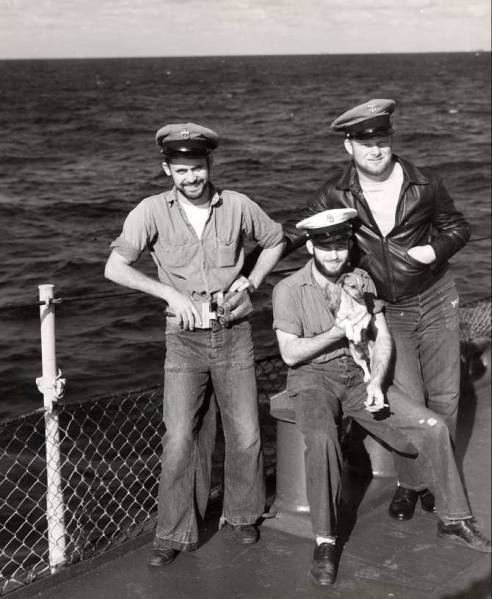
He cross decked to the ship from a Yard Water Barge (YW) in Da Nang Republic of Viet Nam. He came to us for a price. He cost six packs of Red Bug Juice, a couple loaves of fresh baked bread and a pound of butter. He left his Mama and his siblings on the deck of the YW.
He was a black and white puppy of questionable ancestry. We were half way to Subic with a tow before the Officers learned he was aboard. The XO was for putting him over the side. He was worried about animal and quarantine laws in the various countries we visited.
The Captain looked at him and said, “He’s a cute Son-of-a-Bitch. Just keep him hidden when we are in port.” That was how he acquired the rather unusual name. Since the term was an integral part of a sailor’s conversation, Son-of-a-Bitch came to think that he was needed in all areas of the ship.
He was sworn in as a Seaman Recruit. Over the first few weeks, he underwent a rigorous training program. He learned to use the fantail for a toilet in good weather and the head in rough weather. He learned that he wasn’t permitted in Sickbay, the Wardroom, or the Galley. He could go pretty much anywhere on the main deck he wished. He learned early that he could climb the ladders, but usually fell when he tried to descend a ladder. He often slept in the passageway forward by Supply.
Son-of-a-Bitch also learned ship’s routine, and since he was a non-watch stander and had no duties, he managed to be at the head of the chow line for all meals.
The signalman had a sewing machine area in the Supply storeroom. One of the deck Seaman who had sewing ability converted an old dress uniform to a doggie size dress blue jumper with the piping rank and everything. He fell in with the Deck/Supply Division for Quarters and Inspections.
During his two and a half years in the crew, he was advanced as high as Seaman several times. Every time you thought he would make it he screwed up and the BM1 held mast on him.
SN Son-of-a-Bitch didn’t go on liberty often because of the necessity to keep him hidden inport. Although a couple of snipes did bring a bitch dog in heat aboard and he had his way with her. Another time some snipes took him ashore in Yokosuka and paid a streetwalker to give him a blowjob.
When we learned, we were getting a new Commanding Officer, the decision was made to retire Son-of-a-Bitch into the care of an EN1. An appropriate retirement ceremony was held on the Foc’sle. He was presented with an Honorable Discharge, DD214, transfer to the Fleet Reserve, and a meritorious promotion to Kay Nine Third Class. A box of Milk Bone Biscuits was ceremoniously opened, and he partook of a couple (the RM3 joined him and ate a couple also).
He was piped over the side and went to live out his retirement years in a life of luxury although the EN1’s wife shortened his name to Son.

Liberty Machine
By: Robert “Okie Bob” Layton
USS Coral Sea 1981
VFP-63
We had just completed a 135 day at sea period in the Indian Ocean. We were pulling into the PI for a much-anticipated liberty. With us was a 3rd class metalsmith by the name of Medina a fairly decent sailor, & “cherry boy to the PI.” Well, old Medina had duty the first day in port, so no off base liberty for him that day. Early next morning as the Liberty party came back onboard old Medina really got his ears full of the wonders of Subic and was really pumped-up about his upcoming liberty.
Since it was his first time, Joe Creapo and Red Lahe were to take Medina under their wings for his “Liberty in PI” indoc. Well true to their character Joe and Red left instructions for Medina to catch a taxi from the Cubi Carrier pier, go to the main gate, walk across Shit River, turn right on Murphy Street, and Meet us at the Marmont bar. Where all of us VFP-63 Det-2 sailors were hanging out.
Well, sir, Medina was completely green in the ways of the PI. So he gets off the ship about 0900 goes down the after brow gets into the taxi line.
Anyone that has been tied up to the carrier pier in Cubi knows how it uses to work. You stood in line and as the taxis pulled up the guy getting into the taxi usually turned around and addressing the remaining line would say something to the effect “anyone going to the main gate—–top of the hill—–exchange—ETC?” room for 1, 2, 3 more.
It was one of them unspoken rules (people who had been there before) done. Everyone shared space and the cost of the ride too!
When it came time for Medina to grab a taxi he failed to observe the taxi etiquette and just jumped into the front seat followed immediately by three sailors (whom he didn’t know) in the back seat.
Throwing away all time-honored precedence Medina started to question the move by the uninvited riders stating “This here is MY taxi now get out.”
The three sailors dumbfounded by his unusual behavior pleaded their case saying “Hey man you’re going to the Main Gate aren’t ya?”
Medina still oblivious to the workings said: “Yes but this is still MY taxi so—get the fuck get out!”
By this time the taxi had traveled about 200 feet when Medina gave the order to the taxi driver to stop.
When the cab came to a halt, the three sailors got out, opened up Medina’s door, —-got Medina the fuck out, and commenced to kick the living shit out of him to the cheers of the remaining Liberty party/taxi line.
After the older sailors had taken care of this west-Pac transportation neophyte, they started loading back into the taxi.
The newly designated shotgun rider looked back & shouted “room for one more–main gate.” And Medina’s recently vacated seat was instantly replaced by another sailor.
Well, the JOOD (junior officer of the deck) had also seen the goings on down on the pier and dispatched the ships oncoming shore patrol to take care of the ruckus on the shore.
Medina was instantly scooped-up and taken to sick bay. Where he was patched-up, stitches above the right eye, skin knocked off cheeks and forehead; you know the common (I-got-my-ass-kicked) injuries. Of course along with the injury came the insult he was taken out of liberty status and restricted to the ship for the remaining import.
We all felt a little sorry for Medina, not for his ass whoop, but because he had missed liberty in one of the best ports in the world.
Back out at sea we were all comparing notes laughing about the good times and just reliving the incredible liberty everyone had experienced in the PI.
Everyone that is except Medina. Who sat quietly in the corner still banged-up, And now about+140 days from his last tube cleaning.
People were just carrying on something awful showing off stuff they had purchased, you know that hard to find things like T-shirts, pictures of dogs playing cards, fine Magsaysay Street jewelry, and tattoos.
After the “show” came the “tell” San Miguel consumption was the topic with everyone trying to convince his shipmate who had drank the most.
Next was the “Top Gun” bragging rites centered on the most bagged hookers competition.
Followed by the “I was a bad ass” stories. It was at this time Medina joined in on the conversation. Rehashing his five-minute Liberty, Medina tried to convince us how he had the upper hand in the great taxi cab brawl.
But you just can’t bullshit them old salts, about mid-sentence in his description of how he had kicked the intruders out of HIS taxi Joe butts in, “Medina” he says “you’re full of shit admit it, you just overloaded your ass and got it handed back to you.”
Medina replies back “Joe if you and Red had been WITH me maybe the odds would have been even, and we could have handled those guys.”
Joe answers back “Medina, Red or me wouldn’t have kicked those guys out, to begin with.”
I’ll tell you what boot camp, Next liberty we will make sure you have a good time—-your way”.
“I’m going to make you a Liberty Machine.”
At this point everyone’s attention was focused on Joe, he adds “Here is how it is going to work.”
(1) I’ll set the machine up down on the pier.
(2) I’ll make sure there are plenty of boots like you standing in line waiting to use the. machine
(3) I’ll have it all painted up so you can’t mistake it (looks something like a photo booth).
(4) After waiting in line for awhile 2+hours you enter the machine.
(5) You will sit down in front of a blank TV screen.
(6) A recording will come on telling you to deposit one dollar (pretty cheap hey).
(7) After you deposit a dollar, a little door will open, out of which will drop a shot glass full of really cheap gin.
(8) As you reach to grab the gin, a hand comes out and locks on your wrist another arm drops down with a needle and starts to give you a Tattoo it reads (MOM).
(9) At the same time your getting tattooed a little suction tube comes out of the bottom and clamps on your dick however it doesn’t give you a blow job just the clap.
(10) The machine will ask for all your money and you wanting to finish your blow job will start to put money into it then you will realize you can do it yourself and stop with the money.
(11) That’s when the two boxing gloves come out of the sides and start to beat the living crap out of you.
(12) Another hand comes out takes your wallet, and all your money rips up your liberty card and loses your ID.
(13) A phone automatically calls the shore patrol.
(14) A side door opens and ejects you out of the machine.
(15) The shore patrol arrives takes you back on board the ship.
“So ya see Medina you don’t need Red or me for liberty, take a tip from us old salts, and just go down & get in line for the Liberty machine.”
“It will be everything you need, cheap drunk, tattoo, quick sex, a case of the clap, a fight on liberty, shore patrol involvement, and punitive action.”
“Damn boy just about everything a seagoing sailor needs to pull off a successful liberty and the beauty about it is——– you have all the evidence of a long and hard liberty (without any witness) so you can tell it any way you want.”
Everyone cracked up, including Medina.
Postscript: Medina did get liberty the next import.

Beer for Breakfast
Garland Davis
Early one day when the sun wouldn’t shine
I walked into the Hole in the Wall not feeling too fine
I saw two sailors with two honey-ko’s an’ San Miguel before ’em
And this was the song that I heard them singing
Chief forgive us and protect us,
We’ve been drinking beer for breakfast
Well my LBFM and I stopped by the table where they was sitting
And I couldn’t believe how drunk they were getting
I said “shipmates, have you been drinking long?”
They said ‘Just long enough to be singing this song”
Chief forgive us and protect us,
We’ve been drinking beer for breakfast
Well they passed me a bottle and I took a little sip
And it felt so good I just couldn’t quit
I drank some more and next thing I knew
All of us were sitting there singing this tune
Chief forgive us and protect us,
We’ve been drinking beer for breakfast
One by one every shipmate who could hear the sound
Heard our ruckus and they came around
And pretty soon the Hole was ringing
With the sound of the every sailor laughing and singing
Chief forgive us and protect us,
We’ve been drinking beer for breakfast

(Chorus)
Wrap me up in me oilskins and jumper
No more on the docks I’ll be seen
Just tell me old shipmates I’m takin’ a trip mates
I’ll see you someday in Fiddler’s Green
Oh in Fiddler’s Green is a place I’ve heard tell
Where sailormen go if they don’t go to hell
Where the weather is fair and the dolphins do play
And the cold coast of Greenland is far far away
Where the skies are all clear and there’s never a gale
And the fish jump on board with a swish of their tails
Where you lie at your leisure – there’s no work to do
And the skipper’s below making tea for the crew
Oh and when you are docked and the long trip is through
There’s pubs and there’s clubs and there’s lassies there too
Where the girls are all pretty and the beer is all free
And there’s bottles of rum growin off every tree
Oh I don’t want a harp nor a halo, not me
Just give me a breeze and a good rollin sea
And I’ll play me auld squeezebox as we sail along
With the wind in the riggin to sing me this song

navy retirement
by: Garland Davis
a quiet knowledge, an
unspoken admission, a stupid goddamn truth
all our great adventures
lie in the past
that that we were has nothing to do with
who we are
but we will never forget that that we were
perhaps our truths no longer hold pleasure
but our fucking truths none the less
that very moment where we finally stopped
growing up and just started growing old
where we donned the cloak of USN(ret)

The Silver Cruiser
By: Garland Davis
He could see the cruiser in the mists at the end of the pier as he walked toward it, his seabag rocking lightly on his shoulder. Funny he always thought it was heavier than this. Although the pier was in golden sunlight, the ship was blurred, the gray almost silvery in the cloudy mist.
His orders had come in the middle of the night. He was to report at 0800 this morning. He glanced at his watch as he crossed the gangway. Exactly on time. He stood on the gangway and saluted during morning colors, turned and saluted the OOD and requested permission to board. The members of the Quarterdeck watch were squared away and efficient. There was something familiar about them. It was as if he knew them.
The Petty Officer of the Watch entered him in to the log and said, “Welcome Aboard Chief. I’ll have the Messenger show you to the CPO Mess.”
He answered, “That’s okay, I know the way. I’ve served in this class before.”
He walked forward on the port side and entered the water tight door just aft of the Wardroom and down the ladder into the Messdecks. He wanted a look at the Messdecks, the Galley, and his cooks. Breakfast was still being served for the guys just coming off watch. The food looked and smelled good. The spaces looked great and the mess cooks were neat and clean.
CS1 Roy, his old Galley Captain and LPO came around the drink line, wiping his hands on a clean apron, and said, “Hey Chief, we have been waiting for you. Good to have you aboard. Gonna be great to serve with you again!”
Roy said to one of the mess cooks. “Get the Chief’s seabag and carry it to the after CPO berthing, just across from his office. You are going to live there aren’t you Chief.”
“I hope so, if there is a bunk available.” The Chief replied.
“Oh, I’m sure there will be.” Roy said as he turned back toward the galley.
He followed the mess cook down the starboard passageway past the scullery. He stopped for a minute and noticed that the scullery looked neater and more squared away than he had ever seen it before. He caught up with the mess cook, thanked him, took his seabag and entered the berthing compartment. He was amazed to find his old bunk and locker vacant.
After making his rack, stowing his locker, and changing into a work khaki uniform, he headed forward, back through the Messdecks, to the CPO Mess. As he entered he saw many familiar faces as well as some strangers. A Master Chief BT that he knew, wearing the Command Master Chief Badge, rose, stuck out his hand, and said, Welcome aboard, Shipmate. We have been waiting for you. Did you find your bunk and locker okay? I had the compartment cleaner clean everything so it would be ready.”
“We’re getting underway. I have to go to the fireroom. I’ll be back in a little while and we can talk. Have a cup of coffee and breakfast. I won’t be long.”, The Master Chief said as he prepared to leave the mess.
“Just some coffee” the Chief said to his back as he went out the door. As he turned, the mess cook set a cup marked with his name and a CPO anchor on the table and said, “Here you go Chief.”
“Still crankin’ in the CPO mess Johnson?” The Chief said, taking a drink from the cup and thinking, this is one fine cup of coffee. He wondered why he knew the kid’s name.
“Yep seems like I’ll always be here. I don’t mind, it’s good duty lookin’ after you guys.” Johnson replied as he gathered up the plates and cups to wash.
“Now set the Special Sea and Anchor Detail for getting underway.” Blasted the 1MC speaker as the Chief sat down in his usual seat with his coffee. He looked around the mess at the Acey Deucy board and dice stowed away in their niche alongside the cribbage board. There was the Chief’s Creed framed in a prominent place on the bulkhead with the three carved wooden anchors from the PI above it.
He felt movement from the ship as the tugs bumped alongside and later could hear the sound of the water rushing down the side as the ship gained speed leaving port. He took a sip of his coffee and thought, “Damn, it is good to be at sea again.”
“Now secure the Special Sea and Anchor Detail, set the normal underway watch, commence ship’s work.” From the 1MC as the Master Chief comes back into the Mess. “Let’s take a walk around, Dave,” he says.
They exit the Mess and go aft toward the Galley. As they walk aft, crew members greet him with, Welcome Chief.” And “Great to have you back Chief.”
The CMC says, “You’ve got a good crew here Chief. You won’t have any worries with them. As a matter of fact, the whole ship functions well without any problems.”
“Where are we headed?” the Chief asks.
“To sea.”
“What are we gonna do?”
“Steam.”
‘When will we be back?”
“Never.”
“Why are we going out?”
“Don’t ask me, I’m just a snipe.”
As they walked down the passageway toward the Galley and Messdecks something didn’t seem right to the Chief. He asked the Master Chief, “We both retired from the Navy. Why are we back?”
“You remember how Boats Grimley used to talk of a silver cruiser in the sky when the end comes?” the BT replied.
“Yes. How could I forget. Tied up at the end of a golden pier.”
“Well this is it, the Silver Cruiser.”
“You mean?”
“Yes! This is our Valhalla! This is a sailor’s heaven! This is where old sailors go for the rest of forever. The Old Man told me our next port of call is a place called Fiddler’s Green! All our old shipmates are there.”
To follow Tales of an Asia Sailor and get e-mail notifications of new posts, click on the three white lines in the red rectangle above, then click on the follow button. To see a menu of previously published articles, click on the three white lines in the red rectangle above.
A native of North Carolina, Garland Davis has lived in Hawaii since 1987. He always had a penchant for writing but did not seriously pursue it until recently. He is a graduate of Hawaii Pacific University, where he majored in Business Management. Garland is a thirty-year Navy retiree and service-connected Disabled Veteran.

Pussy Whipped
By: Lee Thayer
This was on my second ship, in San Diego. I had a guy in my Division that was pussy whipped even to the point of lying to the chain of command. This is a no shitter story, I was on the quarterdeck when this happened.
The kid started out with “my wife was pregnant but had a miscarriage, can I have a few days off?” Well, sure, we were going to be in town for a few weeks, so we give the kid about three days special libs. All seems good, about another month or two later, “my wife was pregnant and had a miscarriage…” You know the rest, asked for a few more days off as we would be in town for a few weeks, the command reluctantly, granted three days special libs.
This happened a third time, chit denied, by the CO (and the whole chain of command). The day after this kid told his wife, I knew her, very attractive woman really, she arrived on the quarterdeck and demanded to see her husband, and the Commanding Officer. Word is passed for the husband, and the CO is politely called and asked to come to the quarterdeck, this going through the CDO, and the XO. Captain agreed to come to the quarterdeck.
The woman lit into the Captain with swear words that would make sailors blush, Captain simply replied, show me a dead fetus, and I will give your husband special liberty. She cursed more, the Captain simply looked over at the OOD and said I want this woman off my ship, if she comes up the brow, shoot her. The POOW loaded and jacked a round into his 45. The MOOW took her off the ship to the pier. CO took the young lad to his stateroom for an ass chewing, the woman never came up that brow again.

Origins of Navy Terminology
Every profession has its own jargon, and the Navy is no exception. For the Navy, it’s bulkhead, deck and overhead and not wall, floor, and ceiling. Some nautical terminology has found its way into everyday use, and you will find the origins of this and Navy terminology below. More terminology will be added from time to time.
Above Board
The term today means someone who is honest, forthright. Its origin comes from the days when pirates would masquerade as honest merchantmen, hiding most of their crew behind the bulwark (side of the ship on the upper deck). They hid below the boards.
Ahoy!
This old traditional greeting for hailing other vessels was originally a Viking battle cry.
Between the Devil and the Deep
In wooden ships, the “devil” was the longest seam of the ship. It ran from the bow to the stern. When at sea and the “devil” had to be caulked, the sailor sat in a bo’sun’s chair to do so. He was suspended between the “devil” and the sea — the “deep” — a very precarious position, especially when the ship was underway.
Chewing the Fat
“God made the vittles but the devil made the cook,” was a popular saying used by seafaring men in the 19th century when salted beef was a staple diet aboard ship.
This tough cured beef, suitable only for long voyages when nothing else was cheap or would keep as well (remember, there was no refrigeration), required prolonged chewing to make it edible. Men often chewed one chunk for hours, just as it were chewing gum and referred to this practice as “chewing the fat.”
Crow’s Nest
The raven, or crow, was an essential part of the Vikings’ navigation equipment. These land-lubbing birds were carried on board to help the ship’s navigator determine where the closest land lay when weather prevented sighting the shore. In cases of poor visibility, a crow was released, and the navigator plotted a course corresponding to the bird’s flight path because the crow invariably headed towards land.
The Norsemen carried the birds in a cage secured to the top of the mast. Later on, as ships grew and the lookout stood his watch in a tub located high on the main mast, the name “crow’s nest” was given to this tub. While today’s Navy still uses lookouts in addition to radars, etc., the crow’s nest is a thing of the past.
Cup of Joe
Josephus Daniels (18 May 1862-15 January 1948) was appointed Secretary of the Navy by President Woodrow Wilson in 1913. Among his reforms of the Navy were inaugurating the practice of making 100 Sailors from the Fleet eligible for entrance into the Naval Academy, the introduction of women into the service, and the abolishment of the officers’ wine mess. From that time on, the strongest drink aboard Navy ships could only be coffee and over the years, a cup of coffee became known as “a cup of Joe”.
Devil to Pay
Today the expression “devil to pay” is used primarily to describe having an unpleasant result from some action that has been taken, as in someone has done something they shouldn’t have and, as a result, “there will be the devil to pay.” Originally, this expression described one of the unpleasant tasks aboard a wooden ship.
The “devil” was the wooden ship’s longest seam in the hull. Caulking was done with “pay” or pitch (a kind of tar). The task of “paying the devil” (caulking the longest seam) by squatting in the bilges was despised by every seaman.
Eight Bells
Aboard Navy ships, bells are struck to designate the hours of being on watch. Each watch is four hours in length. One bell is struck after the first half-hour has passed, two bells after one hour has passed, three bells after an hour and a half, four bells after two hours, and so forth up to eight bells are struck at the completion of the four hours. Completing a watch with no incidents to report was “Eight bells and all is well.”
The practice of using bells stems from the days of the sailing ships. Sailors couldn’t afford to have their own time pieces and relied on the ship’s bells to tell time. The ship’s boy kept time by using a half-hour glass. Each time the sand ran out, he would turn the glass over and ring the appropriate number of bells.
Fathom
Fathom was originally a land measuring term derived from the Ango-Saxon word “faetm” meaning to embrace. In those days, most measurements were based on average size of parts of the body, such as the hand (horses are still measured this way) or the foot (that’s why 12 inches are so named). A fathom is the average distance from fingertip to fingertip of the outstretched arms of a man — about six feet. Since a man stretches out his arms to embrace his sweetheart, Britain’s Parliament declared that distance be called a “fathom,” and it be a unit of measure. A fathom remains six feet. The word was also used to describe taking the measure or “to fathom” something. Today, of course, when one is trying to figure something out, they are trying to “fathom” it.
Feeling Blue
If you are sad and describe yourself as “feeling blue,” you are using a phrase coined from a custom among many old deepwater sailing ships. If the ship lost the captain or any of the officers during its voyage, she would fly blue flags and have a blue band painted along her entire hull when returning to home port.
Forecastle
The appropriate pronunciation for this word is fo’ksul. The forecastle is the forward part of the main deck. It derives its name from the days of Viking galleys when wooden castles were built on the forward and after parts the main deck from which archers and other fighting men could shoot arrows and throw spears, rocks, etc.
Galley
The galley is the kitchen of the ship. The best explanation as to its origin is that it is a corruption of “gallery”. Ancient sailors cooked their meals on a brick or stone gallery laid amidships.
Gun Salutes
Gun salutes were first fired as an act of good faith. In the days when it took so long to reload a gun, it was a proof of friendly intention when the ship’s cannon were discharged upon entering port.
Head
The “head” aboard a Navy ship is the bathroom. The term comes from the days of sailing ships when the place for the crew to relieve themselves was all the way forward on either side of the bowsprit, the integral part of the hull to which the figurehead was fastened.
He Knows the Ropes
In the very early days, this phrase was written on a seaman’s discharge to indicate that he was still a novice. All he knew about being a sailor was just the names and uses of the principal ropes (lines). Today, this same phrase means the opposite — that the person fully knows and understands the operation (usually of the organization).
Holystone
The last Navy ships with teak decks were the battleships, now since decommissioned. Teak, and other wooden decks, were scrubbed with a piece of sandstone, nicknamed at one time by an anonymous witty sailor as the “holystone.” It was so named because since its use always brought a man to his knees, it must be holy! However, holystones were banned by the Navy by General Order Number 215 of 5 March 1931 because they wore down the expensive teak decks too fast.
Hunky-Dory
The term meaning everything is O.K. was coined from a street named “Honki-Dori” in Yokohama, Japan. Since the inhabitants of this street catered to the pleasures of sailors, it is easy to understand why the street’s name became synonymous for anything that is enjoyable or at least satisfactory. And, the logical follow-on is “Okey-dokey.”
Listless
Today it means to be dull or without pep. It comes from the days of sail when a ship was becalmed and rode on an even keel …. without the port or starbord list experienced under a good breeze. No wind, no list; no list, lifeless.
Log Book
In the early days of sailing ships, the ship’s records were written on shingles cut from logs. These shingles were hinged and opened like a book. The record was called the “log book.” Later on, when paper was readily available and bound into books, the record maintained it name.
Long Shot
Today it’s a gambling term for an event that would take an inordinate amount of luck. It’s origins are nautical. Because ships’ guns in early days were very inaccurate except at close quarters, it was an extremely lucky shot that would find its target from any great distance.
Mayday
“Mayday” is the internationally recognized voice radio signal for ships and people in serious trouble at sea. Made official in 1948, it is an anglicizing of the French m’aidez, “help me”.
No Quarter
“No quarter given” means that one gives his opponent no opportunity to surrender. It stems from the old custom by which officers, upon surrender, could ransom themselves by paying one quarter of a year’s pay.
Pea Coat
Sailors who have to endure pea-soup weather often don their pea coats but the coat’s name isn’t derived from the weather. The heavy topcoat worn in cold, miserable weather by seafaring men was once tailored from pilot cloth — a heavy, course, stout kind of twilled blue cloth with the nap on one side. The cloth was sometimes called P-cloth for the initial letter of “pilot” and the garment made from it was called a p-jacket — later, a pea coat. The term has been used since 1723 to denote coats made from that cloth.
Port holes
The word “port hole” originated during the reign of Henry VI of England (1485). King Henry insisted on mounting guns too large for his ship and the traditional methods of securing these weapons on the forecastle and aftcastle could not be used.
A French shipbuilder named James Baker was commissioned to solve the problem. He put small doors in the side of the ship and mounted the cannon inside the ship. These doors protected the cannon from weather and were opened when the cannon were to be used. The French word for “door” is “porte” which was later Anglicized to “port” and later went on to mean any opening in the ship’s side, whether for cannon or not.
Scuttlebutt
The origin of the word “scuttlebutt,” which is nautical parlance for a rumor, comes from a combination of “scuttle” — to make a hole in the ship’s hull and thereby causing her to sink — and “butt” — a cask or hogshead used in the days of wooden ships to hold drinking water. The cask from which the ship’s crew took their drinking water — like a water fountain — was the “scuttlebutt”. Even in today’s Navy a drinking fountain is referred to as such. But, since the crew used to congregate around the “scuttlebutt”, that is where the rumors about the ship or voyage would begin. Thus, then and now, rumors are talk from the “scuttlebutt” or just “scuttlebutt”.
S.O.S.
Contrary to popular notion, the letters S.O.S. do not stand for “Save Our Ship” or “Save Our Souls”. They were selected to indicate a distress because, in Morse code, these letters and their combination create an unmistakable sound pattern.
Splice the Main Brace
In the age of sail, ship’s rigging was a favorite target during sea battles because destroying the opponent’s ability to maneuver or get away would put you at obvious advantage. Therefore, the first and most important task after a battle was to repair damaged rigging (also known as lines- but never “rope”!). Examples of lines include braces (lines that adjust the angle at which a sail is set in relation to the wind) and stays (lines supporting the masts).
The main brace was the principal line controlling the rotation of the main sail. Splicing this line was one of the most difficult chores aboard ship, and one on which the ship’s safety depended. It was the custom, after the main brace was properly spliced, to serve grog to the entire crew. Thus, today, after a hard day (or, not so hard day), the phrase has become an invitation to have a drink.
Starboard
The Vikings called the side of their ship its board, and they placed the steering oar, the “star” on the right side of the ship, thus that side became known as the “star board.” It’s been that way ever since. And, because the oar was in the right side, the ship was tied to the dock at the left side. This was known as the loading side or “larboard”. Later, it was decided that “larboard” and “starboard” were too similar, especially when trying to be heard over the roar of a heavy sea, so the phrase became the “side at which you tied up to in port” or the “port” side.
Taken Aback
One of the hazards faced in days of sailing ships has been incorporated into English to describe someone who has been jolted by unpleasant news. We say that person has been “taken aback.” The person is at a momentary loss; unable to act or even to speak. A danger faced by sailing ships was for a sudden shift in wind to come up (from a sudden squall), blowing the sails back against the masts, putting the ship in grave danger of having the masts break off and rendering the ship totally helpless. The ship was taken aback.
Three Mile Limit
The original three-mile limit was the recognized distance from a nation’s shore over which that nation had jurisdiction. This border of international waters or the “high seas” was established because, at the time this international law was established, three miles was the longest range of any nation’s most powerful guns, and therefore, the limit from shore batteries at which they could enforce their laws. (International law and the 1988 Territorial Sea Proclamation established the “high seas” border at the 12-mile limit.)
Three Sheets to the Wind
We use the term “three sheets to the wind” to describe someone who has too much to drink. As such, they are often bedraggled with perhaps shirttails out, clothes a mess. The reference is to a sailing ship in disarray, that is with sheets (lines — not “ropes” — that adjust the angle at which a sail is set in relation to the wind ) flapping loosely in the breeze.
Took the wind out of his sails
Often we use “took the wind out of his sails” to describe getting the best of an opponent in an argument. Originally it described a battle maneuver of sailing ships. One ship would pass close to its adversary and on its windward side. The ship and sails would block the wind from the second vessel, causing it to lose headway. Losing motion meant losing maneuverability and the ability to carry on a fight.
Wallop
When the French burned the town of Brighton, England, in the 1500s, King Henry VIII send Admiral Wallop to retaliate and teach the French a lesson. He so thoroughly wrecked the French coasts, that ever since, a devestating blow is said to be an “awful wallop.”
Watches
Traditionally, a 24-hour day is divided into seven watches. These are: midnight to 4 a.m. [0000-0400], the mid-watch; 4 to 8 a.m. [0400-0800], morning watch; 8 a.m. to noon [0800-1200], forenoon watch; noon to 4 p.m. [1200-1600], afternoon watch; 4 to 6 p.m. [1600-1800] first dog watch; 6 to 8 p.m. [1800-2000], second dog watch; and, 8 p.m. to midnight [2000-2400], evening watch. The half hours of the watch are marked by the striking the bell an appropriate number of times.
| The Old Outfit
By: A World War Two Sailor
Come gather round me lads and I’ll tell you a thing or two, We wore the ole bell bottoms, with a flat hat on our head; Now, when a ship puts out to sea, I’ll tell you son it hurts, What happened to the KiYi brush, and the old salt-water bath? In your seabag all your skivvies, were neatly rolled and stopped; We had scullery maids and succotash and good old S.O.S.; Now, you never hear of Davey Jones, Shellbacks or Polliwogs; We were all two-fisted drinkers – and no one thought you sinned, Rocks and shoals have long since gone, and now it’s U.C.M.J.; So when my earthly hitch is over, and the good Lord picks the best, |
 Tales of an Asia Sailor