
Monthly Archives: June 2017
The Caine Mutiny
The Caine Mutiny
A Facebook post by Dave Petersen. Published with his permission
LIEUTENANT COMMANDER PHILIP FRANCIS QUEEG USN served as commanding officer of the USS Arthur Wingate Caine DMS-18 (or DMS-22 in the original source material). (Note: “DMS” stands for “Destroyer Minesweeper” and refers to a World War I era destroyer converted for high-speed sweeping. DMS’s of that era carry low registry numbers because they are among the first destroyers to launch.)

He succeeded to this command in September of 1943. On 18 December 1944, his executive officer, Lieutenant Steven W. Maryk USNR, relieved him of command under Artlcles 184, 185 and 186 of the Articles for the Government of the Navy, then the governing body of regulations for the Navy. (World War II, of course, predated the Uniform Code of Military Justice that now serves as the body of military law in all services.) That act occasioned a sensational court-martial of Maryk that, ironically, caused the Navy to shunt Commander Queeg into shore billets for the duration of the war.
Queeg graduated the US Naval Academy in 1936. As the court-martial of Lt. Maryk (see above) later disclosed, he did not bear up well under the hazing from upperclass midshipmen. He came out of the Academy determined to prove himself perfect and to give no one any cause for complaint.
In 1937 he served as an ensign aboard the destroyer USS Barzun, on assignment in the Atlantic, on patrol for German U-Boats. His service record includes one letter of commendation he earned on that cruise. The occasion: as crew’s mess treasurer (his collateral duty), he discovered a discrepancy in the ship’s cooks accounts, concerning a quantity of cheese for which the cook could not account. Queeg insisted on following the lead, though his executive officer told him to “forget it.” Queeg discovered that one sailor had made a wax impression of the key to the galley icebox and was helping himself to the cheese every chance he got. Queeg caught the sailor red-handed and saw him tried and convicted in a summary court-martial, and drummed out of the Navy in disgrace.
In September of 1943 he transferred to the Pacific and finally earned his first command: as commanding officer of the USS Caine. Queeg ran his ship “by the book.” And from the beginning, he had problems.

Among his first missions, he drew orders to tow practice targets for the battleships and destroyers in Pearl Harbor. After but a few such missions, he cut a towline by steaming over it in a circle. He did this because, of all things, he was reprimanding a sailor at length for having his shirttail out–and also reprimanding the ship’s morale officer (then-Ens. Willis Seward Keith USNR) and communications officer (Lt. Thomas Keefer USNR) for alleged lapses in supervising this sailor. (The source material identifies said sailor as Signalman Third Class Louis Urban USN, but the famous Humphrey Bogart movie identifies him as Water Tender Third Class “Horrible” Dlugatch USN.) Queeg sent word to Commander, Service Squadron Pacific that a “defective” towline had parted, leaving the target adrift. The service squadron’s commanding admiral, thoroughly irritated, cut orders to send the Caine and one other DMS to the San Francisco Navy Yard for overhaul and new radar installations. As soon as he brought the ship in, he had to report to Com Twelve to talk about losing the practice target. He managed to convince Com Twelve that he could still handle things aboard the Caine.
Shore leave at his home in Phoenix, Arizona with his wife, his son, and his family dog was a bit of a strain. The Navy didn’t help his mood any when it cut the leave short. Hastily he summoned the officers and crew back to the Caine, and steamed southwest for Pearl Harbor–minus some twenty-five of his crew, who would rather stand trial by court-martial for missing ship than sail with him. He didn’t care–or at least, didn’t let on.
Shortly after making Pearl, he got orders to take part in the Flintlock Maneuver, otherwise known as the Battle of Kwajalein. His specific orders: to shepherd a wave of LVT attack boats from their transport to a line of departure 1000 yards off the beach of Jacob Island. He ran a mile ahead of the attack boats, insisted on turning tail way short of the line of departure, dropped a yellow dye marker, and retired at high speed, leaving the LVT crews and Marines to grope their way to their landfall as best they could. Thereafter his officers habitually referred to him as “Old Yellowstain.”
His interactions with his officers and crew went from bad to worse. Different projects mention different incidents, in different chronological order. But one incident stands out in the record: the Strawberry Incident. The details: Ensign Jorgensen, wardroom mess treasurer, managed to obtain a gallon of frozen strawberries from the crew of USS Bridge. That night, the officers helped themselves to a total of twenty-three helpings of ice cream and strawberries. And then Captain Queeg sent down for another helping of ice cream and strawberries. Whittaker, the leading steward, brought him the ice cream and said, “There [aren’t any more] strawberries.” At once Queeg jumped on this chance to investigate another theft. He refused to believe that Whittaker and his fellow steward’s mates had simply eaten the remaining quart of strawberries for themselves. He insisted on this narrative: that another sailor aboard the Caine had made himself a duplicate key to the wardroom icebox. He ordered all men aboard, officer and crew alike, to turn in every key they had. Then he ordered the officers to search the ship and crew for any stray keys. He little knew how bitterly he had heightened the resentment of himself on the part of the crew–or played straight into the hands of Lieutenant Keefer.
He found out soon enough on the morning of 18 December. The Caine encountered winds and seas the like of which he had never before experienced: Beaufort Force 10 to 12 winds and mountainous waves. He tried going down wind, to get out of the path of the storm, but the ship broached to three times in one hour. Then he froze to the engine-room telegraph. He barely felt it when Lt. Maryk actually shoved him aside. But when he realized the ship was now headed into the wind, he snapped out of his fog and insisted that Maryk turn the ship about. Not only did Maryk refuse, but he also put Queeg on the sick list as per Article 184. Thereafter Maryk steered the ship through the storm (and by one account, offered rescue to three survivors of a capsized ship, USS George Black).
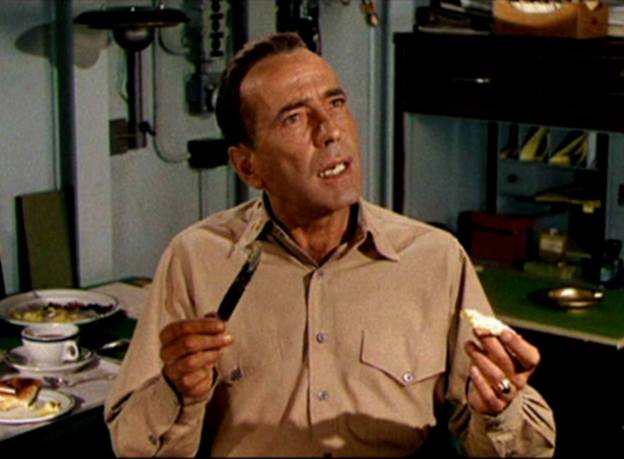
Queeg did make one other attempt to resume command, on the morning of the nineteenth. He tried to stop Maryk from reporting his relief of command to the local Officer in Tactical Command (OTC). Queeg tried to get Maryk to erase the incident from the quartermaster’s log and Officer of the Deck’s rough log, this although every regulation in the book forbade such erasures. Maryk refused, on principle. So Queeg, furious, told Maryk to go hang himself if he wanted to, and get out of his cabin.
Directly the Caine next made port, the local commandant had Queeg examined. He then asked Queeg whether to let Maryk take the Caine to Lingayen Gulf, where the Fifth Fleet next needed her. Queeg agreed. Maryk got the Caine through, this although she came under attack from a kami-kaze suicide pilot.
Eventually the Caine and all her officers came back to San Francisco, where the local JAG set up a court-martial, assigned Lt. Cmdr. Jack Challee USN to prosecute, and recruited Lt. Barney Greenwald USNR to defend. The court-martial proved disastrous for Queeg. Having to tell his side of the Shirttail Business, the Yellow Stain Business, the Strawberry Business, and a few other “businesses” of that nature proved his undoing. He didn’t take it with any terrible surprise when the court acquitted Maryk of the charge (of either Making a Mutiny or Conduct to the Prejudice of Good Order and Discipline). But Queeg was right about one thing: Maryk would never get a major command ever again.
BLOG NOTE:
Herman Wouk’s The Caine Mutiny may be the greatest American novel of World War II. This 1951 study of men at war with a foreign foe and with each other spent 122 weeks on the New York Times bestseller list and received a Pulitzer Prize in 1952. Wouk adapted the novel, his third, into a hit play; The Caine Mutiny Court-Martial became a much-produced classic. The 1954 film based on the book starred Humphrey Bogart in his least typical and arguably greatest role as Lieutenant Commander Philip Francis Queeg, the paranoid bully who captains a beleaguered destroyer-minesweeper. The Caine Mutiny earned seven Academy Award nominations. Since then, Wouk’s story has been retold countless times on stage, in film, and on television.
Wouk’s fictional revolt rings true because he was writing from intimate firsthand experience during World War II with the conditions, ships, and character types he portrays.
Wouk was an established writer by the time of Pearl Harbor. He enlisted immediately after that attack, attending midshipman school at Columbia University and communications school at the United States Naval Academy in Annapolis. Wouk fought in the Pacific from early 1943 until the war ended, serving in eight invasions aboard the World War I–era destroyer-minesweepers Zane and Southard.
Navy Truisms
Navy Truisms
By Anonymous
• A Sailor will walk 10 miles in a freezing rain to get a beer but complain about standing a 4 hour quarterdeck watch on a beautiful, balmy spring day.
• A Sailor will lie, cheat and scam to get off the ship early and then will have no idea where he wants to go.
• Sailors are territorial. They have their assigned spaces to clean and maintain. Woe betide the shipmate who tracks through a freshly swabbed deck.

• Sailors constantly complain about the food on the mess decks while concurrently going back for second or even third helpings.
• After a cruise, a Sailor will realize how much he misses being at sea. And after retiring from the Navy considers going on a cruise and visiting some of our past favorite ports. Of course we’ll have to pony up better than $5,000 for the privilege. Just to think, Uncle Sam actually use to pay us to visit those same ports years ago.
• You can spend three years on a ship and never visit every nook and cranny or even every major space aboard. Yet, you can name all your shipmates and every liberty port.
• Campari and soda taken in the warm Spanish sun is an excellent hangover remedy.

• PO2 / E-5 is almost the perfect military pay grade. Too senior to catch the crap details, too junior to be blamed if things go awry.
• Never be first, never be last and never volunteer for anything.
• Almost every port has a “gut.” An area teeming with cheap bars, easy women and partiers, which is usually the “Off-limits” area.
• Contrary to popular belief, Master Chief Petty Officers do not walk on water. They walk just above it.
• Sad but true, when visiting even the most exotic ports of call, some Sailors only see the inside of the nearest bars/clubs.
• Also under the category of sad but true, that lithe, sultry Mediterranean or Asian beauty you spent those wonderful three days with and have dreamed about ever since, is almost certainly a grandmother now.
• A Sailor can, and will, sleep anywhere, anytime.
• Yes, it’s true, it does flow downhill.

• In the traditional “crackerjack” uniform you were recognized as a member of United States Navy, no matter what port or part of the world you were in. Damn all who want to eliminate or change that uniform.
• The Marine dress blue uniform is, by far, the sharpest of all the armed forces.
• Most Sailors won’t disrespect a shipmate’s mother. On the other hand, it’s not entirely wise to tell them they have a good looking sister either.
• Sailors and Marines will generally fight one another, and fight together against all comers.
• If you can at all help it, never tell anyone that you are seasick.
• Check the rear dungaree pockets of a Sailor. Right pocket a wallet. Left pocket a wheel book.
• The guys who seemed to get away with doing the least, always seemed to be first in the pay line and the chow line.
• General Quarters drills and the need to evacuate one’s bowels often seem to coincide.
• Speaking of which, when the need arises, the nearest head is always the one which is secured for cleaning.
• Four people you never screw with: the doc, the DK, PC and the ship’s barber.
• In the summer, all deck seamen wanted to be signalmen. In the winter they wanted to be radiomen.
• Do snipes ever get the grease and oil off their hands?
• Never play a drinking game which involves the loser paying for all the drinks.
• There are only two good ships: the one you came from and the one you’re going to.
• Whites, coming from the cleaners, clean, pressed and starched, last that way about 30 microseconds after donning them. The Navy dress white uniform is a natural dirt magnet.
• Sweat pumps operate in direct proportion to the seniority of the official visiting.
• The shrill call of a bosun’s pipe still puts a chill down my spine.
• Three biggest lies in the Navy: We’re happy to be here; this is not an inspection; we’re here to help.
• Everything goes in the log.
• Rule 1: The Chief is always right. Rule 2: When in doubt refer to Rule 1.
• A wet napkin under your tray keeps the tray from sliding on the mess deck table in rough seas, keeping at least one hand free to hold on to your beverage.
• Never walk between the projector and the movie screen after movie call and the flick has started.
• A guy who doesn’t share a care package from home is no shipmate.
• When transiting the ocean, the ship’s chronometer is always advanced at 0200 which makes for a short night. When going in the opposite direction, the chronometer is retarded at 1400 which extends the work day.

• When I sleep, I often dream I am back at sea.
• If I had to do it all over again, I would. TWICE!
GOOD SHIPMATES ARE FRIENDS FOR LIFE!
The Naval Supply Systems
The Naval Supply Systems
By Garland Davis
Back in the day, you know when we were wet behind the ears teenage sailors manning a fleet of ships worn out from fighting WWII and the Korean wars, trying and succeeding in keeping them steaming off the coast of Vietnam, a place that we had only recently heard of, the Naval Supply System was a little ragged around the edges. It was run by a bunch of shore duty pukes and civilians who acted as if the cost of anything they issued to an afloat unit came directly from their pockets.

The major point of supply was either a Supply Center or a Supply Depot. These entities required properly completed and signed invoices for items that weren’t in stock. When you tried to walk a requisition through for the butter that had been NIS’d on yesterday’s delivery, yet you had just seen the butter in their reefer when you surreptitiously toured that it and were told it was not in stock because they were saving the butter for the shore duty galleys, the Officer’s Club, or the Flagship.
Is it any wonder fleet sailors were watched with a jaundiced eye when they neared anything that wasn’t welded to the deck or pier? It wasn’t uncommon to see a Yeoman strolling up the gangway with a box of typing paper that he had liberated from a pallet of stores meant for the ship that would soon tie up outboard.

I once talked a yardbird with a forklift into moving a pallet of food items from an empty berth to the foot of my ship’s gangway and had the items struck below by the time the other ship arrived. I was even gracious enough to loan their Chief Cook some of his own items while he sorted out his supply problems with NSD.
I remember snipes returning from a tender with pockets loaded down with so much metal that they clanked when they walked. They stole stuff that they had no idea what it was used for…why they needed it… it was just there.
The deck apes and others who stood cold topside watches traded old, taped up, greasy foul weather jackets between the watchstanders. Foul weather jackets were costly and there just wasn’t money to replace them with newer adequate ones. Yet, every tender sailor you saw sported a new clean foul weather jacket with sufficient pockets to carry his aviator sunglasses. I have seen numerous jackets where the AD-15 stenciled on the back had been covered with a white square and DD-??? Stenciled in black on the square. The owner of said foul weather jacket often sported new aviator sunglasses.
Snipes learned that they could steal anything within thirty feet of a dude wearing a welder’s mask. I had a cook striker come into the mess decks with an oxy acetylene regulator valve. I asked him where he got it and what was he going to do with it. He told me he stole it from a shop on the Prairie and figured the Shipfitters could use it. I have had crewmembers bring me can openers, knives, cutting boards and other galley accoutrements because it was there and they thought I might be able to use it.

Supply Officers hated ServeMart. A ServeMart chit was a sailor’s invitation to steal. You were given a requisition for money value only. You then went into the ServeMart with a shopping cart and chose items up to the money value of the requisition. Many a Blue Jacket’s personal tool box was stocked with tools from your local ServeMart.
I was in one ship where the air conditioning was extremely poor. It was tantamount to sleeping in a Sauna. A substantial air conditioning unit was dropped on the pier for a ship that was due in that day. Because of an emergency, the other ship would be a couple days late in arriving. By the time they tied up, said AC unit was firmly installed providing cool air to the Supply and Snipes berthing. The exterior of the unit was properly distressed, you know, banged, scratched, and repainted. As far as any of us knew, it had been there forever.
This was all long ago, in a different Navy. A long time ago when the Earth was young and so were we. They were great times because we beat the system and kept our old worn out ships at sea and out on the gunline.
I am proud to have been a small, insignificant part of it, to have had the honor of serving in ships with proud histories. These days you couldn’t duplicate our life, it’s gone and won’t be coming back. Today’s sailors can’t miss what they have never known.
Damn! It was a great time to be alive. Nineteen years old and a part of the world’s greatest Navy. Saltwater Buccaneers! It was one big sea going, “Hole in the Wall” gang.
Melbourne-Evans Collision
Melbourne–Evans Collision
By Garland Davis

The Melbourne–Evans collision was a collision between the light aircraft carrier HMAS Melbourne of the Royal Australian Navy (RAN) and the destroyer USS Frank E. Evans of the United States Navy (USN). On 3 June 1969, the two ships were participating in SEATO Exercise Sea Spirit in the South China Sea. At approximately 3:00 am, when ordered to a new escort station, Evans sailed under Melbourne‘s bow, where she was cut in two. Seventy-four of Evans‘ crew were killed.
A joint RAN–USN board of inquiry was held to establish the events of the collision and the responsibility of those involved. This inquiry, which was believed by the Australians to be biased against them, found that both ships were at fault for the collision. Four officers (the captains of Melbourne and Evans, plus the two junior officers in control of Evans at the time of the collision) were court-martialled based on the results of the inquiry; while the three USN officers were charged, the RAN officer was cleared of wrongdoing.
On the night of 2–3 June, Melbourne and her escorts were involved in anti-submarine training exercises. In preparation for launching a Grumman S-2 Tracker aircraft, Stevenson ordered Evans to the plane guard station, reminded the destroyer of Melbourne‘s course, and instructed the carrier’s navigational lights to be brought to full brilliance. This was the fourth time that Evans had been asked to assume this station that night, and the previous three maneuvers had been without incident. Evans was positioned on Melbourne‘s port bow but began the maneuver by turning starboard, toward the carrier. A radio message was sent from Melbourne to Evans‘s bridge and Combat Information Centre, warning the destroyer that she was on a collision course, which Evans acknowledged. Seeing the destroyer take no action and on a course to place herself under Melbourne‘s bow, Stevenson ordered the carrier hard to port, signaling the turn by both radio and siren blasts. At approximately the same time, Evans turned hard to starboard to avoid the approaching carrier. It is uncertain which ship began to maneuver first, but each ship’s bridge crew claimed that they were informed of the other ship’s turn after they commenced their own. After having narrowly passed in front of Melbourne, the turns quickly placed Evans back in the carrier’s path. Melbourne hit Evans amidships at 3:15 am, cutting the destroyer in two.
Melbourne stopped immediately after the collision and deployed her boats, liferafts, and lifebuoys, before carefully maneuvering alongside the stern section of Evans. Sailors from both ships used mooring lines to lash the two ships together, allowing Melbourne to evacuate the survivors in that section. The bow section sank quickly; the majority of those killed were believed to have been trapped within. Members of Melbourne‘s crew dived into the water to rescue overboard survivors close to the carrier, while the carrier’s boats and helicopters collected those farther out. Clothing, blankets, and beer were provided to survivors from the carrier’s stores, some RAN sailors offered their own uniforms, and the ship’s band was instructed to set up on the flight deck to entertain and distract the USN personnel. All of the survivors were located within 12 minutes of the collision and rescued before half an hour had passed, although the search continued for 15 more hours.
Seventy-four of the 273 crew on Evans were killed. It was later learned that Evans‘s commanding officer—Commander Albert S. McLemore—was asleep in his quarters at the time of the incident, and charge of the vessel was held by Lieutenants Ronald Ramsey and James Hopson; the former had failed the qualification exam to stand watch, while the latter was at sea for the first time.
]
Following the evacuation of Evans‘s stern, the section was cast off while the carrier moved away to avoid damage, but against expectation, it failed to sink.The stern was recovered and towed by fleet tug USS Tawasa to Subic Bay, arriving there on 9 June. After being stripped for parts, the hulk was decommissioned on 1 July and was later sunk when used for target practice.
Melbourne traveled to Singapore, arriving on 6 June, where she received temporary repairs to her bow. The carrier departed on 27 June and arrived in Sydney on 9 July, where she remained until November docked at Cockatoo Island Dockyard for repairs and installation of the new bow.
817 Squadron RAN—which was responsible for the Westland Wessex helicopters embarked on Melbourne at the time of the collision—was later awarded the Presidential Unit Citation for their rescue efforts. Five other decorations were presented to Australian personnel in relation to the rescue of Evans‘s crew: one George Medal, one Member of the Order of the British Empire (MBE), one Air Force Cross, and two British Empire Medals. Fifteen additional commendations for gallantry were awarded by the Australian Naval Board.
Gut Bandits and Belly Robbers
Gut Bandits and Belly Robbers
by Bob ‘Dex’ Armstrong

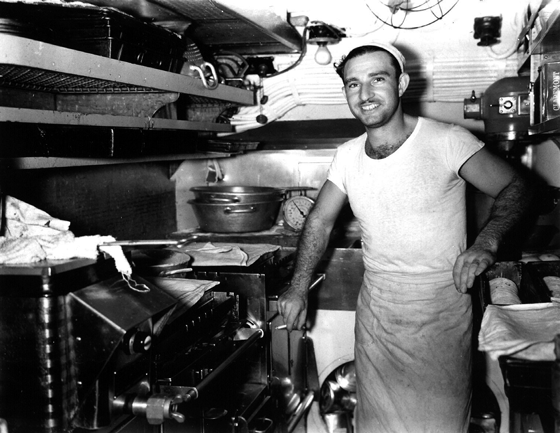
Without question, we had the best cooks in the Navy and the finest chow. Did we tell the cooks how good they were? Are you kidding? Insulting cooks was the major form of recreation and crew entertainment. Thin-skinned cooks didn’t last that long. A cook had to be both a great cook and have the hide of a Sherman tank.
In the past, we had a discussion on creamed chipped beef – On toast ‘Shit on a Shingle’, ‘Puss n’ Scabs’, ‘Foreskins on a Raft’, ‘Mung’… A dear child has many names. I have to go on record… I loved the stuff. I literally ate tons of it. While my shipmates moaned and groaned, I scoffed it up.
My mom died when I was nine. I grew up eating institutional chow… Good cream chipped beef is good rib-sticking chow. Kids who grew up eating mom’s traditional breakfast, entered the Navy considering Captain Crunch, Pop Tarts, Cream of Wheat, Cheerios and other stuff like toaster waffles, as what breakfast should be.
In most instances, they would have done one helluva lot better if they had thrown away the contents and eaten the gahdam box… Probably more nutritious.

If there are any old smoke boat stewburners out there, I doff my hat to you. I never ate better chow before of after my boat service. You guys dabbled in culinary magic and performed miracles with stainless steel pots, baking sheets and old worn out equipment. We handed you insult, you gave us great chow. There has never been a more lopsided return on investment.
We always knew when you loused something up… You always covered up with either canned mystery meat or gahdam macaroni and that Navy Velveeta cheese. That Velveeta cheese was at the extreme tail end of what could be remotely understood as acceptable chow. You could vulcanize tractor trailer tires with Navy Velveeta and you would eliminate all those recap chunks on the side of American highways.
That stuff never dissolved… It had a half-life on par with ancient Egyptian statuary. I still have a five pound wad of it stuck in my lower intestinal tract.
With all the asbestos we breathed and the Velveeta we ate, when they cremate an old smoke boat sailor, they are going to have to bust our lungs up with a sledgehammer and shovel a lot of melted cheese out of those cremation contraptions.
It was great food.
I remember standing topside watch in Halifax. It was cold… Had the 4 to 8… The after battery hatch was open. For an hour before dawn, the smell of baking cinnamon buns floated topside through the hatch. By the time I raised the below decks watch and got a load of fresh baked buns topside, my tongue was hanging out like 3 feet of red blanket.
I shared them with a boat watch moored outboard and the duty watch on a Canadian can. I hollered down for more but then ol’ Rodney “Rat” Johnson came topside. He was wearing the professional vestments of his position… A dirty apron, a sweat-soaked shirt… And an inverted white hat.
“Dex… What ‘n the hell’s going on? Where are my night buns disappearing to?”
I yelled to the guys on the other ships…
“This is the guy who makes these great rolls!”
“Hey, Cookie… You want a job in the Royal Canadian Navy?”
“Hey Cookie, damn good buns!”
“Hey Cookie… What ‘n the hell you doin’ in the Navy… You could make a gahdam fortune sellin’ these things.”
Only time I saw Rat at a loss for words. He smiled and said,
“Tell the freeloading bastards I’ll send up some more and make twice as many tomorrow night.”
He didn’t have to do that. He was a big part of what serving in the boats meant to a lot of us.
The Commissaryman of the old sub force put up with a lot… I know, I pinned a lot of it on them. You could steal a couple of brownies and get chased back to the maneuvering room by a man waving a cleaver. You could have someone shake you awake in the middle of the night of your twenty-first birthday… To be greeted by forty-odd shipmates participating in a conspiracy to wish you happy birthday. The centerpiece was a birthday cake with 21 Marlboro cigarettes sticking in it and a sentimental inscription that read,
“Dex, now you can buy a legal drink”
You old boat cooks were the best. In the Great Receiving Station in the Sky, Rat Johnson will be standing in a little galley that’s tough to turn around in… He’ll be feeding us all great stuff and yelling,
“If you bastards have any complaints… Eat down the street.”
He always said that.
 Tales of an Asia Sailor