Hurricane/Typhoon

Hurricane/Typhoon

By: Garland Davis

Hurricane.jpg

From Wikipedia: A typhoon is a mature tropical cyclone that develops in the northwestern part of the Pacific Ocean between 180° and 100°E. This region is referred to as the northwest Pacific basin. For organizational purposes, the northern Pacific Ocean is divided into three regions: the eastern (North America to 140°W), central (140°W to 180°), and western (180° to 100°E). Identical phenomena in the eastern north Pacific are called hurricanes, with tropical cyclones moving into the western Pacific re-designated as typhoons.

The Hurricane Season for the Hawaiian Islands runs from June first through November. There are, on average, four Central Pacific hurricanes each year and three named tropical storms. So far this year, we have had fourteen hurricanes. Only the first one did any damage and then only to the Big Island of Hawaii. Number fifteen, another tropical storm is forming in the Eastern Pacific and is expected to be at hurricane strength by the time it crosses into the central area later this week.

Having served twenty-five years afloat in, mostly, the Western Pacific, I probably saw more hurricanes/typhoons than most people, but I have only experienced two hurricanes ashore, Hurricane Hazel, as a child, and hurricane Iniki in Hawaii after I retired.

Growing up in the Piedmont region of North Carolina the worst threat from the Atlantic Hurricanes was some increased rainfall. There was little to no threat from the higher winds. On October 15, 1954, Hurricane became the, once in a century, exception. Hazel made landfall at Long beach, N.C., a community of Oak Island as a category four hurricane with winds exceeding 140 miles per hour. After landfall it tracked inland, and battering winds cut a wide swath northward toward Raleigh.

Hurricane1.jpg

I remember Hazel well. I was in the sixth grade. It was raining as we ran for the school bus. And it kept raining. By the time we arrived at school, the parking lot was flooded by a few inches and the side ditches of the roads were over flowing. The principle was at the bus stop informing the drivers to take everyone home. School had been canceled because of the weather. As we went back through the low point below Baux Mountain, we could see the creek was already over flowing.

My brother and I arrived home soaking wet. We lived on a dirt road and the bus driver refused to take us to the house. He didn’t want to risk getting stuck. It was only a mile to our house. We had to walk and were completely soaked with my brother crying by the time we made it home. There were other kids on our road, but we had the furthest to go. It rained for the next two days. When the weather cleared up, the Yadkin River looked like the Missississippi River and the creek behind the house was lapping at the lower level of the barn where the stalls were, a hundred yards from it’s normal banks. We moved the cows, goats and the mule into the garage and the shed. The aftermath of the flooding clearly showed the power of water.

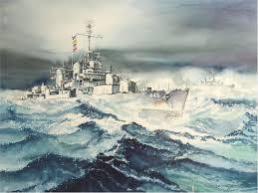
I cannot begin to count the number of typhoons that I have experienced. The Navy, when possible, sends ships to sea, when a typhoon or hurricane is imminent. A ship needs sea room to maneuver. Every mariner’s worst nightmare is to be caught on a lee shore during a storm.

I was serving in USS Mahopac, an Ocean Going Tug. We left Vung Tau, Viet Nam in the fall of 1968 with a huge square-ended floating crane in tow. We were bound for Sasebo, Japan. Our best towing speed was about three knots (80 miles per day). The trip would take about thirty days. A few days into the trip, we learned that we were in the path of a typhoon. We couldn’t run because of the drag of the tow and we could not abandon it. We had to ride it out.

Once the storm hit we could barely make turns (revolutions of the screw) for two knots. The towing motor reel that contained the towing wire would pay out wire when the strain was too heavy and take it back noisily when there was slack. If all the wire was taken off the spool it could result in damage to the motor and the ship and loss of the tow. Two knots were barely enough to maintain steerage way, keep the bow of the ship into the wind and seas and not severely overtax the towing equipment. We could not see the tow, it was lost in the rain. The only reason we knew it was there was the tension on the tow cable.

Water was washing over the signal bridge (the highest deck on the ship). We were taking up to forty-five degree rolls. The crew was extremely seasick. There were about six of us, out of a crew of forty-four that weren’t sick. The Captain, SM1, 2 EN1’s and an ICFN and I. The CO, the SM1 and I manned the bridge throughout that night, while the engineers kept the diesels running. I was helmsman for over twelve hours that night. Conditions started easing when morning came. I went to the galley to prepare some food and we started kicking guys out of their racks and getting them moving around again.

After about seventy-two hours of these conditions, the weather cleared and we sorted ourselves out and took inventory. We lost that radar antenna and mast, the ships boat, and anything that wasn’t bolted down. The exhaust stack from the engine room was bent aft at a slight angle. All electrical navigation was knocked out.

During the storm, the Navigator could only guess as to our position. When the he was able to get a position, he discovered that we were almost one hundred eighty astern of our last known position before the storm. The tow had towed us from a position north of Da Nang, South Viet Nam to a position NNE of Cape St Jacques, the southern tip of Viet Nam. I rode out many other storms, but this one was the worst.

I have been asked if I was afraid when the Morton came under fire during the waning days of the Viet Nam war. I tell them no. I got over being afraid during a storm one night in the South China Sea.

Hurricane or Typhoon, it doesn’t matter what the hell you call them.
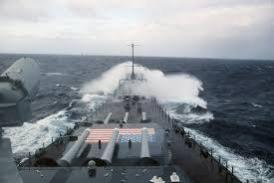
Hurricane2.jpg

Standard

Ten Signs That You Are a Sailor

Ten Signs That You Are a Sailor

By Garland Davis

five_us_navy_petty_officers_in_uniform.jpg

  1. Walking fast. You might be doing a great job of blending into your civilian surroundings, but your walk is always going to give you away. Sailors walk with a purpose as if their trip to the grocery store is a CNO press briefing.
  2. Hair. Broke your habit of getting a high and tight? Good for you. But that leaves you two options: the fade and the classic “Officer or Pilot hair.” Yes, we see you pushing the edges of the “three inches on the top” rule as prescribed in Naval Regulation 2201.1.a.
  3. Eating fast. Habits are hard to kick. And rarely in the Navy did you ever have ample time to appreciate your food even if you could.
  4. The power stance. Chief Petty Officers and Officers are easy to spot: Just look for the person attempting to own the room with the “crossed arms and not leaning against anything” stance.
  5. Jargon. Just try not to say “Roger that,” “Aye, Aye,” or “negative” in conversations. Just try. Eventually, your language will out you.
  6. Walking. There is no way that a group of Sailors can take a casual stroll down a sidewalk without eventually falling into step. Even if you try not to, you will.
  7. Sunglasses. Congratulations, you’re not wearing Oakleys or G.I. frames. Well done. But you’re still wearing sunglasses all the time, even when it is cloudy out.
  8. Absurd politeness. You can easily pick out Sailors by their over usage of “sir” and “ma’am.” It is a credit to the Navy’s discipline that a cashier at Piggly-Wiggly receives the same clipped tones and politeness That a Three Star Admiral would.
  9. Scanning crowds. Go to a department store, a mall or a party, and you’re bound to see that one person who is constantly scanning. Standing usually somewhere where they can see the whole room. And may God help the person acting suspicious because the Navy promotes being confrontational.
  10. Sleeping anywhere. Sailors can sleep approximately anywhere, in any weather, on anything. They also come out of it rapidly and coherently.
  11. You can’t converse worth a shit without using words Mom told you not to say.
  12. While others are agonizing over the choice of a wine for dinner, you order a draft beer.
Standard

Shit Happens

Shit Happens

Inspection1.jpg

In the Beginning was the Plan, and then came the Assumptions, and the Assumptions were without form, and the Plan was without substance.

Darkness was upon the faces of the men and women. The men and women went unto their Leading Seaman and said, “This is a crock of shit and it stinks”

The Leading Seaman went unto the Petty Officers saying, “It is a pail of dung and we can’t live with the smell.”

The Petty Officers went unto the Chief Petty Officers saying, “It is a container of excrement and it is very strong, such that none may abide by it.”

The Chief Petty Officers went unto the Division Officer saying, “It is a vessel of fertilizer and none may abide its strength”

The Division Officer went unto the Department Head saying, “It contains that which aids plant growth and it is very strong.”

The Department Head went unto the Executive Officer saying, “It promotes growth and it is very powerful.”

The Executive Officer went unto the Captain and said, “This new plan will actively promote the growth and vigour of the Men and Women with very powerful effects.”

The Captain looked upon the Plan and saw that it was good, and said, “Make it so.”

The Plan became Policy.

That my friends, is how shit happens.

Inspection.jpg

Standard

Brother of the ‘Phin

Dieselboat.jpg

Brother of the ‘Phin

Larry Dunn

Dieselboat1.jpg


I chanced upon a sailor once

with an emblem on his chest.

It appeared to be two angry sharks

on a trash can for a rest.


His white hat was wrinkled and dirty;

his neckerchief tied too tight

and he had only one eye open

as he staggered through the night.


He was young and scrawny and wiry;

with knuckles cracked and oozing.

I could tell from the way he looked and smelled

he’d spent the night whorin’ and boozin’.


But as he pulled abreast, he squared his hat

and said “Sir, do you have a light?

I’m due back aboard by quarter to four

Or the COB will be settin’ me right.”


As I fumbled around for my lighter

he pulled some smokes from his sock

“and I’ll be damned lucky to make it,” he muttered

‘Cause I’m steamin’ against the clock.”


Through the flame of my well-worn Zippo

I could see a smile on his face.

“But, you know — it was damn well worth it.

That ‘Bell’s’ is a helluva place.”


He sucked the smoke deep down in his lungs

and blew smoke rings up towards the moon

Then he rolled up his cuffs, pushed his hat to the back

and said, “Maybe there’ll be a cab soon.”


In spite of the time he was losing

He was wanting to shoot the breeze

So we sat on the curb, like two birds on a perch

as he talked of his life on the seas.


I asked about the thing on his chest

and he looked at me with a grin.

Then he squared his hat, snubbed out his smoke

and said, “I’m a Brother of the ‘Phin.”


“I’m one of the boys who go under the sea

where the lights from above don’t shine;

Where mermaids play and Neptune is king

and life and death intertwine.”


“Life on a boat goes deep in your blood

and nothing on earth can compare

to the feeling inside as she commences a dive

going deep on a hope and a prayer.”


“I’ve sailed some fearsome waters

down below the raging main

and I’ve heard that old boat creak and groan

like the wheels of a railroad train.”


“It’s the one place on earth where there ain’t no slack

where you don’t have more than you need;

where each man is prince of his own little space

and each lives by the submarine creed.”


“There ain’t much I’ve done in this fickle life

that would cause other men to take note,

But I’ve walked in the steps of some mighty fine men

who helped keep this country afloat.”


“They slipped silently through the layers

down below that raging main

while up above enemy men-o’-war

laid claim to the same domain.”


“Brave sailors were they

in their sleek boats of steel

silently stalking their prey

and closing in for the kill.”


“They died as they lived

unafraid, proud and free

Putting all on the line

to secure liberty.”


“Their bones now rest in glory

down in Neptune’s hallowed ground

But their souls stand tall at the right hand of God

Awaiting the klaxon’s next sound.”


“So, it’s more than a ‘thing’ that I wear on my chest

It’s a badge of the brave, proud and true.

It’s a tribute to those who have gone here before

riding boats that are still overdue”


“It’s the “Dolphins” of a submariner

worn proudly by the few

who’ve qualified at every watch

and touched every bolt and screw.”


“They know the boat on which they sail

like they know their very soul

and through the fires of hell or the pearly gates

they’re ready for each patrol.”


“But when in port they take great sport

standing out from all the rest.

For deep inside, they burn with pride

for the dolphins on their chest.”


Then he stood erect, squared his hat

and pulled his neckerchief down to the ‘V’

He rolled down his cuffs, put his smokes in his sock

and squinted back towards the sea.


“I can hear them diesels calling

So I’d best be on my way.

We’ll be punchin’ holes in the ocean

when the sun peeks over the bay.”


As I watched him turn and walk away

I felt honored to know such men.

for they bring life to Duty, Honor, Country

these “Brothers of the ‘Phin.”

Nuke Boat.jpg

Standard

LET THERE BE NO MOANING AT THE BAR…

LET THERE BE NO MOANING AT THE BAR…

USS-John-McCain-Sailors-1.jpg

Fitz.jpg

Old sailors sit

And chew the fat

About things that used to be,

Of the things they’ve seen’

The places they’ve been,

When they ventured out to sea.


They remember friends

From long ago,

The times they had back then,

The money they spent,

The beer they drank,

In their days as sailing men.


Their lives are lived

In the days gone by

With the thoughts that forever last.

Of bell bottom blues,

Winged white hats,

And good times in their past.


They recall long nights

With the moon so bright

Far out on the lonely sea.

The thoughts they had

As youthful lads,

When their lives were wild and free.


They know so well

How their hearts would swell

When old glory fluttered proud and free.

And the underway pennant

Such a beautiful sight

As they plowed through an angry sea.


They talk of the chow

Ol’ cookie would make

And the shrill of the bos’n pipe.

How salt spray fell

Like sparks from hell

When a storm struck in the night.


They remember old shipmates

Already gone

Who forever hold a spot in their heart,

When sailors were bold,

And friendships would hold,

Until death ripped them apart.


They speak of nights

Spent in bawdy houses

On many a foreign shore,

Of the beer they’d down

While gathering around,

Telling jokes with a busty whore.


Their sailing days

Are gone away,

Never again will they cross the brow.

But they have no regrets,

They know they are blessed,

For honoring the sacred vow.


Their numbers grow less

With each passing day

As the final muster begins,

There’s nothing to lose,

All have paid their dues,

And they’ll sail with shipmates again.


I’ll hear them say

Before getting underway

That there’s still some sailing to do,

They’ll say with a grin that their ship has come in

And the Lord is commanding the crew.

Standard

The Old Navy

The Old Navy

By Garland Davis

FLETCHER.jpg

Did you ever sit around the work center or on the fantail and listen to a coffee logged Chief or a gut heavy First Class expound with horse shit crusted lies about something he referred to as “The Old Navy. You know the Navy in which we kids wouldn’t have lasted a half hour. It seems “Kids” was old coot speak any son of a bitch under the age of forty.

Something happened. Somewhere along the way, I joined the ranks of those old coots. It happened gradually. I don’t know when it occurred…you know when the stud I once was became the old goat I am. I used to envisage the old Navy as a bunch of guys with white or no hair, big guts, and packing an AARP card. (Boy, you know when you turn fifty, the assholes at AARP put out an APB on your ass.)

If someone had said at the time that I would look back with nostalgia on my days at sea and say things like, “The best days of my life,” I would have been convinced that the son-of-a-bitch was not right in the head. Time passing seems to cause me to remember things like cold and wet, bouncing off bulkheads in heavy seas, unwashed and smelly during water hours differently. We remember with affection painting acres of metal only to start all over once you are finished.

Fletcher2.jpg

There were interminable nights spent in the fart, dirty clothes, and unwashed body aromas of unairconditioned berthing spaces. Sea stores and cigar smoke permeated almost every space, except for the magazines. Unlike Clinton, we inhaled, regularly. Whether you smoked cigarettes or not if you went to the mess decks movie and breathed, you smoked.

I wonder if the new, more sensitive, more diverse Navy has magic raisin bread. You know, the raisin bread that you could shake and all the raisins would run away.

Speaking of food, I never figured out the dumpster on the pier that was labeled “Edible Garbage.” Edible Garbage? Who eats that? Why cart it off to the pier? If it was edible all you had to do was leave it by the Boiler Room escape trunk. BT’s will eat anything, especially if you let them think they are stealing it.

A boomer bubblehead once wrote, “Man, if you ain’t been on 120 day submerged run without an algebra book or Vienna symphony tapes, you don’t know nothing about sea duty.” “Sweetheart, if you ain’t tied yourself into a rack on a Fletcher class can in rough weather, trying to read a fuck book while scratching your athlete’s foot on the bunk chains and listening to the fat guy in the bottom bunk farting, you ain’t been to sea.”

I love this shit. Some things don’t change when you get older. That’s right, I am not old and I didn’t get old. I am older and getting older. You know it when you hear someone at the reunion talking about six hundred pound, twelve hundred pound steam systems, punching tubes or cleaning firesides. And when you watch a show on the Discovery Channel about Taffy III at Leyte Gulf. You know those guys could tell today’s snowflakes something about “Old Navy.”

One of the great things about growing older is the reunions where we relive it vicariously, although maybe not remembered or told exactly as it happened. You know the guys, all they ever spent 120 days under was an LBFM.

Then one day, a Facebook shipmate calls to let me know that his wife cracked up at some inane horseshit that I wrote about the “Old Navy.” It seems to make it all worthwhile.

Christ, it was fun. Sorta like being turned loose in the Barrio with a ninety-six and a handful of purple Peso notes, you know the ones similar to Disneyland ride tickets.

And the world is good. North American bluejackets still live…Someone has the helm…And the Night Baker will be pulling the first of the cinnamon rolls from the oven in a few minutes

Helm2.jpg

Standard

God Made a Sailor

Radio personality Paul Harvey once made a speech, “God Made a Farmer. The idea for this came to me from that speech. I apologize to Mr. Harvey for my impertinence in taking license with his speech.

God Made a Sailor

By: Garland Davis

And on the 8th day. God looked down on his planned paradise at the great stretches of ocean and said, “I need a brave person to live upon and tame these waters and make them his life.” So, God made a sailor.

God said, “I need a person to stand watches throughout the dark of night in all manners of weathers, to tend the fires in the boilers, to steer a course straight and true, to watch all directions for danger, to read the stars and keep an accurate course, to prowl the lower levels  and shaft alleys, to repair that which is broken, to keep a clean ship, to cook and feed all, and then stay out past midnight drinking and carousing, and do it all again another day.” So, God made a sailor.

God said, “I need a man with the strength to handle heavy metal yet gentle enough to comfort a crying child or a shipmate who has just lost his mother. I need somebody to train and lead the young, to spend the time to know the job is being done properly. I need someone to work through meals and eat midrats gratefully before going back to the necessary job.” So, God made a sailor.

God said, “I need someone to sit up all night with a wounded Sailor or Marine, to watch him die. Then dry his eyes and say, ‘I’ll save the next one.’ I need somebody who can make something of nothing, someone who can do much with little and is willing to try to do everything with nothing. Who when duty calls, will finish a forty-hour week by Tuesday noon, then although in pain, will put in another seventy-two hours in the boiler room, engine room, on deck, in the offices, in the galley, or scrubbing pots and pans in the scullery.” So, God made a sailor.

God said, “I need a young man to prowl the roofs day and night, amidst the chaos, heat, and noise, to cater to the needs and maintenance of the warbirds, to send them into the air and to safely bring them back to their home, a special man to wear wings on his chest and sleeve.” So, God made a sailor.

God said, “I need a man to prowl the depths, to stealthily find and confront those who would do harm to his shipmates on the surface, to live for months without the wind or the sun, to strive for and proudly wear a pair of gold or silver dolphins upon his chest. So, God made a sailor.

God said, “I need a man able and willing to ride the waters in gales and storms, ready and willing to fight to maintain the freedoms of his fellow countrymen. A man ready to race to the aid of his country’s friends in catastrophe or war.” So, God made a sailor.

God said, “I need a man who can do all these things and more yet still take the time to give up an hour of much-needed sleep to go listen to a Chaplain say his words and then kneel down and give thanks for all that has come his way.” So, God made a sailor.

God said, “Someone with a love of country and family held together by his strength and soft, strong bonds of sharing and duty. Someone who laughs and sighs with pride and shining eyes, when his son says he wants to spend his life ‘doing what dad does.’” So, God made a sailor.

Standard

The Recruiter

As my daughter recently graduated boot camp in Great Lakes, I remembered I typed the following one night.

20748295_1575690062494496_760792865096589309_o.jpg

Brandi Nicole Petersen and her shipmate Tina Tellone after graduation, hamming it up!


The Recruiter

Written by John Petersen, MM1, US Navy Vet

This is the life, the recruiter said all bright eyed and without a doubt,
as he (she) as instructed thru the door would not let you out.
Your name, last and first, SSN, birthplace, life’s history on the spot,
all aspects of your upbringing the recruiter instantly records like it or not.
After what seems like hours, you’ve spilled your guts from day one,
Seems the recruiter wants to know everything, this person will dig till they’re done.
Comes to a point where you think ‘Can I just get signed up and move on with my life’?
Do they really need to know the history of my wife?’
The Moon with a fence around it, it can be all yours, that’s what you hear,
you’ll get everything you want the recruiter’s message is clear.
As you sign your name and subject yourself to the unknown, you ponder,
‘My life is now golden, I’ll have all I’ve ever wanted, and the world I’ll wander!
I’ve been promised a future of travel, glamour, a life truly one to turn others green,
The jealousy and envy they’ll forever grumble about, quietly, unseen.
I’ll visit places ‘round this globe most only dream about, and I’ll hear it,
The closest they’ll get to those places would be National Geographic’.
You’ve passed the ASVAB, and with this, it has been found, in your favor,
That you CAN walk and chew gum simultaneously, your choice of flavor.
The military physical, oh what an absolute thrill, all would vent,
Only an alien abduction would top this momentous event!
Being poked and prodded, in ways never thought allowed,
Longest day you’ve ever had, at the end feeling less than proud.
Things are not what you expected so far, not what you thought was true,
This you consider while in line to get your first official military hair do.
The line outside the door, those from all walks of life, no matter the season,
Hair of all colors, long, short, mohawks, styles that defy any reason.
Won’t matter within minutes, you notice while watching the exit position,
In the end, we’ll all look like a tennis ball with a thyroid condition.
Trip to the beauty shop has come to an end, yet the fun’s just begun, no gag,
Around the corner you’re marched, time for uniform issue, civvies in a bag.
A never ending line of enthusiastic, eager young cronies,
Starting their new lives fashionably attired in Maytag white chonies.
Assuredly, you’re told, these uniforms will fit like a glove,
You’ll have the appearance of professionalism, a look you will love.
The outcome, however, belies all you’ve been guaranteed,
The mirror reveals a two-toned eggplant, full and ripe with seed.
Your new home for the next several weeks is now within sight,
A huge block of concrete shining brightly in the Sun’s light.
A slight snicker you stifle as you enter this shiny abode,
That personal room you were promised, a promise put on hold.
There they are, spaced and measured with a MILSPEC measuring tape,
Twenty sets of bunk beds lined up either side, the precision leaves you agape.
For the next several weeks, life becomes an unforeseen reality,
You and all your new shipmates have become a family.
Think about it, and consider all the new friends you’ve made, if you will,
That in a few short weeks this new ‘family’ will be separated against all will.
Roughly 80 humans, each with a desire of their own,
Have chosen the path of their future, and with their hand held high that seed has been sown.
Final pass and review is now nothing more than a memory for us all, they are,
Each of this ‘family’ now heading off to parts until now unknown, some very far.
So we’ve passed that first step in our lives in the service, no longer a booter,
And our experience is proof, ‘Never trust fully that Recruiter’!

Seen by John Petersen at Wednesday 10:46pm

Type a message…

Standard

I grew into it

Mister Mac's avatartheleansubmariner

I grew into it.

When you are seventeen and the whole world is just outside of you front door, you can be a little anxious to get started. Some kids will go off to college, some will go to work in a factory or mill, and some kids find themselves drawn to something more adventurous. In my case, that was the military and more specifically, the Navy.

I convinced my parents to sign the permission slip and without much real thought on my part (other than the foreign ports I would hopefully see) I raised my right hand and said a bunch of words. At seventeen, I honestly had very little idea what the words meant or what I was obligating myself for. As we were lining up to say them at the Navy office, I seem to remember a serious feeling coming over the whole proceeding. Up until that…

View original post 702 more words

Standard

Chinese Pirate, Madame Ching

Chinese Pirate, Madame Ching

From: Dave Petersen

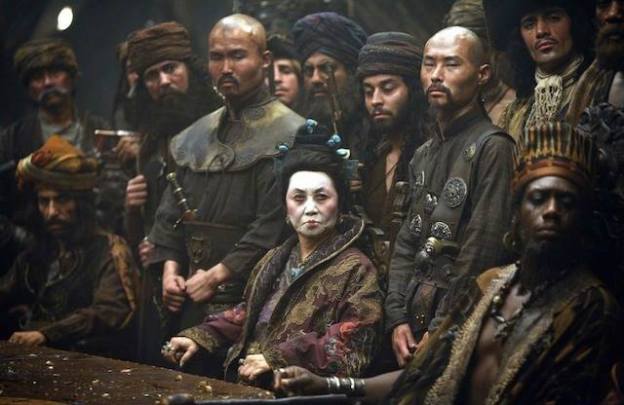
Shih Yang also known popularly as Madame Ching was one of the greatest Chinese pirates who sailed the seas in the 19th century.

At the height of her career, she commanded approximately 2,000 ships and 50,000 pirates controlling the seas from Hong Kong to the Vietnamese border. Piracy was instigated by the people living by the sea; they were starving. They could see the Portuguese and English trading ships carrying fruit, vegetables, and meat to the more wealthy Chinese people.

When one of these ships was wrecked by a storm, the sea-side villagers sailed out to the ship to retrieve its cargo. When they got to the ship the product was still being guarded! Out of desperation, the villagers murdered all the guards and took the food home.

This activity was soon organized into a systematic operation under the command of Ching Yih. In fact, other pirates realized how good he was and joined under his command. Ching did not limit his thievery to the sea. His crew also went inland. Along with booty and produce, this pirate crew took villagers as slaves.

The officials at Peking sent forty warships to take down this pirate armada but failed. Ching sank all these ships except twenty-eight, which he kept for his armada. After the battle with Peking, Ching decided to ‘take’ a wife. Twenty of the ‘choice’ female slaves were brought before him bound, one being Shih Yang. Not only was Shih thought to be beautiful, but she was larger than most women and her feet had not been bound as is traditional custom.

Ching unbound Shih and she clawed at his face almost blinding him. He decided to persuade her to marry him by giving her jewels, garments, and slaves. He also said this is the type of luxury she would have as his wife. Shih would only agree to marry Ching if she received half of all his property and joint command of the pirate fleet. He agreed and they were married in 1801.

They also adopted a boy named Chang Poa (then 15) who was a captive of Ching. She soon took command of two of his squadrons, which totaled a third of the entire fleet. Where she learned how to command at sea is unknown, but she was so gifted that even her husband feared her. By 1806, virtually every Chinese vessel passing the coast paid protection money.

Ching and Shih were only married a short time as Ching was killed during a typhoon in 1807. After his death, Shih informed the captains that she meant to command the entire fleet and no one disagreed. Shortly thereafter, Shih fell into an affair with her adopted son who was already a lieutenant in the fleet. They were soon married which cemented the family’s hold on the armada.

The fleet, under Madame Ching, was even more prosperous than before. Madame Ching was so organized that she posted rules of conduct on even the smallest sailing vessel. One of the regulations was ‘To use violence against any woman, or to wed her without permission, shall be punished with death.’ She also realized that to feed and care for the large number of pirates one could not raid on shore or the villagers would be hostile. To remedy this situation, she hired villagers who grew grapes, rice, etc. to work for her so she would always have supplies.

She also announced that any pirate who pilfered from these employees would be executed. Madame Ching was never defeated as it was stronger than the Chinese military. Out of desperation, the emperor of China granted amnesty to all pirates in 1810. Madame Ching negotiated the pardons for herself and her captains.

The agreement was made that Madame Ching (which went to her husband) would command a part of the Imperial fleet, receive a palace and high honors for her and her captains and retain her fortune if she would retire. She agreed and it is said that ‘the seas were once again peaceful’.

Madame Ching and Chang Pao settled in Fukien. They had one son. Chang Poa spent the rest of his life in a comfortable government position (died in 1822 at the age of 36). After Chang’s death, Shih returned to Canton where she ran a gambling house and brothel until her death in 1844. She was in her sixties.

Image may contain: 10 people

Standard