
The Fireship

The Fireship

As I walked out one evening upon a night’s career,

I spied a lofty clipper ship and to her I did steer.

She hoisted up her sig-a-nals which I so quickly knew,

And when she saw me bunting up she immediately hove to.

She had a dark and a roving eye, and her hair hung downs in ring-a-lets.

She was a nice girl, a decent girl, but one of the rakish kind.


“Oh sir, won’t you excuse me for staying out so late,

And if my parents heard of this, then sad would be my fate.

My father, he’s a minister, a good and righteous man,

My mother she’s a Methodist; I do the best I can.”

She had a dark and a roving eye, etc.


I eyed that girl both up and down for I’d heard such talk before,

And when she moored herself to me I knew she was a whore.

But still she was a pretty girl; she shyly hung her head.

“I’ll go along with you, my lad,” was what to me she said.


I took her to a tav-er-in and treated her with wine.

Little did I think that she was one of the rakish kind.

I handled her, I dandled her, and much to my surprise,

Turns out she was a fireship rigged up in a disguise.


So up the stairs and into bed I took that maiden fair.

I fired off my carronade into her thatch of hair.

I fired off a broadside until my shot was spent,

Then rammed that fireship’s waterline until my ram was bent.


Then in the morning she was gone, my money was gone too.

My clothes she’d hocked, my watch she stole, my seabag bid adieu.

But she’d left behind a souvenir, I’d have you all to know.

And in nine days, to my surprise, there was fire down below.


So come all you good whaler boys that sail the wintry seas,

And come all you good sailor boys, a warning take by me:

Beware of lofty clipper ships, they’ll be the ruin of you,

For she not only made me walk the plank, she set fire to me mainmast, too.
Standard

Are naval vessels safer at sea or in port during a hurricane or tsunami?

Are naval vessels safer at sea or in port during a hurricane or tsunami?


Brion Boyles QMC (SW) (Ret)

Custom model builder, owner (1997-present)

Tsunami or hurricane, a ship will certainly be susceptible to damage while pier-side or anchored in a harbor. Not only is her own maneuverability restricted to pick her way or or avoid beating up against a quay or pier, but she may be damaged by OTHER vessels breaking their moorings and mucking about. A tsunami could pitch her onto the beach or against obstructions, not to mention the drastic run of water retreating OUT to sea (often exposing the floor ) BEFORE a tsunami waves strikes. Such a quick grounding, potentially breaking her back, and then sudden re-floating without time to repair could easily be deadly for any ship. A harbor emergency may stretch available tug boats to the limit, and a vessel might easily be blown aground in a hurricane. One such vessel I served aboard was blown aground in Apra harbor, Guam during a typhoon, had her propellor shaft bent and was eventually scrapped.

Smart mariners know how to safely navigate typhoons at sea. I myself encountered nine typhoons at sea in one season, on a U.S. Navy LST in the 1980’s. There are “dangerous” and “less dangerous” areas to try and ride one out a storm. Additionally, smart seamanship can reduce the effects of the storm on the vessel’s ride. A vessel has little or no chance to move once caught in port. Therefore, most would put to sea to avoid being banged about in the tight confines of a harbor.

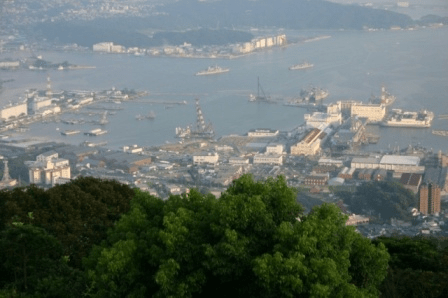
There is one exception: Sasebo, Japan is the world’s safest “typhoon haven”. Reached by a series of zig-zags thru several high, cliff-sided approaches and surrounded by high hills, I have often ridden out such weather there. The sum total of the storm was a bit of high wind, 3– 4-foot waves and a lot of rain.

Standard

Donald K. Ross

Donald K. Ross


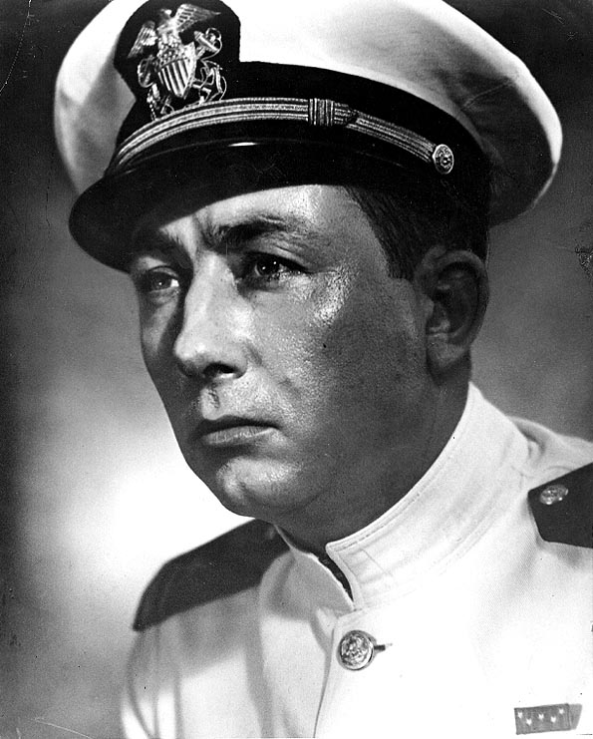
Donald Kirby Ross (December 8, 1910 – May 27, 1992) was an officer of the United States Navy who received the first Medal of Honor of World War II. This award was made for his actions during the Japanese attack on Pearl Harbor in 1941.

Ross was born on December 8, 1910, in Beverly, Kansas. He enlisted in the U.S. Navy in Denver, Colorado, on June 3, 1929, and graduated as company honorman from basic training at Naval Station San Diego. He completed Machinist Mate School at Norfolk, Virginia, first in his class and was assigned to the transport ship USS Henderson (AP-1) on a China service run.

While serving aboard the hospital ship USS Relief (AH-1), Ross saw his first action (with the U.S. Marines) in Nicaragua in 1931. Advancing through the ranks on the minesweeper USS Brant (AM-24), destroyer USS Simpson (DD-221) and cruiser USS Minneapolis (CA-36), he attained the rank of Warrant Officer Machinist in October 1940 and was assigned to the battleship USS Nevada (BB-36).

During December 7, 1941, Japanese attack on Pearl Harbor, Nevada was badly damaged by bombs and torpedoes. Ross distinguished himself by assuming responsibility to furnish power to get the ship underway — the only battleship to do so during the Japanese attack. When the forward dynamo room where he was stationed filled with smoke and steam, he ordered his men to leave and continued servicing the dynamo himself until being blinded and falling unconscious. Upon being rescued and resuscitated, he went back to secure the forward dynamo, then worked in the aft dynamo room until losing consciousness a second time due to exhaustion. After waking, he again returned to his duties until Nevada was beached. His actions kept the ship under power, preventing it from sinking in the channel and blocking other ships in the harbor.

Despite his impaired eyesight, Ross refused hospitalization and instead helped with rescue efforts. He entered a hospital three days after the attack, and his vision returned to normal after three weeks. He returned to Nevada, December 17, 1941, remaining in the ship’s company for the duration of the war. For these actions, he was presented with the Medal of Honor by Admiral Chester Nimitz on April 18, 1942, becoming the first person to receive the medal in World War II.

Ross was promoted to chief warrant machinist in March 1942 and was commissioned an Ensign in June 1942. Later in the war, he also served on Nevada during the landings at Normandy and Southern France. He rose steadily in temporary rank to Lieutenant Commander by the end of the war, reverting to Lieutenant at its conclusion. He again received a promotion to Lieutenant Commander in 1949 and to Commander in November 1954. Upon his retirement from active duty in July 1956, after twenty-seven years’ of service aboard every type of surface ship then afloat, he was promoted to Captain on the basis of his combat awards.

After leaving the Navy, Ross settled in Port Orchard, Washington, and ran a dairy farm. He and his wife, Helen, had four children: Fred, Robert, Penny, and Donna.

He wrote a book about his fellow Medal of Honor recipients with ties to Washington State — Men of Valor — published in 1980. Ross attended 50th Anniversary ceremonies at Pearl Harbor on December 7, 1991, during which, Ross was given the honor of introducing President George H. W. Bush. Ross also participated in the dedication of a memorial to his old ship, the USS Nevada]

Ross died of a heart attack in Bremerton, Washington, on May 27, 1992, at age 81. His ashes were scattered at sea over the USS Nevada.

In 1997, the guided-missile destroyer USS Ross (DDG-71) was named in his honor.

Medal of Honor citation

Ross’ official Medal of Honor citation reads:

For distinguished conduct in the line of his profession, extraordinary courage and disregard of his own life during the attack on the Fleet in Pearl Harbor, Territory of Hawaii, by Japanese forces on 7 December 1941. When his station in the forward dynamo room of the U.S.S. Nevada became almost untenable due to smoke, steam, and heat, Machinist Ross forced his men to leave that station and performed all the duties himself until blinded and unconscious. Upon being rescued and resuscitated, he returned and secured the forward dynamo room and proceeded to the after dynamo room where he was later again rendered unconscious by exhaustion. Again recovering consciousness he returned to his station where he remained until directed to abandon it.

Standard

Capt John P. Cromwell

Capt John P. Cromwell

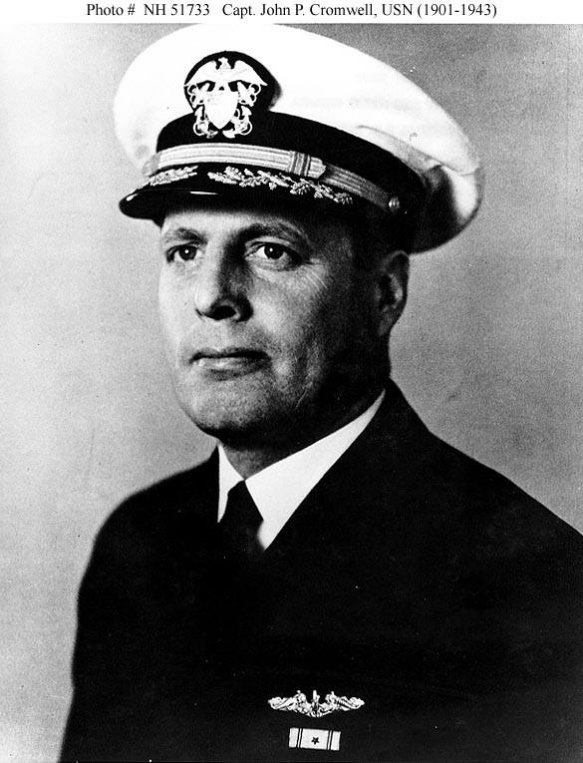
During this week in 1901, a hero is born. Captain John P. Cromwell would become the most senior submariner to receive the Medal of Honor during World War II. He stayed aboard his sinking submarine because he knew that his death would keep vital American secrets out of enemy hands.

What kinds of thoughts go through your head when you know that you are minutes away from drowning? What kind of dread fills your being as you watch the water rise? How many memories of family overwhelm your final moments?

Thankfully, most of us will never know the answers to these questions. And yet this is exactly the type of death that Cromwell chose—all for the good of his country.

Cromwell had been serving in the Navy since his graduation from the U.S. Naval Academy in 1924. He’d served on battleships and on submarines. He’d been an engineering officer, and he’d worked in D.C. By late 1943, he was serving at sea aboard USS Sculpin. He was commander of several submarine divisions, and he was privy to many of America’s most important secrets.

Unfortunately, that voyage aboard Sculpin would prove to be his final war patrol, although the details of his last days would not come to light until after the Japanese surrender in 1945.

The conflict that led to Cromwell’s brave decision occurred on November 19, 1943. Sculpin was then preparing to attack a Japanese convoy, but it was one of those days when nothing seemed to be going right. Perhaps most fatally, Sculpin’s depth gauge had become damaged during one encounter, but Sculpin’s crew had no idea: They thought the gauge was operating normally.

You can imagine that several things went wrong after that. At one point, Sculpin tried to go to periscope depth, but it accidentally surfaced and revealed its presence to the Japanese destroyer Yamagumo instead. The battle that followed went badly, and Americans were forced to scuttle the submarine. Their capture by the Japanese was inevitable.

At this point, Cromwell had a tough choice to make. He knew a lot about Ultra, the project that had enabled Allied forces to intercept and read encrypted enemy communications. Moreover, he knew a fair amount about ongoing Allied operations in the Pacific. If he were captured by the Japanese, all that information would be at risk. “I can’t go with you,” he reportedly told the officer then commanding Sculpin. “I know too much.”

“Determined to sacrifice himself rather than risk capture and subsequent danger of revealing plans under Japanese torture or use of drugs,” Cromwell’s Medal citation describes, “he stoically remained aboard the mortally wounded vessel as she plunged to her death.”

Cromwell maintained the viability of America’s ongoing missions at the cost of his own life, and yet no one had any idea what he’d done until after the war. Only then were survivors of Sculpin released from Japanese captivity, finally free to describe what they’d witnessed on that November day.

Cromwell’s widow would soon be presented with her husband’s Medal of Honor.

“His great moral courage in the face of certain death adds new luster to the traditions of the U.S. Naval Service,” his citation concludes.

Yes, it certainly does.

Standard

A GREAT EVENT! NEVER FORGET!

A GREAT EVENT! NEVER FORGET!

Story provided by Paul Reuter

An incident took place at sea on 14 September 2001, just a few days after the attacks on New York and Washington.

In the time leading up to 11 September 2001, the USS Winston S. Churchill was in port in Plymouth, England, where it was moored next to the SMS Lütjens of the German Navy.

During their time in port together, the officers and crews of the USS Churchill and the SMS Lütjens had combined for a number of events in the generous spirit of friendship and brotherhood.

After the attacks, however, the USS Churchill immediately got underway to perform a number of drills while waiting for further orders.

On board the USS Churchill an Officer (Ensign) sent an email to his dad and his dad in turned sent it to the local newspaper. Below is a portion of that email:

Dear Dad,

Well, we are still out at sea, with little direction as to what our next priority is.

The remainder of our port visits, which were to be centered around max liberty and goodwill to the United Kingdom, have all but been cancelled. We have spent every day since the attacks going back and forth within imaginary boxes drawn in the ocean, standing high-security watches, and trying to make the best of our time.

It hasn’t been that fun I must confess, and to be even more honest, a lot of people are frustrated at the fact that they either can’t be home, or we don’t have more direction right now.

We have seen the articles and the photographs, and they are sickening. Being isolated as we are, I don’t think we appreciate the full scope of what is happening back home, but we are definitely feeling the effects.

About two hours ago the junior officers were called to the bridge to conduct Shiphandling drills.

We were about to do a man overboard when we got a call from the LUTJENS D-185, a German warship that was moored ahead of us on the pier in Plymouth, England.

While in port, the USS WINSTON S CHURCHILL and the LUTJENS got together for a sports day/cookout on our fantail, and we made some pretty good friends.

Now at sea they called over on bridge-to-bridge, requesting to pass us close up on our port side, to say good-bye.

We prepared to render them honors on the bridge wing, and the Captain told the crew to come topside to wish them farewell.

As they were making their approach, our Conning Officer saw through her binoculars and announced that they were flying an American flag.

As they came even closer, we saw that it was flying at half-mast.

The bridge wing was crowded with people as the Boatswain’s Mate blew two whistles- Attention to Port- the ship came up alongside and we saw that the entire crew of the German ship were manning the rails, in their dress blues.

They had made up a sign that was displayed on the side that read “We Stand By You.”

Needless to say there was not a dry eye on the bridge as they stayed alongside us for a few minutes and we cut our salutes.

It was probably the most powerful thing I have seen in my entire life and more than a few of us fought to retain our composure.

It was a beautiful day outside today. We are no longer at liberty to divulge over unsecure e-mail our location, but we could not have asked for a finer day at sea.

The German Navy did an incredible thing for this crew, and it has truly been the highest point in the days since the attacks.

After the ship pulled away and we prepared to begin our man overboard drills the Officer of the Deck turned to me and said “I’m staying Navy.”

Image may contain: sky, ocean, outdoor and water

Standard

USS San Diego CL-53

USS San Diego CL-53

San Diego arrives at Yokosuka Naval Base, 30 August 1945

The second USS San Diego (CL-53) was an Atlanta-class light cruiser of the United States Navy, commissioned just after the US entry into World War II, and active throughout the Pacific theater. Armed with 16 5 in (127 mm)/38 cal DP anti-aircraft guns and 16 Bofors 40 mm AA guns, the Atlanta-class cruisers had one of the heaviest anti-aircraft broadsides of any warship of World War II.

San Diego was one of the most decorated US ships of World War II, being awarded 18 battle stars, and was the first major Allied warship to enter Tokyo Bay after the surrender of Japan. Decommissioned in 1946, the ship was sold for scrapping in December 1960.

1942–1943

After shakedown training in Chesapeake Bay, San Diego sailed via the Panama Canal to the west coast, arriving at her namesake city on 16 May 1942. Escorting Saratoga at best speed, San Diego barely missed the Battle of Midway. On 15 June, she began escort duty for Hornet in operations in the South Pacific. Early in August, she supported the first American offensive of the war, the invasion of the Solomons at Guadalcanal. With powerful air and naval forces, the Japanese fiercely contested the American thrust and inflicted heavy damage; San Diego witnessed the sinking of Wasp on 15 September and of Hornet on 26 October.

San Diego gave antiaircraft protection for Enterprise as part of the decisive three-day Naval Battle of Guadalcanal from 12–15 November 1942. After several months of service in the dangerous waters surrounding the Solomon Islands, San Diego sailed via Espiritu Santo, New Hebrides, to Auckland New Zealand, for replenishment.

At Noumea, New Caledonia, the light cruiser joined Saratoga, the only American carrier available in the South Pacific, and HMS Victorious in support of the invasion of Munda, New Georgia, and of Bougainville. On 5 November and 11 November 1943, she joined Saratoga and Princeton in highly successful raids against Rabaul. San Diego served as part of Operation Galvanic, the capture of Tarawa in the Gilbert Islands. She escorted Lexington, damaged by a torpedo, to Pearl Harbor for repairs on 9 December. San Diego continued on to San Francisco for installation of modern radar equipment, a Combat Information Center and 40mm anti aircraft guns to replace her obsolete 1.1 in (27 mm) batteries.

1944

She joined Vice Admiral Marc Mitscher’s Fast Carrier Task Force at Pearl Harbor in January 1944 and served as an important part of that mighty force for the remainder of the war. Her rapid-fire guns protected the carriers against aerial attack. San Diego participated in “Operation Flintlock”, the capture of Majuro and Kwajalein, and “Catchpole”, the invasion of Eniwetok, in the Marshall Islands from 31 January to 4 March. During this period, Task Force 58 (TF 58) delivered a devastating attack against Truk, the Japanese naval base known as the “Gibraltar of the Pacific.

San Diego steamed back to San Francisco for more additions to her radar and then rejoined the carrier force at Majuro in time to join in raids against Wake and Marcus Islands in June. She was part of the carrier force covering the invasion of Saipan, participated in strikes against the Bonin Islands, and shared in the victory of the First Battle of the Philippine Sea on 19–20 June. After a brief replenishment stop at Eniwetok, San Diego and her carriers supported the invasion of Guam and Tinian, struck at Palau, and conducted the first carrier raids against the Philippines. On 6 and 8 August, she stood by as the carriers gave close air support to Marines landing on Peleliu, Palau Islands.On 21 September, the Task Force struck at the Manila Bay area. After replenishing at Saipan and Ulithi, she sailed with TF 38 in its first strike against Okinawa. From 12–15 October, the carriers pounded the airfields of Formosa while San Diego‘s guns shot down two of the nine Japanese attackers in her sector and drove the others away; however, some enemy planes got through and damaged Houston and Canberra. San Diego helped escort the two crippled cruisers out of danger to Ulithi. After rejoining the fast carrier force, she successfully rode out the typhoon of 17–18 December, despite heavy rolling of the ship.

1945

In January 1945, TF 38 entered the South China Sea for attacks against Formosa, Luzon, Indochina, and southern China. The force struck Okinawa before returning to Ulithi for replenishment.

San Diego next participated in carrier operations against the home islands of Japan, the first since the Doolittle Raid of 1942. The carrier force finished the month of February with strikes against Iwo Jima.On 1 March, San Diego and other cruisers were detached from the carrier force to bombard Okino Daijo Island in support of the landings on Okinawa. After another visit to Ulithi, she joined in carrier strikes against Kyūshū, again shooting down or driving away enemy planes attacking the carriers. On the night of 27–28 March, San Diego participated in the shelling of Minami Daito Jima; on 11 April, and again on 16 April, her guns shot down two attackers. She helped furnish anti-aircraft protection for ships damaged by suicide attacks and escorted them to safety. After a stop at Ulithi, she continued as part of the carrier force supporting the invasion of Okinawa, until she entered an advanced base drydock at Guiuan, Samar Island, Philippines, for repairs and maintenance.]

She then served once more with the carrier force operating off the coast of Japan from 10 July until hostilities ceased. On 27 August, San Diego was the first major Allied warship to enter Tokyo Bay since the beginning of the war, and she helped in the occupation of the Yokosuka Naval Base and the surrender of the Japanese battleship Nagato. After having steamed over 300,000 mi (480,000 km) in the Pacific, she returned to San Francisco on 14 September 1945. San Diego gave further service as part of “Operation Magic Carpet” in bringing American troops home.

Standard

A VISITOR FROM THE PAST

A VISITOR FROM THE PAST

By Thelen Paulk

I had a dream the other night I didn’t understand.

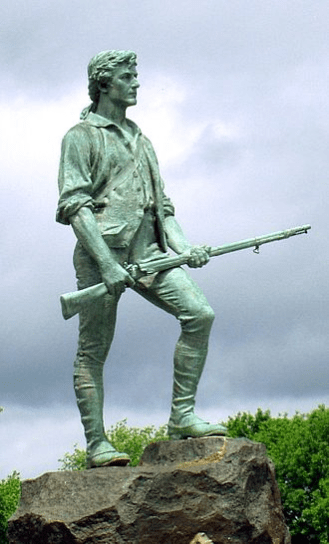
A figure walking through the mist with a flintlock in his hand.

His clothes were torn and dirty as he stood there by my bed.

He took off his three cornered hat and speaking low, he said:

“We fought a revolution to secure our liberty.

We wrote the Constitution as a shield from tyranny.

For future generations, this legacy we gave.

In this, the land of the free and the home of the brave:

You buy permits to travel and permits to own a gun.

Permits to start a business or to build a place for one.

On land that you believe you own, you pay a yearly rent, although you have no voice in choosing how the money’s spent.

Your children must attend a school that doesn’t educate.

Your Christian values can’t be taught according to the state.

You read about the current news in a regulated press.

You pay a tax you do not owe to please the foreign I.R.S.

Your money is no longer made of silver or of gold.

You trade your wealth for paper, so your lives can be controlled.

You pay for crimes that make our Nation turn from God in shame.

You’ve taken Satan’s number as you’ve traded in your name.

You’ve given government control to those who do you harm,

so they can padlock churches and steal the family farm

And keep our country deep in debt, put men of God in jail, harass your fellow countrymen, while corrupted courts prevail.

Your public servants don’t uphold the solemn oath they’ve sworn.

They defy and rape the nation and leave it’s fabric tattered and torn.

Your leaders ship artillery arid guns to foreign shores,

and send your sons to slaughter fighting other people’s wars

Can you regain the freedom for which we fought and died?

Or don’t you have the courage or the faith to stand with pride?

Are there no more values for which you’ll fight to save?

Or do you wish your children to live in fear as a slave?

People of the Republic arise and take a stand!

Defend the Constitution, the Supreme Law of the Land!

Preserve our Great Republic and God Given Rights!

And pray to God to keep the torch of Freedom burning bright!”

As I awoke he vanished in the mist from whence he came.

His words were true. We are not Free. We have ourselves to blame.

For even now as tyrants trample each God Given Right,

we only watch and tremble, too afraid to stand and fight.

If he stood by your bedside in a dream while you’re asleep,

and wonders what remains of our Rights he fought so hard to keep.

What would be your answer if he called out from the grave?

Standard

The Patten Family and the USS Nevada (1941)

Mister Mac's avatartheleansubmariner

As it so often happens, I was looking through the archives and discovered an article that jumped off the pages at me. This article was found in a collection of Navy Department News Releases and was released seventy seven years ago today (September 7, 2018)

NAVY DEPARTMENT

HOLD FOR RELEASE

SUNDAY PAPERS, SEPTEMBER 7, 1941

FATHER TO JOIN SEVEN SONS IN THE U. S. NAVY

A sea meeting unique in the world’s naval history will take place on the quarterdeck of the USS NEVADA on Tuesday night with the central figure, strangely enough, a farmer from Ridgefield, Washington. Officers and crew of the big battleship drawn up at rigid attention for the impressive rite, Captain F. W. Scandland, U. S. Navy, the NEWADA’s commanding officer, will administer the Navy enlistment oath to the farmer– Clarence Floyd Patten, a man of about 50 years.

Standing just behind the principal in the…

View original post 969 more words

Standard