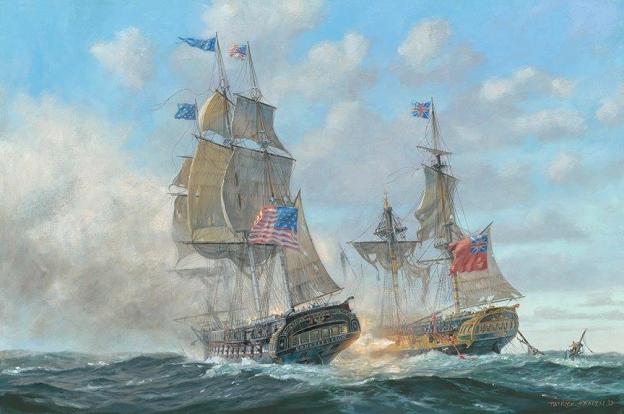
“Constitution vs Guerriere

“Constitution vs Guerriere”

by Patrick O’Brien

On August 2nd, 1812 the “Constitution” set sail departing from Boston and sailed east in hopes of finding some British ships. After meeting no British ships, the “Constitution” sailed along the coast of Nova Scotia, and then Newfoundland, finally stationing off Cape Race in the Gulf of the St. Lawrence. It was here that the Americans captured and burned two brigs of little value. On August 15th the “Constitution” recaptured an American brig from the British ship-sloop “Avenger”, however, the British ship managed to escape. Captain Isaac Hull put a crew on the brig and they sailed it back to an American port.

At 2:00 p.m. on August 19th the crew of the “Constitution” made out a large sail which proved to be the British frigate “Guerriere” captained by James Dacres. At 4:30 p.m. the two ships began to position themselves and hoisted their flags (colors). At 5:00 p.m. the “Guerriere” opened fire with her weather guns, the shots splashed in the water short of the American ship. The British then fired her port broadsides, two of these shots hit the American ship, the rest went over and through her rigging. As the British prepared to fire again the “Constitution” fired her port guns. The two ships were a fair distance apart, and for the next 60 minutes or so they continued like this with very little damage being done to either party.

At 6:00 p.m. they moved closer, at 6:05 p.m. the two ships were within pistol-shot of each other. A furious cannonade began, at 6:20 p.m. the “Constitution” shot away the “Guerriere’s” mizzen-mast, the British ship was damaged. The “Constitution” came around the “Guerriere’s” bow and delivered a heavy raking fire which shot away the British frigate’s main yard. The Americans came around yet again and raked the “Guerriere”. The mizzen-mast of the British ship was now dragging in the water and the two ships came in close to each other. The British bow guns did some damage to the captain’s cabin of the “Constitution”, a fire even started there. An American officer by the name of Lieutenant Hoffmann put the fire out.

It was about here that both crews tried to board the others ship, or at least thought about it. And it was also here where most of the “Constitution’s” casualties were taken. In fact, both sides suffered greatly from musketry at this point. On the “Guerriere” the loss was much greater. Captain James Dacres was shot in the back while cheering on his crew to fight. The ships finally worked themselves free of each other, and then the “Guerriere’s” foremast and main-mast came crashing down leaving the British ship defenseless.

At 6:30 p.m. the “Constitution” ran off a little and made repairs which only took minutes to complete. Captain Isaac Hull stood and watched at 7:00 p.m. as the battered British ship surrendered, unable to continue the fight.

The “Constitution” had a crew of 456 and carried 44 guns. The Guerriere had a crew of 272 men and carried 38 guns. The American casualties were 14, which included Lieutenant William S. Bush, of the marines, and six seamen killed. And her first lieutenant, Charles Morris, Master, John C. Alwyn, four seamen, and one marine wounded. Total seven killed and seven wounded. Almost all the American casualties came from the enemy musketry when the two ships came together. The British lost 23 killed and mortally wounded, including her second lieutenant, Henry Ready, and 56 wounded severely and slightly, including Captain Dacres for a total of 79. The rest of the British crew became prisoners.
Standard

Vice Admiral John D Bulkeley

Vice Admiral John D. Bulkeley

This post is for my shipmates from the U.S.S. Luce sailor. Remember when the ship had a stores replenishment when we were in Gitmo and one of the sailors ate some ham he had swiped and opened the can and a couple of days later made a sandwich and got food poisoning.

The Captain went all ahead full into Gitmo to get the guy some medical help. These pictures are of John D. Bulkeley Vice Admiral who was the commander of Gitmo and had sent there by President Kennedy.

The Admiral had strict rules about entering and leaving the harbor at safe speeds. He sent the Captain a message castigating him for the reckless way he had entered port and approached the pier. The line handlers on the dock were about to run away because they thought the ship was going to hit but the Captain stopped on a dime.

When the Captain messaged the Admiral the circumstances of his entry, the Admiral replied, “Finest example of ship handling under emergency conditions I have ever seen.”

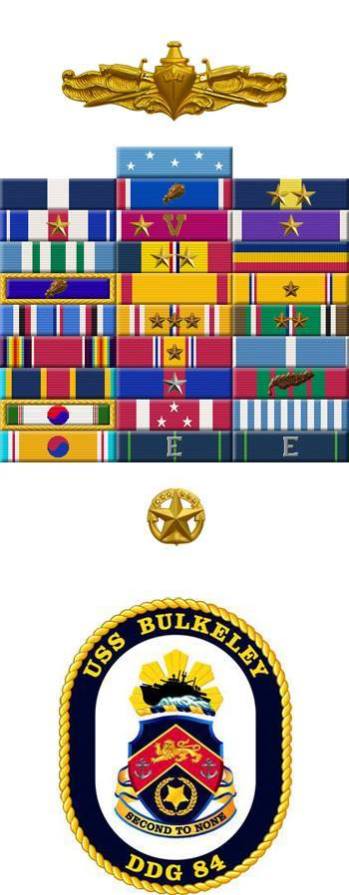
I was telephone talker to CIC on the bridge that day and I never forgot the Admiral’s name. I was thinking about this and decided to Google the Admiral’s name and what a sailor he was. He was commander of PT Boats during WW2 and was responsible for rescuing MacArthur his family and staff and transporting them 600 miles in open waters. He received the Medal of Honor. He was also in the Normandy invasion and just after got his first big ship, a destroyer and charged two German ships with only one 5 inch gun working on his ship and sunk them both! He had a book written about him ( see picture). Also, check out the ribbons he earned and note that he had a DDG named after him. The Movie (They Were Expendable) was based on him in WW2. He died in 1988 he was 84 years old. What a Great American!!!!

Medal of Honor citation

Bulkeley’s Medal of Honor citation reads:

For extraordinary heroism, distinguished service, and conspicuous gallantry above and beyond the call of duty as commander of Motor Torpedo Boat Squadron 3, in Philippine waters during the period 7 December 1941 to 10 April 1942. The remarkable achievement of LCDR Bulkeley’s command in damaging or destroying a notable number of Japanese enemy planes, surface combatant and merchant ships, and in dispersing landing parties and land-based enemy forces during the 4 months and 8 days of operation without benefit of repairs, overhaul, or maintenance facilities for his squadron, is believed to be without precedent in this type of warfare. His dynamic forcefulness and daring in offensive action, his brilliantly planned and skillfully executed attacks, supplemented by unique resourcefulness and ingenuity, characterize him as an outstanding leader of men and a gallant and intrepid seaman. These qualities coupled with a complete disregard for his own personal safety reflect great credit upon him and the Naval Service.

Standard

Who Packs Your Parachute

WHO PACKS YOUR PARACHUTE?!

Captain Charles Plum, a US Naval Academy graduate, was a jet fighter pilot in Vietnam.

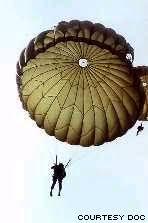
After 75 combat missions, his plane was destroyed by a surface-to-air missile. Capt. Plumb ejected and parachuted into enemy hands. He was captured & spent six years in a Communist prison.

Capt. Plumb survived that ordeal and now lectures about lessons learned from that experience.

One day, when Capt. Plumb and his wife were sitting in a restaurant, a man at another table came up and said…..

“You’re Capt. Plumb! You flew jet fighters in Vietnam from the aircraft carrier Kitty Hawk. You were shot down!”

“How in the world did you know that?” asked Capt. Plumb.

“I packed your parachute,” the man replied.

Capt. Plumb gasped in surprise and gratitude.

The man pumped his hand and said, “I guess it worked!”

Capt. Plumb assured him, “It sure did-if your ‘chute hadn’t worked, I wouldn’t be here today.”

Capt. Plumb couldn’t sleep that night, thinking about that man.

Capt. Plumb says, ‘I kept wondering what he might have looked like in a Navy uniform-a Dixie cup hat, a bib in the back, and bell bottom trousers. I wondered how many times I might have passed him on the Kitty Hawk. I wondered how many times I might have seen him and not even said good morning, how are you or anything because, you see, I was a fighter pilot and he was just a Sailor.

Capt. Plumb thought of the many hours the Sailor had spent on a long wooden table in the bowels of the ship carefully weaving the shrouds and folding the silks of each chute, holding in his hands each time the fate of someone he didn’t know.

MORAL OF THE STORY: Sometimes in the daily challenges that life gives us, we miss what is really important. We may fail to say hello, please, or thank you, congratulate someone on something wonderful that has happened to them, give a compliment, or just do something nice for no reason. We need to recognize people who pack our parachute.

NOTE: Captain Charles Plum is now a popular motivational speaker, and was asked by the media and several other organizations if this story was true. Captain Plum assured them that it was.

Standard

The greatest joy, the deepest sorrow – Remembering the Thresher

I had a shipmate who was lost on Thresher, CS2 Ronald Muise.

Mister Mac's avatartheleansubmariner

The greatest joy, the deepest sorrow.

As we approach the anniversary of the loss of the USS Thresher, I am once again reminded that the world of Submariners and their families are consumed with the greatest of joys and the deepest sorrows.

The joy comes when a boat has completed her mission and returns safely home. As the small black object on the horizon starts getting bigger and bigger, you can almost feel the joy of the wives and children. Dad has been gone for so long and so many things have changed. Holidays were missed, special school events were not seen and so many of life’s little blessings were passed by. But in this moment, that magnificent hull is coming closer and closer. Maybe there is a band. Certainly there is anticipation. What will they say to each other after so many months of long separation?

There is the…

View original post 304 more words

Standard

National Beer Day

National Beer Day

By Garland Davis

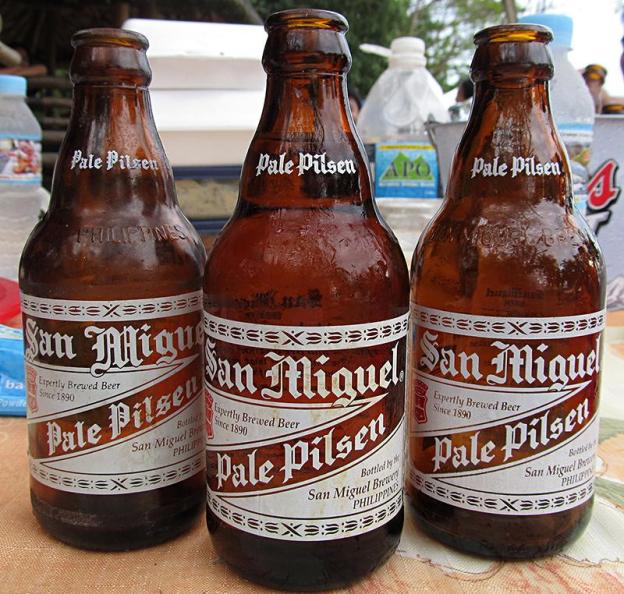
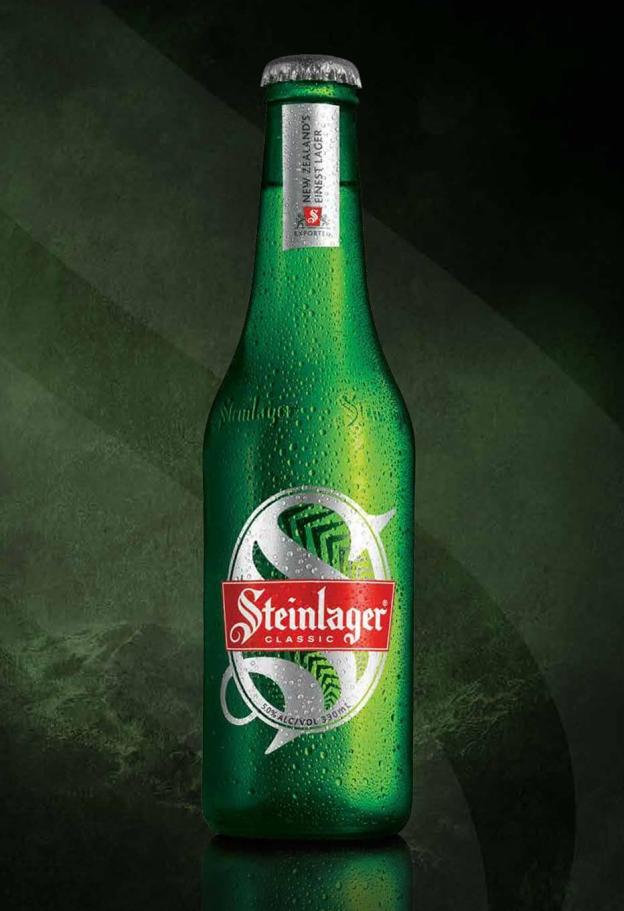
April 7 is National Beer Day, a day that Asia Sailors celebrate by…Drinking Beer.

National Beer Day is celebrated in the United States every year on April 7, marking the day that the Cullen–Harrison Act was enacted after having been signed into law by President Franklin D. Roosevelt on March 22, 1933. This led to the Eighteenth Amendment being repealed on December 5, 1933, with the ratification of the Twenty-first Amendment to the U.S. Constitution. April 6, the day prior to National Beer Day, is known as New Beer’s Eve.

Upon signing the legislation, Roosevelt made his famous remark, “I think this would be a good time for a beer. The law went into effect on April 7 of that year in states that had enacted their own law allowing such sales. The beer could contain up to 3.2% alcohol by weight (or 4.05% by volume) compared to the 0.5% limit of the Volstead Act because 3.2% was considered too low to produce intoxication.

People across the country responded by gathering outside breweries, some beginning the night before. On that first day, 1.5 million barrels of beer were consumed, inspiring the future holiday. Today, April 7 is recognized as National Beer Day and April 6 is known as New Beer’s Eve.

The Cullen-Harrison Act was not the official end of prohibition in the US (that happened on December 5, 1933, when the 21st Amendment was ratified). What the Cullen-Harrison Act did do was redefine an “intoxicating beverage” under the Volstead Act. As such, April 7 is a beer specific holiday and should not be confused with Repeal Day celebrated on December 5.

National Beer Day was first created in 2009 by Justin Smith of Richmond, Virginia. After much prodding from his friend, Mike Connolly, Smith started a Facebook page that was noticed by Colorado Beer Examiner, Eli Shayotovich. Smith’s promotion of the new holiday via various social media outlets was rewarded when the beer drinking app, “Untappd”, created a badge for National Beer Day that rewarded participants that checked a beer into the app on April 7. National Beer Day has since been trending every year on April 7 using the hashtag #NationalBeerDay.

National Beer Day was officially recognized by Virginia Governor Terry McAuliffe in 2017.

National Beer Day was officially recognized on the Congressional Record by Congressman Dave Brat in 2017.

In 2018, House Joint Resolution 90 was introduced in Virginia General Assembly to officially recognize National Beer Day in the Commonwealth of Virginia.

Kloster

Standard

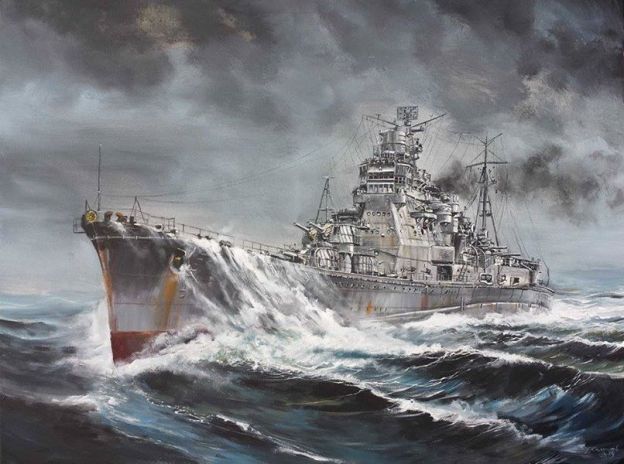
Japanese Cruiser Takao,

Japanese Cruiser Takao,

by Lukasz Kasperczyk

Takao was the first of four Takao-class heavy cruisers, designed to be an improvement over the previous Myōkō-class design.

The Takao-class ships were part of the Imperial Japanese Navy’s strategy of the Decisive Battle and of forming the backbone of a multipurpose long-range strike force. Takao was named after a mountain.

At the start of World War II, Takao was commanded by Captain Asakura Bunji and assigned to Vice Admiral Kondo Nobutake’s Cruiser Division 4 together with her sister ships Atago and Maya. In late December 1941, she provided gunfire support for the landings at Lingayen Gulf on Luzon in the Philippines.

In early 1942, Takao operated in the Battle of the Java Sea in early March. On March 1, one of Takao’s floatplanes bombed the Dutch merchant ship Enggano. The next night, Takao and Atago sank the old United States Navy destroyer Pillsbury with no survivors.

On March 4, Takao, Atago, Maya and two destroyers, attacked a convoy near Tjilatjap. The Royal Australian Navy sloop HMAS Yarra defending the convoy was sunk with 34 survivors of her crew of 151. (Of these 34 survivors, only 13 were alive to be picked up a week later by the Dutch submarine K XI and taken to Ceylon.) The Japanese cruisers then sank three ships from the convoy: the tanker Francol, the depot ship Anking, and a minesweeper. Two Dutch freighters were also captured.

In June 1942, Takao and Maya supported the invasion of the Aleutian Islands. On June 5, Takao shot down a B-17 Flying Fortress.

In August 1942, Takao was assigned to Operation Ka, the Japanese reinforcement during the Battle of Guadalcanal, and participated in the Battle of the Santa Cruz Islands on October 26. A determined attempt to shell the US base at Henderson Field led to the Naval Battle of Guadalcanal: early in the morning of 15 November 1942, the battleship Kirishima, supported by Takao and Atago, engaged the American battleships Washington and South Dakota. All three Japanese ships hit South Dakota multiple times with shells, knocking out her radar and fire controls. However, Kirishima was quickly disabled by Washington and sank a few hours later. Atago was damaged. Takao escaped unharmed.

In 1943, Takao supported the evacuation of Guadalcanal. She operated in the central Pacific from her base at Truk. On 5 November 1943, while being refueled at Rabaul in the Bismarck Islands she came under attack by SBD Dauntless dive bombers from USS Saratoga. Takao was hit by two bombs that killed 23. Her damaged steering mechanism forced her to return to Yokosuka in Japan for repairs.

On 22 October 1944, Takao joined the “Centre Force”. On October 23, as she was passing Palawan Island, the force came under attack from two US submarines. Takao was hit by two torpedoes from USS Darter, which shattered two shafts, broke her fantail and flooded three boiler rooms. She turned back to Brunei, escorted by the destroyers Naganami and Asashimo, the torpedo boat Hiyodori and the transport Mitsu Maru. This flotilla was tailed by Darter and Dace until after midnight on 24 October, when Darter ran aground on the Bombay Shoal and Dace stayed to rescue her crew.

Takao was so badly damaged that it was considered impossible to send her back to Japan any time soon for full repairs. So the stern was cut off and shored up, and she was moored as an anti-aircraft battery for the defense of Singapore. While berthed there, she was attacked on July 31, 1945 by the British midget submarine HMS XE3. The submarine attached six limpet mines to Takao’s hull using a piece of rope (the hull was covered with thick layer of seaweed, and the magnets of the limpet mines would not hold them on the hull.) When the mines exploded, they blew a hole 20 m by 10 m. Most of Takao’s guns were put out of action, the rangefinders were destroyed.

On 5 September 1945, the Straits of Johor naval base was surrendered by the Japanese to the British and the formal boarding of the still partially manned Takao took place on 21 September 1945. She was finally towed to the Straits of Malacca to be used as a target ship for HMS Newfoundland and sunk on October 19, 1946.

Image may contain: sky, cloud, ocean, outdoor and water

Standard

On Eternal Patrol

Philip Joseph Gabrunas

REMEMBERING ONE OF OUR HEROES!

If you have ever been stationed in Pearl Harbor and especially on the Submarine Base….you will know up on the hill along North Road there is a ball field named, “Gabrunas Field”.

Also, there is a barracks building on Subase named, “Gabrunas Hall”.

Trivia: Who was “Gabrunas”?!

ANSWER: Philip Joseph Gabrunas was a Motor Machinist Mate Chief stationed on the submarine USS Sculpin SS-191.

On 19 November 943, Chief Gabrunas, a Boston native, was 29 years old, assigned to the submarine USS Sculpin SS-191 when it was sunk by a Japanese destroyer north of Oroluk, an island near Truk, located in the South Pacific.

Chief Gabrunas was manning the hydraulic manifold when the USS Sculpin was sunk.

Chief Gabrunas went down with the sub, he knew his fate and accepted it, and he is credited with saving several lives of his fellow shipmates.

Chief Gabrunas was awarded a Silver Star and Purple Heart posthumously for his actions,

Chief Gabrunas is on eternal patrol.

REST IN PEACE SHIPMATE!

Standard

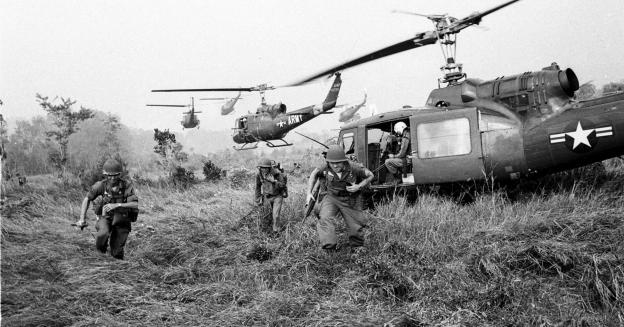
Warrior or Poet

Warrior or Poet

Still in Nam

It’s been 50 years since Vietnam

I’ve left that world behind

The memories and nightmares

Follow me from time to time


I went down to the Wall today

To visit Philips and Lamb

And while I was there I saw a face

From far off Vietnam


Would you look at here my wily friend

It’s been a long, long time

It’s good to see you here today

You’ve often been on my mind


I heard that you went back to school,

To finish your degree

You married your childhood sweetheart

And had two kids or was it three


I’ve had a rough year or two

Traveling from town to town

I cannot seem to find a spot

Where I want to settle down.


I do odd jobs from time to time

A Jack of all trades, that’s me

I just can’t seem to shake the past

It has such a strong hold on me


I remember the day, when we were hit

It hasn’t lessened with time

I know there’s nothing we could of done

But these memories linger on my mind


We were coming back to camp from our latest patrol

The undergrowth thick, the going slow

Philips was the first to go down

When he stepped on that trap, close to the ground


We picked him up and started back

Ever mindful of the chance of attack

“John Wayne” we shouted as we came in

“All is well” was the answer that came back again


We just made it back outside the compound

And that’s when Lamb, hit the ground

I can still hear the bullets as they whizzed by

The sound of the cicadas as they filled the sky


We were so close but so far away

We lost two heroes on that day

There were letters they wrote, while we were away

I promised to deliver, if they passed away


When our unit got back from Vietnam

I went to visit the families of Philips and Lamb

The visit didn’t last long, it’s really hard to tell

The loved ones of the fallen,of their last days served in hell


But time does fly and we move on

Should be a title to a song

Every night I return to the fight, the heat, and the fear

And the memories get stronger, year after year.


I can’t go back, except in my mind

It hasn’t changed anything, over all this time

But I often come to the wall, just to say hi

To tell them a story, share a drink, or just cry.


I didn’t mean to burden you with my troubles, now at hand

But only the ones who have been there will truly understand

It was nice to see you, give my love to kids and wife

It was an honor to have served with you, and these heroes in my life.


Reflection

I reflect upon the things that I’ve seen

When I was nothing more than a teen

When I was young, my love was true

I served proudly the Red, White, and Blue


I was nothing more than a boy

When I was sent to fight against Hanoi

The evil I’ve seen,it will not stop

The Horrors of that time I have not forgot


I finally got back to this land

No longer a boy, but now a man

The gaps between my friends started to grow

They did not serve, they did not know


How do you tell someone who was not there

Why you get that thousand yard stare?

The ones at home, not deployed

Did not greet us with pride and joy


Even the Veterans of Foreign Wars

Would not welcome us in their doors

As the people passed us by

We heard their loud protesters cry


“We don’t want the war no more

What are we here fighting for?

It left us bitter, cynical, and cold

And now we are all growing old


They finally say “Welcome Home”

We are here, you are not alone

Do we forgive them for what they said?

The protesters cries still in our head


The Veterans of Foreign Wars

Now welcome us in their doors

“We are all comrades, proud and brave

They recognize the sacrifice we gave”


Decades pass, the time does fly

We no longer hear the protesters cry

The Patriot Guard was given birth

To protect the soldiers who left this earth


To make sure the families do not hear the cries

The dishonor to the soldiers who served with pride

The Run for the Wall, has grown each year

The people line the street and give a cheer


We support the ones, whose love is true

The Heroes of the Red, White, and Blue

My family is gone, and I lay alone

In my two bedroom mobile home


My hair is thinning and going gray

But these memories still won’t go away

How do you tell someone who was not there

Even now about that thousand yard stare?

Standard

The Chief Petty Officer

The Chief Petty Officer

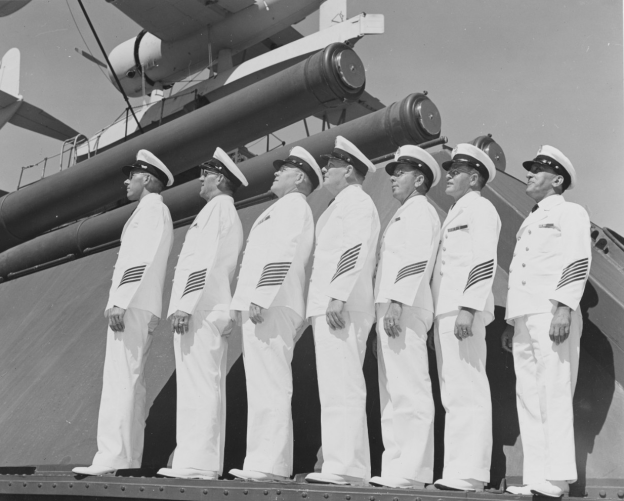
The earliest known use of the term “chief petty officer” dates back to 1776 onboard Continental Navy Ship Alfred, when the title “chief cook” was conferred upon cook’s mate Jacob Wasbie. This was an informal designation that noted Wasbie as the foremost ship’s cook but was not officially recognized nor consistently used throughout the Navy.

The chief petty officer, as recognized today, was officially established 1 April 1893, when the rank “petty officer first class” was shifted to “chief petty officer.” This originally encompassed nine ratings (occupational specialties): chief master-at-arms, chief boatswain’s mate, chief quartermaster, chief gunner’s mate, chief machinist, chief carpenter’s mate, chief yeoman, apothecary, and bandmaster. Chief Petty Officer could be either an acting (temporary) appointment, designated as AA, or a permanent appointment, designated as PA. The Career Compensation Act of 1949 created an E-7 grade that standardized pay for all chief petty officers, regardless of acting or permanent status. Acting status for chief petty officers was not eliminated until 1965. A 1958 amendment to the Career Compensation Act added two new pay grades, senior chief (E-8) and master chief (E-9), and created six new rating titles.

Today, there are three chief petty officer ranks: chief petty officer, senior chief petty officer, and master chief petty officer. Chiefs are recognized for exemplary technical expertise within their rating, superior administrative skills, and strong leadership ability. Most importantly, chiefs bridge the gap between officers and enlisted personnel, acting as supervisors as well as advocates for their Sailors.

Standard