
What is a Sailor

Heavy Seas
By FTG1 Tracy Garner DD 468, DD 836, DD 884

For a tin can at sea, deteriorating weather conditions could bring anything from a bumpy ride over choppy seas to mountainous waves crashing over the main deck. It could mean a brief encounter of a few hours, or a struggle lasting several miserable days. It has been said that to appreciate the power and grandeur of nature, one could stand at the edge of the Grand Canyon and gaze out over the precipice. This would surely impress upon you just how puny and insignificant you truly are. I would add that if you should do that with the wind howling and the earth pitching and rolling beneath you as you desperately cling to a small bush you could then acquire roughly the same appreciation of your puniness as does a tin can sailor riding out a storm at sea.
The way it starts: The first hint of what is to come could be the proverbial red sky at morning. Or it could be the less dramatic mid-day sky gradually becoming gray, along with the suddenly restless sea. The word would be passed to prepare for heavy seas as the wind begins to form whitecaps and whip a fine spray off the higher waves. As the waves grow larger and the wind increases, the sky and sea merge into a gray haze while the ship begins to respond with pitches and rolls of increasing magnitude with no real pattern. A certain carnival atmosphere develops and the noise level within the ship increases as a sudden heavier roll is met with exuberant whooping and hollering, often accompanied by the sound of some unsecured piece of gear crashing to the deck. This continues as the angle of the rolls increase until, at some point, the ship gradually becomes quieter. Everything that was going to fall has either fallen or been secured, and simply being about the heaving decks is no longer such great fun for the tiring crew. Now the loudest sounds heard are of the bow plunging down into the next wave trough, waves slamming against the hull, and the constant squeaking of the expansion joints. If it gets bad enough, sometimes the whole ship shudders as the screws break the surface due to the ship riding over the crest of a particularly large wave. In the pilot house, the inclinometer is now being watched as much as the chronometer as the helmsman must continually fight to keep the ship on course since winds and gravity work with the waves to skew the ship left and right.
When the carnival ride has lasted long enough but doesn’t end, one could start to see similarities between this situation and a tilt-a-whirl ride operated by a sadistic madman with the power to make the ride last as long as he wishes and even go faster. There is no emergency stop button and no way off. Storm or no storm, life goes on. The ships routine is maintained if possible, watches must be stood and ships work will still be accomplished. Everything that needed to be done still needs to be done but now the doing becomes more difficult. Any small task that requires two hands now requires two men since you can use one hand for the ship, but must reserve the other for yourself. Simply moving about the ship means keeping one hand free to grasp whatever is handy that will keep you from careening off in some unwanted, possibly dangerous, direction. Going through a watertight door often becomes a struggle as the ship rolls and the weight of the door requires all your strength to pull it closed behind you, you dare not release your grip to let the door swing uncontrolled. The interior passageways become wet and slick from the sea spray entering as people access the weather decks while moving around topside becomes a series of ungainly dashes across a pitching, rolling and dangerously slick deck. These dashes are usually made while keeping your back to the wind and the biting rain or spray. The word is passed over the 1MC for all hands to lay clear of the forecastle and fantail. It becomes too dangerous to venture there because the odd wave breaks over the decks, carrying away anything or anyone not secured. Having a meal becomes an adventure requiring you to manage your tray with one hand while alternately eating or hanging onto the table with the other, and the deck would always become slick from the inevitable spilled food. The menu would be modified somewhat, no need to make a bad situation worse. Breakfast eggs are scrambled only, no over easy (the steam line griddle is also pitching and rolling). This whole process of going to the mess deck for a meal would seem to be a lot of trouble for one with no appetite, but skipping a meal is not a wise choice. At the end of a long day, you wearily climb into your bunk and then grasp your bunk frame or chain to keep from being tossed onto the deck during a heavy roll, awake or asleep you do not give up that hold. When it is time to hit the deck you will have newly stiff and aching muscles from clinging to your bunk for hours. These aches will accompany the existing dull aches and pains accumulated from the physical struggles of the day before. You start your new day by being tired.

And then there is the sickness:
Everyone who has experienced a storm at sea more than once probably has developed his own way of coping. Some are affected more by the motion than others but I think everyone suffers to some extent. What works for one will not necessarily work for another and it is a solitary challenge to find your own way to endure. The always present, well-meaning advice may or may not be worthwhile. For example, the often suggested and timeworn trick of eating crackers is suspect. I have seen boxes of crackers eaten between bouts of cracker spewing; they may help some, but not all. In a sense, even though you are crowded together in the steel confines of the ship, when the storm hits you are very much alone.
When it comes, the nagging queasiness is yours and no one else’s. To prevent it from becoming the all-consuming seasickness requires you find some coping skills, and those can only be found within. They say seasickness is mostly a mental state, and your mental state is what you make it.
Even though the struggle to prevent the queasiness from becoming nausea and vomiting is a solitary pursuit, for the maintenance of good order and discipline, all hands must consider their shipmates. Even if you should be that rare individual who feels no ill effects from the motion, due to the lack of adequate ventilation you still do not open a can of sardines or light a cigar inside the ship. Also, there will be no whining or complaining, since anyone you can complain to will be in the same boat, so to speak. Whining is sure to bring ridicule and scorn, but no sympathy. If you do come to the point of actually needing a trash can between your knees you may receive a sympathetic word, along with a request to take it somewhere else. The smell of vomit lingers in the close confines of a space, much to the discomfort of those required to be there. Also, cleaning up vomit often results in a chain reaction. Last but not least, the considerate shipmate always pukes leeward. My first and only experience of actual, hanging over the rail, seasickness did not occur during my first or even my worst storm. After that one unforgettable episode, I decided that nothing that will likely happen at sea can be much worse than reliving that terrible day. My own experience taught me that I would fare much better by just staying too busy to give much thought to the ship’s motion. If it became too rough to work, or if I ran out of anything to do, I should simply stretch out somewhere, with my work jacket for a pillow and my ball cap over my eyes, and nap. After all, what are the chances that the Chief would leave the goat locker and come looking with some task or other, he would likely be immersed in his own storm coping ritual.

There are not that many places in a tin can where a man can stretch out and reasonably expect to be left alone. My favorite was my tiny air-conditioned Mk 25 radar room on the 01 levels, across from radio central. Any port in a storm, I suppose.
The absolute worst thing I could do was to just sit wedged in a corner thinking about my discomfort, or discussing it with a shipmate.
And then it would pass: As the worst of the storm passes, the skies begin to clear and with the sun, random rainbows appear. The seas calm, conditions quickly return to normal. The ships’ routine becomes an actual routine again as the crew cleans up the mess and repairs any damage. With the return of calm seas and clear skies, modified condition Yoke would be set and the watertight doors topside opened to help air out the interior spaces. Soon all would be just as if nothing unpleasant had ever happened and the specific memories of this storm will simply merge with those from the past.
Instead of being a place of mortal danger, the fantail is once again the crews’ preferred gathering place for scuttlebutt and socializing while watching the sunset.
Thanks to foul weather, I was once fortunate enough to have a unique experience and learn first hand, how they did it in the days of old. During a visit to Bangkok, I had bought an inexpensive hammock made with nylon netting. Taking little space, it was easy to keep rolled and stashed out of sight. While riding out one uncomfortably close typhoon I decided I should try it out at sea. The only place I knew which had room to sling a hammock fore and aft, and was normally unoccupied at night, was the ordnance shop on the 01 levels behind the after stack. I informed some people where I could be found and retired to the shop for the night. The hammock was slung between bulkheads and above the workbench with enough room to avoid hitting anything as it swung suspended high in the small space. I then turned out the lights and, using my Zippo to light my way, carefully climbed from the bench into the hammock and settled in. The experience was unlike anything I had known before. Reclined in complete darkness, snuggled down into the hammock, all sensation of the ships rolls simply disappeared. Even with the lateral motion added to the rolls due to my height above the waterline, the only apparent effect was the sense of becoming noticeably heavier and lighter as I swung wildly to and fro. I could completely relax without fear of being tossed onto the deck below. To wake hours later refreshed and feeling as if I had spent the night at a Holiday Inn was a most pleasant revelation. I have since decided that hammocks may not have been used on destroyers of the day simply because the Navy was averse to spoiling its enlisted men.
Thanks, Tracy
Boy Howdy and Love
By Garland Davis

Love was very difficult for Boy Howdy to talk about. And yes his name is Boy Jenkins. He is from one of those southern states that only use the vowel A. His mother died shortly after his twin sister and he were born. Without a name, the county clerk entered the names ‘Girl’ Jenkins and ‘Boy’ Jenkins on their birth certificates. He had picked up the nickname Boy Howdy from the Chief on his first ship
Boy believed that love was difficult for normal men to talk about. In fact, all the months’ Boy had been shacked up with Rosalita in Olongapo, he cannot recall opening up his heart on the subject of love, except for the afternoons he spent with Carmen at the Marmont Hotel in the Barrio.
But, Little Sister Maria was the one he really loved!
Fresh Water Carriers
ALTHOUGH THE UNITED STATES commissioned a staggering 151 aircraft carriers during World War Two, it’s safe to say that none were quite like the USS Wolverine and her sister ship the USS Sable.
Not only were the two flattops the only American wartime carriers powered by coal (most naval vessels of the era ran on fuel oil), both served their entire military careers on Lake Michigan – a landlocked Great Lake in the middle of North America.
And while these freshwater fighting ships faced no enemy and fired not a single shot in anger, both were invaluable to the American war effort. Together, the vessels prepared thousands of naval aviators for the dangerous job of landing planes on pitching and rolling flight decks at sea. And it was squadrons of these same naval aviators that helped turn the tide against the Axis.
Yet despite their importance, the Wolverine and Sable have become little more than two curious footnotes to the larger history of the Second World War. That is, until now! Here’s their story.

Before it was converted to an aircraft carrier, the USS Wolverine was the Lake Erie luxury liner the Seeandbee. (Image source: WikiCommons)
Commissioned in 1942 as a training ship for naval aviators, the Wolverine began its life in 1913 as the paddle-wheel steamer Seeandbee, a Lake Erie luxury cruise liner capable of carrying 1,500 passengers. The 500-foot-long vessel featured 500 private cabins, a saloon and a great formal dining hall, complete with an orchestra.
For years, the Seeandbee’s berths were filled with upscale travelers looking to get from Buffalo to Cleveland overnight in style. But as ticket sales slumped during the Great Depression, the ship’s future seemed uncertain. It wasn’t until 1942 that she won a new and entirely unexpected lease on life.
Within weeks of the Japanese attack on Pearl Harbor, Washington bought the aging steamship and began converting her for military use. The navy was desperate for training aircraft carriers for an onslaught of rookie pilots and deck crew and the admirals couldn’t spare a single serving flattop for the role. But ships like the Seeandbee might fit the bill.
In just four months, work crews cut away the vessel’s superstructure and fitted her hull with a 500-foot wooden flight deck and arrester cables. A small bridge along the starboard side was also added.
Re-christened the USS Wolverine (IX-64) and commissioned in August of 1942, the vessel, which lacked the hangar decks and defensive weaponry of a conventional aircraft carrier, would be little more than a floating runway. Yet despite her shortcomings, the Wolverine was a handy platform for pilots to practice takeoffs and landing, thus freeing up frontline carriers for combat duty. By early 1943, the vessel was sailing daily from Chicago’s Navy Pier into Lake Michigan where she’d conduct flight training operations.

The USS Wolverine was about 250 feet shorter than a frontline Yorktown-class carrier. (Image source: WikiCommons)
By 1943, the navy needed even more carrier pilots trained, so in May the Wolverine was joined by another flattop, the newly refurbished USS Sable.
This newer carrier had been converted from the 518-foot-long paddle-wheel liner Greater Buffalo, the former pride of the Detroit and Cleveland Navigation Company’s Lake Erie fleet.
In her prime, the Greater Buffalo treated passengers to luxury staterooms, a vast dining hall, an onboard movie theatre, and even its own radio station. But by 1941, the GB sat idle. The following year, she too was acquired by the navy and retrofitted with a flight deck — this one made of steel. Eight rows of arresting cables were also added and a bridge. Down below were pilot briefing rooms, living quarters, mess halls and even laundry facilities for both aviators and crew.

The Cornbelt Fleet at anchor at Chicago’s Navy Pier. (Image source: WikiCommons)
Together, the two unlikely vessels became known affectionately as “the Cornbelt Fleet” — a nod to the ships’ landlocked Midwestern cruising grounds.
By the late spring of 1943, the Sable and Wolverine were launching and recovering single-engine warplanes flown by aviators from Chicago’s Glenview Naval Air Station. The training ran seven days a week. When operations were in full swing, 100 fliers a day were earning their carrier qualifications on the two ships’ decks.
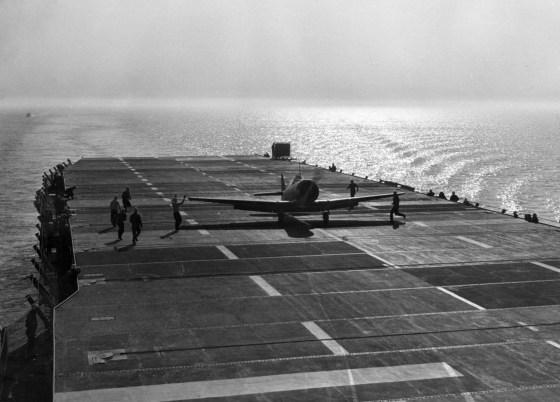
A Navy trainer touches down on the USS Sable somewhere off Chicago. (Image source: WikiCommons)
But it wasn’t all smooth sailing for the Cornbelt Fleet. Despite steaming off the so-called Windy City, the air on Lake Michigan was often too calm to allow for safe carrier flying. The wind over deck (WOD) speeds necessary for aircraft launch and recovery were a far cry from those found on the world’s oceans. The often still air also kept heavy frontline combat planes like Hellcats, Corsairs, and Avengers from getting stiff enough tailwinds for safe touchdowns. Takeoffs were also a challenge. Even SNJ Texan trainers, Navy variants of the lightweight AT-6, often had trouble operating from the Sable and Wolverine. In fact, wind conditions were sometimes so calm, flight operations had to be suspended altogether for days at a time.
Yet despite these limitations, the carrier pilot training program was a resounding success. Nearly 18,000 fliers conducted more than 116,000 landings and take-offs on the two vessels between 1943 and 1945. During that period, fewer than 300 planes were lost.

A Grumman Wildcat cracks up on the deck of the USS Sable. (Image source: WikiCommons)
With the war won, the need for carrier pilots ended virtually overnight. Both ships were decommissioned within weeks of Japan’s surrender. While the Wolverine was sold off for scrap, the Great Lakes Historical Society offered to convert the Sable into a floating museum at Put-in-Bay, Ohio. Sadly, the plans fell through and in 1947 the carrier was sent to a shipyard in Hamilton, Ontario to be broken up.
All that remains of the Wolverine and Sable now are photos and some newsreel footage.
Standin’ in the Moonlight
By Gerald Donohue

Standin’ in the moonlight
peein’ on the grass
my dog right beside me
scratchin’ his own ass
neighbors all around me
separated by tall fence
suddenly I realize
chain-link ain’t that dense.
The Gunline
By: Garland Davis

It was an unwritten code of the sailor: never stand when you can sit; never sit when you can lie down, and never stay awake when you can sleep. This was never truer than when providing gunfire support to Army and Marine troops engaged with Viet Cong insurgents or North Viet Army regulars.
Between watch standing, General Quarters, refueling, re-arming, stores unreps, and added bullshit from topside, there was little time to get a few hours of uninterrupted sleep. Add water hours and the seeming monotony of the meals, powdered fucking milk, the same shitty movies, and the ship store out of every cigarette brand except outdated, unfiltered Luckies it was amazing that morale did not go completely to shit.
The clammy incessant heat drove everyone to seek whatever cooling comfort that was available. A-gang machinist mates frequently needed to get into the reefers to check the internal temperatures. Everyone was begging the cooks for a little ice. Giving in to them would have meant no ice for the bug juice at the meals. The bug juice sucked, but it made the fuel oil flavored water drinkable. The fucking galley serving ice cream and all the fucking bowls were hot from the scullery and melted it before you could reach the table.
Meet your closest shipmate in a passageway and greet him, he either returns the greeting, tells you to fuck off, or completely ignores you. Tempers were on edge. Added to the mix were the racial tensions and anti-war sentiments of the country seeping into the fleet. Real and imagined remarks, slurs, and treatment were causing problems. Capable CPO’s, able LPO’s and knowledgeable Officers were often busy diffusing situations. Situations very often, caused by some of my fellow CPO’s and some dumbshit Junior Officers.
Even with morale in the shitter, with black and white sailors distrusting each other, hippies and dope smokers trying to drop out, there was still a sense of camaraderie in the crew.
The ship suffered a casualty in Mount 51 and the something to do with breechblock needed replacement (I don’t remember the exact details). This was categorized as a two to three-day yard job. While the officers were busy sending messages to whomever and re-planning firing missions, the GM1 with assistance from the BM1 and the A-Gang MMC set about changing the breechblock assembly. The Gunnery Officer, upon discovering this told them to stop, that they couldn’t do it. It was a yard job. GM1 went to the Weapon’s boss and told him that he thought it could be done at sea if the rigging was right and that the BMC and BM1 were available to handle that. The MMC would provide tools and the HT’s would weld fittings needed for the riggers. He and the Weps Boss went to the CO. The Old Man listened and told them to give it their best shot.
During the next forty-eight hours, the whole crew came together to offer help and support any way possible. All the animosity and slights seemed to drop away. We were all shipmates. To shorten a long story, we went back on the gunline two days later with mount 51 in battery.
Finally arriving in Subic, a few days liberty and many of the slights and disagreements forgotten, we were ready to go out and do it again. We were young and did things we were not supposed to be able to do. We did them because we did not know we couldn’t.
Legacies
By: Garland Davis
Definition of legacy
plural leg·a·cies
I learned of an event yesterday that has me thinking about legacies. Not the monetary or property legacy in the definition but the historical legacy that a person leaves in the minds and memories of those left behind. Was the person a good or bad person, etc.
We often hear the word legacy in connection with presidential terms and libraries. Lincoln set the bar pretty high by freeing the slaves and preserving the United States. If the pundits and newscasters are to be believed, the thing foremost on a president’s mind is the legacy he will leave.
Barrack H. Obama’s legacy is:
His predecessor, G.W. Bush’s legacy is as follows:
I’ll leave Bill Clinton’s legacy with a single line. Although I could write much more, this will be what he is most remembered for:
George H.W. Bush’s legacy is pretty much:
Those of us who served in the military under Reagan remember:
Jimmy Carter brings to mind a number of things:
I could continue going back president by president, but I think that is enough to emphasize the point I am trying to make. I am sure there are those who would dispute my points, but this is my opinion.
A lady I knew died in her sleep two years ago. It caused me to think about legacies that us common people leave behind.
Her father was a sailor who promised the pregnant Japanese girl that he would return for her and her baby and then abandoned her. Her stepfather, another sailor, barely tolerated her and when her brother was born, he and her mother pretty much ignored her. She was often neglected and left with relatives for weeks at a time. She did poorly in school and was passed through the system with a very poor education.
She discovered alcohol at an early age and then drugs. She did straighten herself up long enough to marry and have a child. But it was short-lived. A Navy wife, alone, her husband deployed and her with a predilection for mind-altering substances, and a willingness to do whatever it took to get them was a ticking time bomb. Her husband was granted a humanitarian transfer to shore duty to care for his daughter. He eventually divorced her, left the Navy and moved, with the daughter, to the mainland. She hadn’t seen the daughter since the girl was a child.
She moved from shack up to shack up. She went where the drugs were. When the men kicked her out, she would go begging to her mother and stepfather for a bed to sleep and food to eat. They always took her in. She would stay for a time and then the urge and need for drugs would send her looking.
I don’t know how long she had been home. One morning, her sister-in-law went to wake her and found her dead.
I guess her legacy will be, poor abandoned and neglected girl who lived her life believing and acting as if she had no value.
I have never considered a personal legacy. I hope I am remembered as a good husband and provider. I also hope I am remembered as a good sailor, a crazy son-of-a-bitch, and a good shipmate. And, I hope that from time to time someone finds the crap I write out there in the ether, reads it and thinks, “I would like to have known him.”
A native of North Carolina, Garland Davis has lived in Hawaii since 1987. He always had a penchant for writing but did not seriously pursue it until recently. He is a graduate of Hawaii Pacific University, where he majored in Business Management. Garland is a thirty-year Navy retiree and service-connected Disabled Veteran.
Chief Petty Officers
By Garland Davis

We weren’t aware of it at the time but it became evident as life wore on, we learned our greatest lessons and true leadership from the finest examples any young man could ever have… Chief Petty Officers.
They were crusty old sons of bitches who had seen and done it all. They had been forged into men and had been time tested through World War Two and the Korean Conflict over more years than a lot of us had time on the planet.
They wore a coat and tie uniforms, but could change into dungarees or wash khaki and do a task better than anyone aboard. But it wasn’t their job to do the work. They were there to ensure that you knew how to do it and did it properly. And if you didn’t do it right, they could come on like the hind wheels of hell.
They usually had a cigarette or cigar in their mouth and a cup of coffee, if not in their hand, within reach. Ashore the coffee was replaced with a mug of beer. You only saw them aboard when you needed tweaking and you seldom saw them ashore. They rarely talked to you unless you were the PO1 when they handed out assignments. They would stop and correct you if they saw you doing something wrong and you felt as if you had grabbed the Brass Ring when one of them stopped to compliment you on your uniform or the job you were doing.
Many of them had tattoos on their forearms that would cause a cathouse madam to blush. Most of them were as tough as midrats steak. But they had to be tough to survive the life they had lived. They had been formed in the crucible of the wars in the Pacific and off Korea, in the months at sea watching for submarines and enemy bombers, of fighting off Kamikaze attacks off Okinawa, sweating depth charges at two hundred feet, or freezing on the flight decks off Pusan. They were and always will be, a breed apart from all other mortals inhabiting this Earth.
They took us seventeen and eighteen-year-olds and hammered and filed us until we fit in the round holes, in other words, they turned us into sailors. Sailors who could think for themselves and react as one when the situation required.
Chief Petty Officers didn’t have to command your respect. You respected them because there was nothing else you could do. They were God’s All-Stars on the oceans.
They were hardcore bastards who called it as they saw it and found no problem with the term ‘Jap’ to refer to the enemy that had visited us at Pearl Harbor on a Sunday morning in 1941 and whom they had taken an ass whipping to. In their day, ‘insensitivity’ was not a word in a Chief’s lexicon. In their minds were memories of lost shipmates and they cursed the cause of their loss. They were expert at choosing descriptive adjectives and nouns, none of which their mothers had taught them.
I remember Chiefs with two rows of ribbons that meant something. Atlantic Theater, Pacific Theater, Silver Star, Bronze Star, and many Purple Hearts. There was a Chief Corpsman with the Navy Cross. I heard that he went ashore with the Marines at Okinawa. He was always directly behind the Captain at personnel inspections. When I was at NAS Lemoore, there was a Chief Cook with a fully loaded Submarine Combat Patrol Pin.
I would marvel at the ribbons and ask, “Hey Chief, what’s that one and that one?”
“Oh Hell kid, I can’t remember. There was a war on. They gave them to us to keep track of the campaigns. We didn’t get a lot of news out where we were. To be honest, we just took their word for it. Hell, you couldn’t pronounce most of the names of the places we went… They’re all Kamikaze survival geedunk. This one is for standing in line at a Honolulu cathouse. Listen, sailor, ribbons don’t make you a sailor. We knew who the heroes were and in the final analysis, that’s all that matters.”
When a Chief called you ‘Sailor’ and accepted you as a shipmate, it was the highest honor you would ever receive in your life. At least it was clearly that for me.
They were not overly conscious of their position. You could find them with their sleeves rolled up in a working party.
“Hey Chief, you don’t need to be out here, we can handle this shit.”
“We all got to eat and the term ‘All Hands’ means just that.
They mentored and trained us. Not only us but hundreds more just like us. If it wasn’t for Chief Petty Officers, there wouldn’t be any United States Navy.
There was no magic that could make a Chief Petty Officer. They were created from deck swabbing, mess cooking, head cleaning seaman and matured in steel hulls of U.S. Fleets over many miles and years. Nothing that a seventeen-year-old smart ass could cook up was original to a Chief. They had seen E-3 assholes come and go. They could read you like a book.
“Seaman Davis, I know what you are thinking. Just one word of advice… DON’T. It won’t be worth it.”
“Aye, Aye Chief.”
You don’t thank Chiefs. No more than your dog thanks you for making him sit or roll over for a treat. You learn to appreciate what they did for you and who they were from the long distance of years. You don’t take the time to recognize his leadership. That comes later when you have experienced poor leadership or when you have the maturity to recognize what a leader should be. The Navy Chief Petty Officer is the standard by which you measure all others
In those days there was no CPO Academy or leadership training. Their education came at the end of an anchor chain and the handle of a swab, or as the first loader on a 3 inch 50 during the battle of Okinawa. They gave their lives to the United States Navy. Airdales, Black Shoes, and Bubbleheads will claim that their Chiefs are best. Let it be said that we don’t have to differentiate, Chief Petty Officer is all I need to know.
So when we get our final PCS orders and we get to where the celestial CNO assigns us, I don’t know that there will be Marines guarding the streets, but I hope there will be an old Chief in stained wash khakis, a cigar stub in his teeth, standing at the brow to assign me a bunk and locker. We will be young again and the fucking coffee will float a rock.
Life kind of stacks the deck, by the time you grow old enough and smart enough to recognize those you should have thanked along the way, it is too late. If it were possible, I would thank my old Chiefs. They would be amazed that they had succeeded in pounding enough into my thick skull to make me a Chief Petty Officer also.
I give my thanks to you old crusty, casehardened, Sons-a-Bitches. Save me a seat in the Mess.

 Tales of an Asia Sailor