Chief Petty Officers and Initiations

Chief Petty Officers and Initiations

By Garland Davis

Any Active or retired Chief who spends as much time on Facebook as me has surely seen and been invited to join the myriad CPO Facebook groups. There is the CPO Mess, the USN CPO Mess, REAL CHIEFS, Navy Chiefs (anything goes), the CPO Charge Book, and I am sure many other groups.

One of the groups requires that a prospective member provide the month, year, and location of his initiation. Just short of swearing a blood oath that he or she was initiated in the time-honored traditions of the CPO Mess, otherwise the person is not a “Real” Chief.

All this caused me to wonder just how did the Naval “tradition” of initiating new CPO’s joining the mess begin?

On March 3, 1893, U.S. Navy Circular #1 announced the establishment of the Chief Petty Officer classification effective April 1, 1893. Today, April 1, 1893, is commemorated with celebrations, ceremonies, and khaki balls. However, the appointment of the first Chief Petty Officers was not a major event of the day. The first Chief Petty Officers of 1893 were not immediately elevated to a higher enlisted status as a result of their appointments. In fact, there is no mention of the establishment of the CPO ratings in the Secretary of the Navy’s annual reports to the U.S. Congress in 1893 or 1894.

For the first ten years, Chief Petty Officers berthed and messed with the First and Second Class Petty Officers in the Senior Petty Officers Mess. The separate berthing and messing of Chief Petty Officers weren’t established until 1902 by a change to U.S. Navy Regulations. All other enlisted men were members of the General Mess.

By the end of WWI, most of the original 1893 CPO’s had left or retired from the Navy. The newer Chiefs had no memory of co-existing with subordinate Petty Officers. The Chief Petty Officer’s mess and quarters were firmly established at sea and ashore. The status of the Chief had also evolved. Chiefs enjoyed privileges such as open-gangway liberty. They also had better living quarters and better food than the rest of the crew.

The distinction between Chief Petty Officers and other enlisted men continued to grow. By 1941, all Chief Petty Officers and Officers were authorized to wear khaki working uniforms. Dungarees remained part of the CPO seabag.

CPO Initiations

Chief petty officer initiations of the 1940s and early 1950s were simple, fun events that welcomed new CPOs into the Chief’s Mess. Many of the events, such as tossing a shipmate into a swimming pool, were performed in front of the officers and crew. It wasn’t uncommon for seamen and junior petty officers to assist in throwing a Boot Chief into the water. After the new Chief dried off and changed clothes the final event generally consisted of having a few, or more, drinks ashore.

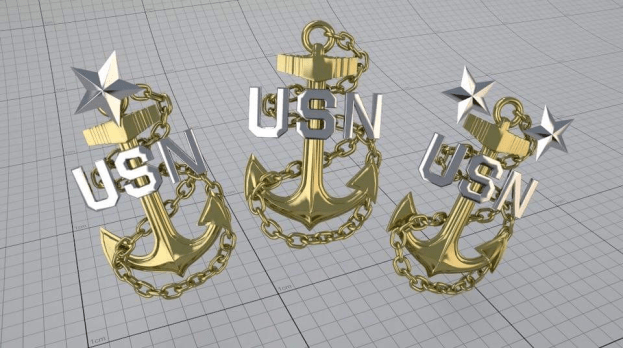
The initiations of the 1940s and 1950s were not the elaborate events that occurred in the 60s, 70s, and 80s. The initiations were usually overseen by the leading chief of the mess. At the time, there were no senior or master chiefs in the Navy. CPO initiations were not organized and varied from command to command. After initiation, there was no pinning ceremony since chief petty officers did not wear collar devices. Collar devices for CPOs were not authorized until 1959. Initially, all CPOs, E7-E9, wore the same collar devices. The final event of CPO initiations often involved the new CPOs donning their new hats and raising mugs of beer in a toast to the Navy. Promotion to Chief was commonly referred to as “wearing the hat.”

CPO initiations began to change during the late 1950s. CPO selectees, or Boot-Chiefs, were no longer simply thrown in a pool or tossed into the water. It became common for new chiefs to eat their first meal in the CPO Mess from a wooden trough using a big metal spoon. The food was edible and not yet the distasteful concoctions that would appear over the following decades. Boot chiefs wore their new chief uniforms during initiation– sometimes with minor modifications such as a “Boot-Chief” sign or a non-regulation hat. Their new uniforms were generally not ruined by initiation although they sometimes got wet.

CPO initiations began to evolve in the 1960s. Some of the rituals seen in “crossing the line” ceremonies such as eating distasteful concoctions of food products and drinking “truth serum” were adopted for CPO initiations. Some of the props used in crossing the line ceremonies such as stocks and ice-filled coffins began to be seen in CPO initiations. Characters like the “judge”, “defense attorney”, and “sheriff” became fixtures as CPO initiations essentially became mock trials or kangaroo courts.

Charge books also became more common. However, they were not the keepsakes that are seen today. CPO selectees were generally required to carry them and present them to any CPO who requested to see it. The most common charge book was one made from a legal size navy record book with a green cover. CPO selectees were always required to carry the book. The books were often attached to a line or chain worn by the selectee. Genuine chief petty officers would sign the book and enter charges against the selectee to be evaluated by the judge on initiation day. Chief petty officers were expected to enter words of wisdom or humorous notes concerning fines to be paid on initiation day. However, it was very common for lewd and vulgar statements to be entered into the book. Desecration of the book by cigarette burns and smearing food or feces on pages was not uncommon. After initiation, the books were often discarded due to their vile smell and vulgar contents.

By the mid-1980s chief petty officer initiations had adopted many of the characteristics of “Crossing the Line” (equator) ceremonies that included favorite props such as stocks and ice-filled coffins. The consumption of food and liquids, both good and not so good, by CPO selectees was the norm. Cross-dressing and crude behavior was entertainment for all who were present. The humor, hardships, and humiliations experienced during chief petty officer initiations formed a common bond between all CPOs.

Initiations prior to 1995 had little training value and were mainly entertainment for the “genuine” chief petty officers. Raw eggs, alcohol, and “truth serum” were consumed and or worn by CPO selectees and any officers who attempted to “practice law” as defense attorneys.

During the late ’90s and early 2000’s the CPO Initiations, as we knew them, ended and were replaced with a program of transitioning new CPO’s into the Mess. The pinning ceremony is still the capstone of the process of welcoming a new Chief.

During the 126 years since the creation of the CPO rate, we see that initiations evolved. The first Chiefs were not initiated in any way. In actuality, neither their circumstances nor uniform changed. The change was to their title and authority. From the beginning until the end of WWII, the initiation consisted of the Chiefs and other members of the crew throwing the new Chief into a pool of over the side and the everyone going ashore and drinking beer. This evolved into the “Kangaroo Court” with base humiliation of the selectee. This practice was ended and CPO’s are accepted into the Mess using more “humane” methods.

My question to all of you, were the original Chiefs, the WI and WWII Chiefs, or the newly appointed Chiefs any better or worse Chief Petty Officers because they weren’t caused to dress funny, chug-a-lug tequila concoctions, eat slop from a trough, protect their private parts from a bowling ball, or pick an olive off a block of ice with their butt crack?

The September 16th pining of the Navy’s Newest Chief Petty Officers draws near. Welcome to the Mess Chief!

Standard

Tales of an Asia Sailor — The Blog

Tales of an Asia Sailor — The Blog

By Garland Davis

I started Tales of an Asia Sailor in November of 2015 as a venue to tell my stories and memories of a time and life that no longer exist. The legend of us began with the China Sailor that was so aptly depicted by Jake Holman (Steve McQueen) and his shipmates in the classic movie “The Sand Pebbles.”

The end of World War Two and the presence of the Seventh Fleet gave rise to the true Asia Sailor who lived in the various countries of Asia as an occupation force and as a deterrent to prevent the Communist nations from overrunning the entire area. This resulted in the Viet Nam War and the apex of Asia Sailor’s lifestyle. We fought a hot war and trained to maintain our edge in a cold war. We fought a war with declining support from our government and the outright scorn of many Americans.

We worked hard and we played hard, in a time and place that lasted for only a short time. There are hundreds of stories from that period. As my good friend and shipmate, Dave McAllister wrote, “Is everyone living this dream or is it just me? I wonder what the unlucky bastards elsewhere in the world are doing tonight. Never did I imagine, dream or the thought dawn on me, that these glory days would too soon end and become the basis of which unbelievable sea stories would spring. As time has a habit of doing, the stories eventually became legend and now many of the legends exist only as myths; the likes of which will never be seen again.”

I use the Blog, primarily as a place to showcase much of the things I have written. From time to time, I include items written by some of my very talented shipmates.

As of today, I have posted over 1000 separate stories and articles. Since the beginning, I have had 485,190 individual views of the posts.

I am overwhelmed by the number of people who have registered for e-mail alerts when a new article is posted and for those of you who follow the Blog.

I want to take this opportunity to thank my shipmates who have permitted me to use their work and I thank all of you who read what is posted here.

Many of you have probably noticed that I haven’t been posting as often as I did in the past and that I am more and more relying on my shipmates for articles. Parkinson’s Disease is beginning to take a toll on my efforts to do many things. I will keep the blog alive and will post when I can.

Any of you are welcome to contact me at davisg022@hotmail.com or by Private Message on FaceBook.

Standard

“I’d Join the Navy”

“I’d Join the Navy”

NAVY HISTORY!

How many of you seen this “Navy Recruiting Poster” before?!

Trivia: Do you know the history of this poster and who the model was?!

ANSWER: The model enlisted in the Navy and became a Chief Petty Officer.

In 1917, as America entered WWI, thousands of young men rushed to join the Army, Marines, and Navy.

Bernice Smith was an energetic 20-year-old woman who stopped by her local California recruiting office and was very interested in signing up with the US Navy.

Upon seeing all of the young men enlisting in the Navy, Bernice suddenly blurted out the words, “Gee I wish I were a man, I’d join the Navy.”

Little did Bernice realize that also present at the recruiting station was one of America’s most famous illustrators, Howard Chandler Christy.

Chandler had done many illustrations for various magazines over the years, but with the outbreak of the war, he was asked by the government to develop a series of military recruitment posters.

Since in 1917 there was no television or radio to broadcast recruitment appeals, posters became the best way to get the public’s attention.

Impressed by what Bernice had said, Chandler approached her and asked if Bernice would agree to pose as his model for an upcoming Navy recruitment poster.

Bernice gladly accepted.

Not only did Chandler draw her dressed up in a Sailor’s outfit, but used her recruiting office quote as the central message of the poster.

This was also the first time sex appeal was used in a recruiting poster.

Chandler’s intent was to use the sexy image of Bernice in the poster to encourage men to join the Navy.

However, in Bernice Smith’s case, an amazing thing happened.

Ten days after posing for Chandler Christy, Bernice went back to her local recruiting office and successfully enlisted in the Navy becoming the first California woman to do so.

Bernice had a successful three-year career in the Navy and eventually rose to the rank of Chief Yeoman.

During WWII, Bernice tried to re-enlist in the Navy but was turned down due to age. The Army did, however, accept her and she served a tour of duty in the Army.

Bernice Smith was also considered the Navy’s first “Pin-up” girl!

After WWII she did clerical work in California veterans hospitals. She retired to Retsil, Kitsap County Washington.

She passed away at the age of 92 on 16 January 1990.

Image may contain: 1 person, smiling, text

Standard

Happy 227th Birthday U. S. Coast Guard

Happy 227th Birthday U.S. Coast Guard

The United States Coast Guard (USCG) is the coastal defense and maritime law enforcement branch of the United States Armed Forces and one of the country’s seven uniformed services. The Coast Guard is a maritime, military, multi-mission service unique among the U.S. military branches for having a maritime law enforcement mission (with jurisdiction in both domestic and international waters) and a federal regulatory agency mission as part of its mission set. It operates under the U.S. Department of Homeland Security during peacetime and can be transferred to the U.S. Department of the Navy by the U.S. President at any time, or by the U.S. Congress during times of war. This has happened twice: in 1917, during World War I, and in 1941, during World War II.

Created by Congress on 4 August 1790 at the request of Alexander Hamilton as the Revenue-Marine, it is the oldest continuous seagoing service of the United States. As Secretary of the Treasury, Hamilton headed the Revenue-Marine, whose original purpose was collecting customs duties in the nation’s seaports. By the 1860s, the service was known as the U.S. Revenue Cutter Service and the term Revenue-Marine gradually fell into disuse.

The modern Coast Guard was formed by a merger of the Revenue Cutter Service and the U.S. Life-Saving Service on 28 January 1915, under the U.S. Department of the Treasury. As one of the country’s five armed services, the Coast Guard has been involved in every U.S. war from 1790 to the Iraq War and the War in Afghanistan.

The Coast Guard has 40,992 men and women on active duty, 7,000 reservists, 31,000 auxiliaries, and 8,577 full-time civilian employees, for a total workforce of 87,569. The Coast Guard maintains an extensive fleet of 243 coastal and ocean-going patrol ships, tenders, tugs and icebreakers called “cutters”, and 1650 smaller boats, as well as an aviation division consisting of 201 helicopters and fixed-wing aircraft. While the U.S. Coast Guard is the smallest of the U.S. military service branches in terms of membership, the U.S. Coast Guard by itself is the world’s 12th largest naval force.

Standard

Real Chiefs

Real Chiefs

Real Chiefs think Ensigns should be seen and not heard and never ever be allowed to read books on leadership.

Real Chiefs don’t own civilian clothes.

Real Chiefs have CPO Association Cards from their last five commands.

Real Chiefs don’t remember life before they were a Chief.

Real Chiefs Wedding Proposal: “There will be a wedding at 1000 hours on 29 October, be there in whites with your gear packed because you will be a prime participant.”

Real Chiefs favorite national holiday is CPO Initiation.

Real Chiefs believe that in the Navy every day is a holiday, every meal is a feast, every payday is a lottery and every muster is a family reunion.

Real Chiefs’ favorite breakfast is shipboard SOS.

Real Chiefs don’t know how to tell civilian time.

Real Chiefs call each other “Chief.”

Real Chiefs greatest fear is signing for property book items.

Real Chiefs dream in Navy Blue, White, Haze Gray and occasionally khaki.

Real Chiefs have served on ships that are now war memorials or tourist attractions.

Real Chiefs get tears in their eyes when the “Chief” dies in the movie “Operation Pacific.”

Real Chiefs don’t like “Certified Navy Twill” (CNT’s). “Wash khaki” is the ONLY thing out of which to make a uniform.

Real Chiefs can find their way to the CPO Club while blindfolded on fifteen different Navy bases.

Real Chiefs have pictures of past ships in their wallets.

Real Chiefs only own ink pens that have “Property U.S. Government” printed on them.

Real Chiefs never volunteer to get mandatory flu shots.

Real Chiefs have a permanent curl in their forefinger.

Real Chiefs don’t order supplies, they swap for them.

Real Chiefs favorite quote is from the movie Ben Hur, “We keep you alive to serve this ship.”

Real Chiefs think excessive modesty is their only fault.

Real Chiefs hate to write evaluations, except for their own.

Real Chiefs turn in a four-page brag sheet for their evaluation.

Real Chiefs always say their last ship was their best ship.

Real Chiefs know that the black tar in their coffee cup makes the coffee taste better.

Real Chiefs are proudest when one of their former strikers makes Chief.

Real Chiefs’ idea of heaven: Three good PO1’s and a Division Officer who does what he is told.

Real Chiefs think John Wayne would have made a good Chief if he had not gone soft and made Marine movies.

Real Chiefs use the term “Good Training” to describe any unpleasant task. Scraping the sides of the ship is “Good Training.” Having to sleep on your seabag in the parking lot because there was no room in the barracks is “Good Training.”

Real Chiefs teach their children that the highest attainment in life should be in becoming a Chief.

Real Chiefs can never fathom why a Chief would even consider accepting a commission.

Real Chiefs think “Crepes and Quiche” are a gay Hollywood couple.

Real Chiefs rather hitchhike than own an imported automobile, truck or motorcycle.

Real Chiefs keep four sets of dress khaki uniforms in the closet in hopes they will come back.

Real Chiefs love their mothers mainly because she has a son or daughter in the Navy.

Real Chiefs believe that the only thing to make life more complete is if he/she had been born in a naval hospital.

Real Chiefs are always right and they know it. In the impossible hypothesis that a subordinate may be right, the former still applies.

Real Chiefs do not regard an officer’s rank and title as the measure of his or her competence.

Real Chiefs are the only people who can make the title “Ensign” sound like a four-letter word.

Real Chiefs are always “The Chief” – even in shower shoes and a towel.

Real Chiefs will tell you that they are always a part of the answer, never the problem.

Real Chiefs will always say, “Let me do it for you, Sir,” and then promptly assign someone to do it.

Real Chiefs don’t sleep; they rest.

Real Chiefs are never late; they are detained elsewhere.

Real Chiefs never leave work; their presence is required elsewhere.

Real Chiefs never eat sliders at mid rats.

Real Chiefs don’t eat quiche, and they can’t pronounce it or spell it.

Real Chiefs never read the newspaper in the mess; they study current events.

Real Chiefs play cut-throat Hearts, not Poker; and never, ever Bridge.

Real Chiefs never play a sport where the ball doesn’t come back by itself (bowling – yes, golf – no, tennis – never).

Real Chiefs call their spouses WIFELANT or WIFEPAC, or CINCHOUSE or CINCFAM.

Real Chiefs are at sea when their kids are born. [“You have to be there to lay the keel but not to launch them.”]

Real Chiefs always say, “Morning,” never “Good morning,” except when they are getting ready to get underway.

Real Chiefs never eat off of the ship. They know the best food is in the Chiefs’ Mess.

Real Chiefs are hated by Supply Officers who take inventory after the Real Chief pays a social call.

Real Chiefs don’t write in cursive, except for their paycheck signatures.

Real Chiefs think that the easiest day at sea is tougher than the worst day on shore duty.

Real Chiefs don’t make coffee.

Real Chiefs know that you can never, ever, at any time, at any location, sea or shore, or under any circumstances, be allowed to run out of coffee.

Real Chiefs never wash out their coffee cups, rinse maybe, but never wash unless they know that it has been pissed in.

Real Chiefs have a coffee pot next to their desks with an intravenous tube running into their arms.

Real Chiefs have a Goat Locker.

Real Chiefs never vacation; every day on the ship is a vacation.

Real Chiefs think that “sensitivity” is a control knob on a radar or sonar console and that’s all it is.

Real Chiefs have the heart of a little boy … kept in a jar on the desk.

Real Chiefs’ think that remote control is a PO1 on the other end of a walkie-talkie.

Real Chiefs know that you don’t need a computer to sail a ship, especially when the power is out.

Real Chiefs think that a seven-course meal on liberty is a baked potato and a six-pack of beer.

Real Chiefs never go on liberty with their juniors; they conduct training sessions.

Real Chiefs never have wine on liberty; it better be brewed and it better be cold.

Real Chiefs can name at least fifteen bars in Hong Kong but know that the best bars are across the bay in Kowloon.

Real Chiefs have tattoos; otherwise, how would they remember what a great time they had on liberty?

Real Chiefs can communicate with each other using farts.

Real Chiefs have mastered the use of the silent, but deadly, fart and they are not afraid to use it, especially around watch stations.

Real Chiefs have a “Zippo” that has been everywhere and still works.

Real Chiefs have tattoos on their forearms that would force them to keep their cuffs buttoned at a church picnic.

Real Chiefs take eighteen-year-old idiots and hammer them into Sailors.

Real Chiefs know that the term “All hands” means “All hands.”

Real Chiefs don’t have to command respect; they get it because there is nothing else that you can give them.

Real Chiefs are expert at choosing descriptive adjectives and nouns, none of which their mothers would endorse.

Real Chiefs have rows of hard-earned, worn, and faded ribbons, but know that ribbons don’t make you a Sailor.

Real Chiefs are matured like good whiskey in steel hulls over many years.

Real Chiefs aren’t the kind of guys you thank; monkeys in zoos don’t spend a lot of time thanking the guy who makes them do tricks for peanuts.

Real Chiefs are the standard by which you measure all others.

Real Chiefs were educated at the other end of an anchor chain from Copenhagen to Singapore.

Real Chiefs never excuse being late, not helping a shipmate, or running out of coffee.

Real Chiefs never spill a drink.

Real Chiefs never drink and drive because you might hit a bump and spill a drink.

Real Chiefs never go to sick call.

Real Chiefs have to go out and bring everyone back.

Real Chiefs know that you never wrestle with a pig because you both get dirty, and the pig likes it.

Real Chiefs never argue with an idiot because people watching may not be able to tell the difference.

Real Chiefs observe everything but admire nothing.

Real Chiefs know that they will always get what they in-spect, not what they ex-pect.

Real Chiefs agreed with John Wayne when he said, “Life is tough! But it’s tougher when you’re stupid!”

Real Chiefs know that no sailor is completely worthless, because worst case, they serve as a good bad example.

Real Chiefs know that there’s no help program like a self-help program.

Real Chiefs will tell you that, “If you are going to do something stupid, at least be smart about it.”

Real Chiefs can write up anyone they want.

Real Chiefs are the ultimate paradox. On the one hand they don’t give a crap, but on the other hand, Real Chiefs are very careful and precise.

Real Chiefs can find the best bar in any port by dead reckoning.

Real Chiefs paint their houses Navy Grey with their addresses taken from their favorite hull number.

Real Chiefs have a red and green buoy at the end of their driveways.

Real Chiefs eat lightning and crap thunder.

Real Chiefs consider a hurricane to be good sea trials.

Real Chiefs are the Navy.

Real Chiefs think that Ensigns, like diapers, should be changed often and for the same reason.

Real Chiefs know that once a job is fouled up, anything that is done to improve it only makes it worse.

Real Chiefs assume nothing is so simple that it cannot be misunderstood and they act accordingly.

Real Chiefs view land as a mere hazard to navigation.

Real Chiefs never attribute to malice that which is adequately explained by stupidity.

Real Chiefs never take the advice of someone who has not had their kind of trouble.

Real Chiefs know that if it is stupid but works, it is not stupid.

Real chiefs will tell you that you can survive on charm for about 5 minutes, after that, you’d better know something.

Real Chiefs know that assumption is the mother of all screw-ups.

Real Chiefs never assume they get the facts.

Real Chiefs do not confuse efforts with results.

Real Chiefs will give you three choices in any situation; change, accept or leave the Navy.

Real Chiefs think multi-tasking is done in the shipyard head reading a newspaper.

Real Chiefs know that prior proper planning prevents piss poor performance.

Real Chiefs know that every part of the Chief’s initiation is an important part of becoming a Chief and don’t need to question it.

Real Chiefs refer to their wives as ComNavSoapSuds.

Real Chiefs know bull when listening to it, and are able to sell bull when spreading it

And they have been initiated, Not just pinned at a tea par

Standard

The Typical Submariner Candidate in 1950 – Not Just Your Usual American Home Town Boy

Mister Mac's avatartheleansubmariner

The Typical Submariner Candidate in 1950 – Not Just Your Usual American Home Town Boy

The average 20 year old American male in 1950 shared a number of things. They were between 9-10 years old when Pearl Harbor was bombed so they grew up while the world was at war. Their entertainment was radio and movies and if they paid attention at all, they got their news from newspapers that were printed in their home towns.

Boys still wore pants and girls for the most part wore dresses. Very few had ever traveled further than their hometowns and even fewer had ever been on an airplane. Trains, busses and trolleys were the main mode of public transportation and cars were just beginning the Golden Age as the war ended and the automotive industry shifted back from making war machines to making dream machines.

From 1948 until 1973, during both peacetime…

View original post 1,772 more words

Standard