Our Greatest Generation

Our Greatest Generation

Jim Barton, Captain USN (Ret)

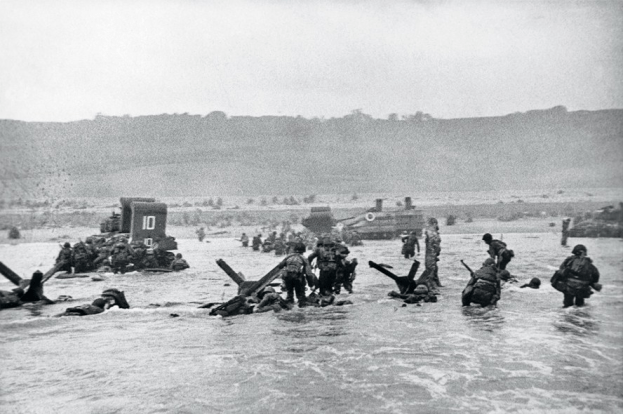
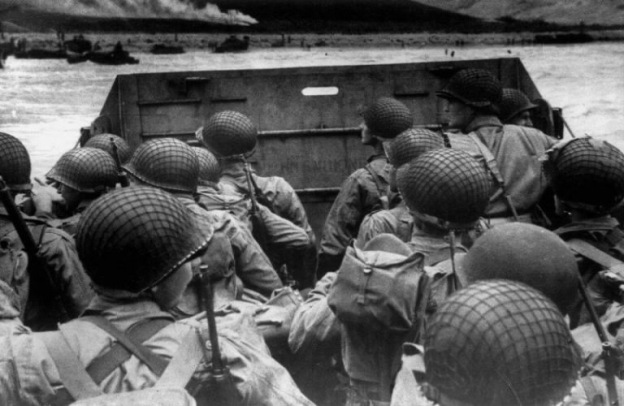
Our recent visit to the Normandy beaches and the impact it had on me caused me to pause and think; to try to imagine; to try to put myself in the place of a soldier awaiting the ramp door to open; to think how it must have been for the coxswain of the Mike Boat as he returned to pick up another load of men; for those pinned down on the beach all under withering fire from unsilenced guns untouched by allied bombs.

As a combat veteran myself, I think we all asked ourselves the following question:

Would the fear of combat compel me to run or to fight?

Thank God they chose to fight because they changed the course, not only of the war; but they changed the course of humanity against a regime so inhumane and brutal.

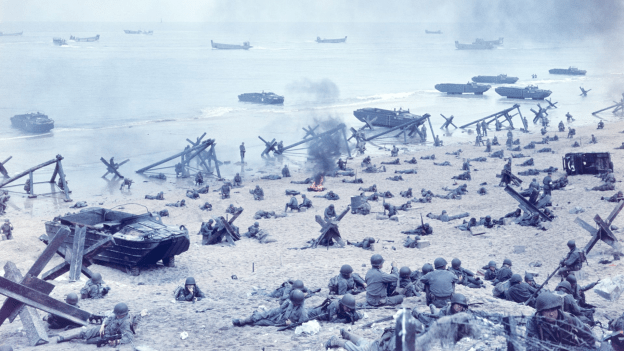
At Omaha Beach, it was horrific with its steep hills and cliffs just behind the beach. I walked that beach a few days ago taking in the difficulty of the task. German machine-gunners mowed down hundreds of Allied soldiers before they ever got off the landing boats onto the Normandy beaches.

But sheer willpower and large numbers of troops landing overwhelmed the German positions with 160,000 assault troops, 12,000 aircraft and 200,000 sailors manning 7,000 sea vessels. And the resupply was massive in the days and weeks which followed. In less than a year, the European war was over. Hitler and his despicable regime were gone or soon to be.

This is a day to be remembered. It is a day so significant it cannot possibly be overstated.

Young brave men, many of whom were teenagers, sacrificed and suffered the horrors of war so that we would know peace.

These were our fathers and uncles, supported by our mothers and aunts at home and for some at war who really were and are the greatest generation. Their numbers are few now and growing fewer every day. If you have the honor of seeing them, thank them not only for their service but for what they gave to us. Their legacy and sacrifice cannot be measured, so vast that it is.

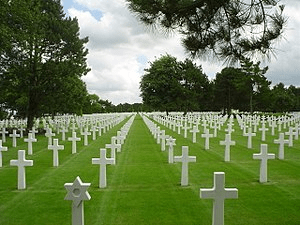
And for them, all gave some and some gave all. And for those who remain, a part of them still can be found on those bloody beaches of June 6, 1944.

Standard

D-Day

D-Day

When in England at a fairly large conference, Secretary of State Colin Powell was asked by the Archbishop of Canterbury if our plans for Iraq were just an example of empire building.

General Powell answered by saying,

“Over the years, the United States has sent many of its fine young men and women into great peril to fight for freedom beyond our borders. The only amount of land we have ever asked for in return is enough to bury those that did not return.”

It became very quiet in the room. You could have heard a pin drop.

Standard

Visiting the Pit

Visiting the Pit

Michael McGrorty

I was A PC and had the habit of visiting friends around the ship. Once I went into the fire room and saw a pal standing watch. He was at a station keeping a log. The space must have been over 125 degrees. The station was beneath a vent that blasted AC down, but it only cooled to about a hundred degrees, if that.

I never saw anybody in the machinery spaces that wasn’t saturated with sweat. I used to tell the BTs and MMs not to carry postage in their shirt pockets because you couldn’t get a refund on ruined stamps.

Noisy? Not at all. There was just a continual background scream as if a very dull cutting tool was shaving hard steel on a lathe.

When the door to the main spaces opened into the main deck passageway, a blast of heat shot out like the lid came off a blast furnace.

They had an ice machine down there in hell, whose purpose was to provide a bit of cold for satan’s assistants. They would guzzle ice water from three-pound coffee cans.

Despite all this, the snipes would come up for chow looking like they’d been pulled through a keyhole. They got a very pale fish-belly appearance after a while. I did not envy them, no matter that their exam multiple was far below mine.

I wonder if most of them knew what the job would entail when they went in.

Standard

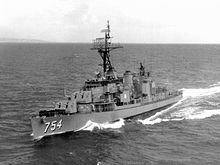
USS Frank E, Evans ·DD-754

USS Frank E, Evans ·DD-754

David Forrest

Written by a shipmate and shared by me.

Z 030312z Jun 69

It was 50 years ago today that I assumed the mid watch, mid – 0800 on 3rd Jun 69 in radio. My ship was the USS Schofield (DEG-3). My ship was in Desron 23 along with the USS James E. Kyes, USS Bronstein, USS Walke, USS Everett F. Larson, and the USS Frank E. Evans. We were on a SEATO exercise in the South China Sea and in company with the HMAS Melbourne, an Australian aircraft carrier. The Evans was in front of the carrier and told to assume plane guard duty 500 yards behind the carrier.

Approximated 0313 we received a flash message from the Melbourne. That flash message was and has to be the most shocking message I ever received. The message said that the Evans was in a collision with the Melbourne and the front half of the ship was on its side. I put the message on the message board and hauled my behind to the captain’s cabin and pounded on his door. I told him the Evans was in a collision and showed him the message. He signed it and said to keep him informed.

A few minutes later we received another message from the Melbourne indicating that the Evans sank. I hauled my behind back up to the captain’s cabin and didn’t knock this time but rushed through the door, opened of course, and shook the captain and told him about it. He signed the message and went to the bridge.

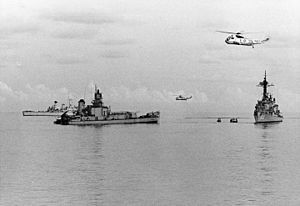
The exercise was canceled as well as our port visit to Thailand. We were on a search and rescue mission for the next 5 days looking for bodies and/or survivors. Unfortunately, we found nothing.

On that morning of 3 June 1969, 74 men lost their lives and are in a watery grave at the bottom of the South China Sea. Today we should remember those brave men who lost their lives in such a horrific way.

May they rest in peace!

Standard

The Pope & a US Navy Chief

The Pope & a US Navy Chief

Pope John Paul dies of old age and finds himself at the gates of Heaven at 0300. He knocks on the gate and a very sleepy-eyed watchman opens the gate and asks, “Waddyah want?”

“I’m the recently deceased Pope and have done 68 years of godly works and thought I should check in here.”

The watchman checks his clipboard and says, “I ain’t got no orders for you here. Just bring your stuff in and we’ll sort this out in the morning.”

They go to an old WWII barracks, 3rd floor, open bay.

All the bottom racks are taken and all empty lockers have no doors. The Pope stows his gear under a rack and climbs into an upper bunk.

The next morning he awakens to sounds of cheering and clapping. He goes to the window and sees a flashy Jaguar convertible parading down the clouds from the golden headquarters building.

The cloud walks are lined with saints and angels cheering and tossing confetti. In the back seat sits a Navy Chief; his EAWS Wings glistening on his chest, a cigar in his mouth, a bottle of San Miguel beer in one hand, and his other arm around a voluptuous Pinay Angel with magnificent halos.

This sight disturbs the Pope and he runs downstairs to the Master-at-Arms shack and says, “Hey, what gives? You put me, the Pope with 68 years of godly deeds, in an open bay barracks, while this Navy Chief, who must’ve committed every sin known and unknown to man is staying in a mansion on the hill and getting a hero’s welcome. How can this be?”

The Master at Arms calmly looks up and says, “Hey, we get a Pope up here every 20 or 30 years, but we’ve never had a Navy Chief before.

Standard

A History Lesson

A History Lesson

Insight Into Japan’s Surrender:

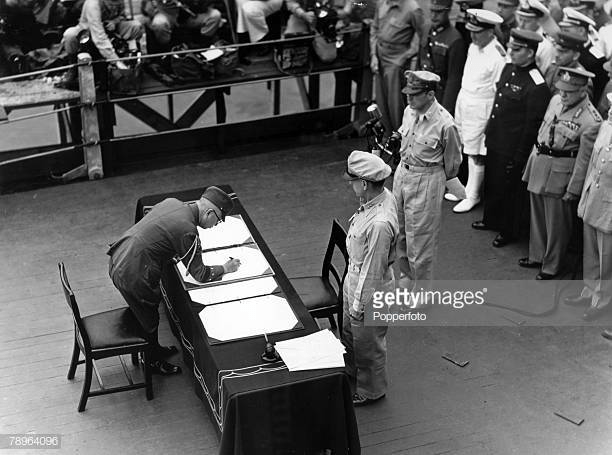
Why did the US choose a US Navy Iowa-class battleship as the location for Japan’s surrender in World War 2 even though they were in Tokyo Bay and could have used a building on land? Pure symbolism.

Nothing says “you’re utterly defeated” than having to board the enemy’s massive battleship in the waters of your own capital city. A naval vessel is considered sovereign territory for the purposes of accepting a surrender. You just don’t get that if you borrow a ceremonial space from the host country. In addition, the Navy originally wanted the USS South Dakota to be the surrender site. It was President Truman who changed it to USS Missouri, Missouri being Truman’s home state. The Japanese delegation had to travel across the water to Missouri, which sat at the center of a huge US fleet. It’s a bit like those movie scenes where someone enters a big-wig’s office, and the big-wig is seated silhouetted at the end of a long room, behind a massive desk. The appellant has to walk all the way to that desk along the featureless space, feeling small, exposed, vulnerable and comparatively worthless before the mogul enthroned in dramatic lighting before him. By the time he gets there the great speech he had prepared is reduced to a muttered sentence or two.

In addition, the USS Missouri flew the flag of Commodore Perry’s 19th-century gunboat diplomacy mission that opened the closeted Edo-era Japan to the world and forced upon them the Meiji restoration which ended the rule of the samurai class. The symbolism here is pretty clear – “this is how we want you to be, and remember what happens to countries that defy us.” It was particularly humiliating for a proud country like Japan, and that was entirely the point. The symbolism of the ceremony was even greater than that. The ship was anchored at the precise latitude/longitude recorded in Perry’s log during his 1845 visit, symbolizing the purpose of both visits to open Japan to the West. Perry’s original flag was also present, having been flown all the way from the Naval Academy for the ceremony.

When the Japanese delegation came aboard, they were forced to use an accommodation way (stairs) situated just forward of turret #1. The freeboard (distance between the ship’s deck and the water line) there makes the climb about twice as long as if it had been set up farther aft, where the freeboard of the ship is less. NOTE: This was even more of an issue for the Japanese surrender party as the senior member, Foreign Affairs Minister Shigemitsu, was crippled by an assassination attempt in 1932, losing his right leg in the process.

The #1 and #2 turrets had been traversed about 20 degrees to starboard. The ostensible reason for this was to get the turret overhangs out of the way to create more room for the ceremony on the starboard veranda deck, but in fact, this would have only required traversing turret #2 had it been the real reason. However, the turret position also put the gun tubes directly over the heads of the Japanese. They were literally boarding the ship “under the gun”.

The honor guard of US sailors (side boys) were all hand-picked to be over six feet tall, further intimidation of the short-statured Japanese. The surrender documents themselves, one copy for the Allies and one for the Japanese contained identical English-language texts, but the Allied copy was bound in good quality leather, while the Japanese copy was bound with light canvas whose stitching looked like it had been done by a drunken tailor using kite string.

After the signing ceremony, the Japanese delegation was not invited for tea and cookies; they were shuffled off the ship as an Allied air armada of over 400 aircraft flew overhead as a final reminder that American forces still had the ability to continue fighting should the Japanese have second thoughts on surrender.

Now you know………….

Standard

Might as Well Go Back to Ohio

Might as Well Go Back to Ohio

Told by Cort Willoughby to Garland Davis who rewrote and embellished

Officer Cort Willoughby was standing a turn on Index Hill, West Liberty, Kentucky next to the State Prison. West Liberty was around the hill. The road Cort was monitoring was the best route to the west side. It was a lonely boring 0200 until his Radar unit went snake shit!

Some dude zippin’ right along in a 45MPH speed zone. The malefactor was hitting 79, moving right smartly. Now Kentucky law says that moving more than 20 over the limit is an arrestable Reckless Driving offense. Cort hit the blue lights and the dude pulls over. After doing the License, Registration, and Proof of Insurance dance Cort strokes the dude with a ticket.

Cort noted that the dude was from Ohio, which was another good reason to fit him with a set of bracelets. Cort didn’t mind the paperwork of an arrest but seldom hooked one up for a speed offense unless there were other more serious mitigating factors.

Cort presents the dude with the ticket and explains his options. The guy looks at the citation, Cort’s unit number and the name of the citing officer. He looks at Cort’s name tag and asks, “Damn, how many Willoughby’s are there around here who are cops?”

“Why,” Cort asks.

He pulls out a citation from Kentucky State Police, unit 790. Kevin Willoughby, Cort’s son, had stroked him about 25 minutes earlier.

“Where are you going?” Cort asked

“Salyersville.” the dude says.

Just to spin him up, bullshitting, of course, Cort says, “You haven’t learned yet, My brother is High Sheriff of that county, My cousin is the Chief of Police in the town and my Pop, a retired State Police Captain, is the Justice of the Peace.”

The dude said, “Damn, I might as well just turn around and go back to Ohio. Willoughby’s everywhere with a fuckin’ badge.”

Standard

Midnight at Sea

Midnight at Sea

From Glenn Hendricks

So…getting off the 2000-2400 watch. Still a little wired from too much coffee and midrats. Not really tired. Steaming between Sasebo and Subic, 1974.

It’s a balmy night, we’re making turns for 16 knots. There is a full moon out, lighting up the ocean surrounding us like a cold white searchlight. You could almost read by the light. All but the brightest stars are washed out by this incredible moon.

I stand on the lee side boat deck on the O2 level next to the motor whale boat and under the Captain’s Gig and light up a cig. Watch the ocean sweep past and listening to the breeze against the superstructure and the distant hum of the forced draft blower intakes on the stack. I toss the butt into the drink and wander aft then down the ladder to the main deck. I turn the corner and walk forward toward the fo’c’sle.

I climb the ladder and walk past the 3 inch twin mount, across the anchor chain and up to the bow. Standing there you can watch the stem cut the water into twin curls, hypnotic in their unending stream.

I look back at the bridge. Only the red and green running lights are showing. The glass is dark. I know lookouts are posted but no movement can be seen. It’s as if I’m the only one aboard. A ghost ship sailing toward the unreachable horizon.

I duck down and light a cig. Standing there I gaze off, listening to the water, the breeze in the rigging of the M frames, the faint murmurer of machinery and contemplate what my future might be. I’m 19 years old.

I toss the butt into the ocean. Consider having another, then decide I need to hit my rack. I turn away from the bow and make my way down to Engineering berthing. Quietly I take my boondockers off by the light of the red night vision lamp, stick them between the AC vent duct and the bulkhead. Put my dirty dungarees into my laundry bag clipped to my bunk and turn in.

Standard

Oklahoma Woodstock

Oklahoma Woodstock

By Robert ‘Okie Bob’ Layton

Byars, McClain County, Oklahoma

1961

My Uncle Jess had rolled into town from Turkey Texas, driving a two-tone, pink and black, chromed out, 1958 Oldsmobile Super 88, man-o-man what a beauty!

Uncle Jess had outfitted the vehicle with a “Desert” canvas water bag hanging off the front grill, and on the passenger side, he had installed a “Thermador” window swamp air cooler. The car was equipped with rear speakers for the radio and with all that excess chrome, it sure-enough qualifies, as an early version of a pimpmobile.

Now Jess liked to drink and be chauffeured around while reminiscing about his youth. Sticking by my family’s rules, about no drinking while driving and motivated by my desire to drive. I eagerly volunteered to drive Uncle Jess around, at the ripe old age of 13.

I guess Jess was quite the “ladies man” in his day. When he came to town, he would have me take him to see some of his old girlfriends. He would often be greeted at the door with hugs and kisses. I meanwhile would wait out in the car playing with the unique “trans-portable” radio while Jess did his calling. After a little bit, Jess would come out, get back in the Olds, and down the road, we would go, to the next old flame.

I never gave it a second thought about what Uncle Jess was up to, for I knew nothing about these older women and my naive immaturity possessed no suspicion.

I eventually came to a realization one day. Jess had me stop at a very popular hamburger joint. I went inside with him and as he cleverly distracted me with a burger and fries, Jess inquired about the whereabouts of the owner. The owner came out from the back, a beautiful mature redhead lady. A person we all knew from my teenage body of friends.

Jess and her greeted, hugged, laughed and joked. They chit-chatted for a bit, while I munched on my burger and fries— tuning out the elderly conversation.

That was not what revised my way of thinking, once we left is what did it!

As I backed the Oldsmobile out of the parking, Uncle Jesse’s old girlfriend came to the entrance, opened the door, smiled, while beckoning an affectionate looking farewell.

Jess grinned and waved.

As we pulled away, he then said to me “You know back in the day she was my favorite”

“Girlfriend” I prodded

“I guess you could say she was my girlfriend”

“Boy-O-boy We use to go at it like rabbits”

“What” I blurted out

For I was stunned, as a teenager, my virgin ears had never heard, any adult talking in sexual terms!

Hearing Uncle Jess say that he used to have sexual relations with this respected mature woman! Why it changed my whole perception. It was like learning your mom and dad had sex to have you! It was an adolescent revelation!

My teenage hormones craved for more stories of old-fashioned passion!!!

“Jess you really did—-did– do her?” I squeaked out

“Yep every chance we got” He proudly announced

He further stated, “She was really something!”

Every chance “WE got” I thought they BOTH had consensual sex!!!!!

I was under the impression only boys took pleasure in sex. My innocent image of adult relations had just zoomed up.

Jess pointed east down highway 19

“Head on out of town and take us to Byars, I got something to show you” he declared

As I headed for Byars Jess position the large brass Santa Fe railroad spittoon. That he kept on the passenger floorboard.

“You see this here spittoon,” he asks.

“Yes sir”

“I took it off a Doodlebug train about 45 years ago”

“I was headed for Byars lake at the time and when the train stopped I just took it with me”

“What was going on at Byars lake?” I ask

“That’s what I’m going to show you”

On our drive to Byars Uncle Jess began to tell me about how they used to meet girls back in the 1920s.

Jessie Harold Brunson [Uncle Jess] was born in Erath Co Texas Dec 20, 1900. He grew up in rural Oklahoma and Texas, coming from a large sharecropping family of 13 kids, they all worked hard and played harder!

He said they lived out by Rosedale in the 20s. They would go to Byars Lake to party.

Now back then going thru the town of Byars were two major railroads that intersected in the town. East to West was the Oklahoma Central and North and south the Santa Fe.

The lake was Built by the Santa Fe railroad to provide water to the steam engines. It was hand dug out using mule teams. The main Santa Fe railroad track ran parallel to the lake going into town and in between the railroad track and the right-of-way was a little strip of land, about a hundred yards wide several hundred yards long.

In this field was a little grassy area that was kept mowed and cleaned.

We pulled up to Byars lake.

The Significance of the sight eluded me. For in front of me lay an overgrown cow pasture with a shallow moss covered lake. I was reminded of a dull worn out penny who’s previous worth had passed with time, no longer relevant to the present and whose value was pertinent only by the holder of the past.

Uncle Jess started talking, pointing to bedraggled areas of the landscape.

“You see that over there, that’s where they had picnic tables”

As he looked out over the overgrown field you could tell It was all coming back into his recollective vision, he started to identify the phantom spots of old.

“Over yonder was a small Pavilion, Gazebo, and a little bandstand” he reflected

“The lake had a pier with rowboats and swimming area,” he added

“The young people would pitch tents and camp out.”

“The town of Byars had a brass band that would perform concerts.”

“People would also bring guitars, fiddles, and banjos, and generate their own entertainment.”

“All that happened here?” I ask

“Yep it was the place to be back then” he proudly informed me

Jess said there was plenty of beer and alcohol and the young people would sing, dance, and play music way into the night.

In the nineteen-teens and twenties, this become a major attraction for young men and women to congregate, to meet people of the same age.

It was the backwood remoteness, away from the etiquette of the Victorian era, that accommodated the Hedonism, being ushered in by the flappers of the roaring twenties.

It is historically noted that up to 5000 young people would come on a weekend, let me tell you any time you get 5000 young people camped out in a remote area away from adult scrutiny you have a happening. In other words, It was the Woodstock of the day

They even built outhouses!!

Because of the two main railroads that intersected in the town of Byars, kids would come from all directions. From the north college kids from Stillwater, Oklahoma A&M.

From the east Ada which was East Central College.

From Norman Oklahoma University they would go down to Purcell and get on a train and then catch a branch line over to Byars

From the south, they would come up out of towns from the main line to Pauls Valley, switch trains and catch a ride to Byars lake.

Jess said that on a good weekend there would be hundreds and thousands of young people camped at Byars Lake and doing what young people do.

During the day they swam and rolled boats on the lake, listened to band concerts, toyed with badminton, played lawn croquet, tossed horseshoes and eventually paired off taking little strolls away from the crowds.

As evening approached People would sing and dance around the campfires and eventually off they go, taking their blankets/quilts. With the Moon and outdoors setting the mood so they went to frolic in the grass and woods.

Fifty years later the youth of 1969 Woodstock were doing nothing new that the kids of 1919 had not already done.

Once the word got out that there was a place, a happening, a rendezvous to go. All the kids wanted to go, to use today’s vernacular “hookup”.

Now all this was was done because there was a means for young people to travel back then—– Trains!

A lot of the small towns were connected by rail. As the railroads expanded they would often branch off of their main lines and interconnect smaller towns one to another. The railroads were helped out by the Federal Government and since they were going to build these Branch lines under government assistance, the government required that they provide public transportation and mail service on these Branch lines on a daily basis.

So it was mandated by law that these railroads had to provide some type of Transportation on a daily basis.

The railroads knew that it was not economically feasible to operate steam Engines up and down these Branch lines on a daily basis. Their solution was motorized coaches that were powered by small gas engines and gear system.

The railroads called the motorized coaches “Doodlebugs”.

The Doodlebugs were Something like the bus routes of today. The routes joined the smaller towns one to another.

They could haul passengers, mail, and limited cargo. A farm boy or girl could flag down the Doodlebug anywhere on the track and hop on board and catch a ride into town. It only took one man to operate it as a bus.

Doodlebugs were quite prevalent on these Branch lines throughout the rural areas and they were found basically all over the United States.

Back in my Uncles day in central Oklahoma, they provided a means of transportation for young people to get on and ride them to Byars Oklahoma and get off at the park.

I can remember riding the Doodlebug from Pauls Valley to Byars in the early fifties with my mother on a trip to visit my Aunt Sudie.

In 1958 the government rescinded the requirement of having to provide transportation on these Branch lines and the railroads quickly took them out of service.

Those last existing Doodlebugs brought an end to an Era of small town rail travel. Something that will never be seen again.

All that remains of the old railroads are the raised right-of-ways, next to fields, clear-cut paths through dense Crosstimbers that now act as highways for deer. No longer are their steel rails drawing lines through the countryside like ribbons through tangled hair. Gone are the sounds of the steam the shrill of the whistle the clank of the engines the laughter of the youth, the songs and music of the era.

Gone are all the great railroads that connect the small towns. The rails providing passage of life the venerable umbilical cords from one town to another.

As for Byars lake, all that remains is a shallow moss-covered lake and overgrown Park. Skirted by an abandoned railroad right away, down the road there are remnants of an old ghost town with dilapidated brick buildings run down houses and empty lots where once people lived and thrived.

As for the railroads, all the tracks a have been taken up the debris from a few old earthen raised right away, Bridges, trestles, testify to the grand days of the railroads. They have been replaced by state highways and County Roads that interconnect a nondescript destination with no distinction.

But there was a time a hundred years ago—– when kids defined their own generation—-adopted their own culture—Long before the hippie movement of the late ’60s

It all happened at Byars Lake—rural Oklahoma—where a century ago we had our own Woodstock.

Thanks, Uncle Jess!

Standard