An Untrue Tale of CV-63 and CV-64

An Untrue Tale of CV-63 and CV-64

By Garland Davis

I heard many stories about ships that I served in that were hard to believe. This one was told to me when I was mess cooking ass an SA. I had no reason not to believe it.

I had heard the story for years that the names and hull numbers of USS Kitty Hawk CV63 and USS Constellation CV64 were swapped because of a fire on Constellation during the building of the ship at the Brooklyn Navy Yard. Kitty Hawk was built at the same time in Camden New Jersey. The story has it that CV63 was the ship being built in Brooklyn and CV64 was being built in New Jersey. The story goes that the Names and Hull Numbers were switched to ensure that Kitty Hawk would be commissioned before Constellation. There is no truth to the legend. Kitty Hawk was commissioned on 29 April 1961 and Constellation was commissioned on 27 October 1961.


The supercarrier USS Kitty Hawk (CV-63), formerly CVA-63, was the second naval ship named after Kitty Hawk, North Carolina, the site of the Wright brothers’ first powered airplane flight. Kitty Hawk was both the first and last active ship of her class, and the last oil-fired aircraft carrier in service with the United States Navy.

Kitty Hawk was laid down by the New York Shipbuilding Corporation, Camden, New Jersey, on 27 December 1956. The ship was launched on 21 May 1960, sponsored by Mrs. Camilla F. McElroy, wife of Defense Secretary Neil H. McElroy. Kitty Hawk was launched by flooding her drydock; the conventional slide down method was ruled out because of her mass and the risk that she might hit the Philadelphia shore on the far side of the Delaware River.

The ship was commissioned 29 April 1961, at Philadelphia Naval Shipyard, Captain William F. Bringle in command.

With the decommissioning of Independence on 30 September 1998, Kitty Hawk became the United States warship with the second-longest active status, after the sailing ship USS Constitution. (Enterprise passed her in 2012; these two aircraft carriers were two of the three carriers to fly the First Navy Jack.)

For 10 years, Kitty Hawk was the forward-deployed carrier at Yokosuka Naval Base in Yokosuka, Japan. In October 2008, she was replaced in this role by George Washington. Kitty Hawk then returned to the United States and had her decommissioning ceremony on 31 January 2009. She was officially decommissioned on 12 May 2009 after almost 49 years of service. Kitty Hawk was replaced by George H.W. Bush. She was stricken from the Naval Vessel Register on 20 October 2017 and will be dismantled.

Constellation after the fire in the building dock

USS Constellation (CV-64), a Kitty Hawk-class Super Carrier, was the third ship of the United States Navy to be named in honor of the “new constellation of stars” on the flag of the United States. One of the fastest ships in the Navy, as proven by her victory during a battlegroup race held in 1985, she was nicknamed “Connie” by her crew and officially as “America’s Flagship”.

The contract to build Constellation was awarded to the New York Naval Shipyard Brooklyn, New York, on 1 July 1956, and her keel was laid down 14 September 1957 at the New York Navy Yard. She was launched 8 October 1960, sponsored by Mary Herter (wife of Secretary of State Christian Herter). Constellation was delivered to the Navy 1 October 1961, and commissioned on 27 October 1961, with Captain T. J. Walker in command. At that time, she had cost about US$264.5 million. Constellation was the last U.S. aircraft carrier (as of 2016) to be built at a yard other than Newport News Shipbuilding & Drydock Company. Constellation was scrapped at Brownsville, Texas, in 2015–2017.

USS Constellation was heavily damaged by fire while under construction on 19 December 1960. The carrier was in the final stages of construction at the Brooklyn Navy Yard in Brooklyn, New York when the fire began.

The fire broke out when a forklift operating on the hangar deck accidentally pushed its cargo into a steel plate knocking it over. The plate then broke off the plug of a 500 US gallons (1,900 l; 420 imp gal) tank of diesel fuel which spilled from the container reaching the lower levels of the ship. The fuel was ignited perhaps by a cutting torch of a fitter and then moved to a wooden scaffolding. The flames spread quickly filling the passageways of the ship with smoke. A Navy commander commented on the nature of the ship’s design at an inquiry, “Ships of this class are the most complex structures ever designed by man.

It took 17 hours for firefighters to extinguish the fire, some of whom had been “driven to the raw edge of exhaustion” after being called into service in the Park Slope air accident. The firefighters saved hundreds of lives without losing any of their own, however, fifty shipyard workers perished. The extensive damage cost 75 million dollars to repair, and delayed the commissioning date by seven months, leading to a rumor that the ship that had burned in New York was Kitty Hawk (CV-63) and the fire caused the Navy to change the names and hull number designations between the two sister ships that were being built simultaneously in separate shipyards in separate states. An abstract of a New York Times article from the day after the fire, 20 December 1960, refers to the ship as USS Constellation.

Standard

Have You Seen

Have You Seen

By Garland Davis

Have you seen

The flying fish’s rush to escape the looming gray predator

The graceful dolphins playfully pacing the bow for hours

The wakes foam straight and true from the past

The sun setting with a great red gleaming westward

The pale moon rising astern with a silver glow

The millions of stars dazzling a darkening sky

And realize that it is everything.

I have…

Standard

Hole in The Wall

The Hole in The Wall

By Garland Davis

It was a place of beginnings and endings, a place of firsts and lasts, a place of meeting and separation, a place of hopes and disappointments.

The Hole in The Wall was on the corner of Magsaysay and Gordon, the first place to get a cold one to begin liberty. It was also the place where a sick, hungover son of a bitch could gag down a couple of cold ones to help him make it through the day until liberty call when he would do it all again. It was the place where many memorable liberties began and the place where they ended. It was also the place where myriad seventeen to twenty-year-old kids had their first quasi-legal beer. I don’t know the drinking age there, but then, no one was checking ID’s. I guess Pesos sufficed to identify those old enough to drink.

It was a place where steadies waited for their sailor to come across the bridge. She waited to make sure some other girl didn’t catch his attention and steal him away. With more than fifteen thousand licensed hostesses in Olongapo, the competition for a sailor’s attention was fierce. Many girls breathed a sigh of relief when he appeared coming across the bridge because it meant that she, her mother, and sister would eat tomorrow.

It was a place where that same girl would say goodbye with crocodile tears the morning her sailor’s ship was leaving. There was the tingle in her stomach and the anticipation of the search for the next one. She could buy that pretty blouse with the fistful of Pesos he gave her right before he kissed her goodbye.

It was a place of disappointment for sailors and girls alike when the one they were waiting for didn’t come.

It was a place where the participants brought the young, or mostly old, women they had spent the night with and had chosen to enter in an “Ugly Contest.”

It was also the place where many sailors had their last San Miguel in the PI and said farewell to their last Olongapo girlfriend before leaving for discharge or retirement.

I know, I was one of those…

Standard

Graf Spee

Graf Spee

Admiral Graf Spee

by Lukasz Kasperczyk

Admiral Graf Spee was a Deutschland-class “Panzerschiff” (armored ship), nicknamed a “pocket battleship” by the British, which served with the Kriegsmarine of Nazi Germany during World War II. The two sister-ships of her class, Deutschland and Admiral Scheer, were reclassified as heavy cruisers in 1940. The vessel was named after Admiral Maximilian von Spee, commander of the East Asia Squadron that fought the battles of Coronel and the Falkland Islands, where he was killed in action, in World War I. She was laid down at the Reichsmarinewerft shipyard in Wilhelmshaven in October 1932 and completed by January 1936. The ship was nominally under the 10,000 long tons (10,000 t) limitation on warship size imposed by the Treaty of Versailles, though with a full load displacement of 16,020 long tons (16,280 t), she significantly exceeded it. Armed with six 28 cm (11 in) guns in two triple gun turrets, Admiral Graf Spee and her sisters were designed to outgun any cruiser fast enough to catch them. Their top speed of 28 knots (52 km/h; 32 mph) left only the few battlecruisers in the Anglo-French navies fast enough and powerful enough to sink them.

The ship conducted five non-intervention patrols during the Spanish Civil War in 1936–1938, and participated in the Coronation Review of King George VI in May 1937. Admiral Graf Spee was deployed to the South Atlantic in the weeks before the outbreak of World War II, to be positioned in merchant sea lanes once war was declared. Between September and December 1939, the ship sank nine ships totaling 50,089 gross register tons (GRT), before being confronted by three British cruisers at the Battle of the River Plate on 13 December. Admiral Graf Spee inflicted heavy damage on the British ships, but she too was damaged and was forced to put into port at Montevideo. Convinced by false reports of superior British naval forces approaching his ship, Hans Langsdorff, the commander of the ship, ordered the vessel to be scuttled. The ship was partially broken up in situ, though part of the ship remains visible above the surface of the water.

Standard

The Battle of Balikpapan

The Battle of Balikpapan

By Dale Byhre

See more of Dale’s art on Facebook at Artwork by Dale Byhre

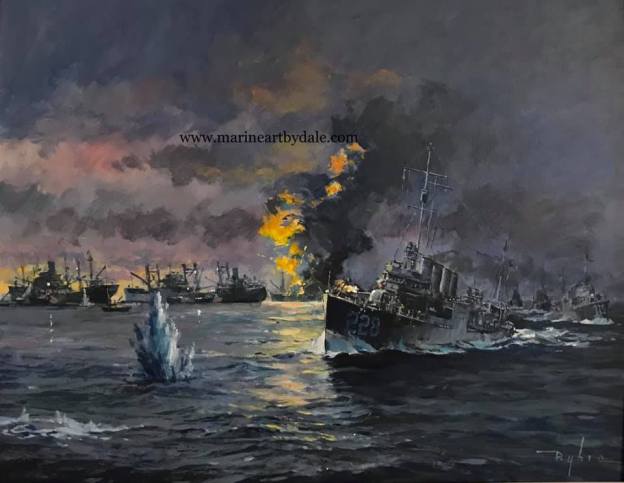
The Battle of Balikpapan’. Seventy- seven years ago on January 24, 1942, four elderly US Navy destroyers of the Asiatic Squadron, delivered a bold and audacious attack against the Imperial Japanese forces landing at the Dutch East Indies port and oil refining complex at Balikpapan, on the island of Borneo. Catching Japanese escorts by surprise, the four destroyers ran at high speed and in-line ahead, wreaking havoc amongst the anchored transports discharging men and equipment at the burning port. Sinking and damaging several of the transports with torpedoes and gunfire, the four flush-decked destroyers eventually made their escape suffering only light damage. It would do little to curb the Japanese onslaught, but at the time was a rare bright spot at a time of disastrous defeats suffered by the allies in the Far East.

The painting shows the destroyer John D Ford, leading its squadron as they make their high speed run through the rows of enemy ships caught unaware. The Ford is beginning a turn to starboard followed by the other destroyers to make another pass with torpedoes and guns while the burning oil facilities and an exploding Japanese ammunition ship light up the night.

Standard

“Scharnhorst

“Scharnhorst immer voran!”


Scharnhorst was a German capital ship, alternatively described as a battleship or battlecruiser, of Nazi Germany’s Kriegsmarine. She was the lead ship of her class, which included one other ship, Gneisenau. The ship was built at the Kriegsmarinewerft dockyard in Wilhelmshaven; she was laid down on 15 June 1935 and launched a year and four months later on 3 October 1936. Completed in January 1939, the ship was armed with a main battery of nine 28 cm (11 in) C/34 guns in three triple turrets. Plans to replace these weapons with six 38 cm (15 in) SK C/34 guns in twin turrets were never carried out.

Scharnhorst and Gneisenau operated together for much of the early portion of World War II, including sorties into the Atlantic to raid British merchant shipping. During her first operation, Scharnhorst sank the auxiliary cruiser HMS Rawalpindi in a short engagement (November 1939). Scharnhorst and Gneisenau participated in Operation Weserübung (April–June 1940), the German invasion of Norway. During operations off Norway, the two ships engaged the battlecruiser HMS Renown and sank the aircraft carrier HMS Glorious as well as her escort destroyers Acasta and Ardent. In that engagement, Scharnhorst achieved one of the longest-range naval gunfire hits in history.

In early 1942, after repeated British bombing raids, the two ships made a daylight dash up the English Channel from occupied France to Germany. In early 1943, Scharnhorst joined the Bismarck-class battleship Tirpitz in Norway to interdict Allied convoys to the Soviet Union. Scharnhorst and several destroyers sortied from Norway to attack a convoy, but British naval patrols intercepted the German force. During the Battle of the North Cape (26 December 1943), the Royal Navy battleship HMS Duke of York and her escorts sank Scharnhorst. Only 36 men were rescued, out of a crew of 1,968.

Standard

Quarterly Marks

Quarterly Marks

By Garland Davis


They were called Quarterly Marks, Semi-Annual Evaluations, and Annual Evaluations. They often caused many headaches for the Petty Officers and Chiefs. Many times what was submitted came back in a form that no way resembled the original input.

The following is an example of the evolution of a problem child Seaman’s evaluations as they progress through the Chain of Command.


LPO’s input on SN Frickerts evaluations:

SN Frickert is barely trainable. His work is poor even with a Petty Officer standing over him. He has raggedy uniforms and has to be supervised to send his stuff to the laundry on laundry day. He has to be taken to the barbershop to get a haircut. He is usually late for quarters unless somebody forces him. He is always on time for the Roach Coach, chow time and liberty call. He is a mouthy little SOB and talks all the time and has something to say about everything and everyone. He is a wart on the forehead of the division and is not recommended for reenlistment.

Division CPO’s input:

SN Frickert presents a leadership challenge. His performance is inadequate even with constant supervision. He is lax in his personal hygiene and care of his uniforms. A recent seabag inspection makes me believe that he would probably have difficulty in appearing in the proper uniform in which to take a shower. He is prone to run his mouth, criticizing every job and person, as a matter of fact, he has enough mouth for two sets of teeth. He has problems with mustering on time for shipboard evolutions. He does manage to make the chow line early and is first on the pier for the Mobile Canteen and it behooves a person not to slow down on the gangway at Liberty Call. He pulls down the reputation of the Division. I do not recommend him for reenlistment.

Division Officer’s content:

SN Frickert has presented a challenge but with hands-on supervision, his performance has improved. He has presented problems with hygiene and clothing issues, but the results of a recent clothing inspection have pinpointed problems and will soon be corrected. He is a loquacious individual who is willing to contribute positively and negatively to any evolution. He is, at times, lax in punctuality mustering for some functions but not all. With positive oversite, he is improving and in time will become an asset to the division. With positive encouragement, he should become eligible for reenlistment when the time comes.


Department Heads input:

Seaman Frickert is developing into an adequate sailor with the potential to excel. He is solving his uniform problems and is working hard on a punctuality issue. He is a knowledgeable sailor and is willing to offer advice on any evolution of the Deck Department. If positive improvement continues and in keeping with the Command’s goal of maintaining a 100% reenlistment rate, he is recommended for reenlistment.


Final evaluation edited and approved by the XO:

Seaman Frickert has developed into an excellent member of the ship’s company. He works well with his Petty Officers. He is cognizant of uniform regulations and has recently made a tremendous effort in upgrading his uniform issue. He is a knowledgeable individual with an amazing insight into all shipboard evolutions and is willing to lend direction and advise to his peers as well as his seniors. He is highly recommended for reenlistment and for advancement to Boatswain’s Mate Third Class.

Standard

Dragging Mud

Dragging Mud

As told by Cort Willoughby

Written and Edited by Garland Davis

Lord Dave and I were flying to Korea. We had taken the train from Sasebo to the airport. Having some time to wait before our flight, we were in the second floor Coffee Shop when I was hit by a blazing shit pain. If I didn’t get to a Thunder Mug forthwith, I was going to mess up a brand-new pair of skivs and lay a green funk of stink all over the place.

I ran down the steps and into the head. I slammed into the stall and realized that there was to wiping gear available! I’m out of there in a dash. I saw a dispenser which showed that 80 yen would solve my problem. Digging through my pockets, I realized that I didn’t have fucking’ 80 yen.

Willy was eyeballin’ my frantic efforts to get some shit paper. I pantomime counting coins. He nods OK. I tear ass up to the coffee shop to get 80 yen.

While I have been trying frantically to get coins, so I could get the resources to do the paperwork, I had drawn quite a cheering section in front of the head. I zap up, grab the 80 yen and rip ass back to the vending machine. We should have sold tickets, by now I have quite a crowd. Lot’s of tut-tutting and sucking of teeth as they watched my antics trying to get some ass wipe.

I inserted the 80 yen, turned the handle, and all most shit right there. I was now the proud owner of a brand-new tampon. My cheering section was falling out with laughter while I am on the very edge of “dragging mud” right there.

I sent a panicked, imploring eyeball to Willy and his Marie Leveau mind reading talents kicked in. He met me halfway down the stairs with the contents three napkin holders. I now had enough to complete the immediate paperwork and to write the after action report.

Sweat flying but in a very relaxed mode, this old Bos’n eased out to a standing ovation from all my impromptu admirers.

DGUTS, Bos’n

Standard

Was that Regular mail delivery or Regulus mail delivery?

Mister Mac's avatartheleansubmariner

Air Mail like None Other

Of all the submarine stories I have ever read, this one ranks with the most unusual. In 1959, the world was still reacting to the Soviet advances in space. The Navy had invested a significant amount of money on the Regulus Missile system as a way to counter Soviet threats. In the background, the Polaris program was about to come on line and change everything. But this story involves another use for the Regulus that is really just a foot note in history.

The story comes from the Postal Service Historic Library and shows an amazing feat that certainly should have a place in history. For the first time in history, mail was delivered using a missile fired from a navy submarine.

The USS Barbero was a Balao class submarine that was a veteran of World War II. She was converted in 1955 allowing her…

View original post 800 more words

Standard

Japanese Squat Toilets

Japanese Squat Toilets

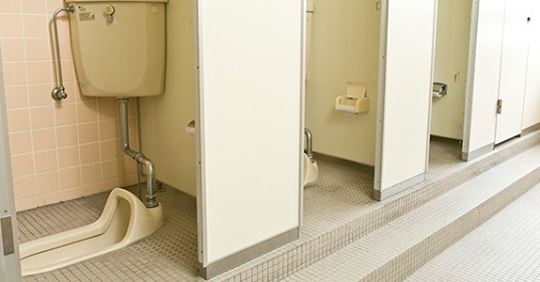
Japan to phase out squat toilets. Sailors will no longer face the adventure of this instrument of torture. Let Brion tell the story:

“Homecoming Parade Float”

By Brion Boyles

OK. so…I was 18, new in the Navy and on my first port visit to Japan. The ship, USS MONTICELLO, had pulled into Yokosuka, and a shipmate asked me if I wanted to go to Tokyo with him and a couple of other guys in a rented car and visit an old friend they knew… maybe play some poker. “Sure!”, I said, and we all piled into the car and headed off.

We parked on a tiny street fronting a tall apartment building and went up to the 4rth floor, where a party was in progress. I sat in on the poker game until I felt the need to unload, asked for the bathroom, and headed in. Locking the door, I turned and looked for the toilet. “Where the fuck is the TOILET!?!?”

There, obviously, is the sink, there’s a wastebasket…and recessed into the floor was what looked like a ceramic bedroom slipper, with a drain hole and some kind of tank above it. This, I figgered, was the mystical Japanese-style toilet I had heard a bit about. As I was already starting to “cap”, I thought no further…dropped trou, squatted over the narrow hole and let loose a perfect, foot-long log so dry and solid it made a “TINK!” noise when it hit the ceramic. I made use of a few sheets of ass-wipe from the roll and then looked for the flush lever.

No flush lever. There was a stumpy thing poking out of the tank, so I pushed it, tried to twist it…no joy. My concrete turd still lay motionless at the bottom of the pure-white trough. Now someone is pounding at the door…”You OK, man?”…

“Yeah! Just a minute!”. Not knowing what else to do, I yanked about 20 feet of toilet paper and carefully picked up my still-warm work of art, rolling it in the toilet paper like an Egyptian artifact. Then, I quietly opened the tiny window over the tank and lobbed the shitlog-mummy out into the darkness of the Oriental night.

I returned to the poker game, whereupon the host said, “I hope that missing lever didn’t give you trouble. Most people figure out that’s what the bottle opener on the string by the sink is for…” “Sure, no sweat…figgered it out right away!” I said, not wanting to look like a “boot camp” in front of all these salty sailors.

Well, we played into the night and decided to head back to the ship, but as we approached the rental car, to my utter shame and horror…I noticed it looked like a badly done float in a High School Homecoming Parade….strewn with toilet paper and Milk Duds…

“WTF?!?!?” sez my shipmate, to which I muttered, “Just get the fuck in, and drive fast. I’ll explain later….”

Standard