The Battle of the Bloody Angle

The Battle of the Bloody Angle

By Brion Boyles

·

I used the battle of The Bloody Angle in my farewell speech to each graduating class of midshipmen, when I taught Celestial Navigation at the NROTC Unit The George Washington University.

It was a commentary on “salutes”… here paraphrased:

“Why a “salute?” Why are they important to you, as young officers? What’s the Big Deal? Here, have some…they’re free…(and I’d flutter my hand over my brow a few dozens times)… You have all been to sea for your training, and you’ve noticed how some men will cross the street for the chance to give their officer a salute, and yet others will duck into the nearest building to avoid “having” to give one… What’s up with that?

“What do YOU do that makes you THAT officer… for whom men cross the street to show their respect?”

“I think on the Bloody Angle… a Civil War battle that was fought but a few miles from here. For 3 days, the Union Army charged entrenched Confederates in a great, bloody battle thought sure to be the death blow for the Confederacy. Union soldiers watched from across fields as the bodies piled up before them…until they could no longer see over them. Every hour of the day, another wave of men would rise and charge into the carnage… By the end of the battle, nearly 30,000 killed and wounded lay over ground no larger than a few football fields….and every one of those charges were lead by narrow-shouldered, pimple-faced, squirrelly little 2nd Lieutenants …just…like …YOU. Young officers who would look over them, raise their sword, and lead them into the smoke….

” What was it about those rank 1st and 2nd Lieutenants that earned them the obedience and faith, that their men would survey the scene in front of them…more than likely certain Death… and yet Image result for sailors saluting images

“The answer is TRUST. You young officers will have plenty of opportunity to earn that trust. Answer your men’s questions. Follow through on their requests. Watch and reward their work. Be fair and efficient, follow your own advice, set the example… but do not hesitate to say “I don’t know” if you do not know, “I cannot” if you cannot. These answers in these instances are NOT faults… but are signs of trust. Be HONEST. Pretend, and they will see right through you…that you care more for your appearances than for them, that you will barter your men for your own ego.

“If you guard the trust your men place in you, then they will guard YOU. You are THEIR officer as much as they are YOUR men. Never forget that… and you will have salutes rain upon you… and they will stand in the ultimate salute when you turn to them and say, “It’s time”.

Standard

“Brandywine, Brandywine this is Singing Bush. Gertrude Check.”

Mister Mac's avatartheleansubmariner

There should be no question in anyone’s mind that submarines are one of the most challenging duties any person could ever volunteer for. The men and now women who sail on these unique ships do so with the understanding that all care has been taken to provide for their safety but in the end, safety takes a place in line behind the word “mission”. I have spoken with combat veterans who faced live fire who told me that they could not see themselves serving on board one of these underwater craft. Yet year over year since 1900, American Bluejackets and Officers have raised their hands and taken an oath to defend the country while serving within the confines of a steel tube, closed on both ends, surrounded by the darkness of the world’s largest battlegrounds: the oceans.

When things go according to plan, the crew submerges the ship, conducts their…

View original post 847 more words

Standard

The 2018 Asia Sailor Westpac’rs Reunion

The 2018 Asia Sailor Westpac’rs Reunion

By Garland

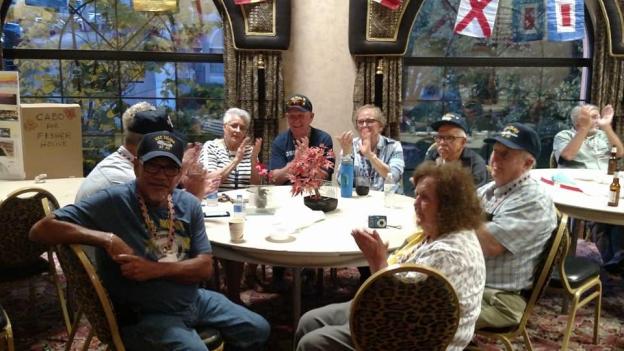
They say that as one gets older time seems to pass faster and faster. Well a number of us have found a way to slow it down. The fifty-one weeks spent waiting for the next Asia Sailor Reunion drag past. Then the week of the reunion passes so fast it is almost impossible to remember everything that occurred. Wait, the memory thing may be caused by the copious amounts of adult beverages swilled by the attendees. (I was going to say imbibed, but swilled better fits what I saw in Branson Last week.)

A partial list of the beverages available to the 118 members and guests who attended the reunion:

Over 1000 bottles and cans of Miller Lite

240 bottles and cans of Bud Light

240 bottles of Budweiser

240 bottles of San Miguel

48 bottles of Red Horse

48 cans of Spotted Cow

I forget how many bottles of Corona

240 bottles or cans of Coors

Some Coors Light

I am sure there are some that I forgot.

I counted 14 bottles and jars of Corn Liquor (better known as Moonshine).

I know of twelve bottles of Kentucky Bourbon. (Probably more.)

Numerous bottles of wine were drunk.

The ladies consumed copious amounts of champagne during their painting class as evidenced by the sterling quality of their artistic endeavors.

These quantities of booze are a little light this year. You see, I didn’t drink this year. No, I haven’t gone all sanctimonious on you. It is just that I no longer need the impetus of alcohol to fall down. I can now manage it all on my own.

The reunion activities didn’t all involve alcohol. Give me a little while and I will think of one…

There were a number of cases of Pepsi, Diet Pepsi, Coke, Diet Coke, and Diet Dr. Pepper consumed by the no-loads (among whom I include myself) and the morning after cottonmouths. (there were probably more cottonmouths at the hotel each morning than in the local swamp).

There was a reversion to our youth during the reunion. Many of us acted as we did in younger days. F-bombs were an integral part of every conversation. It, in its many variations, was probably the most overused word during the five days of the festivities.

There was more to the reunion than sitting around drinking. There was the joy of meeting old shipmates and renewing friendships, putting faces to some Facebook shipmates and making new friends, then sitting around drinking with them.

On a serious side, the members opened up their hearts and wallets for the annual raffle and auction. We raised in excess of $7,000 to support the Fisher House Charity and the Wat Sa School in Thailand. Bravo Zulu my shipmates. I am proud to be a member of the Asia Sailor Westpac’rs.

Many attendees already have room reservations for next year. Already counting the days until we do it again. I tell you it is the most fun you’ll have with your clothes on.

I logged the reunion secured at 2130, Sunday 20 May.

BTW, when I went in to check the Jungle Room Monday morning, there were three lone beers floating in a cooler of tepid water and an unopened bottle of Carolina Moonshine and one of Kentucky Bourbon on the table. Take that for action Mac.

Many members proclaim the Asia Sailor Westpac’rs Reunion the best they have ever attended. The credit for producing six outstanding reunions goes to David “Mac” McAllister and his lovely bride Kathy Mac. Actually, the credit goes to Kathy, Mac is just the menial labor. Bravo Zulu shipmates on the best one yet!

Sea stories abound…

Sam Davis and his lovely bride…

Doc expounding on something…

Bullshit predominates every conversation…

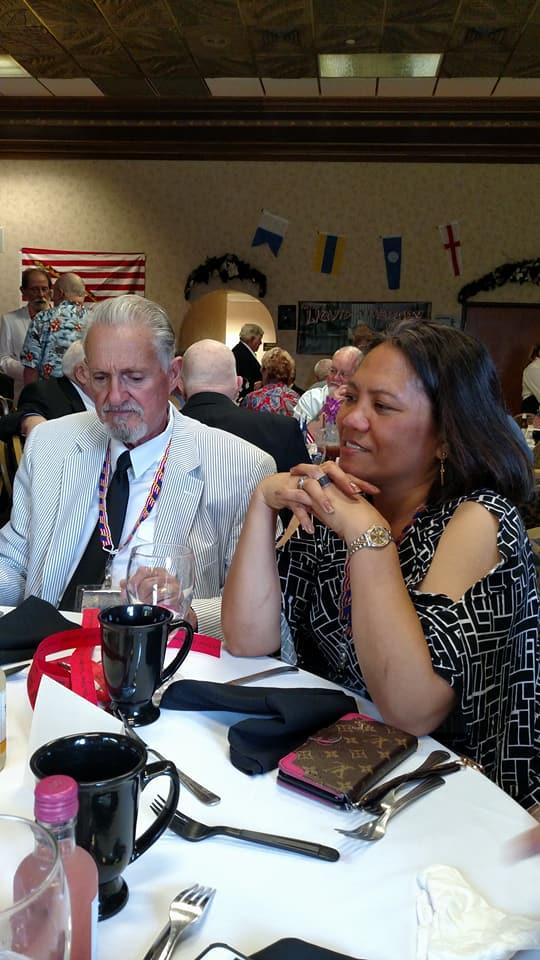
Old and new shipmates…

The bar…

A spectacular new gangway provided by shipmates Kurt Stuvengen, Pat Mullins and Fred Kruse…

A Blues Band entertains while Sam Davis is “getting down.”

Standard

Fire At Sea

Fire At Sea

No automatic alt text available.

USS White Plains AFS-4 Fire.

On 9 May 1989, while underway in the South China Sea en route to Guam, the White Plains experienced a major Class Bravo fire in the main engine room while conducting underway fuel replenishment with the combat replenishment ship USS Sacramento (AOE-1). The fire resulted from the ejection of a valve stem on the fuel transfer system which sent a high-pressure spray of fuel over the boiler and consequently ignited into a fireball.

There were 6 fatalities and 161 injuries reported as a result of the fire.

Standard

Channel Fever

Channel Fever

Channel Fever…….. Is a condition that takes over the mind and body of a sailor after a long voyage as the last few days of the trip approach. Sailors are known to stay awake all night, start laughing and smiling for no reason, and behave in an unpredictable manner once they allow themselves to begin thinking of all the wonderful things that await them ashore once the ship is all-fast at the dock.

There are a large number of Asia Sailors around the country and world who are experiencing something similar as the time for the Annual Asia Sailor Westpac’rs approaches. In just nine short days the festivities will already be underway in the Jungle Room of the Clarion Hotel in Branson, Missouri.

Standard

OLONGAPO in the 60’s and 70’s

OLONGAPO in the 60’s and 70’s

Was it a place that had a reputation that was overly exaggerated by the thousands of Sailors and Marines who had frequented it? Or maybe it was just a Dream!

In actuality what it WAS was a town in the Philippines with a seemingly unending row of Night Clubs and other establishments located in a tropical paradise that was situated just outside the Gates of one of the most critical and important U.S. Military Bases in the World. Most all of the Bars and Nightclubs there came complete with some of the best music I’ve ever heard anywhere, and each club had a bevy of beautiful women present who seemed to be almost Angelic……all there to provide company and comfort to lonesome sailors who had been too long at sea, and to help them relax and feel human again.

Each Night it was much like a carnival atmosphere for Adults Only…Music blasting from every doorway, Glaring Lights, Jeepneys and Tricycles belching Carbon Monoxide fumes and sounding their horns while transporting folks all around town, the Spicy Aroma of the many different foods being prepared along the sides of the road filling the Air, Occasional fist fights and altercations between Sailors and Marines that generally lasted no longer than it took for each side to realize that it was much more fun to drink beer and get laid than it was to fight with each other. Then there came the PARADE shortly before midnight..a nightly event where all who were going back aboard the base needed to get it in gear lest they wind up being too late for the Gate, the rest finding their way to other domiciles in order to spend the night with their HoneyCo.

Each Day awakened with the sounds of roosters crowing, and the hawking of vendors selling cold Orange Sodas and such to soothe the thirsts of many who were making their way back to their Ships after partying too heavily the night before.

For the record, I for one think it was WAS Paradise…..true, it was a bit “Rough around the Edges” type of Paradise, but nonetheless, it was indeed what I suppose many would classify to be a Paradise,

There was absolutely no place like it on earth…… Good People, Good Food, Cold Beer, Smiling Faces, Beautiful Women… and plenty of them, almost everywhere you looked. Not only were there many beautiful women there, most everyone encountered was super nice and hospitable.

I vividly recall my first trip there, I was but a young Sailor experiencing his first exposure to a foreign port, upon exiting the gate we were first greeted by the almost gagging smells emitting from “Shit River”, a stagnant and barely flowing open sewer with a bridge over it that connected Olongapo to the Base, a river in which kids dove from small boats into the rancid water in order to retrieve coins tossed to them by the sailors crossing the bridge into town, and then finally…..after listening to all the stories from my shipmates for many weeks……I entered Olongapo for the first time and I could not believe my eyes. Oh sure I had been told many times by the Old Hands of the many unique attractions of this Port but quite frankly I believed them mostly to be nothing but overly glorified memories of the ones relating them to me, WOW was I ever wrong, and I discovered that ALL they had told me was True.

In the later years of my Naval Career, while crossing the pond we often “Pumped Up the Newbies” with tales of what they could expect when we hit Subic Bay. It was during these times that I remembered back to when I was once like these young Sailors…..and now it was their turn, many of them had never even left their hometowns, and now in what seemed like they went at warp speed after exiting Boot Camp, they found themselves riding a fully armed US Navy Warship manned by a crew of seasoned sailors, churning across the big pond and traveling into adventures that they could never really conceive of without actually experiencing them. In being there with these young Sailors as they first exited the Gate at Naval Station Subic Bay, then crossed the RIVER and “The Bridge” that in many cases initiated their graduation from Boys into Men, I found great pleasure in escorting them into one helluva Port and at the same time recalling the days when I had first had that amazing experience.

Now unfortunately, gone are the days of Seventh Fleet Liberty in the World’s Greatest Port…..now changed and “Civilized” immeasurably from the way it was back in the days when young Sailors and Marines first met Dr. San Miguel, Fell in Love way too many times, and experienced the greatest Liberty Port in the World….Those days that I experienced long ago were extremely happy days, and when we got Liberty it generally involved maximum exposure to lots of Mud, Blood, and Beer as the Streets were unpaved and things got really WET and WILD during the Monsoons. They were happy days spent with beautiful people in a place that seemed to me to be a Paradise on Earth! I always have, and always will love ALL of the Philippines and I still visit there as often as I can.

Standard

The Battle of the Coral Sea

The Battle of the Coral Sea

By Garland Davis

The Battle of the Coral Sea, fought from 4 to 8 May 1942, was a major naval battle between the Imperial Japanese Navy (IJN) and naval and air forces from the United States and Australia, taking place in the Pacific Theatre of World War II. The battle is historically significant as the first action in which aircraft carriers engaged each other, as well as the first in which neither side’s ships sighted or fired directly upon the other.

In an attempt to strengthen their defensive position in the South Pacific, the Japanese decided to invade and occupy Port Moresby (in New Guinea) and Tulagi (in the southeastern Solomon Islands). The plan to accomplish this was called Operation MO and involved several major units of Japan’s Combined Fleet. These included two fleet carriers and a light carrier to provide air cover for the invasion forces. It was under the overall command of Japanese Admiral Shigeyoshi Inoue.

The U.S. learned of the Japanese plan through signals intelligence and sent two United States Navy carrier task forces and a joint Australian-U.S. cruiser force to oppose the offensive. These were under the overall command of U.S. Admiral Frank J. Fletcher.

On 3–4 May, Japanese forces successfully invaded and occupied Tulagi, although several of their supporting warships were sunk or damaged in surprise attacks by aircraft from the U.S. fleet carrier Yorktown. Now aware of the presence of U.S. carriers in the area, the Japanese fleet carriers advanced towards the Coral Sea with the intention of locating and destroying the Allied naval forces. Beginning on 7 May, the carrier forces from the two sides engaged in airstrikes over two consecutive days. On the first day, the U.S. sank the Japanese light carrier Shōhō; meanwhile, the Japanese sank a U.S. destroyer and heavily damaged a fleet oiler(which was later scuttled). The next day, the Japanese fleet carrier Shōkaku was heavily damaged, the U.S. fleet carrier Lexington critically damaged (and later scuttled), and Yorktown damaged. With both sides having suffered heavy losses in aircraft and carriers damaged or sunk, the two forces disengaged and retired from the battle area. Because of the loss of carrier air cover, Inoue recalled the Port Moresby invasion fleet, intending to try again later.

Although a tactical victory for the Japanese in terms of ships sunk, the battle would prove to be a strategic victory for the Allies for several reasons. The battle marked the first time since the start of the war that a major Japanese advance had been checked by the Allies. More importantly, the Japanese fleet carriers Shōkaku and Zuikaku – the former damaged and the latter with a depleted aircraft complement – were unable to participate in the Battle of Midway the following month, while Yorktown did participate, ensuring a rough parity in aircraft between the two adversaries and contributing significantly to the U.S. victory in that battle. The severe losses in carriers at Midway prevented the Japanese from reattempting to invade Port Moresby from the ocean and helped prompt their ill-fated land offensive over the Kokoda trail. Two months later, the Allies took advantage of Japan’s resulting strategic vulnerability in the South Pacific and launched the Guadalcanal Campaign; this, along with the New Guinea Campaign, eventually broke Japanese defenses in the South Pacific and was a significant contributing factor to Japan’s ultimate surrender in World War II.

Belligerents

United States

Australia

Japan

Commanders and leaders

Chester W. Nimitz

Frank J. Fletcher

Thomas C. Kinkaid

Aubrey Fitch

George Brett

Douglas MacArthur

John Crace

Isoroku Yamamoto

Shigeyoshi Inoue

Takeo Takagi

Kiyohide Shima

Aritomo Gotō

Chūichi Hara

Sadamichi Kajioka

Strength

2 fleet aircraft carriers,

9 cruisers,

13 destroyers,

2 oilers,

1 seaplane tender,

128 carrier aircraft

2 fleet aircraft carriers,

1 light carrier,

9 cruisers,

15 destroyers,

5 minesweepers,

2 minelayers,

2 submarine chasers,

3 gunboats,

1 oil tanker,

1 seaplane tender,

12 transports,

127 carrier aircraft

Casualties and losses

1 fleet carrier scuttled,

1 destroyer sunk,

1 oiler sunk,

1 fleet carrier damaged,

69 aircraft destroyed.

656 killed

1 light carrier sunk,

1 destroyer sunk,

3 small warships sunk,

1 fleet carrier damaged,

1 destroyer damaged,

1 smaller warship damaged,

1 transport damaged,

92 aircraft destroyed.

966 killed

Standard

Robert Eugene Bush

Robert Eugene Bush

Robert Eugene Bush of Tacoma, Washington, was the youngest member of the U.S. Navy in World War II to receive the Medal of Honor. At the age of 18, he was awarded the medal for heroic actions “above and beyond the call of duty” while serving as a hospital corpsman attached to a U.S. Marine Corps rifle company on this day in 1945, during the Battle of Okinawa.

Bush joined the U.S. Naval Reserve in January 1944 as an apprentice seaman. He then joined the Naval Hospital Corps. By the invasion of Okinawa, which began on April 1, 1945, he was serving as a hospital apprentice first class and assigned to G Company, 2nd Battalion, 5th Marines.

On May 2, 1945, he was wounded in action by shrapnel from three enemy hand grenades while attending to his wounded platoon commander and at the same time, firing the lieutenant’s rifle to protect the lieutenant, himself, and the rest of the platoon during an enemy attack.

Bush was honorably discharged in July 1945 and presented the Medal of Honor by President Harry S. Truman in October 1945.

After the war, he studied business administration at the University of Washington and founded the Bayview Lumber Company at South Bend in 1951 and Bayview Redi-Mix at Elma, Washington, building both into multi-million dollar businesses. Bush was also active in championing veterans’ causes and served for two years as President of the Congressional Medal of Honor Society.

Bush died from kidney cancer in November 2005 at age 79.

Standard

A little respect… 42 years later, its still not that big of a deal

Mister Mac's avatartheleansubmariner

Recently I was following a post on one of my submarine Facebook pages. The original guy had posted about a lack of recognition. To be fair, he had a lot of supporters and frankly I can’t give him a hard time since I have seen some of this through the years myself.

“Okay I have somewhat of a bitch to air:I  have been looking for a new career however when I get the part of the application for Veteran Status I find that I do not fit any of the categories!!!! It simply appears to me that the time I spent on the XXXXXXX does not matter since it was only the Cold War and I didn’t get some little medal for doing what I so proudly volunteered to do – Serve My Country!!! Apparently those of us that served in the 70s – 80s are not a protected status.

Okay…

View original post 788 more words

Standard