TYPHOON IN SUBIC BAY, PHILLIPINES

by Alan ‘Frapper’ Lehman

HMAS DERWENT 1976

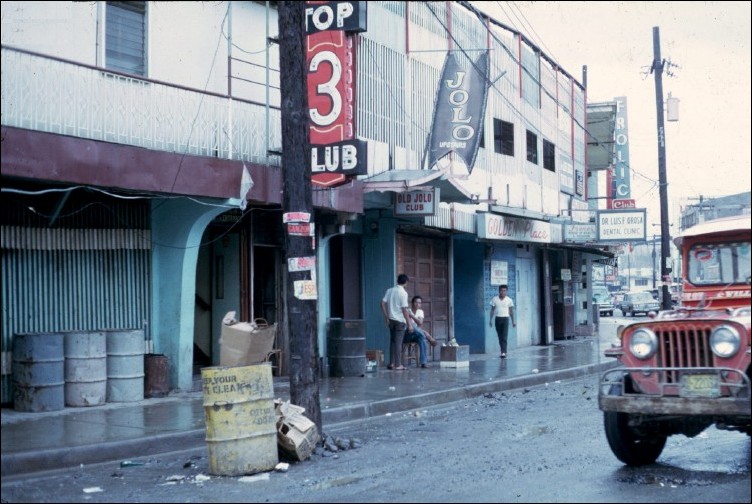
We all know the fun of a visit to Olongapo, Subic Bay in the Philippines.  Many a story has been told of exploits in Olongapo. Stories regarding the Crocodile in the main Street out front of Paulines  (Magsaysay Drive), stories of the Period of Marshall Law in the Philippines and stories of the Bargirls, especially the ones in (THE JOLO BAR), where anything goes.  The memories are flooding back. 
It was a Saturday around lunch time and Bummer Briggs (yes, Bummer again) and myself were going back on board for a little rest and change of clothes after an all nighter in Olongapo.  Once we had walked back on board, the Boatswains Mate informed us that all leave (Liberty) was cancelled and the ship was under sailing orders due to an approaching Typhoon.  It was called Typhoon Pitang and it was a Super Typhoon with sustained winds of 260 km/h. It mainly affected the Northern Luzon area of the Philippines.  We were located in central Luzon, but as the Typhoon approached us from the Pacific, nobody knew for sure which way it was going to move.

There were a lot of warships berthed in Subic Bay at the time, but one of those, the Aircraft Carrier USS Ranger was the senior ship in port and as such was in charge of the rest of us. 

Image preview

Ranger directed that all ships would sail and ride out the Typhoon at sea.  Warships tend to get smashed around in port during big storms.

Bummer and myself went down below and started complaining about the fact that we could not go ashore again and were heading out to sea into a raging Typhoon.  That’s when an idea began to form in my head.  Australian warships at the time used to run a short leave card which was placed into a board with pigeon holes arranged alphabetically.  When you left the ship your card was placed into the relevant pigeon hole and when you come back on board, you collected your card from the pigeon holes. This indicated to the gangway staff who was on board and who was off the ship.

My plan was to somehow get off the ship, but we had to get our short leave cards back into the pigeon holes first.  I left that up to Bummer, he was a devious individual and if anybody could do it, he could.  Whilst this was happening, I procured a Jacobs Ladder (rope ladder with wooden slats for your feet).  Up near the bow of our ship a Painting lighter had been tied to us so that sailors could paint the side of the ship.  It was still there and using the Jacobs ladder we could climb down to the lighter and then climb up the wharf and then head back into town.  I had a friend who pulled up the ladder for us after we had exited the ship. Good plan I thought and it worked a treat, and before we knew it, we were back in Olongapo.  We headed for the American Legion Outpost.
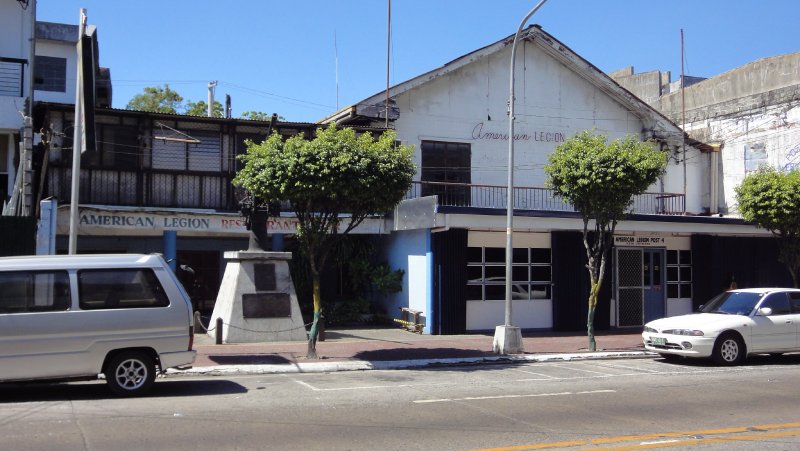
Magsaysay Drive, Olongapo | Philippine Photos

The American Legion has Outposts all over the world and Focuses on service to veterans, service members and communities, the Legion evolved from a group of war-weary veterans of World War I into one of the most influential non-profit groups in the United States. The Post Four Legion in Olongapo had a bar and restaurant and a limited number of Bargirls.  You could get American Beer and good old fashioned American Meals at the Outpost.

Once inside we met some American Veterans who lived in the Philippines and they had a phone link to USS Ranger and kept us up to date on the preparations for all ships to sail.  Whilst we were there drinking, Naval Security vehicles were driving around Olongapo using a loud hailer ordering all sailors to report back to their ships. Technically you could say that we disobeyed the Naval Security patrol orders, but my hearing wasn’t the best.

Needless to say, the Typhoon veered away to the north and ships did not have to sail after all. Myself and Bummer had another night in exciting Olongapo.

Standard

Baloy Beach Bar

by Dave ‘Haze’ Gray

May be an image of one or more people and indoor

Baloy Beach?

I remember once long ago, sitting at the open-air bar on Baloy Beach, drinking with a shipmate, Jack Coates, when a bubblehead friend’s current girlfriend (his boat was at sea), wearing a bikini that would fit in the watch pocket of my Levi’s came to the bar, bought a San Miguel. She said, “Hi Dave. I didn’tsee you long time.”

“Well, hello Maria, you are as pretty as ever!”

She smiled at me and then walked onto the beach, spread the beach towel she was carrying, slathered herself with Baby Oil, and stretched out to sunbathe.

After I finished my beer, I bought two, walked to where she was laying, and offered her one. After a short conversation, the two of us repaired to the bubblehead’s house for a session of gymnastics.

When I got back to the bar, an hour or so later, my drinking buddy, Jack, said to me in his alcohol generated gravelly voice, “Come here Boy, let me smell yo’ breath, I’ll bet it smells like Baby Oil,”

BTW, the young lady and I had a history.

Standard

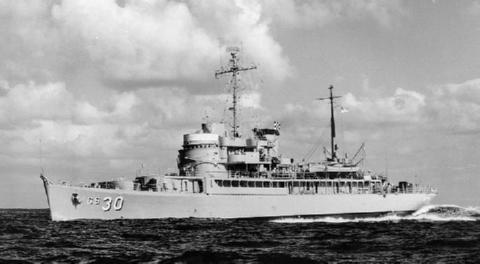
USS San Pablo AGS-30

USS SAN PABLO (AGS-30) Deployments & History

While in Dakar in 1949, USS San Pablo (AGS 30) received a seemingly important phone call from someone speaking French. Because no one on the ship could understand, the crew grabbed a nearby French officer who spoke to the caller. However, the French officer could not translate because he did not speak English. The crew then found a bilingual sailor visiting USS Rehoboth who spoke to the French officer. After a brief conversation, the sailor reported that the call had been a wrong number.

Standard

Coming home, 1945

Author Unknown

In 1939, there were 334,000 servicemen, not counting the Coast Guard.

In 1945, there were over 16 million, including the Coast Guard.

At the end of the war, over 8 million of these men and women were scattered overseas in Europe, the Pacific and Asia.

Shipping them out wasn’t a particular problem but getting them home was a massive logistical headache.

Army Chief of Staff General George C. Marshall had already established committees to address the issue in 1943.

 Soldiers returning home on the USS General Harry Taylor in August 1945.

When Germany fell in May 1945, the US . Navy was still busy fighting in the Pacific and couldn’t assist.

The job of transporting 3 million men home fell to the Army and the Merchant Marine.

300 Victory and Liberty cargo ships were converted to troop transports for the task.

During the war, 148,000 troops crossed the Atlantic west to east each month; the rush home ramped this up to 435,000 a month over 14 months.

 Hammocks crammed into available spaces aboard USS Intrepid.

In October 1945, with the war in Asia also over, the Navy started chipping in, converting all available vessels to transport duty.

On smaller ships like destroyers, capable of carrying perhaps 300 men, soldiers were told to hang their hammocks in whatever nook and cranny they could find

.Carriers were particularly useful, as their large open hangar decks could house 3,000 or more troops in relative comfort, with bunks, sometimes in stacks of five welded or bolted in place.

 Bunks aboard the Army transport SS Pennant

The Navy wasn’t picky, though: cruisers, battleships, hospital ships, even LSTs (Landing Ship, Tank) werepacked full of men yearning for home.

Two British ocean liners under American control, the RMS Queen Mary and Queen Elizabeth, had already served as troop transports before and continued to do so during the operation, each capable of carrying up to 15,000 people at a time, though their normal, peacetime capacity was less than 2,200.

Twenty-nine ships were dedicated to transporting war brides: women married to American soldiers during the war.

 Troops performing a lifeboat drill on board theQueen Mary in December 1944, before Operation Magic Carpet

The Japanese surrender in August 1945 came none too soon, but it put an extra burden on Operation Magic Carpet.The war in Asia had been expected to go well into 1946 and the Navy and the War Shipping Administration were hard-pressed to bring home all the soldiers who now hadto get home earlier than anticipated.

The transports carrying them also had to collect numerous POWs from recently liberated Japanese camps, many of whom suffered from malnutrition and illness.

 U.S. soldiers recently liberated from Japanese POW camps

The time to get home depended a lot on the circumstances. USS Lake Champlain, a brand new Essex-class carrier that arrived too late for the war, could cross the Atlantic and take 3,300 troops home in a little under 4 days and 8 hours

.Meanwhile, troops going home from Australia or India would sometimes spend months on slower vessels.

                Hangar of the USS Wasp during the operation

There was enormous pressure on the operation to bring home as many men as possible by Christmas 1945.

Therefore, a sub-operation, Operation Santa Claus, was dedicated to the purpose.

Due to storms at sea and an over abundance of soldiers eligible for return home, however, Santa Claus could only return a fraction home in time and many still not quite home but at least to American soil.

The nation’s transportation network was overloaded, trains heading west from the East Coast were on average 6 hours behind schedule and trains heading east from the West Coast were twice that late.

The crowded flight deck of the USS Saratoga.

The USS Saratoga transported home a total of 29,204 servicemen during Operation Magic Carpet, more than any other ship. Many freshly discharged men found themselves stuck in separation centers but faced an outpouring of love and friendliness from the locals. Many townsfolk took in freshly arrived troops and invited them to Christmas dinner in their homes.

Still others gave their train tickets to soldiers and still others organized quick parties at local train stations for men on layover.

A Los Angeles taxi driver took six soldiers all the way to Chicago; another driver took a car load of men to Manhattan , the Bronx, Pittsburgh , Long Island, Buffalo and New Hampshire. Neither of the drivers accepted a fare beyond the cost of gas.

 Overjoyed troops returning home on the battleship USS Texas

All in all, though, the Christmas deadline proved untenable. The last 29 troop transports, carrying some 200,000 men from the China-India-Burma theater, arrived to America in April 1946, bringing Operation Magic Carpet to an end, though an additional 127,000 soldiers still took until September to return home and finally lay down the burden of war.

Standard

LBFM or Something

A shipmate sent the above photo and challenged me to write a story for my Blog about her. Here is what I came up with:

LBFM or Something

By:  Garland Davis

We all know at least a dozen LBFM’s.  The one featured in this story was a little more L and B than most sailors would meet during a safari into the wilds of Magsaysay Street or if one was brave enough, the Barrio, or even Subic City.  She wasn’t a great conversationalist, but there was something alluring about her smile.  As a matter of fact, she was butt fuckin ugly.  But as the number of San Miguels or glasses of Mojo were consumed, one would begin to see beauty where none existed.

She wasn’t the ugliest girl I ever woke up with, but she is a goddamned strong second.

I will say that she could do many tricks swinging on a six-inch penis as long as I could keep her from swinging on the clothesline like a monkey.

Standard

HAIRCUT SINGAPORE/THAILAND

by Alan ‘Frapper’ Lehman

HMAS SWAN 1974

Image preview

During my time in the Navy I had a posting to HMAS Swan, a Destroyer Escort. I had the reputation of being a bit of a rebel.  It’s not that I disobeyed orders or anything like that, but more along the lines of getting drunk quite often and other passive transgressions.  I was particularly fond of long hair and I was forever getting into strife because of it.  We were at sea this particular day and Petty Officer Tab Hunter (Communications) came up to me and said it would be a good idea if I got a haircut in Singapore, our next port of call.

I had every intention of getting a haircut, but being shift workers, we got early leave (Liberty) and bars were open in Sembawang (Where Aussie and British ships used to tie up) and of course we started drinking early.  So, first day, NO Haircut, Second day, NO Haircut, Third day Petty Officer Hunter said to me, “Get a Haircut”. Fourth day, NO Haircut. (I have attached a photo of me and my long hair in a bar in Subic Bay, I am the guy on the front left with riding boots on and a beautiful Olongapo Bargirl.

Image preview

Technically, you could say I disobeyed a Direct Order but, I was just a Rebel and Rebels were loved by the masses. The Eureka Stockade is a case in point.  We sailed from Singapore the next day with Bangkok our next Port of call.  It was going to take a week to get there because we had Naval Exercises with other Navies in the area.  The first day at sea I got charged with disobeying a direct order by Tab Hunter and fronted the Executive Officer (2 IC) of the HMAS Swan.  Charges were proved due to the fact I still had long hair and I received 14 days stoppage of leave (confined to the ship) as my punishment. 7 days of that stoppage were served at sea and did not adversely affect me, but once we arrived in Bangkok it was a different story.

The girls in Bangkok are very beautiful and so obliging and you do not want to be confined to the ship in Bangkok.  First night in port most of the crew were in town enjoying their leave and here was me, stuck on board.  At 1900 I had to muster at the gangway and the Officer of The Day inspected me and confirmed I was indeed on board.  As I went down below an idea started to blossom in my mind.  I had to report to the Gangway again at 0600 in the morning and apart from that, I had no other obligations.  Whilst alongside in Bangkok all upper deck screen doors and hatches had to be locked because pirates or robbers or thieves used to silently board your ship and steal whatever they could.  The GDP (Gun Direction Platform) had a hatch that was roped off on the inside and with the help of a friend I exited the hatch in my civilian clothes at 1930 and my friend secured the rope again on the inside.  I had his assurance that he would undo the rope early next morning so I could sneak back on board in time for my 0600 muster.

As luck would have it, we were tied up outboard of a British ship and so I simply stepped across from my ship onto theirs and walked down to their gangway and after making sure the coast was clear, I walked off their ship and headed into town.

I headed to The World Hotel, it is a well-known drinking spot in Bangkok, especially during the Vietnam War era.  When I got there, I noticed a good number of the ships communications crew all in the Hotel Pool with Bargirls by their side and drinks in hand.  There was something wrong with this scene though.  Everybody was naked.  I couldn’t believe it and they couldn’t believe that I was actually off the ship and drinking with them. Early next morning I headed back on board and sure enough, my mate had untied the rope and I got back into my ship with no problems.  I Had my 0600 muster and all was good.

Each morning all the Communications Crew had to Muster in the Communications Centre for Job allocation for the day.  Everybody was talking about the previous night and the drinking and the girls and one of the guys said to me, “That girl you had last night was beautiful Frapper”. Just as he said those fateful words, Tab Hunter walked in through the door, he heard the comment. Later as we were up on deck working during the day, Tab Hunter walks up to me and says, “So, you went ashore last night”.  I had to agree with him because I don’t lie.  He said to me, Don’t go ashore again tonight will you. I said NO Tab.

We were in port Bangkok for another 6 days and I snuck off the ship every night.  I don’t know if he knew or not, but I had a great time in Bangkok.

Standard

CRAZY BUT TOUGH SAILORS!

stolen from Peter T. Yeschenko

May be an image of one or more people, people standing, bicycle, outdoors and text that says 'NEW YO LOS ANGELES RETURN'

DID YOU KNOW…that Sailors crossed the country chained to their bicycles on a bet?!

Service members have been known to do some crazy things for bets. From drinking chem light fluid to shot gunning beers through a discarded AT4 anti-tank weapon, troops rarely shy away from challenges.

One of the most epic challenges ever accepted took place over 100 years ago.

In May 1919, silent film star Roscoe “Fatty” Arbuckle issued a public challenge: $3,500, over $55,000 in 2021, to anyone who could ride a single-speed bicycle from Los Angeles to New York before 1 November of that year.

Tony Pizzo and CJ Devine, two US Navy Sailors, took the bet.

They requested permission to embark on the coast-to-coast journey from the Assistant Secretary of the Navy. Imagine submitting a leave chit for that trip today. LOL!

With approval granted, Pizzo and Devine were chained to their bicycles in a ceremony in Los Angeles on 18 May 1919 and set out for New York.

The cross-country ride was a difficult one. The interstate system that crisscrosses the nation today did not exist in 1919. Instead, Pizzo and Devine were forced to ride mostly on dirt roads and gravel trails. Additionally, the roads were full of inexperienced drivers, many of whom had only recently purchased their automobile. The Sailors had many close calls, one of which took place at the Grand Canyon.

Upon entering Arizona, Pizzo and Devine decided to do some sightseeing and visited the Grand Canyon. The natural wonder became a national park just nine months prior to their arrival. Riding up the rim of the canyon, they stopped to have their picture taken by famed photographer Emery Kolb. On the rim, Devine’s bike slipped and fell into the canyon, almost taking him with it. Pizzo grabbed Devine’s legs and saved him from a fatal fall.

Unfortunately, Devine’s luck was expended with his close call at the Grand Canyon. The Sailors made it to Kansas City together where Devine was tragically hit by a car. Though he survived the accident, his injuries took him out of the competition, leaving Pizzo to finish the ride on his own.

Pizzo continued on the journey, averaging over 100 miles a day.

Through his steadfast determination, Pizzo rode triumphantly into New York on 30 October 1919 with 2 days to spare.

He checked into the the Hotel McAlpin still chained to his bike. The next day, New York Mayor John Hylan welcomed the Sailor in a ceremony and freed him from his chains.

Although Pizzo said that he wouldn’t make the trip again for a million dollars, that’s exactly what he did, minus the million dollars. 🙂The following year in 1920, Pizzo chained himself to the same bike and made the return trip from New York to Los Angeles.

Devine, who recovered from his injuries, accompanied him as his manager and publicist.

The Navy took advantage of the national stunt and kept Pizzo in the service as a recruiter. He rode to every state capital and was booked at speaking engagements across the country.

His incredible physical feat helped to portray the Navy as a tough service with tough Sailors.

Standard

The Mess Deck Ice Cream Machine

by Joseph Werner

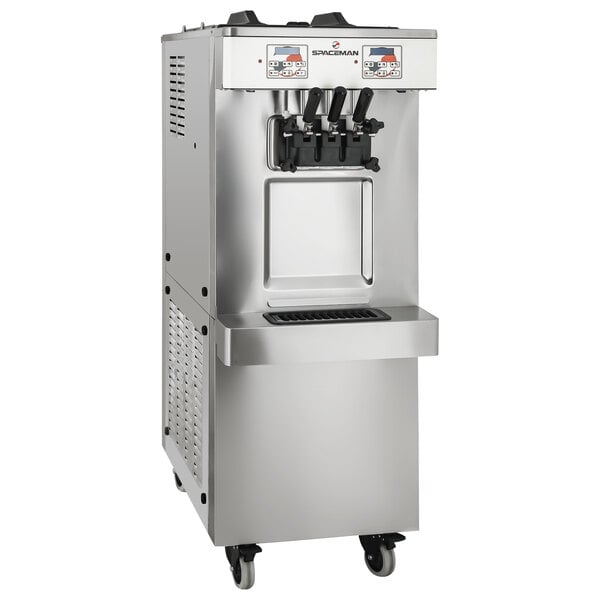
Spaceman 6250-C Soft Serve Floor Model Ice Cream Machine with 2 Hoppers and  3 Dispensers - 208-230V

The famous Mess Decks Ice Cream machine.

I was standing watch in Radio and the CHENG comes in with a message written on the back of the POD. It was a CASREP. The CO of the ship hated to send CASREPs. All CASREP had to be released by him. The CHENG told me get it ready and he will have the CO release it. He waited in Radio until I finished and proof read what I prepared. He then asked me to make copies. CHENG then took the copies and distro’d them to CO/XO/and all Department heads. The skipper always called down about 1300 to have his traffic delivered to him. I took the messages to him in the CO inport cabin. The radioman had to wait around until he was done to return the high classified message board back to radio. The CO sees the CASREP message. He calls down to the OOD and tells him to pass the word for the CHENG to his cabin now.

The RMCS just came in radio to check on how the watch was going. I showed him about the CASREP. He starts to laugh his ass off. He asked me what part did I play in this message. I told him I prepared it and let the CHENG distro it to CO/XO/All department Heads. He laughs. RMCS being pretty crazy himself he calls the COMMO and OPS. They come to radio. The COMMO is freaking out, OPS boss is laughing his ass off. OPS boss calls the CHENG and ask him to come up to radio. CHENG shows up and OPS tells him the CO told him he has to supervise the next burn run. CHENG just laughs. He says guess you will have to fly me back from Antarctica. The Skipper told him he will get him assigned there.

I totally forgot it was April fools day. The CASREP was on the ICE Cream machine and had a precedence of immediate and stated the ship was Not Mission Capable.

The next day the CO is in radio and ask me if I helped the CHENG with the CASREP, he told me I was getting orders to Antarctica with the CHENG. I was a RMSN (busted to SN for a previous liberty incident in Taiwan). A month later the skipper reinstated me to 3rd class and my orders came in for the USS Lockwood.

Standard

Fifty-Six Years (Aug 31, 2021)

by Garland Davis

Two years after the first date and over a year since our marriage

When we were children and watching a western movie and the girl came charging by in a runaway buckboard and our hero took after her on his trusty steed and rescued the girl just before the buckboard plunged over the cliff that happened to be there in the middle of a flat prairie and she batted her big eyes at him, you knew the mushy crap was about to start. You wondered what was wrong with cowboy heroes. Why did they always get sidetracked from chasing the bad guys by girls and mushy stuff?

This one will be mushy stuff. I have permission.

All stories of young love begin when two people meet. There are fireworks. Possibly angels singing. Bluebirds singing and that kind of movie crap. I met her in the Billet Office for Bayside Courts in Yokohama Japan. The Navy Housing Activity at Yokohama was comprised of four officers, fifty-six enlisted and a contingent of Japanese civilians that maintained and administered the more than three thousand Navy Housing units that provided quarters for Naval Personnel in the Kanto Area of Japan.

There were no barracks for enlisted. One building of an old Army BOQ complex was devoted to housing single enlisted sailors. She worked in the Billet Office and assigned me to a room. Room? WTF! Officers lived in rooms. Sailors lived in open bay barracks. But there it was a room. She explained to me that maid service was available for ten dollars a payday. The maids would clean your room and do your laundry. When I got to the room, I thought I had died and gone to heaven. The maid assigned to me helped me unpack and placed everything in the closets. Where she wanted them.

I quickly fell into a routine of awakening, dressing, going to the NEX cafeteria for breakfast (There was no enlisted galley), and then to work at the Commissary Store. We worked Tuesday thru Saturday and were not required to stand any duty days. At approximately 1630 my shipmates and I would stroll across the street to the Yokohama Seaside Club and take advantage of the ten cents Happy Hour. About 1900 or so we would take a cab to Bayside Courts shift into civilian clothes and head for the Zebra Club downtown for a couple and then on to Chinatown for an evening comprised of drinks and mushy stuff.

From the day in July when I arrived there until shortly before the Navy day celebration in October, I lived this idyllic sailor’s life. The command announced a date for the Navy Day Ball at the Seaside Club. Each member was permitted to bring a guest. A group of us were in a room at Bayside drinking beer when the subject of dates for the Navy Day Ball arose. Different bar girls were suggested.

I told them, “I am going to ask the girl who works at the Billet Office.”

“Not a chance Stewburner. She won’t date sailors. Believe me many have tried and no one has been successful.” Was the consensus.

I had just enough beer, so I said, “I’ll show you just wait and see.” And off to the billeting office, I went.

I walked in, she came to the counter and asked how she could help me. I told her, “I came to invite you to the Navy Day Ball as my guest.”

She said, “Okay.” She gave me directions where I could meet her.

I went back to the room with a shit eating grin on my face, opened a cold one, and sat down.

“Struck out, huh? I knew you would. She won’t go out with sailors.”

I said, “I have to pick her up at six thirty Friday evening.”

Of course, I got the, “What did you do, lick your eyebrows? What do you have that nobody else does?”

I picked her up for our date. We had a good time. Over the next few weeks, we became inseparable.

Fifty-six years ago today that young Japanese girl and I, both of us barely out of our teens, caught the train at Yokohama Central Station for Tokyo. It was to be our wedding day. There was no preacher or organist, no best man or bridesmaid. There was just a busy office in the American Embassy Annex and a Japanese government office.

I was carrying an envelope of papers that had begun six months before as a single sheet of paper asking the U.S. Navy for permission to marry a Japanese National. The envelope contained the results of physical examinations and background investigations. Also included were interviews with a Legal Officer, counseling interviews with Chaplains and English translations of my fiancé’s birth records and copies of the investigations of her family and background. And finally a letter from Commander Naval Forces, Japan granting approval of my request.

A clerk at the counter took the papers separated those he needed and returned the remainder to me. After a time, we were given forms in Japanese and directed to take them to a Japanese government office to register our marriage and then return to the embassy. This took some time because Japanese bureaucrats love properly completed forms and placing numerous rubber stamps on them. By mid-afternoon, we were back at the embassy annex and returned the properly stamped and annotated forms to the clerk.

We waited for a time with another couple and finally were called to the counter. The other serviceman and I were directed to stand at the counter with our brides behind us. A number of forms were placed on the counter and we were instructed to sign them. A gentleman came from an inner office and introduced himself as a U.S. Consulate Officer. He instructed us prospective husbands to raise our right hands and said, “Do you swear that everything you have signed is the truth to the best of your knowledge, so help you, God?” We both replied, “Yes.” He said, “Congratulations,” shook our hands and left. The clerk gave us our marriage certificates and congratulated us.

There were no vows, no “I do’s.” Just simply completing paperwork and registering the fact with the Japanese government. I often joke that I dropped my pen, bent over to pick it up and when I stood up, the gentleman shook my hand and said, “Congratulations.”

It has been a tumultuous fifty-six years. There was the Vietnam War, twenty-six more years of the Navy, lengthy separations and, not a lot of money during the early years. Like most couples, we had to adjust to each other. Now we are aging and dealing with my Parkinson’s disease and the loss of our beloved dog last week. I guess you can say that after fifty-six years, we have succeeded.

Looking back, I wouldn’t have it any differently. She is my best friend, and I love her with all my being. As the poets say, “She completes me.”

Today is our fifty-sixth anniversary

Standard