Haircuts and Grooming

Haircuts and Grooming

By:  Garland Davis


I was thirteen years old when I got my first Barber Shop haircut. Until his death, my Dad cut the boys’ hair. I remember he originally used a squeeze handle clipper that tore out as much hair as it cut. We were happy when he bought the five-dollar electric clipper. The new clipper made so much noise that hearing protection was needed. It sounded like a jet airplane revving for takeoff, but haircuts were more comfortable and much less painful. That is unless you moved while he was cutting your hair. Then Dad would make it painful. It didn’t matter how you wanted your hair cut. Dad made that decision (I am pretty sure; he could only do two styles, trimmed or bald). He also cut his own hair. He was very good at trimming the back using a mirror and the clippers.

After Dad died Mama would take us, about once a month, to a man who lived on Route 66 for haircuts. He had a block building with a single barber chair. I remember that it cost thirty-five cents each for the haircuts. I know the man cut hair part time, because we always went in the evening. He was a veteran who had served in the Marine Corps and had been injured on Guadalcanal during World War II. He walked with a defined limp.  It sticks in my mind that he worked for the Post Office.

During the late fifties, flattop haircuts were all the rage. Barbers charged more for that style haircut. I wanted a flattop, and Mama told me that I would have to pay for it myself. I went to Davis’ Barbershop in the single stop light burg of Ogburn Station. I paid seventy-five cents for that haircut. I also paid twenty-five cents for a tin of “Butch Wax” to keep it standing stiffly. Those were the days of flattops, jelly roll cuts, and duck tails. Each successive style seemed to get a little longer than the ones before. The long hair that the Beatles ushered in was on the horizon.

The day before I left for the Naval Training Center, San Diego, I told the barber to give me a boot camp haircut.  The first stop upon arriving at NTC was the Barber. What my civilian barber deemed a “boot camp” haircut was totally unsatisfactory to the Navy barber.

For the next thirty years, the service pretty much dictated the length and style of haircuts and during the twenty-one years I was afloat provided the barbers and haircuts free of charge. They were generally fairly competent barbers, although there were a few that I would be reluctant to let mow my lawn.  But the haircuts were free and left more money in one’s pocket for liberty. Ashore, the Navy Exchange shops were cheap enough that it only cost a couple of beers for a haircut. I was pretty much satisfied with Navy haircuts.  I usually found that wallet was a lot more appealing than appearance to the young ladies I frolicked with.

In a missive about haircuts and barbers, I would be remiss if I didn’t pay homage to the additional services provided in the barbershops of Vung Tau, Keelung, Kuala Lumpur Taipei, Pusan, and Olangapo.  Let’s just say, the services the young lovelies provided under the oversize sheets beat the hell out of a neck rub and a manicure. Although, those were available also. When visiting those ports one seemed to give more attention to appearance as it was not unusual to get multiple haircuts in a day.

Since retiring from the Navy, I have used the ‘irritation quotient’ to determine the frequency of haircuts. I let my hair grow until the irritation factor reaches a point that will drive me to spend eighteen dollars, plus tip, to get a haircut.  When my friends, also retired from the Navy, ask how often I get it cut, I usually tell them, “Every three or four months, whether it needs it or not.”  My wife has given up mentioning it.  When I tell her I am thinking of getting my haircut, she usually answers, “Whatever.”

I had my hair cut yesterday afternoon at a salon near my home. A lovely young Filipina stylist provided the haircut.  I am seriously considering paying more attention to my grooming. I anticipate more frequent visits to that salon.

I used to not worry how it was cut.  I always knew it would grow back.  But in recent years, I have begun to have my doubts.  There seems to be less of it.  Maybe It doesn’t always grow back anymore.


To follow Tales of an Asia Sailor and get e-mail notifications of new posts, click on the three white lines in the red rectangle above, then click on the follow button.

A native of North Carolina, Garland Davis has lived in Hawaii since 1987. He always had a penchant for writing but did not seriously pursue it until recently. He is a graduate of Hawaii Pacific University, where he majored in Business Management. Garland is a thirty-year Navy retiree and service-connected Disabled Veteran.


Standard

What is the Navy?

What is the Navy?

Written by:
Boats Thompson
Deck Department LPO
USS San Diego LPD 22

The Navy is the Commander in Chief asking where the nearest aircraft carrier is, and a scrubby boatswain’s mate sitting on a pair of bits teaching a young seaman how to splice line. A tobacco-chewing gunner standing a sharp watch in a far-off land. That’s the Navy. And so is the big, fat engineer who can make a diesel engine run better just by standing next to it.

There’s a man in San Francisco who remembers the USS Missouri made port there in the autumn of ’61. That’s the Navy. So is the recruiter who accepted a young man from Long Beach, California for master-at-arms training named Michael Monsoor who would go on to be a Medal of Honor recipient. The Navy is a spirited rivalry of humankind against the ocean, skill against nature, a daily struggle. Everything is measured and evaluated. Every heroic, every failing is seen and congratulated or counseled.

In the Navy democracy shines its clearest. The only race that matters is the race to roll a firehose. The creed is our very own. Color merely something to distinguish one flight deck job from another.

The Navy is a recruit. His experience no bigger than the lump in his throat as he begins basic training. It’s a veteran too, a tired old man of forty-five hoping that those aching muscles can pull him through one last deployment. Nicknames are the Navy, names like Boats and Wheels and Guns, and Bull, and Cowboy, and Sparky, and A-Gang.

The Navy is the cool, clear eyes of Arleigh Burke, the flashing heroism of Alan Shephard, the true grit of Carl Brashear.

The Navy is service, as simple as muster, instruction, and inspection, yet as complex as the American spirit it symbolizes – a lifestyle, a business, and sometimes almost even a religion.

Why the tale of John Paul Jones engaging an English ship in foreign waters and then having the tenacity to declare “I have not yet begun to fight.” That’s the Navy. So is the bravado of a doomed Captain James Lawrence saying, “Don’t give up the ship. Fight her ’till she sinks.”

The Navy is the damage control locker, general quarters, the boatswain’s locker, tiger cruises, The Chief’s Mess, Anchors Aweigh, and the Star Spangled Banner.

The Navy is a tongue-tied kid from every small town and massive city growing up to be a Chief Petty Officer or mustang or ships’s captain and praising Neptune for showing him the way around the globe and back again. This is a Navy for America. Still a Navy for America. Always a Navy for America.

Written by:
Boats Thompson
Deck Department LPO
USS San Diego LPD 22

Standard

Modern Personal Communications

Modern Personal Communications

By:  Garland Davis


“What Hath God Wrought?”– A message dispatched by Samuel F.B. Morse from the U.S. Capitol to Alfred Vail at a railroad station in Baltimore, Maryland on May 24, 1844 in a demonstration to members of Congress.  The message was telegraphed back a minute later.

“On March 10, 1876, I shouted into M [the mouthpiece] the following sentence: ‘Mr. Watson–come here–I want to see you.’ To my delight he came and declared that he had heard and understood what I said.”  — Alexander Graham Bell

In 1896, Gugliemo Marconi was awarded British patent 12039, Improvements in transmitting electrical impulses and signals and in apparatus there-for, the first patent ever issued for a Hertzian wave (radio wave) base wireless telegraphic system. In 1897, he established a radio station on the Isle of Wight, England.

In 1900, Brazilian priest Roberto Landell de Moura transmitted the human voice wirelessly. According to the newspaper Jornal do Comercio (June 10, 1900), he conducted his first public experiment on June 3, 1900, in front of journalists and the General Consul of Great Britain, C.P. Lupton, in Sao Paulo, Brazil, for a distance of approximately 5.0 miles

“S” — The first transmission of a radio message across the Atlantic Ocean by Gugliemo Marconi on December 12, 1901.

Each of these functions was an element in the development of the mobile telephone. Perhaps one of the earliest fictional descriptions of a mobile phone can be found in the 1948 science fiction novel Space Cadet by Robert Heinlein. The protagonist, who has just traveled to Colorado from his home in Des Moines, receives a call from his father on a pocket telephone. Before going to space he decides to ship the telephone home “since it was limited by its short range to the neighborhood of an earth-side [i.e. terrestrial] relay office.” Ten years later, an essay by Arthur C. Clark envisioned a “personal transceiver, so small and compact that every man carries one.” He wrote: “the time will come when we will be able to call a person anywhere on Earth merely by dialing a number.” Such a device would also, in Clarke’s vision, include means for global positioning so that “no one need ever again be lost.”

“Hey Jerry, how the fuck are you doing today?”  A call I made to Jerry Juliana using a wireless cellular telephone from the island of Oahu to the mountains of West Virginia on March 9, 2016.

Now, I know you are asking, what does this have to do with anything.  These quotes and facts show technological progression in man’s ability to communicate over long distances culminating in today’s personal cellular telephone.

The telegraph made it possible to send messages across the nation in a matter of hours where before it had taken about ten days by Pony Express.  The early telegraph required multiple operators to receive and re-transmit the message onto the next operator down the line.  This system was quickly replaced by an invention of Thomas Edison that automatically retransmitted the message as it was received thereby decreasing the time for a message to travel long distances.

The telephone made it possible for wires to carry the human voice to anyone else who also had a telephone attached to the same wire system.  Instead of Morse Code messages being sent back and forth, voice messages, questions, and answers could go back and forth in immediate time thereby eliminating delays in communications.

Next came the radio which gave the ability to transmit and receive Morse Code messages through the air without the wires.  Anyone with a receiver and transmitter built to the proper frequencies could send and receive messages.  With the addition of the ability to transmit voice messages came the ability of radio owner/operators to talk with each other.  Anyone with the proper equipment could also listen in on conversations. An offshoot of the ability for two way communications came the commercial broadcasting system and one way communications, entertainment and news information.

The next natural development of radio was the ability to transmit and receive photographs and then moving pictures culminating in television.

In a little over a century, mankind’s ability to communicate grew from horsemen and horse-drawn coaches carrying handwritten letters to a realization of Arthur C. Clarke’s prediction of a handheld device that could be used to communicate with others as well as determine its location anywhere on Earth. But it enables a person to do much more. Ironically it can be used to send written (texting and e-(electronic) mail communications between organizations and individuals when the entire purpose of these innovations was to eliminate the necessity to send written messages.

The practice of texting has become so prevalent that many states and municipalities have passed laws making it a crime to drive and text or even talk on a cellular telephone.  At the same time, I see from the new car commercials, the car manufacturers are adding Wi-Fi and Blue Tooth technology to the 2016 models along with a touch screen to control functions of the car.

I have friends who still work for Navy contractors and sometimes go to sea on ships.  They tell me that when the ship is in sight of one of the islands, the weather decks are covered by sailors talking on cell phones, sometimes to each other.

It seems as if every time my wife and I go to dinner, patrons at other tables are staring at a cellphone screen and punching messages instead of carrying on a conversation with others at the table.

I was in Costco the other day and the checkout lines were backed up.  I was number six in line.  Each of the five people in front of me was looking down at their cell phones, either checking e-mail, playing a game, or texting.  I remember reading an article in a Japanese publication that pointed out the patience the Japanese people have when waiting in line and the impatience of the Americans.  I think the cell phone has solved the problem.  I had to keep reminding the lady in front of me to move up as the line shortened.

I doubt seriously that there is a single teenager within a ten-mile radius of me who doesn’t have a cell phone.  I know that there are almost as many cell phone stores and kiosks as there are Starbucks.  I see children who cannot be much older than eight or nine years old carrying and using cell phones.  Many parents give their children cell phones because it gives the parent the ability to track the movements of the child when they are in school or otherwise out of the home.

The location function also gives others the ability to track anyone’s location as long as they are carrying a cell phone.  Supposedly, law enforcement or governmental organizations require a warrant to track a telephone’s location. The courts have ruled in the past that the owner of a cell phone has the legal right to track the location of that phone.  If your employer provides you with a company telephone, you are subject to tracking while you are carrying that phone.

The cell phone camera has made it possible for me to see all my FaceBook friend’s kids, their puppies, their kitties, and virtually every meal they have eaten since the advent of the technology, ad nasuem.  This is not to mention videos of pranks, assaults, traffic stops, traffic accidents, and anything else that falls within the range of their phone’s camera. I seldom watch the videos; my ADHD just won’t permit me to watch anything over a few seconds long unless they are videos of ships or scantily clad Asian girls.

I once had an appointment with a fellow to discuss a business proposition.  I have previously done some consulting for prospective entrepreneurs.  I have a good reputation for my ability to determine the viability of restaurant sites.  The man owns a couple of franchise restaurants and is planning to open another.  He wanted to engage me to look at a couple of prospective sites and provide him with a report and recommendations as to the value of the sites as restaurant locations.

I thought, “Why Not.”  It would take a couple of weeks on the sites, determining vehicular access, amount of traffic, traffic patterns, the reasons for the traffic, the demographics and population density of the areas, the income levels of the population, and the ethnic makeup of the population.  It would take about a week to put the reports of the two sites together and a recommendation paper.  I figured I could pick up about three thousand for the deal.

We met in coffee shop to discuss the proposition.

Now, I think cell phones are one of the greatest technological developments of the twentieth century.  A device you can carry in your pocket and literally talk with someone on the other side of the world for a few pennies.  It has become indispensable for many of us.  If I leave home without it in my pocket, I am as uncomfortable as if I had left without my underwear.

I am sure we all know the one asshole that, while talking with you or visiting your home will take a call and carry on a protracted conversation as if you were not even there reducing you to the insignificant.

After the third call that night, I told the asshole that I didn’t think we could do business and left him sitting there in the coffee shop with a “What did I do look” on his face.

He didn’t have a fucking clue!

Now, cell phones are not necessarily a bad thing.  Women were on the verge of taking over the world, at least, the Western world, until some sexist pig living in Silicon Valley developed the technology that makes the cell phone possible.  Because of this, women have taken a sidetrack on which all four billion of them will soon be happily talking to each other twenty-four hours a day, getting nothing else done and men will be back in control.

Where will the technology of personal communications take us in the future?  I’ll make a prediction.  Since brain functions are nothing more than electrical impulses and radio waves are created by electrical impulses why not use the increased ability of the microchip to translate brain impulses into radio waves that can be transmitted over the cell phone system. Another person can receive these waves, a microchip can translate them into brain impulses and the receiving person knows the thoughts of the sender.

For over a century, science fiction writers have written about natural Extra Sensory Perception (ESP) or the ability of two or more individuals to communicate by reading each other’s thoughts.  Showmen and con artists have touted the ability to read minds for centuries.  I think ESP and mind reading will be an eventual development in the progression of mankind’s ability to communicate personally. 

The next small step will be the ability to control the thoughts and actions of the receivers by use of cell phone and microchip technology.


To follow Tales of an Asia Sailor and get e-mail notifications of new posts, click on the three white lines in the red rectangle above, then click on the follow button.

A native of North Carolina, Garland Davis has lived in Hawaii since 1987. He always had a penchant for writing but did not seriously pursue it until recently. He is a graduate of Hawaii Pacific University, where he majored in Business Management. Garland is a thirty-year Navy retiree and service-connected Disabled Veteran.
Standard

Smokes and Suds

Smokes and Suds

By:  Garland Davis


I Never trust a fighting man who doesn’t smoke or drink.”… Admiral William Frederick (Bull) Halsey Jr.

I started smoking, surreptitiously, at about twelve or thirteen.  It was shortly after my Dad died.  I wouldn’t even have taken the chance while he was living. Growing up in a state where tobacco was king, where everyone smoked, cigarettes and cigars were easy to come by.  Everyone would sell them to a kid.  You just had to say they were for your Mom or Dad if anyone asked.  When I could afford cigarettes, I bought them.  When I couldn’t, I bummed them or did without.  Looking back, that would have been a good time to quit.  I thought the Maverick brothers on the TV series were cool with their cigars, so I started smoking cigars also.  In those days you could buy a decent cigar for ten cents and a good one for a quarter.

I smoked until boot camp, where I was presented with another great time to quit smoking.  The Company Commander got pissed off and turned off the smoking lamp for the entire company for about six weeks because the Battalion Commander found a cigarette butt adrift.  I, unlike some of my fellow victims, obeyed the rules and didn’t smoke during this period.  After the six-week hiatus, the only thing that I can equate that first smoke to is an orgasm.

In those days, cigarettes cost about two bucks a carton at the Exchange.  A payday trip to the Exchange to get cigarettes, cigars and toiletries always saw the essentials in stock.  We all ran into the perpetual bum, the guy who never had his own smokes. I never wanted to be that guy and always made sure that I had a stock of smokes on hand.

On my first ship, I learned that “Sea Stores”, non-tax paid cigarettes, only sold when outside the three-mile limit, were less than a buck a carton.  Now this was a smoker’s heaven.  I served in an Ocean Going Tug that was too small to have a store.  It was also slow, with a top speed of twelve knots, and much slower when burdened with a tow. I learned to buy a large stock of smokes before leaving port.  I remember one extended mission where everyone ran out of smokes.  We pulled into Singapore and for some time afterward, we were all smoking English Cigarettes.

I smoked throughout my Navy career.  In 1985, I was presented with another opportunity to stop smoking.  I had stomach ulcers and it became necessary for surgery.  The Doc’s decided to remove one-third of my stomach and a portion of the small intestine.  In preparation for the surgery, I had a consultation with the anesthesiologist.  He told me that the gas they used during surgery was an insult to the lungs and sometimes people died and it was always people who smoked that died.  This was said while the whole time he was smoking a cigar.  I quit smoking for a week before the surgery and for about two months afterward.  Having coffee one morning and my wife’s cigarettes were on the table.  Took one and lit it without even thinking, like I had done thousands of times before.

I smoked for another eleven years after that.  Finally decided that the time to quit had arrived.  Smoked my last cigarette on Christmas Eve 1996.  No patches, no therapy, no hypnotism, just quit.

My first experience with drinking occurred when I was about fourteen.  The juvenile delinquents that I palled around with and I found a quart jar of clear liquid under a bush in the woods.  Of course, we knew that it was moonshine whiskey.  This was bootleg country.  Just about everyone I knew had a relative that was or had been a bootlegger.  We decided to drink the stuff.  Of course we were all lying about how many times we had drank white likker in the past.  I recall taking a sip and thought the top of my head was coming off.  But of course, I said, “Damn that’s good.”  We each had a sip and all proclaimed how good it was.  We hid it for later, but could never find it again.  I always suspected that one of my cohorts took it.

I was bout fifteen when my uncle gave me a six pack of Pabst’s Blue Ribbon beer.  I learned that beer was something that I could enjoy drinking.  In those days, the age to purchase beer, in North Carolina, was eighteen.  Twenty-one for whisky or other spirits.  I quickly learned which of the small country stores in the county never bothered with identification.  I remember one farmer/store operator who proclaimed his policy of, “If a boy is old enough to tote the money in here, far as I’m concerned, he’s old enough to tote the beer out a here.”

I arrived in San Diego at seventeen, and of course, there was no drinking until twenty-one.  The naval authorities and the state of California took the no drinking thing seriously.  I saw a long dry spell before me.

The next year while stationed at Lemoore California, someone left a half fifth of vodka in the dayroom of the cooks barracks.  A fellow cook and I drank it, with grape kool ade, the only thing available.  That was the first time I got sick from drinking.  I remember the purple water in the toilet.  I haven’t been able to drink grape kool aid or grape soda in the fifty years since. No problem drinking Vodka.

The following year I was assigned into an ammunition ship in Port Chicago, Ca.  When I reported, the ship was in the yards in San Francisco. Expected the California rules would keep me dry, but my shipmate Ike introduced me to some dives in the questionable neighborhoods of Frisco where no one seemed to give a damn how old you were.  After we left the yards and moved to the Ammunition Depot at Concord, I learned that there was a club on base where underage sailors could drink beer in undress blues.

After taking on an ammunition load and enduring REFTRA we departed the Bay Area for Hawaii and the Far East.  During our stop in Hawaii, I learned that the EM Club just required underage personnel (the age in Hawaii was twenty at the time) to sign a log acknowledging that you understood the drinking age.  Then they sold you booze.  No problem, unless you got into trouble or got drunk.  Then they used your signature in the book against you.  After Hawaii came Guam and then Japan, the PI, and Hong Kong.

After leaving The ammo ship, I went to CS “B” school in San Diego.  I was barely twenty.  I had recently made second class.  I sewed a hash mark on my liberty blues.  This was in the days when many third class cooks were sporting two and three hash marks.  I would go into a bar, put my left arm on the bar and order.  Worked.  San Diego wasn’t so dry after all.

After San Diego, I was ordered to the Navy Commissary Store, Yokohama, Japan. For the remainder of my naval career in the Far East and Hawaii, I drank when I could.  Unlike many of my shipmates and friends, I could always take it or leave it.  I quit, for a while, about a year and a half ago for health reasons until I read a study that found evidence that an ingredient in hops may be beneficial to persons suffering from Parkinson’s disease. Yea, let’s hear it for hops!

Many of my FaceBook friends ask why I always share Bud Light posts.  I have been asked if I own stock in Anheuser Busch.  The truth is:  I have a born again sister who has categorized me as a drunken sinner.  I do it to irritate her.


To follow Tales of an Asia Sailor and get e-mail notifications of new posts, click on the three white lines in the red rectangle above, then click on the follow button.

A native of North Carolina, Garland Davis has lived in Hawaii since 1987. He always had a penchant for writing but did not seriously pursue it until recently. He is a graduate of Hawaii Pacific University, where he majored in Business Management. Garland is a thirty-year Navy retiree and service-connected Disabled Veteran.


Standard

Old Ironsides

Old Ironsides

By:  Garland Davis


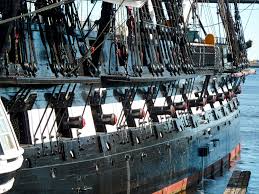
USS Constitution is a wooden hulled, three-masted Heavy Frigate of the United States Navy, named by President George Washington after the Constitution of the United States.  Launched in 1797, Constitution was one of six original frigates authorized for construction by the Naval Act of 1794 and the third constructed.  The frigates were designed to be the Navy’s capital ships, and were larger, more heavily built, and armed than standard frigates of the period.  Constitution was built in Boston, Massachusetts at Edmund Hall’s shipyard.  Her first duties with the newly formed United States Navy were to provide protection for American merchant shipping during the Quasi-War with France   and to defeat the Barbary pirates in the First Barbary War.

She is most famous for her actions during the War of 1812 against the United Kingdom, when she captured numerous merchant ships and defeated the British warships: HMS Guerriere, HMS Java, HMS Pictou, HMS Cyane, and HMS Levant. The battle with Guerriere earned her the nickname “Old Ironsides” and the public adoration that repeatedly saved her from scrapping.

She served as Flagship in Mediterranean and African Squadrons and circled the world in 1840.  During the American Civil War, she served as a training ship for the IU.S. Naval Academy.  She carried U.S. artwork and industrial displays to the Paris Exposition of 1878.

Retired from active service in 1881, Constitution served as a receiving ship in Norfolk Virginia.  A national campaign to collect funds to save Constitution from scrapping and restore her was invigorated by Doctor and Poet Oliver Wendell Holmes’ poem “Old Ironsides.”  His son Oliver Wendell Holmes Jr served as Chief Justice of the Supreme Court from 1902 until 1932.


Old Ironsides

BY OLIVER WENDELL HOLMES SR.


Ay, tear her tattered ensign down!

Long has it waved on high,

And many an eye has danced to see

That banner in the sky;

Beneath it rung the battle shout,

And burst the cannon’s roar; —

The meteor of the ocean air

Shall sweep the clouds no more!


Her deck, once red with heroes’ blood

Where knelt the vanquished foe,

When winds were hurrying o’er the flood

And waves were white below,

No more shall feel the victor’s tread,

Or know the conquered knee; —

The harpies of the shore shall pluck

The eagle of the sea!


O, better that her shattered hulk

Should sink beneath the wave;

Her thunders shook the mighty deep,

And there should be her grave;

Nail to the mast her holy flag,

Set every thread-bare sail,

And give her to the god of storms, —

The lightning and the gale!


To follow Tales of an Asia Sailor and get e-mail notifications of new posts, click on the three white lines in the red rectangle above, then click on the follow button.

A native of North Carolina, Garland Davis has lived in Hawaii since 1987. He always had a penchant for writing but did not seriously pursue it until recently. He is a graduate of Hawaii Pacific University, where he majored in Business Management. Garland is a thirty-year Navy retiree and service-connected Disabled Veteran.

Standard

AWAY YOU SANTEE

Found this one on the Web:


AWAY YOU SANTEE, MY DEAR ANNIE, OH YOU NEW YORK GIRLS
YOU LOVE US FOR OUR MONEY.

We know the track to Auckland, the light at the Kinsale Head,
We’ve crept close-hauled while the leadsman bawled the depth of the Channel bed.

We’ve panted in the tropic, while the pitch boiled-up on deck,
We saved our hides, little else besides, from an ice-cold, North Sea wreck.
We know the quays of Glasgow, the boom of the lone Azores,
We’ve had our grub from a salt-horse tub condemned by the Navy stores.

We’ve drunk our rum in Portland, we’ve thrashed through the Bering Strait,
We’ve ‘toed the mark’ on a Yankee barque, with a hard-case, Down-East Mate.
We know the streets of Santos, the river at Saigon,
We’ve had a glass with a Chinese lass in houseboat in Canton.

They’ll pay us off in Liverpool then after a spell ashore,
Again we’ll ship on a southern trip in a week or barely more.
So – Goodbye Sal and Lucy, it’s time we were afloat,
With a straw-stuffed bed, an aching head, a knife and an oilskin coat.

Sing: TIME FOR US TO LEAVE HER, sing: BOUND FOR THE RIO GRANDE
As the tug turns back we’ll follow her track for a last long look at land.
As the purple disappears and only the blue is seen,
Commend our bones to Davy Jones, our souls to Fiddler’s Green.

Standard

The Cold Iron Watch

The Cold Iron Watch

By: John Petersen


You’ve been at sea for months, your routine has become a rut.

Get off watch, eat, sleep, train, maybe a shower,

then back on watch, but there’s that weird feeling in your gut.

Home port is near, time to prepare and arrange your brain,

for all those months at sea have been nothing but a drain.

Finally, the last line is secure, all shore services connected!

Another successful switch, your friendly EM has shore power selected!

The main engine is locked, evaps brought down, and then as a closer,

“Test the over speed trips on the SSTG’s, this pm was due in October”!

As luck would have it, (or maybe not), guess what? You have duty tonight!

Checking the watch bill you realize the night will not be alright.

You’ve been awarded after all the months of hard, sweaty work,

the first cold iron watch, from midnight to four,

No homecoming party with your buds to attend, no night on the town,

just you, lonely snipe, touring now silent spaces that cool down to their core.

Remember that feeling? The one in your gut?

You’re reminded of that as a door somewhere above is slammed shut.

As you check these spaces now growing cold and still,

you stop at each ladder and entrance, and get this uncomfortable chill.

There’s no more noise, no constant and steady hum and mechanical beat,

of all the things it takes to ensure this vessel is never in fear of defeat.

Descending several decks to the port shaft alley for readings and such,

that long narrow space can’t possibly be that bad, for some four hours back,

this huge shaft was turning strong, giving no slack.

Now it is still, as is your heart,

for there is no noise, until that pump down the ally,

goes into auto start!

Down in the aft engine room, things get really strange you see,

for every screaming turbine is now still and rumored boogums are unleashed and set free.

Every sound is heard, every creak, groan and slight squeal,

you swear you saw something move, upsetting your previous meal.

Roaming the upper level can be enough to give anyone a start,

yet that lower level in an engine room when cold will stop the saltiest heart.

Four hours of anxious, nail biting watch standing, in the middle of the night no less,

Does nothing for your sense of wellbeing, not to mention your shorts, you confess!

And as if things weren’t bad enough, in the port shaft alley towards the end of hour three,

Whatever sense of security you have left, decides it’s time to flee.

While checking the shaft seal, several decks down and all the way back,

The lights start to flicker, suddenly the world goes black.

Now for all the sailors of this mighty vessel who live life above the waterline,

A loss of power would be a mere inconvenience, it’ll come back on in due time.

But when you’re the poor snipe stuck deep in the bowels of this storied ship,

The sudden darkness and silence stokes fear and quivers the lip.

It matters not what your rate, rank or level of seniority, I will tell this:

Standing the cold iron watch will make you a man, and those shorts you will not miss!

MM1 Petersen


A native of Nebraska, I have lived in Southern California since 1970. I graduated high school in ’81 and went straight into the Navy, Machinist Mate being my trade, all commands I served on were Pacific theater. After 12 years active and 22 years inactive reserve, I now manage a dry ice plant for Airgas.

Standard

Jake Buys a TV Set

Jake Buys a TV Set

By: Garland Davis


The era is in the late nineteen fifties.

It was getting on toward evening.  Hank and Jake had arrived at the country store simultaneously.  The store sat back off a dirt lane.   The store was a house that old man McGregor had converted into a one-room store. His clientele consisted mostly of the farm families that lived nearby.  A front porch ran the width of the building and usually had two or more men in overalls, brogans and a variety of caps or hats sitting around on the two chairs or pop crates.

A widow woman that lived over on Dippen Road had started calling the store the “Buzzard’s Roost.” She said that when you drove up to the store, it was like a venue of buzzards sitting on a tree limb watching you.  Sometimes it was akin to running a gauntlet, just getting into the store.

As they arrived at the porch, Willard came out carrying a bottle of RC and a Moon Pie.  He was wearing denim pants, a logger’s shirt, and a straw Mexican sombrero.  He said, “Howdy Jake, you too Hank.  How’s you fellers doin’?”

“I jist stopped by fer a drank and a plug a t’baccer.  I gotta git home fer supper.  Mah Ole Woman gits kinda persnickety if Ah’s late.,Jake answered.

“Me too said, Hank. I wonder iffen thay’s got tha Beechnut t’baccer yit?,  Said Hank.

Jake said, “Ah hopesthey got’s that Beechnut floor sweepins.  Ya ‘bout chewed up all mah plug t’baccer. 

Hey, Willard, whar dji git that there Mescan hat?”

Ah got it throwin nickels over at tha Stokes County fare.  It is real good fer shadin yer eyes.” Willard answered as he stepped off the porch heading for an old rusty ’49 Dodge. “Ah, got to be goin’. Ah tole Miz Ferguson I’d come by and split some far wood fer her.  See ya fellers tomorrow.”

Hank and Jake move into the store, make their purchases and return to the porch, pulling the two vacant chairs near the edge so they could spit into the dirt.

Hank says,  “Jake, ya been complainin’ bout me borrowing your plug t’baccer.  Here ya can have tha first bite a my Beechnut.”

“At’s okay.  That ole Beechnut jist ain’t got no taste.  Ah gots me a fresh plug.  Ah thank we gots time fer a chew ‘fore time ta go home fer supper.”Jake replied to the offer.

“Jake, some feller told me yistiddy that you done gone and got one of the television movin’ picture thangs.  Is that so?”

“Yeah, mah Ole Woman’s cousin was gonna buy him a new one, so he let me have the old one fer twenny dollars.  I had ta give him one ole Duke’s and Sadie’s puppies ta boot. We got that television thang last week.  Ah declares, Ah spent haf a day on tha roof a tha house ‘justin tha antanner thang ta make the pi’cher right.  Ah was hanging on ta tha chimbly an mah Ole Woman and dotters was all hollerin’ at me to ‘turn it more, turn it back, turn it more.’  Ah swear womens cain’t make up their min fer squat.” Jake went on at length.

Hank asked, “What kinda stuff ‘ave they got on it?”

“Well Sattidy night tha Long Ranger and Tonta was on and they was some rasslin.  That was purty good.  Sundy night that Elvis feller was sposed ta be on a show by some feller name of Ed somthin’.  Well we had that big thunderstorm and tha  electric was knocked out an’ we couldn’t see hit.  Mah dotters carried on somethin’ awful.  They was cryin’ lak somebody died.  An mah oldest one was mad at Duke Power.  Ah din’t know that girl knowed all them cuss words.”

 “ Tha Gran’ Ole Opry is sposed ta be on at eight ‘clock tonight.  Why don’t ya brang your woman and younguns over ta watch it.  But tell them boys, I won’t put up wi’ no foolin’ round with my dotters. I’se got mah eye on them, specially that oldest un.

Hank said, “I might do that.  Iffen mah wife wants to.  Iffen yore girls ud stop cuttin’ their eyes at mah boys, they wouldn’t be no problems.  You watch yore gals and Ah’ll watch mah boys.

“Allright.  Ah tell ya younguns takes a lot a lookin after.  ‘Specially dotters. Not like when we was younguns. Mah Pap would ware mah ass out with a plow line iffen Ah didn’t do right.  Mah Ole Woman says it ain’t right ta be whoopin’ no girls.  She tells me ta talk ta them.  Ya tells em right and it jist goes right thru their empty heads.” 

“All they thanks about is buyin dresses and shoes.  An Dam’ if they don’t want ta buy a record player so’s they kin buy them Elvis fellers records.  Ah tole them they kin listen fer them on tha radio. Ah told them Ah would blister their butts if Ah ever hear ‘bout them doin’ that rocky roll dancin’. An Ah told them that Ah better not ketch them doin any a that belly rubbin dancin’. That’s tha kind that gits ya in trouble.

 Square dancing’s okay, Ah tole ‘em., Jake finished.

Jake went on, “I fergot ta tell ya ‘bout Square Curly and Aunt Beccer up in Possum Holler.  Square had him four gallons a moonshine that he had done made up at his still and was brangin’ it down that mountain ta sell in Possum Creek.  He seed tha revenuers comin’ up tha path.  He knowed iffen he got caught with that much white likker, tha jedge would give him eighteen months on that road gang. So he ducked down a path b’hind Aunt Beccer’s cabin, what was all tha way up tha holler.  One a tha revenuers seen him and started down tha same path. Ta git rid a tha ev’dence he poured all four gallons a likker inta that sprang where Aunt Beccer gits her drankin water.  He lost his likker but din’t git locked up.

‘Bout a quarter hour after all this, Aunt Beccer come out with her water bucket ta git water.  She dipped a bucket a water an’ then took tha dipper and had her a drank.  Tha water was different.  She had another little taste an then another.  After five er six tastes, she run back ta  tha house an got ever bucket and empty jar she had.  This was tha best water she had ever drunk.

After she had all that wunnerful water put in her kitchen, she d’cided to go down ta Possum Creek.  It was ‘bout a month since she had been down ta tha store. She put on her Sundy dress what she wore ta church an started down tha path that led outta tha holler.

Well people knowed that sumpthin’ was different ‘bout Beccer.  They said she was smilin’ and sayin’ howdy ta everbody.  You’da thought Beccer’s face would break iffen she ever smiled. It was Satidy, an as thangs went, hit seemed they was having a square dance in Possum Creek that night.  They said that Beccer was completely scandalous.  She was dancing and throwing up her dress so high, that ya could almost see her bloomers.  Beccer was sick tha, next mornin’ and missed church fer tha first time anybody could remember.  They said tha preacher preached on the thang ‘bout demons gittin’ inside a people and making act different then normal., Jake finished.

Hank jumped up saying, Ah got ta go.  Hit’s almost supper time.  Mah woman’ll be madder than a ole settin’ hen if ah’s late.  She’ll be accusin’ me ah drankin’ white likker er sumthin’.

Me too.  Ah’ll see ya after while fer that Grand Ole Opry.  Bye.
The two farmers went to their trucks and left the lane, one turning left, the other right.


 To follow Tales of an Asia Sailor and get e-mail notifications of new posts, click on the three white lines in the red rectangle above, then click on the follow button.

A native of North Carolina, Garland Davis has lived in Hawaii since 1987. He always had a penchant for writing but did not seriously pursue it until recently. He is a graduate of Hawaii Pacific University, where he majored in Business Management. Garland is a thirty-year Navy retiree and service-connected Disabled Veteran.


Standard

Sailor


By:  David ‘Mac’ McAllister


Padding into the house, shaking off the cold, after our daily walk; I found my favorite place near the wood stove and laid down for my afternoon nap. It was fall here in the Ozarks and getting cold. As I stretched out, my eyes caught his as he eased himself into his favorite spot, an old armchair next to the blazing fire. As I drifted off, my subconscious guided my dreams returning me to the day we first met.

My brothers and sister were standing on tip toes peering over the edge of a cardboard box just outside the 32nd street gate in San Diego. Having been there most of the day we were restless and wanted out to run and play when he appeared. Staggering out the gate he spied us as we bounced up and down with excitement in anticipation of the stranger. Smelling of bourbon and tobacco smoke, he reached down and picked me up by the scruff of the neck holding me at arm’s length for quarters, muster, instruction and inspection. Our eyes met; his liquid blue; mine large and brown as I plied his heart with my best puppy dog look. Oh you know the one, ears at half-mast and head down looking up just enough so that a very thin amount of the white of the eye shows. Instantly, I was in love.

Tossing a few bucks to my little masters, tasked with getting rid of me and my litter mates, he stuffed me into his bridge coat pocket slurring “You’re with me, Sailor”. We swayed to and fro, like a ship upon the sea, down the street until we finally reached a small split level walk up apartment. Here he straightened up as best he could, placed a hand upon me for reassurance and entered the place with as much dignity as drunken Chief Petty Officer could muster. Once inside he snatched me out of his pocket, placed me on the floor and commenced to lay down the rules and regulations of which I didn’t understand one bit. However, there was something about not crapping on the floor and a bitch of a landlady that didn’t like sailors or dogs.

I was fine until the lights went out and with the darkness, I began to miss my brothers and sister. The only way I knew to express my despair was vocally. I started with small yips that gained momentum culminating in a fully-fledged squeaky rather high pitched puppy howl; after all, that’s how dogs cry.

Well now, that got the lights turned on, a scolding with something about the bitch from hell landlady and then lights out. More howling, lights on, more scolding, lights out; howling, lights on, scolding, lights out and so on and so forth until finally he picked me up tossing me on his bed. Gratefully I snuggled in, pressing my short length up against his leg and fell quickly asleep dreaming peaceful dreams of green meadows and un-chased rabbits; until the pounding on the door woke us both up that is.

Stumbling to the door he was muttering something about being in the shits and pointing an incriminating finger at me. Opening the door, he cast his best face forward upon the scariest human I had met so far in my young life. As I looked at this house coat clad, hair curler laden being I knew instinctively what he meant about being in the shits.

She started in nonstop, “Chief you know the rules, no pets. Now don’t tell me you don’t have any pets I heard that dog yowling all night.” Yowling? Are you shittin’ me, she can’t even recognize a fully-fledged howl when she hears one? Then I heard the Chief take control of the situation as only, I would come to learn, the Chief could do. “Madame THAT is no dog THAT is my shipmate and HIS name is Sailor. I am now retired from the Navy and WE will be leaving California for the Dust Bowl.” And so my journey through the Chiefs retirement years began – as his Shipmate.

Soon we were pointing the hood of an old second-hand pickup truck eastward. The Chief at the helm behind the wheel; me, as navigator, with my little rear feet, tippy-toed on the seat, front paws on the window sill, head barely sticking out the window and tongue in the breeze. We were footloose and fancy-free as San Diego, California as a former life for us both disappeared in the rear view mirror. Our happy travels took us across the Mojave Desert and through the wilds of Arizona. On to Tucumcari New Mexico and as we cut the panhandle of Texas, he seemed hell bent upon an unknown destination. When the deserts and flatlands of the west gave way to the lushly green and gently rolling hills of the Ozarks we stopped.

He went inside this exquisitely smelling restaurant while I waited outside scrounging around for whatever was causing that wonderful aroma. Returning he had that breathtaking odor all about him as he opened this grease-stained paper napkin and shared its contents with me. Bacon, it became the second love of my young life. As I horsed down the crunchy goodness he said, “Sailor, seems these folks here have no idea what a Navy Chief is, guess we’ll hang out here awhile”.

Seems the people of the Ozarks were as dog-friendly as they were sailor friendly; so from a seedy but clean motel room to a rather remote cabin back in the woods, that “awhile” stretched into years. Our days past by seamlessly as we explored the woods, enjoyed the seasons and grew fonder of one another in the process.

Oh, we had our growing pains for sure. I had to get this “No crapping on the floor” thing down; then there was the time in my adolescence.  Seems I took off after a rabbit that needed chasing and caught the scent of an unknown but strangely alluring fragrance on the wind. Abandoning the chase, I followed that bouquet to the most stunningly beautiful little French poodle I had ever seen. Several days later I brought my severely drained, tired and hungry ass back home to a stern inspection and retribution.  “Who gave you a 72hr liberty card, Shipmate?” was all he said to me. After that cool reception, some good ole’ chow, a little rack time and a few pitiful looks (Oh you know the kind, ears at half-mast and head down looking up just enough so that a very thin amount of the white of the eye shows) we were tight again.

Well now, he wasn’t perfect either. I came to know that whenever my food bowl was topped off, extra water bowls put out and my doggie door was left open I wouldn’t be seeing him around for a day or two. I guess he got a little whiff of something on the wind from time to time as well. After a few days, he’d sway through the door singing those stupid sailor songs of his with that ever familiar odor of bourbon, tobacco smoke, and perfume about his person. No problem, a little pouting, some pitiful looks (Yeah you know the ones, ears at half-mast and head down looking up just enough so that a very thin amount of the white of the eye shows) just to let him know that a 72 hr. liberty wasn’t appreciated, and we would be as tight as ever.

As the population of French Poodle mix puppies and the rate of recurrence of his relationships grew, he and I both floated effortlessly through the years. As we grayed and became ever more grizzled, our walks became more leisurely. Frequent stops to smell and water the flowers, more sitting, more resting and plenty of breathers slowly took the place of our former briskness of step. Butterflies rather than rabbits became my chase of choice and he started coveting beer over the bourbon. One day we awoke and found ourselves getting older. Seems the French Poodle lost interest in me and he was spending more time around the homestead. Our relationship shifted into more of a caretaker mode with each of us looking out for the other. He started speaking of this Fiddlers Green place and naps took the place of fetch. As content as a couple of old farts could be, we settled into enjoying the world a little more peacefully.

It was darkening as I awoke to the stillness of the Ozark twilight. I dragged my old bones up and stretched, forepaws low; ass end high, to clear the cobwebs. Softly, I padded over to his chair, as I had done my whole life, and laid my head on his lap with my best puppy dog look. Oh, you know the one, ears at half-mast and head down looking up just enough so that a very thin amount of the white of the eye shows. However, this time, the familiar hand on my head didn’t come. As I raised my head to look, I noticed he appeared to still be asleep. A peaceful countenance with the suggestion of a smile graced his face. I nuzzled his limp and unresponsive hand and realized as it fell lifelessly to the side of his chair just what he must have been referring to when he spoke these days past of Fiddlers Green.
Sadly, wondering whether dogs were allowed in Fiddlers Green, I walked through my doggie door outside and was greeted by the light of a rising full Moon. I sat heavy hearted upon the outdoor deck we had built together gazing into the soft glow of the light that flooded me while the eerie shadows of the trees were cast upon everything.

The only way I knew to express my despair was vocally. I started with small yips that gained momentum culminating in a fully-fledged adult dog howl; after all, that’s how dogs cry.


David “Mac” McAllister a native of California, now resides in the Ozark Mountains of Southwest Mo. Having served in Asia for the majority of his 24-year Navy career, he now divides his time as an over the road trucker, volunteer for local veteran repatriation events and as an Asia Sailor Westpac’rs Association board member and reunion coordinator. In his spare time, he enjoys writing about his experiences in Westpac and sharing them online with his Shipmates.


Standard

Heavenly E-Mail

I wrote this one night after reading and thinking about what all the uncontrolled immigration is doing to our country.

Heavenly E-Mail

By: Garland Davis


From: stpeter@thegate.hvn.com
To: gabriel@archangel.hvn.com

Subj: Entrance Policy

Hey Gabe, you gotta talk to the boss.

I know talking to all those open border socialists from Boston and San Francisco made him rethink the concepts of a wall between heaven and hell. But since he opened the gates between here and there this place is literally going to hell. The immigrants say they are cold and have started breaking up the martyr’s crosses and angel’s harps to build fires. They keep poking the Seraphim with the pitchforks they carry with them. There is a group that calls themselves angels, but they eschew wings for motorcycles. Like I said, “this place is going to hell!”

Also, giving in to all the pet owners, so they could have their doggies and kitties by opening the gate to the lesser creatures is an unmitigated disaster. We have serpents, frogs and lizards crawling all over the place. We have ants in the manna, stray dogs crapping in the streets, and feral cats digging up the flower beds. And you should see what the elephants are leaving in the streets.  The vampire bats are scaring the crap out of the winged angels and they are threatening to unionize.

But the real disaster is the cockroaches. We are being overrun by fuckin’ cockroaches.

Gabe, you got to do something.

Pete


To follow Tales of an Asia Sailor and get e-mail notifications of new posts, click on the three white lines in the red rectangle above, then click on the follow button.

A native of North Carolina, Garland Davis has lived in Hawaii since 1987. He always had a penchant for writing but did not seriously pursue it until recently. He is a graduate of Hawaii Pacific University, where he majored in Business Management. Garland is a thirty-year Navy retiree and service-connected Disabled Veteran.


Standard