A History Lesson
Insight Into Japan’s Surrender:
Why did the US choose a US Navy Iowa-class battleship as the location for Japan’s surrender in World War 2 even though they were in Tokyo Bay and could have used a building on land? Pure symbolism.

Nothing says “you’re utterly defeated” than having to board the enemy’s massive battleship in the waters of your own capital city. A naval vessel is considered sovereign territory for the purposes of accepting a surrender. You just don’t get that if you borrow a ceremonial space from the host country. In addition, the Navy originally wanted the USS South Dakota to be the surrender site. It was President Truman who changed it to USS Missouri, Missouri being Truman’s home state. The Japanese delegation had to travel across the water to Missouri, which sat at the center of a huge US fleet. It’s a bit like those movie scenes where someone enters a big-wig’s office, and the big-wig is seated silhouetted at the end of a long room, behind a massive desk. The appellant has to walk all the way to that desk along the featureless space, feeling small, exposed, vulnerable and comparatively worthless before the mogul enthroned in dramatic lighting before him. By the time he gets there the great speech he had prepared is reduced to a muttered sentence or two.
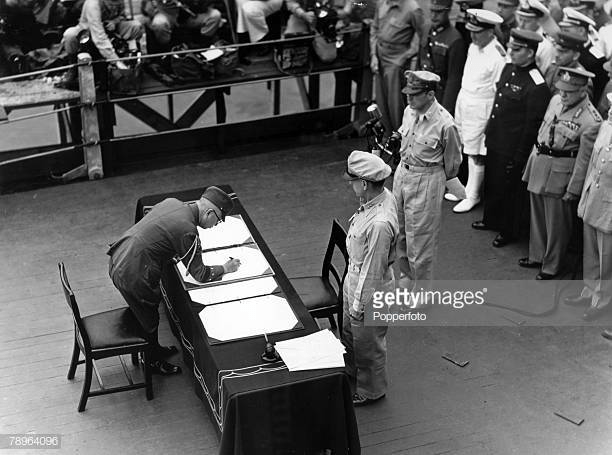
In addition, the USS Missouri flew the flag of Commodore Perry’s 19th-century gunboat diplomacy mission that opened the closeted Edo-era Japan to the world and forced upon them the Meiji restoration which ended the rule of the samurai class. The symbolism here is pretty clear – “this is how we want you to be, and remember what happens to countries that defy us.” It was particularly humiliating for a proud country like Japan, and that was entirely the point. The symbolism of the ceremony was even greater than that. The ship was anchored at the precise latitude/longitude recorded in Perry’s log during his 1845 visit, symbolizing the purpose of both visits to open Japan to the West. Perry’s original flag was also present, having been flown all the way from the Naval Academy for the ceremony.
When the Japanese delegation came aboard, they were forced to use an accommodation way (stairs) situated just forward of turret #1. The freeboard (distance between the ship’s deck and the water line) there makes the climb about twice as long as if it had been set up farther aft, where the freeboard of the ship is less. NOTE: This was even more of an issue for the Japanese surrender party as the senior member, Foreign Affairs Minister Shigemitsu, was crippled by an assassination attempt in 1932, losing his right leg in the process.
The #1 and #2 turrets had been traversed about 20 degrees to starboard. The ostensible reason for this was to get the turret overhangs out of the way to create more room for the ceremony on the starboard veranda deck, but in fact, this would have only required traversing turret #2 had it been the real reason. However, the turret position also put the gun tubes directly over the heads of the Japanese. They were literally boarding the ship “under the gun”.
The honor guard of US sailors (side boys) were all hand-picked to be over six feet tall, further intimidation of the short-statured Japanese. The surrender documents themselves, one copy for the Allies and one for the Japanese contained identical English-language texts, but the Allied copy was bound in good quality leather, while the Japanese copy was bound with light canvas whose stitching looked like it had been done by a drunken tailor using kite string.

After the signing ceremony, the Japanese delegation was not invited for tea and cookies; they were shuffled off the ship as an Allied air armada of over 400 aircraft flew overhead as a final reminder that American forces still had the ability to continue fighting should the Japanese have second thoughts on surrender.
Now you know………….




 Tales of an Asia Sailor